
Quick Answer
After training, athletes should prioritize carbohydrates to replenish glycogen, protein to support muscle repair, and fluids/electrolytes to rehydrate. A balanced recovery meal within 30–90 minutes helps optimize recovery, reduce fatigue, and improve performance in the next training session.
Key Takeaways
- Post-workout nutrition is essential for performance, recovery, and adaptation
- Carbohydrates restore glycogen and support energy availability
- Protein promotes muscle repair and strength development
- Hydration plays a critical role in recovery and performance
- Recovery needs vary based on training type, intensity, and duration
- Consistently inadequate recovery nutrition can impair recovery and may contribute to increased injury risk.
Table of Contents
Introduction
Post-workout recovery nutrition for athletes plays a critical role in recovery, performance, and long-term athletic development. Many athletes focus heavily on training—but overlook what happens after.
They finish a workout and:
- delay eating
- grab something random
- or skip recovery nutrition entirely
Then they feel:
- fatigued
- sore
- inconsistent in performance
The reality is:
👉 Recovery is where progress actually happens.
Training creates stress.
While pre-workout nutrition prepares your body for training, recovery nutrition supports how well you adapt afterward. Recovery is what allows your body to adapt, rebuild, and perform better next time.
Within the M3 Performance Framework (Mind • Meals • Motion):
- Meals → provide the nutrients needed for recovery
- Motion → creates the demand for recovery
- Mind → determines whether recovery habits are consistent
If you’re not fueling recovery properly, you’re limiting your results—no matter how hard you train.
The M3 Recovery Framework
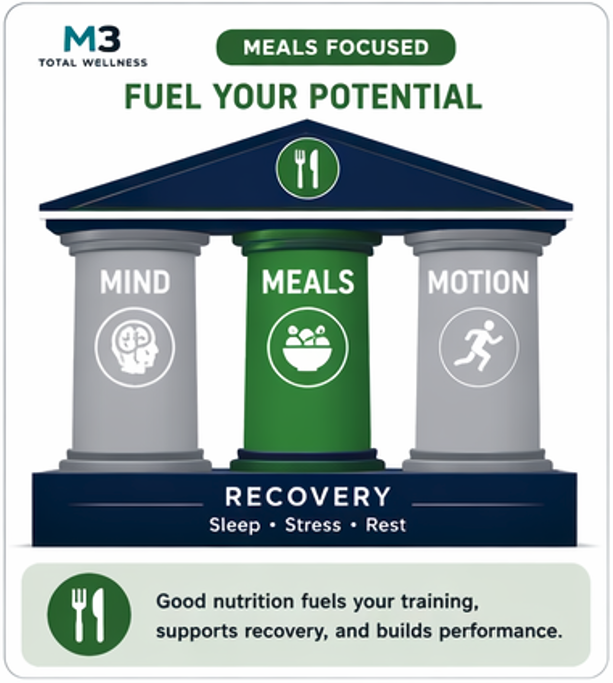
Recovery is not just about what you eat—it’s about how consistently you support your body after training.
Mind
- Recognizing recovery as part of training—not optional
- Avoiding the “I’ll eat later” mindset
- Building consistent post-workout habits
Meals
- Carbohydrates → restore glycogen (energy stores)
- Protein → repair and rebuild muscle
- Fluids + electrolytes → restore hydration balance
Motion
- Training creates muscle breakdown and energy depletion
- Recovery nutrition supports adaptation and performance
👉 When these three areas align, recovery becomes intentional—not accidental.
What Happens in the Body After Training?
After a workout, your body enters a recovery state where several key processes occur:
- Glycogen depletion → stored carbohydrates are used for energy
- Muscle breakdown → small amounts of muscle damage occur
- Fluid loss → sweat reduces hydration and electrolyte balance
- Increased nutrient uptake → your body becomes more efficient at absorbing nutrients
This is often referred to as the post-exercise recovery window, where nutrition can significantly impact how well you recover.
👉 The better you fuel during this phase, the better your body adapts.
The Science of Post-Workout Recovery Nutrition
Post-workout nutrition plays a key role in how the body restores energy, repairs muscle, and adapts to training. These processes are primarily driven by carbohydrate availability, protein intake, and hydration status.
Carbohydrates → Glycogen Replenishment
Carbohydrates are the primary fuel source for moderate- to high-intensity exercise.
During training:
- glycogen stores in muscle are progressively depleted
- the extent of depletion depends on intensity, duration, and training volume
When glycogen levels are low:
- fatigue occurs sooner
- performance in subsequent sessions declines
- training quality may decrease
Post-exercise carbohydrate intake supports:
- restoration of glycogen stores
- maintenance of training intensity
- improved recovery between sessions
This is especially important for athletes who:
- train multiple times per day
- compete frequently
- perform high-intensity or intermittent sports
👉 In these cases, inadequate carbohydrate intake can lead to consistently reduced performance over time.
Protein → Muscle Repair and Adaptation
Resistance and high-intensity exercise create micro-damage in muscle tissue.
Protein intake after training provides essential amino acids that:
- stimulate muscle protein synthesis (MPS)
- support repair of damaged tissue
- contribute to strength and performance adaptations
Research suggests that:
👉 ~20–40g of high-quality protein post-exercise is sufficient to maximize MPS in most athletes
However, total daily protein intake and distribution across meals are also critical.
👉 Post-workout protein is important—but it works best as part of an overall consistent intake strategy.
Hydration → Fluid and Electrolyte Balance
Fluid losses during exercise—primarily through sweat—can significantly impact recovery.
Even a 2% loss in body weight from dehydration can:
- reduce endurance performance
- impair cognitive function
- increase perceived effort
In addition to water, athletes lose electrolytes such as sodium, which are important for:
- fluid balance
- muscle function
- nerve signaling
Post-workout hydration should aim to:
- replace fluid losses
- restore electrolyte balance
- support overall recovery
👉 Athletes who train in heat, sweat heavily, or have multiple sessions per day may require more structured hydration strategies.
Nutrient Timing → Supporting Recovery Efficiency
The concept of a strict “anabolic window” has evolved, but timing still plays a role in recovery.
After exercise, the body is more sensitive to nutrient intake, particularly for:
- glycogen resynthesis
- muscle protein synthesis
Consuming carbohydrates and protein within ~30–90 minutes post-exercise can help:
- accelerate recovery processes
- improve readiness for the next session
This becomes more important when:
- recovery time is limited
- training frequency is high
👉 For most athletes, consistency in fueling matters more than perfect timing—but both contribute to performance.
These principles are well-supported in sports nutrition research and form the foundation of effective recovery strategies for athletes.
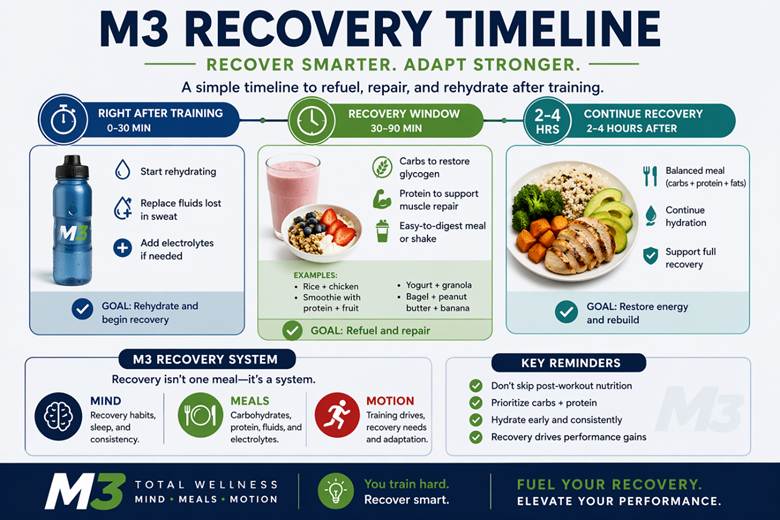
What Should Athletes Eat After a Workout? (Post-Workout Nutrition for Athletes)
Instead of overcomplicating recovery nutrition, focus on building a simple, repeatable structure.
A simple and effective approach:
👉 Carbohydrates + Protein + Fluids
Balanced meal examples:
- Chicken, rice, and vegetables
- Protein smoothie + banana
- Greek yogurt + granola + fruit
- Eggs + toast + avocado
- Rice bowl with lean protein
Quick options (if short on time):
- protein shake + fruit
- chocolate milk
- yogurt + granola
👉 You don’t need perfect meals—just consistent ones.
How Soon Should You Eat?
Timing plays a role—but it doesn’t need to be stressful.
👉 Aim to eat within 30–90 minutes post-workout
This becomes more important if:
- you train multiple times per day
- you have another session within 24 hours
- your training is high intensity
👉 Consistency matters more than exact timing.
What Happens If You Skip Recovery Nutrition?
Skipping post-workout nutrition can have both short-term and long-term effects.
Short-term:
- fatigue
- low energy
- reduced performance
Long-term:
- stalled progress
- increased injury risk
- potential low energy availability (LEA)
Many athletes believe they’re eating “healthy”—but are actually underfueling for performance.
Visual Framework
Instead of guessing what to eat after training, use this simple structure to guide your recovery nutrition.
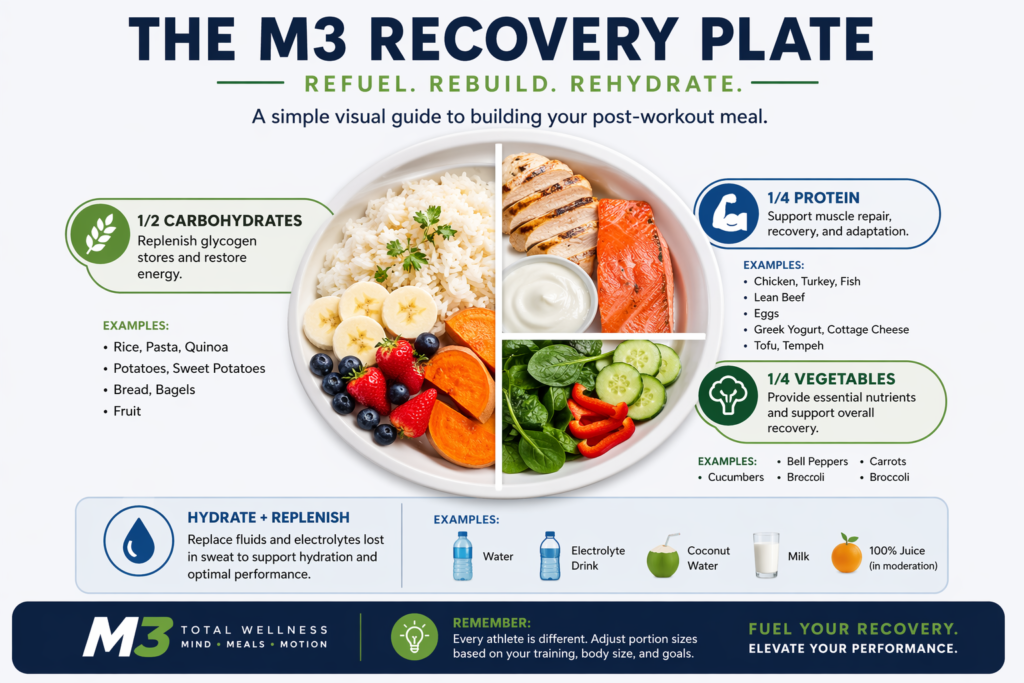
This visual simplifies recovery into a repeatable structure you can apply after any training session—so you’re not guessing what to eat when you’re tired.
Sport-Specific Example (Volleyball)
After a long volleyball session—especially beach or high-intensity indoor play—your body has been under significant physical demand.
You’ve likely:
- performed repeated explosive jumps
- relied heavily on anaerobic energy systems
- experienced a noticeable drop in glycogen (carbohydrate stores)
- lost fluids and electrolytes through sweat
From a performance standpoint, this combination creates a high demand for recovery.
Where many athletes fall short is not during training—but immediately after.
A common pattern looks like this:
- finishing a session and delaying food intake
- only drinking water without replacing electrolytes
- underestimating how much energy was actually used
On the surface, this might not seem like a big issue.
But over time, it leads to:
- reduced jump performance
- slower reaction time
- increased fatigue in subsequent sessions
A more effective recovery approach would include:
- a carbohydrate-focused meal to restore glycogen (e.g., rice, pasta, or potatoes)
- a quality protein source to support muscle repair (e.g., chicken, fish, eggs, or yogurt)
- fluids and electrolytes to rehydrate and restore balance
For example:
👉 a rice bowl with lean protein, fruit on the side, and an electrolyte drink
This type of recovery strategy helps:
- restore energy stores
- reduce muscle soreness
- support consistent performance across practices and matches
In a sport like volleyball—where performance depends on repeated explosive efforts—
👉 recovery nutrition directly influences how you perform the next time you step on the court.
This becomes even more important during tournament play or back-to-back training days, where recovery time is limited.
Practitioner Insight: What I See in Real Athletes
From working with athletes, one of the most consistent patterns I see is this:
👉 Athletes are very intentional before training—but inconsistent after.
They plan their pre-workout meals, think about energy, and want to perform well.
But once the session ends, recovery becomes an afterthought.
I commonly see athletes:
- wait too long to eat after training
- rely on convenience foods that lack enough carbohydrates or protein
- underestimate how much fluid they’ve lost
And the result isn’t always obvious right away.
Instead, it shows up as:
- lingering fatigue later in the day
- decreased performance in the next session
- feeling “off” despite training consistently
What’s important to understand is this:
👉 Recovery nutrition isn’t just about feeling better—it directly impacts how your body adapts to training.
When athletes improve their post-workout fueling—even without changing their training—
I often see:
- better energy levels
- improved consistency
- faster recovery between sessions
In many cases, recovery is the missing link between effort and results.
After understanding how recovery nutrition supports performance, the next step is applying these principles consistently.
Most athletes don’t struggle with knowing what to do—they struggle with doing it consistently after training.
The goal isn’t perfection.
It’s building a routine you can follow every time you train.
Here’s how to start.
Action Steps: How to Improve Your Recovery Nutrition
- Decide your post-workout meal before you train
Recovery shouldn’t be a decision you make when you’re tired.
Plan it ahead so it becomes automatic.
- Eat within 30–90 minutes—even if it’s something small
If you’re not hungry, start with something light like a smoothie or yogurt.
Delaying too long is where most athletes fall off.
- Anchor your meal with carbs first, then add protein
Think:
- “What’s my carb source?” (rice, fruit, bread)
- “What’s my protein source?” (chicken, yogurt, shake)
Keep it simple and repeatable.
- Build a ‘default recovery option’ for busy days
Have a go-to option like:
- protein shake + banana
- yogurt + granola
Consistency beats variety after training.
- Match your recovery to how hard you trained
Hard session → more carbs + hydration
Light session → keep it simple
Fueling should reflect your workload.
- Track how you feel the next day
Your recovery strategy is working if you feel:
- energized
- less sore
- ready to train
If not, adjust your nutrition.
👉 If recovery nutrition isn’t consistent, performance won’t be either.
Conclusion
Post-workout nutrition is one of the most overlooked factors in athletic performance.
Many athletes focus on training harder—but don’t give the same attention to how they recover. Over time, this creates a gap between effort and results.
The reality is simple:
👉 training creates the stimulus, but recovery determines the outcome
When you consistently:
- restore energy with carbohydrates
- support muscle repair with protein
- rehydrate effectively
you give your body what it needs to adapt, improve, and perform at a higher level.
You don’t need a perfect recovery plan.
But you do need a consistent one.
Because at the end of the day:
👉 how you recover directly impacts how you perform.
And for many athletes, the difference isn’t effort—it’s how well they recover from that effort.
Take the Next Step
If you’re training hard but still feeling:
- fatigued after sessions
- slow to recover
- inconsistent in your performance
there’s a gap between your training and your fueling.
Most athletes don’t need more effort—they need a strategy that actually supports how they train.
At M3 Total Wellness, I help athletes:
- align their nutrition with their training demands
- recover faster between sessions
- build consistent fueling habits that improve performance
👉 If you’re ready to perform better and recover more effectively, schedule a performance assessment here.
References
Thomas, D. T., Erdman, K. A., & Burke, L. M. (2016). Nutrition and athletic performance. Medicine & Science in Sports & Exercise, 48(3), 543–568. https://doi.org/10.1249/MSS.0000000000000852
Kerksick, C. M., Arent, S., Schoenfeld, B. J., Stout, J. R., Campbell, B., Wilborn, C. D., Taylor, L., Kalman, D., Smith-Ryan, A. E., Kreider, R. B., & Antonio, J. (2017). International society of sports nutrition position stand: Nutrient timing. Journal of the International Society of Sports Nutrition, 14(1), 33. https://doi.org/10.1186/s12970-017-0189-4
Burke, L. M., Hawley, J. A., Wong, S. H., & Jeukendrup, A. E. (2011). Carbohydrates for training and competition. Journal of Sports Sciences, 29(Suppl 1), S17–S27. https://doi.org/10.1080/02640414.2011.585473
Jäger, R., Kerksick, C. M., Campbell, B. I., Cribb, P. J., Wells, S. D., Skwiat, T. M., Purpura, M., Ziegenfuss, T. N., Ferrando, A. A., Arent, S. M., Smith-Ryan, A. E., Stout, J. R., & Antonio, J. (2017). International society of sports nutrition position stand: Protein and exercise. Journal of the International Society of Sports Nutrition, 14(1), 20. https://doi.org/10.1186/s12970-017-0177-8
Sawka, M. N., Burke, L. M., Eichner, E. R., Maughan, R. J., Montain, S. J., & Stachenfeld, N. S. (2007). American College of Sports Medicine position stand: Exercise and fluid replacement. Medicine & Science in Sports & Exercise, 39(2), 377–390. https://doi.org/10.1249/mss.0b013e31802ca597