
Quick Answer
Before training, athletes should prioritize carbohydrates for energy, include moderate protein when appropriate, and adjust timing based on workout intensity and schedule. Unlike competition fueling, pre-workout nutrition should be flexible and support consistent training quality over time.
Key Takeaways
- Pre-workout nutrition directly impacts training quality and adaptation
- Carbohydrates are the primary fuel for most training sessions
- Nutrition should match workout intensity, duration, and timing
- Not every session requires a full meal—timing and flexibility matter
- Hydration plays a key role in performance and recovery
- Training nutrition is about consistency, not perfection
Table of Contents
Introduction
Pre-workout nutrition for athletes is one of the most important factors influencing training performance, energy levels, and long-term athletic development. It’s about fueling your training so you can actually improve.
Many athletes train hard but underfuel. Meals are skipped, rushed, or replaced with caffeine. Over time, this leads to inconsistent energy, reduced training quality, and limited progress.
Unlike competition fueling, which is designed to maximize performance for a single event, pre-workout nutrition is focused on supporting consistent training quality over time.
Within the M3 Performance Framework (Mind • Meals • Motion):
- Meals → provide the energy needed to train effectively
- Mind → supports planning and consistency
- Motion → determines how much fuel is required
Training is where adaptation happens—but only if it’s properly fueled.
Why Pre-Workout Nutrition Matters for Training
Training drives progress—but that progress depends on having enough energy available to perform the work.
When athletes consistently underfuel before training, the body compensates by reducing output. This can result in:
- lower training intensity
- reduced total volume
- decreased ability to sustain effort
Over time, this impacts:
- strength and power development
- skill execution and consistency
- recovery between sessions
In contrast, properly fueled athletes are better able to:
- maintain training intensity
- complete planned workloads
- improve technical execution
- recover more effectively
Pre-workout nutrition is not just about how you feel during a session—it influences how productive that session is for long-term progress.
The M3 Pre-Workout Framework
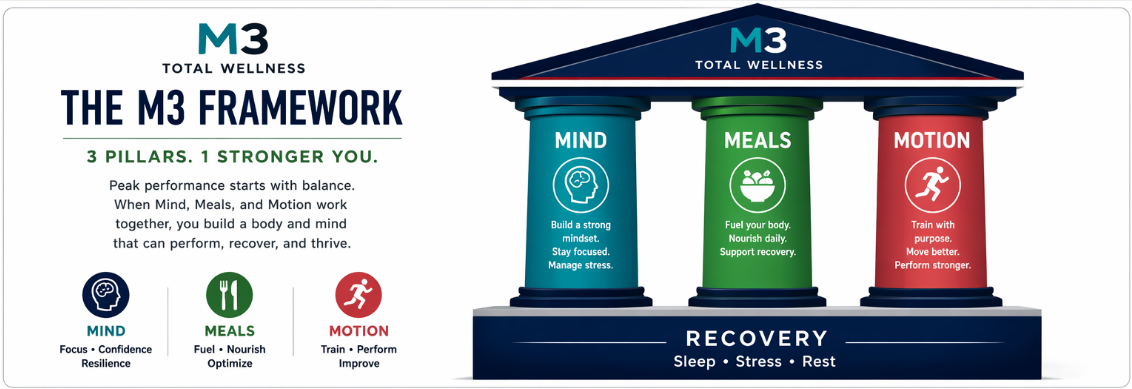
Mind
- plan meals around training
- avoid skipping meals due to schedule
- build consistent habits
Meals
- carbohydrates → primary fuel
- protein → supports muscle
- fluids → hydration
Motion
- intensity determines carbohydrate needs
- duration influences total energy demand
Fueling should match the demands of the session—not follow a one-size-fits-all approach.
The Science of Pre-Workout Fueling
Carbohydrates → Fuel for Training Output
Carbohydrates are stored as glycogen and used during exercise, especially during:
- strength training
- interval training
- sport-specific drills
Low carbohydrate availability can lead to:
- decreased output
- earlier fatigue
- reduced training quality
For athletes training multiple times per week, maintaining adequate glycogen stores is critical, as repeated underfueling can negatively impact overall training progression.
Protein → Supports Adaptation
Including protein before training may:
- support muscle protein turnover
- reduce muscle breakdown
- contribute to recovery
While not required before every session, it can be beneficial depending on total daily intake and training goals.
Fat & Fiber → Consider Timing
Fat and fiber slow digestion.
- Closer to training → keep intake lower to support comfort
- Further from training → more flexibility
The goal is to support energy availability without causing digestive discomfort.
What Should Athletes Eat Before a Workout?
Pre-workout nutrition is not about following a strict meal plan—it’s about making decisions based on your schedule, your training demands, and how your body responds to food.
Three key factors determine what you should eat:
- Time before training
- Training intensity and duration
- Individual tolerance
Rather than aiming for a “perfect” meal, focus on foods that:
- provide reliable energy
- digest comfortably
- fit your routine
Consistency matters more than perfection.
How Timing Affects Your Pre-Workout Nutrition
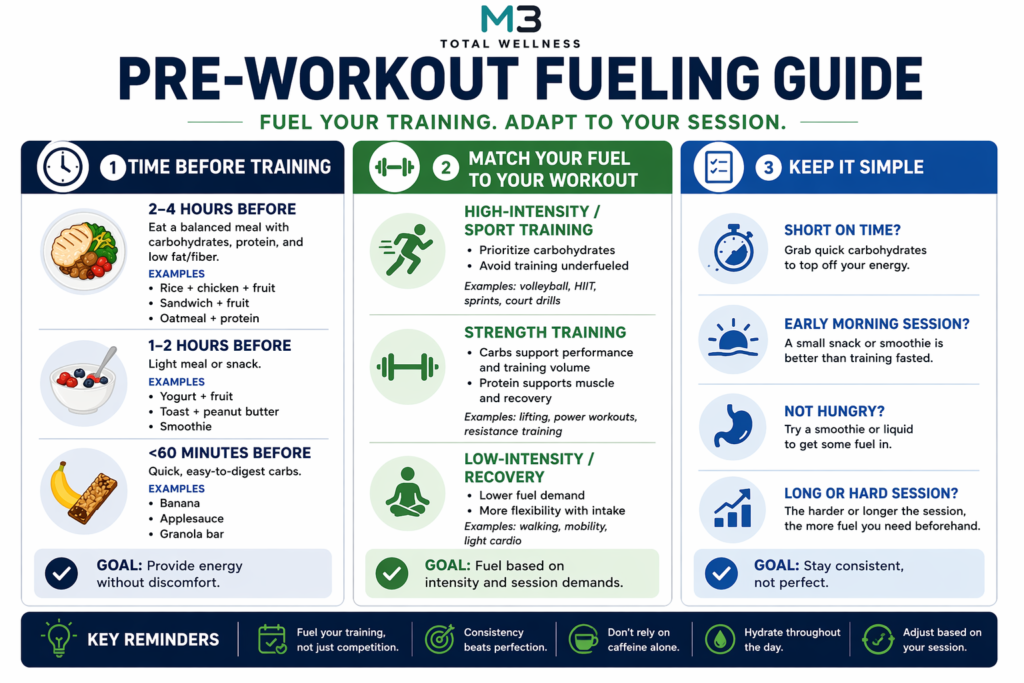
If You Have 2–4 Hours Before Training
A balanced meal works best:
- rice, protein, vegetables
- sandwich with fruit
- oatmeal with protein
If You Have 1–2 Hours
A smaller meal or snack:
- yogurt + fruit
- toast + peanut butter
- smoothie
If You Have <60 Minutes
Quick, easy-to-digest carbohydrates:
- banana
- applesauce
- granola bar
Adjusting Nutrition Based on Training Type
Not all workouts require the same fueling strategy.
Different types of training place different demands on the body, and as intensity increases, reliance on carbohydrate as a primary fuel source also increases.
High-Intensity or Sport-Specific Training
Examples: volleyball, HIIT, sprint intervals
- prioritize carbohydrate intake
- avoid training underfueled
- consider a pre-workout snack if needed
These sessions rely heavily on glycogen and require readily available energy.
Strength Training
- carbohydrates help maintain performance and volume across sets
- protein may support muscle maintenance and recovery
Inadequate fueling may reduce total workload, limiting strength and hypertrophy adaptations.
Low-Intensity or Recovery Sessions
Examples: walking, light cardio
- lower energy demand
- more flexibility with intake
- smaller meals or snacks may be sufficient
Early Morning Training
Time is limited, so full meals may not be realistic.
Simple options:
- fruit
- toast
- smoothies
Even a small amount of carbohydrate can improve performance compared to training completely fasted.
What to Avoid Before Training
The goal before training is to maximize energy while minimizing discomfort.
Foods that may interfere include:
- high-fat meals → slow digestion and may feel heavy
- large portions close to training → increase discomfort
- high-fiber foods right before exercise → may cause bloating
These foods are not “bad”—they just need to be timed appropriately.
Common Pre-Workout Mistakes
1. Treating Training Like Competition
Training nutrition should be flexible—not rigid.
2. Underfueling Regularly
Leads to reduced performance and limited adaptation.
3. Relying on Stimulants Instead of Fuel
Caffeine does not replace proper energy intake.
4. Ignoring Hydration
Dehydration reduces both performance and recovery.
5. Inconsistency
Fueling well some days and underfueling others leads to unpredictable performance.
Consistency matters more than perfection.
Sport-Specific Example (Volleyball Training)
Volleyball training involves repeated jumps, quick movements, and high-intensity skill execution.
These efforts rely heavily on carbohydrate availability.
When underfueled, athletes may experience:
- reduced jump height over time
- slower reaction speed
- decreased consistency in passing and hitting
- earlier fatigue
A practical approach:
- balanced meal 2–3 hours before training
- snack if needed closer to the session
- consistent hydration
Training performance directly influences game performance.
Practitioner Insight: What I See in Real Athletes
In practice, the biggest issue is not a lack of knowledge—it’s a lack of structure.
Athletes often:
- train at inconsistent times
- fail to plan meals around training
- underestimate their fueling needs
This leads to fluctuating energy and inconsistent performance.
When athletes begin aligning nutrition with their training schedule—even with small changes—improvements in energy, focus, and training quality are often immediate.
How to Build a Pre-Workout Routine That Works
Pre-workout nutrition is most effective when it becomes part of a routine.
A strong routine includes:
- eating at consistent times before training
- using familiar, well-tolerated foods
- adjusting portions based on session demands
- avoiding last-minute decisions
This reduces guesswork and helps create more consistent training performance.
Action Steps
If you want to improve your pre-workout fueling:
- Plan meals around your training schedule
- Eat a balanced meal 2–4 hours before training when possible
- Use a lighter carbohydrate snack closer to training if needed
- Match your intake to the intensity and duration of your workout
- Stay hydrated throughout the day
Small, consistent habits lead to better training outcomes.
Conclusion
Pre-workout nutrition plays a key role in training quality and long-term performance.
Without proper fueling, training intensity drops, fatigue increases, and progress is limited. With a structured and flexible approach, athletes can maintain energy, improve consistency, and get more out of every session.
Within the M3 Performance Framework, this is where preparation (Mind), fueling (Meals), and execution (Motion) come together to support performance and progress.
Take the Next Step
Pre-workout nutrition does not need to be complicated—but it does need to be intentional.
If you want to improve your training quality, recovery, and performance, your fueling strategy should match your training demands.
👉 For competition-specific fueling, read this guide on what to eat before a game.
👉 Ready to take your performance to the next level? Book an assessment and build a personalized fueling strategy around your training.
References
Aragon, A. A., & Schoenfeld, B. J. (2013). Nutrient timing revisited: Is there a post-exercise anabolic window? Journal of the International Society of Sports Nutrition, 10(1), 5. https://doi.org/10.1186/1550-2783-10-5
Burke, L. M., Hawley, J. A., Wong, S. H., & Jeukendrup, A. E. (2011). Carbohydrates for training and competition. Journal of Sports Sciences, 29(sup1), S17–S27. https://doi.org/10.1080/02640414.2011.585473
Impey, S. G., Hearris, M. A., Hammond, K. M., et al. (2018). Fuel for the work required: A theoretical framework for carbohydrate periodization and the glycogen threshold hypothesis. Sports Medicine, 48(5), 1031–1048. https://doi.org/10.1007/s40279-018-0867-7
Jeukendrup, A. E. (2014). A step towards personalized sports nutrition: Carbohydrate intake during exercise. Sports Medicine, 44(Suppl 1), S25–S33. https://doi.org/10.1007/s40279-014-0148-z
Kerksick, C. M., Arent, S., Schoenfeld, B. J., et al. (2017). International society of sports nutrition position stand: Nutrient timing. Journal of the International Society of Sports Nutrition, 14(1), 33. https://doi.org/10.1186/s12970-017-0189-4
Sawka, M. N., Burke, L. M., Eichner, E. R., et al. (2007). American College of Sports Medicine position stand: Exercise and fluid replacement. Medicine & Science in Sports & Exercise, 39(2), 377–390. https://doi.org/10.1249/mss.0b013e31802ca597
Schoenfeld, B. J., Aragon, A. A., Wilborn, C. D., et al. (2014). Body composition changes associated with fasted versus non-fasted aerobic exercise. Journal of the International Society of Sports Nutrition, 11(1), 54. https://doi.org/10.1186/s12970-014-0054-7
Thomas, D. T., Erdman, K. A., & Burke, L. M. (2016). Position of the Academy of Nutrition and Dietetics, Dietitians of Canada, and the American College of Sports Medicine: Nutrition and athletic performance. Medicine & Science in Sports & Exercise, 48(3), 543–568. https://doi.org/10.1249/MSS.0000000000000852