
Quick Answer
Most athletes need approximately 1.2–2.0 grams of protein per kilogram of body weight per day to support recovery, muscle repair, and adaptation to training. The exact amount depends on the athlete, sport, training volume, and goals. While protein is important, many athletes overestimate how much they need and underestimate the importance of overall nutrition.
Key Takeaways
- Protein supports muscle repair, recovery, and adaptation to training
- Athletes generally need more protein than sedentary individuals
- Most athletes benefit from approximately 1.2–2.0 g/kg/day
- Protein distribution throughout the day matters
- More protein is not always better
- Carbohydrates and total energy intake remain critical for performance
- Consistency usually matters more than perfection
Introduction
If I asked a group of athletes what nutrient is most important for performance, most would probably say protein.
Honestly, I wouldn’t blame them.
Protein is everywhere.
Social media influencers talk about it.
Supplement companies market it aggressively.
Fitness culture often treats it like the answer to every performance goal.
As a result, many athletes become laser-focused on protein.
They track protein grams.
They buy protein powders.
They worry about whether every meal contains enough protein.
Meanwhile, some of those same athletes are:
- skipping meals
- under-eating carbohydrates
- struggling with recovery
- feeling exhausted during training
That’s where things get interesting.
Protein needs for athletes absolutely matter.
It plays a major role in:
- recovery
- muscle repair
- strength development
- adaptation to training
But protein is only one piece of the performance puzzle.
I’ve worked with athletes who were consuming more than enough protein yet still felt terrible during workouts because they weren’t eating enough overall.
I’ve also worked with athletes who genuinely weren’t eating enough protein and were making recovery harder than it needed to be.
The goal isn’t to maximize protein.
The goal is to optimize performance.
Within the M3 Performance Framework:
- Mind influences how athletes think about protein
- Meals provide the nutrients needed for recovery
- Motion creates the training stress that protein helps repair
When those three pieces work together, athletes tend to perform and recover much better.
For a broader overview of performance nutrition, start with:
👉 How Athletes Should Eat for Performance: The M3 Fueling Framework
Table of Contents
The M3 Protein Framework
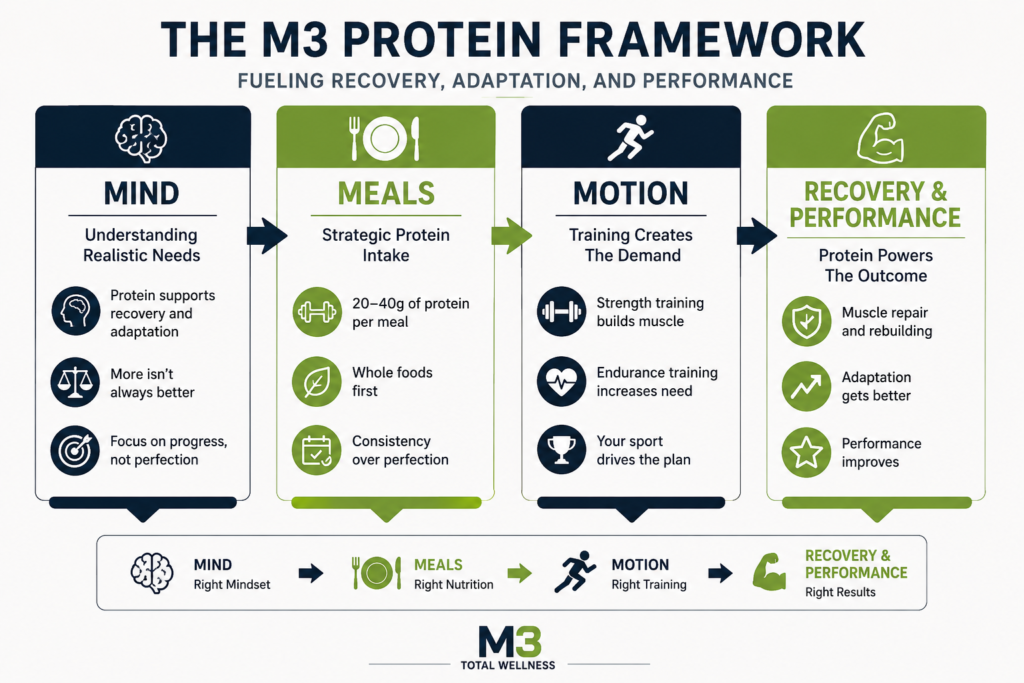
Mind
One of the biggest challenges athletes face isn’t necessarily eating protein.
It’s understanding how much they actually need.
Many athletes have absorbed messages like:
- more protein equals more muscle
- every meal must be extremely high in protein
- protein supplements are mandatory
- carbohydrates are less important
Unfortunately, these beliefs can create unnecessary stress around nutrition.
One thing I notice often is that athletes can tell me exactly how many grams of protein are in their shake, but they have no idea how much they ate before practice or whether they’re meeting their overall energy needs.
That’s usually a clue that priorities have become a little unbalanced.
Good sports nutrition isn’t about obsessing over one nutrient.
It’s about understanding how nutrients work together.
Meals
Protein should be a regular part of an athlete’s eating pattern.
Not because every meal needs to be loaded with protein, but because recovery is an ongoing process.
Athletes generally do best when protein is:
- included at meals
- included in some snacks
- spread throughout the day
- combined with carbohydrates
One of the biggest mistakes I see is athletes trying to “catch up” by eating huge amounts of protein at dinner after eating very little throughout the day.
The body doesn’t really work that way.
Consistent intake tends to work much better than massive intake all at once.
Motion
Training creates stress.
That’s the point.
Whether an athlete is:
- lifting weights
- sprinting
- playing volleyball
- training for endurance events
exercise challenges the body and creates the need for adaptation.
Protein helps support that adaptation.
Without training, extra protein doesn’t magically build muscle.
Without adequate nutrition, training adaptations may be limited.
Motion creates the demand.
Protein helps support the response.
Why Protein Matters for Athletes
Protein is made up of amino acids, which serve as building blocks for many structures and functions within the body.
For athletes, protein plays an important role in:
- muscle repair
- recovery
- maintaining lean body mass
- adaptation to training
- immune function
- overall health
After training, the body enters a recovery process.
Muscle tissue experiences small amounts of damage and stress.
The body then repairs and rebuilds that tissue.
Protein provides the raw materials needed for that process.
This is one reason athletes generally require more protein than sedentary individuals.
Not because they’re trying to become bodybuilders.
Because they’re asking more from their bodies.
The Science of Protein and Muscle Adaptation
Muscle Protein Synthesis (MPS)
If you’ve spent any time in fitness circles, you’ve probably heard the term “muscle protein synthesis.”
It sounds complicated, but the concept is fairly simple.
Training creates a stimulus.
Recovery allows adaptation.
Protein provides amino acids that help support that rebuilding process.
After exercise, the body becomes more responsive to protein intake, which helps stimulate muscle protein synthesis.
Over time, repeated cycles of:
training
→ recovery
→ adaptation
help athletes become stronger and more resilient.
Protein Turnover
One thing many athletes don’t realize is that the body is constantly breaking down and rebuilding proteins.
This process happens whether you’re training or not.
Exercise simply increases the demand.
That’s one reason protein intake needs to be consistent.
Recovery isn’t something that only happens immediately after workouts.
It’s happening all the time.
Leucine and Protein Quality
Not all protein sources are identical.
Certain amino acids play especially important roles in muscle repair.
One of the most studied is leucine.
Leucine helps activate pathways involved in muscle protein synthesis.
Foods naturally rich in leucine include:
- dairy products
- whey protein
- eggs
- poultry
- fish
- lean meats
Plant-based athletes can absolutely meet protein needs as well, but they may need to pay slightly closer attention to food variety and total intake.
The good news is that athletes don’t need to obsess over individual amino acids.
A balanced eating pattern with sufficient protein generally covers the basics.
How Much Protein Do Athletes Need?
This is probably the question I get most often when talking about protein.
And honestly, it’s usually followed by another question:
“Should I be eating more?”
Sometimes the answer is yes.
But surprisingly often, the answer is no.
Many athletes assume that if protein helps build and repair muscle, then more protein must automatically be better.
The reality is a little more nuanced.
Most athletes perform well within a range of approximately:
- 1.2–1.6 g/kg/day for endurance athletes
- 1.6–2.0 g/kg/day for strength and power athletes
These recommendations are based on training demands, recovery needs, and current sports nutrition research.
For example:
A 75 kg (165 lb) athlete may benefit from approximately:
- 90–120g/day during lighter training periods
- 120–150g/day during heavier training periods
That range is much lower than some athletes expect.
I’ve worked with athletes who believed they needed over 250 grams of protein daily despite weighing less than 180 pounds.
Meanwhile, they were under-eating carbohydrates and wondering why they felt exhausted during training.
If you’ve already read my article on Carbohydrates and Athletic Performance, you’ll notice a recurring theme:
Performance nutrition is about balance.
Protein repairs.
Carbohydrates fuel.
Athletes need both.
Protein Timing and Distribution
One thing we’ve learned over the past decade is that total protein intake matters, but distribution matters too.
In other words:
Eating 140 grams of protein per day is important.
How you spread that protein throughout the day also matters.
The “One Giant Dinner” Problem
Many athletes accidentally follow a pattern like this:
Breakfast:
Very little protein
Lunch:
Moderate protein
Dinner:
Massive protein intake
Protein shake before bed
This often happens because:
- mornings are rushed
- lunches are inconsistent
- dinner becomes the largest meal
The problem is that recovery occurs throughout the day.
Your muscles don’t wait until 8 PM to begin recovering.
A more effective approach is spreading protein more evenly.
A Better Distribution Strategy
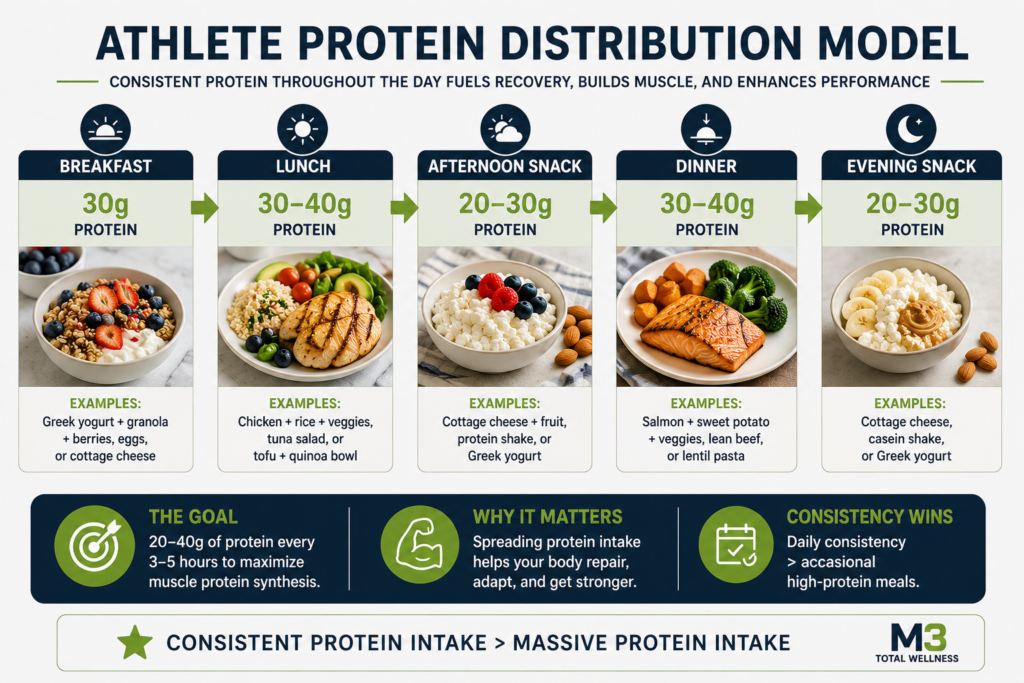
Most athletes benefit from consuming approximately:
20–40 grams of protein
every 3–5 hours throughout the day.
Example:
Breakfast:
30g
Lunch:
35g
Snack:
20g
Dinner:
35g
Evening snack:
20g
This approach supports recovery opportunities throughout the day rather than relying on one huge protein-heavy meal.
Post-Workout Protein
Athletes often ask:
“Do I need a protein shake immediately after training?”
Not necessarily.
The post-workout window is important, but it’s much larger than many people think.
What matters most is making sure protein is consumed reasonably close to training and as part of an overall balanced eating pattern.
I usually encourage athletes to combine:
- protein
- carbohydrates
- fluids
after training.
This supports both muscle repair and glycogen replenishment.
For a deeper discussion, see:
👉 Post-Workout Recovery Nutrition for Athletes
Best Protein Sources for Athletes
Protein quality matters, but athletes don’t need to chase perfection.
I encourage athletes to focus on consistency first.
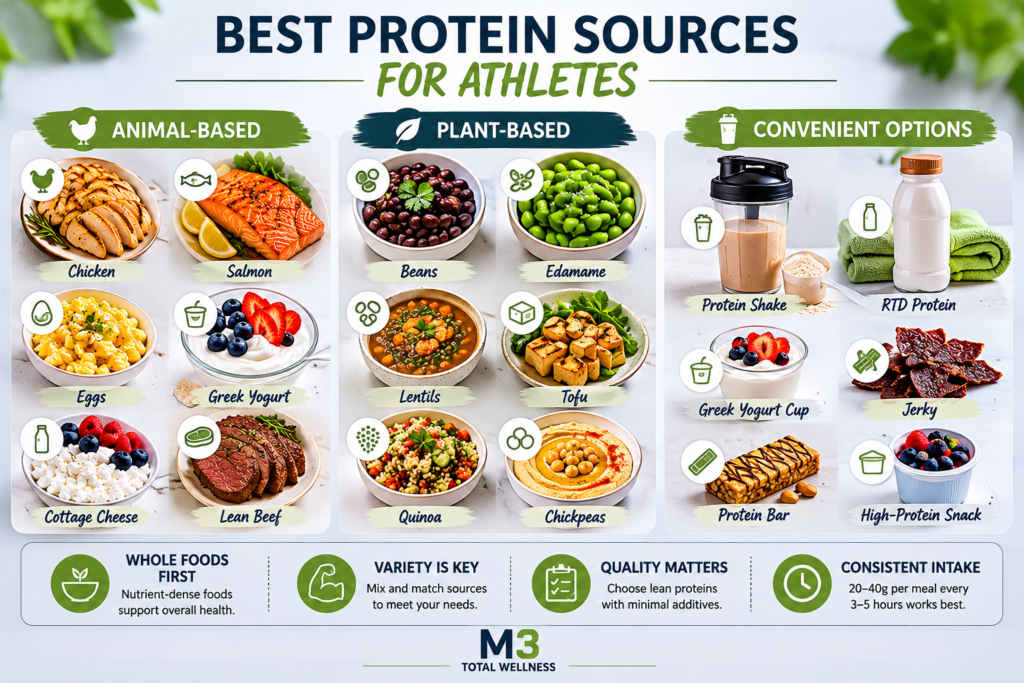
Animal-Based Protein Sources
Examples include:
- chicken
- turkey
- fish
- eggs
- Greek yogurt
- cottage cheese
- lean beef
- milk
These foods generally provide:
- complete amino acid profiles
- high protein quality
- strong leucine content
They are often efficient options for supporting recovery.
Plant-Based Protein Sources
Plant-based athletes can absolutely meet protein needs.
Examples include:
- tofu
- tempeh
- edamame
- lentils
- beans
- soy milk
- quinoa
- plant protein powders
One misconception I still hear is:
“You can’t build muscle on plant proteins.”
That’s simply not true.
Plant-based athletes may need to pay a little more attention to variety and total intake, but they can absolutely support strength, recovery, and performance.
Convenient Protein Options
Let’s be honest.
Life gets busy.
Athletes don’t always have time to cook.
Convenient options include:
- protein shakes
- ready-to-drink protein beverages
- Greek yogurt cups
- cottage cheese
- jerky
- high-protein snacks
Supplements can be useful.
But they should supplement a nutrition plan, not replace one.
Common Protein Mistakes
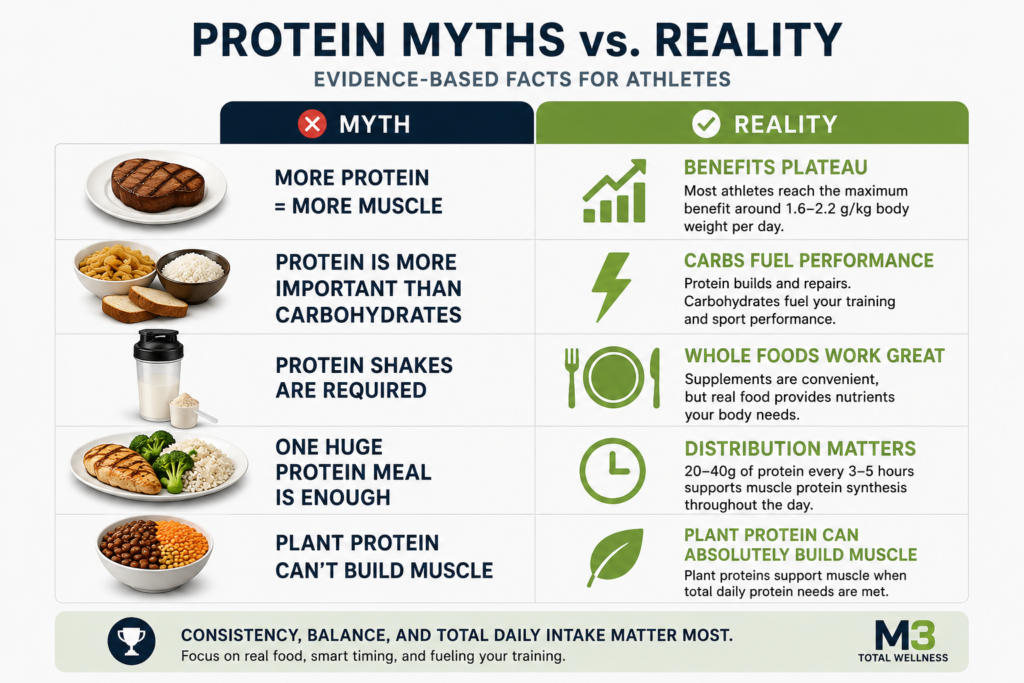
Mistake #1: Thinking More Protein Always Means Better Results
This is probably the biggest myth in sports nutrition.
More protein does not automatically mean:
- more muscle
- faster recovery
- better performance
The body can only utilize protein so efficiently.
Beyond a certain point, increasing protein intake usually provides diminishing returns.
I’ve seen athletes obsess over hitting 220 grams of protein while completely neglecting hydration, sleep, and carbohydrate intake.
That’s like putting premium tires on a car that has no fuel.
Mistake #2: Not Eating Enough Protein
The opposite problem also exists.
Some athletes genuinely under-eat protein.
This often occurs when:
- athletes skip meals
- athletes diet aggressively
- athletes rely heavily on convenience foods
Over time, inadequate protein intake may impair recovery and adaptation.
Mistake #3: Poor Protein Distribution
As discussed earlier:
Distributing adequate protein across several meals is generally more useful than consuming most of your daily protein in one sitting.
Protein intake should reflect that.
Mistake #4: Ignoring Overall Nutrition
One thing I consistently see is athletes treating protein like a magic nutrient.
Protein matters.
But protein alone does not:
- fuel practices
- replenish glycogen
- prevent dehydration
- replace sleep
If you’re under-eating carbohydrates, struggling with hydration, or sleeping five hours per night, more protein probably isn’t the solution.
For a broader perspective:
👉 How Athletes Should Eat for Performance: The M3 Fueling Framework
Do Athletes Need Protein Supplements?
Not necessarily.
Most athletes can meet their protein needs through food.
Protein supplements simply provide convenience.
They’re useful when:
- travel is frequent
- schedules are busy
- appetite is low
- food access is limited
But they’re not mandatory.
The best protein powder is usually the one that helps you consistently meet your needs and fits your preferences.
Can You Eat Too Much Protein?
Yes.
Contrary to what social media sometimes suggests, there is a point where additional protein becomes less beneficial.
The bigger issue isn’t usually harm.
The bigger issue is opportunity cost.
Every extra calorie coming from protein is a calorie not coming from something else.
Sometimes athletes push protein intake so high that they crowd out:
- carbohydrates
- fruits
- vegetables
- other important nutrients
This can negatively affect performance.
Is Plant Protein Enough for Athletes?
Absolutely.
The key is planning.
Plant-based athletes should focus on:
- variety
- consistency
- total intake
Foods like:
- soy products
- legumes
- lentils
- quinoa
- plant protein powders
can all contribute to meeting protein goals.
The M3 Protein Distribution Model
Sport-Specific Example: Volleyball
Volleyball is a great example of why protein matters—but also why protein isn’t everything.
Volleyball athletes need:
- explosive power
- repeated jumping
- quick recovery
- sustained concentration
Protein helps support recovery between practices and competitions.
But if you’ve ever played an all-day tournament, you know protein alone won’t carry you through the day.
I’ve seen athletes show up with protein shakes and protein bars but very few carbohydrates.
By the afternoon, energy levels often start crashing.
The athletes who perform best consistently tend to focus on overall fueling rather than a single nutrient.
That’s why protein and carbohydrates work best together.
For competition fueling strategies:
👉 What to Eat Before a Game
Practitioner Insight: What I See in Real Athletes
One of the most common patterns I see is that athletes fall into one of two groups.
Group one worries about protein constantly.
Group two barely thinks about it.
The best results usually come from somewhere in the middle.
Athletes don’t need to obsess over protein.
But they shouldn’t ignore it either.
Some of the biggest improvements I’ve seen in recovery and performance didn’t come from adding supplements.
They came from helping athletes consistently hit reasonable protein targets while improving overall nutrition habits.
Sometimes sports nutrition isn’t about doing more.
It’s about doing the basics consistently.
Action Steps
- Aim for approximately 1.2–2.0 g/kg/day based on your training demands.
- Include protein in each main meal.
- Spread protein throughout the day.
- Combine protein with carbohydrates after training.
- Focus on consistency rather than perfection.
- Avoid treating protein as the only nutrient that matters.
Conclusion
Protein plays an important role in athletic performance.
It supports:
- recovery
- muscle repair
- adaptation
- maintenance of lean body mass
But protein isn’t a magic solution.
Athletes who focus exclusively on protein often overlook the bigger picture.
Within the M3 Performance Framework, protein works best when combined with:
- adequate energy intake
- carbohydrates
- hydration
- recovery habits
- consistent training
The goal isn’t eating as much protein as possible.
The goal is giving your body what it needs to recover, adapt, and perform at its best.
Take the Next Step
Many athletes spend years chasing the “perfect” protein intake.
They buy supplements, track protein grams, and worry about whether they’re getting enough at every meal.
But the truth is that sports nutrition is about much more than protein alone.
The athletes who consistently perform at a high level usually aren’t the ones obsessing over a single nutrient. They’re the ones building sustainable habits around fueling, recovery, hydration, and training.
If you’re unsure whether you’re eating enough protein, struggling with recovery, trying to build muscle, or wondering how to balance protein with the rest of your nutrition, a personalized plan can help remove the guesswork.
At M3 Total Wellness, I help athletes build practical, evidence-based nutrition strategies that support performance, recovery, body composition goals, and long-term success.
Whether you’re a volleyball player, strength athlete, endurance athlete, CrossFit athlete, or active adult, the goal is the same:
Fuel smarter. Recover better. Perform consistently.
👉 Schedule a Performance Assessment to receive personalized nutrition guidance based on your sport, training schedule, and performance goals.
References
Amawi, A., Aljamal, A., Alshamrani, M., Alzahrani, M., Alsolami, M., Almehmadi, M., & Alqahtani, A. (2024). Athletes’ nutritional demands: A narrative review of nutritional requirements and strategies for optimal performance. Frontiers in Nutrition, 10, 1331854. https://doi.org/10.3389/fnut.2023.1331854
Antonio, J., Schoenfeld, B. J., Roberts, J., et al. (2024). Common questions and misconceptions about protein supplementation: What does the scientific evidence really show? Journal of the International Society of Sports Nutrition, 21(1). https://doi.org/10.1080/15502783.2024.2341903
Jahan-Mihan, A., Antonio, J., & Campbell, B. (2025). Current perspectives on protein supplementation in athletes. Nutrients, 17(22), 3528. https://doi.org/10.3390/nu17223528
Jäger, R., Kerksick, C. M., Campbell, B. I., et al. (2017). International Society of Sports Nutrition position stand: Protein and exercise. Journal of the International Society of Sports Nutrition, 14(20). https://doi.org/10.1186/s12970-017-0177-8
Mountjoy, M., Ackerman, K. E., Bailey, D. M., Burke, L. M., Constantini, N., Lebrun, C., et al. (2023). International Olympic Committee consensus statement on Relative Energy Deficiency in Sport (REDs): 2023 update. British Journal of Sports Medicine, 57(17), 1073–1098. https://doi.org/10.1136/bjsports-2023-106994
Sims, S. T., Heather, A. K., Desbrow, B., et al. (2023). International Society of Sports Nutrition position stand: Nutrition and supplementation considerations for female athletes. Journal of the International Society of Sports Nutrition, 20(1). https://doi.org/10.1080/15502783.2023.2204066
Zhao, S., Wang, J., & colleagues. (2024). The effect of protein intake on athletic performance: Current evidence and practical applications. Frontiers in Nutrition, 11. https://doi.org/10.3389/fnut.2024.1455728