Quick Answer
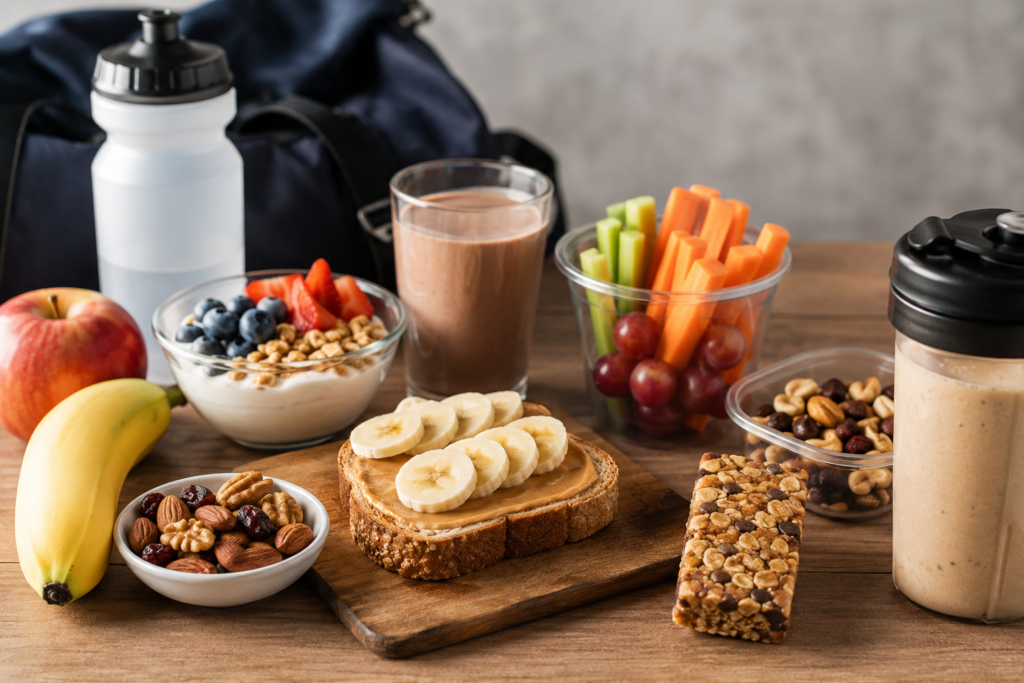
The best snacks for athletes combine carbohydrates for energy, protein for recovery, and practical timing to support training demands. Smart snacks help athletes maintain energy levels, improve workout quality, support recovery, and avoid long periods of underfueling throughout the day.
Some of the best snack options for athletes include:
- Greek yogurt with fruit
- Peanut butter toast
- Protein smoothies
- Trail mix
- Granola bars
- Chocolate milk
- Fruit with nuts
The “best” snack depends on:
- overall nutrition needs
- training timing
- exercise intensity
- digestion tolerance
- sport demands
Key Takeaways
- Snacks help athletes maintain more consistent energy levels throughout the day
- Carbohydrates support workout performance and glycogen replenishment
- Protein supports muscle repair and recovery
- Snack timing matters before, during, and after training
- Many athletes unintentionally underfuel by skipping snacks
- Portable snacks improve consistency during busy schedules
- Strategic snacking can improve recovery, energy, and training quality
Table of Contents
Introduction
A lot of athletes think about meals.
Far fewer think about snacks strategically.
But honestly, snacks are often the difference between:
- feeling energized at practice
- or dragging through the second half of training wondering why energy suddenly crashed
I see this constantly with athletes.
Many are training hard, practicing multiple times per week, lifting, working, going to school, or spending entire weekends at tournaments — but they still go several hours without eating anything meaningful between meals.
Then they wonder why they:
- feel exhausted during practice
- crave everything at night
- struggle with recovery
- feel inconsistent from session to session
As both a sports dietitian and volleyball athlete, I’ve noticed that many athletes underestimate how much consistent fueling matters. They may eat reasonably well at dinner, but the entire afternoon leading into practice was underfueled.
That gap matters.
Within the M3 Performance Framework:
- Mind = planning and consistency
- Meals = structured fueling
- Motion = increased demands from training
Snacks help bridge those gaps and support more consistent energy throughout the day.
And for many athletes, improving snack quality and consistency is one of the simplest performance nutrition changes they can make immediately.
Why Snacks Matter for Athletes
One thing I’ve noticed with athletes is that many unintentionally underfuel earlier in the day.
This is especially common with:
- high school athletes
- college athletes
- busy adults who train after work
- volleyball players during tournament season
A common pattern looks something like this:
- quick breakfast or no breakfast
- small lunch
- long gap before practice
- intense training session
- huge dinner late at night
The athlete may eat a substantial amount by the end of the day, but fueling before and during training may still have been inadequate.
That can affect:
- workout quality
- energy levels
- concentration
- recovery
- appetite regulation
I’ve personally experienced this during long volleyball days. If I wait too long to eat between matches or practices, I notice my energy and focus drop significantly later in the day, especially during beach volleyball in the Florida heat.
That’s where snacks become extremely valuable.
They help athletes:
- maintain more stable energy
- support recovery
- improve consistency
- avoid large energy crashes
- fuel training more effectively
For athletes with demanding schedules, snacks are not “extra.” They are part of the fueling strategy.
What Are the Best Snacks for Athletes?
The best snacks for athletes usually combine carbohydrates for energy and protein for recovery. Good options include Greek yogurt with fruit, peanut butter toast, protein smoothies, trail mix, granola bars, and chocolate milk.
The ideal snack depends on:
- workout timing
- training intensity
- digestion tolerance
- overall energy needs
For example, an athlete preparing for practice may benefit more from quick carbohydrates, while an athlete recovering after training may need a combination of carbohydrates and protein.
The M3 Snacking Framework
Mind
Strategic snacking starts with planning.
Most athletes do not intentionally underfuel. Usually, they are simply busy and unprepared.
When schedules become hectic, athletes often rely on whatever food is immediately available. That may mean:
- vending machine snacks
- fast food
- going hours without eating
Building better fueling habits often starts with small practical changes like:
- keeping snacks in a gym bag
- bringing food to tournaments
- planning ahead before long practice days
- improving consistency rather than chasing perfection
Meals
Snacks are designed to support meals—not replace them.
Athletes often need additional fuel between meals to:
- maintain energy
- support recovery
- improve total nutrient intake
- fuel longer training sessions
Motion
The greater the training demand, the greater the fueling demand.
Athletes involved in:
- double practice days
- tournaments
- endurance training
- beach volleyball
- strength training
often require more consistent fueling throughout the day than they realize.
The Science of Snacking and Energy Availability
The body performs best when energy availability remains relatively stable.
Long gaps without eating can contribute to:
- fatigue
- decreased concentration
- irritability
- low blood sugar
- reduced workout quality
Over time, chronic underfueling may negatively affect:
- recovery
- training adaptation
- muscle repair
- performance consistency
- appetite regulation
This is one reason sports dietitians often encourage athletes to avoid going many hours without eating.
According to the American College of Sports Medicine, consistent fueling helps support both athletic performance and recovery demands.
Why Carbohydrates Matter in Athlete Snacks
Carbohydrates are the body’s preferred fuel source during moderate to high-intensity exercise.
During training, stored carbohydrates (glycogen) are broken down to support muscular contractions and energy production. As glycogen stores become depleted, athletes may notice:
- decreased endurance
- lower power output
- slower reaction time
- mental fatigue
- reduced training intensity
Strategic carbohydrate-containing snacks help replenish glycogen stores and support more consistent energy throughout the day.
Good carbohydrate snack sources include:
- fruit
- oatmeal
- pretzels
- granola bars
- cereal
- crackers
- smoothies
Honestly, many athletes perform noticeably better simply by increasing consistent carbohydrate intake around training.
Why Protein Matters in Athlete Snacks
Protein supports:
- muscle repair
- recovery adaptation
- muscle protein synthesis
- satiety
Including protein in snacks can help athletes distribute protein intake more evenly throughout the day rather than trying to consume most of it at dinner.
Good protein-rich snack options include:
- Greek yogurt
- cottage cheese
- milk
- protein shakes
- edamame
- eggs
- turkey slices
- protein bars
Athletes focused on strength training or muscle gain may particularly benefit from including protein after training sessions.
Why Many Athletes Struggle With Snacking Consistently
Most athletes are not intentionally trying to underfuel.
Usually, life just gets in the way.
Athletes are balancing:
- school
- work
- commuting
- practices
- lifting
- tournaments
- social schedules
And fueling often becomes reactive instead of intentional.
I’ve worked with athletes who genuinely believed they were eating enough because dinner was large, but once we walked through their actual day, there were sometimes 6–8 hour gaps with almost no meaningful fuel intake.
That’s a problem.
Another issue is that many athletes try to “eat cleaner” or avoid snacks because they associate snacking with unhealthy eating.
In reality, strategic snacks can improve:
- recovery
- energy consistency
- appetite regulation
- performance
- body composition support
Honestly, many athletes would feel and perform better simply by fueling more consistently throughout the day.
How to Build a Balanced Athlete Snack
Athlete snacks do not need to be complicated.
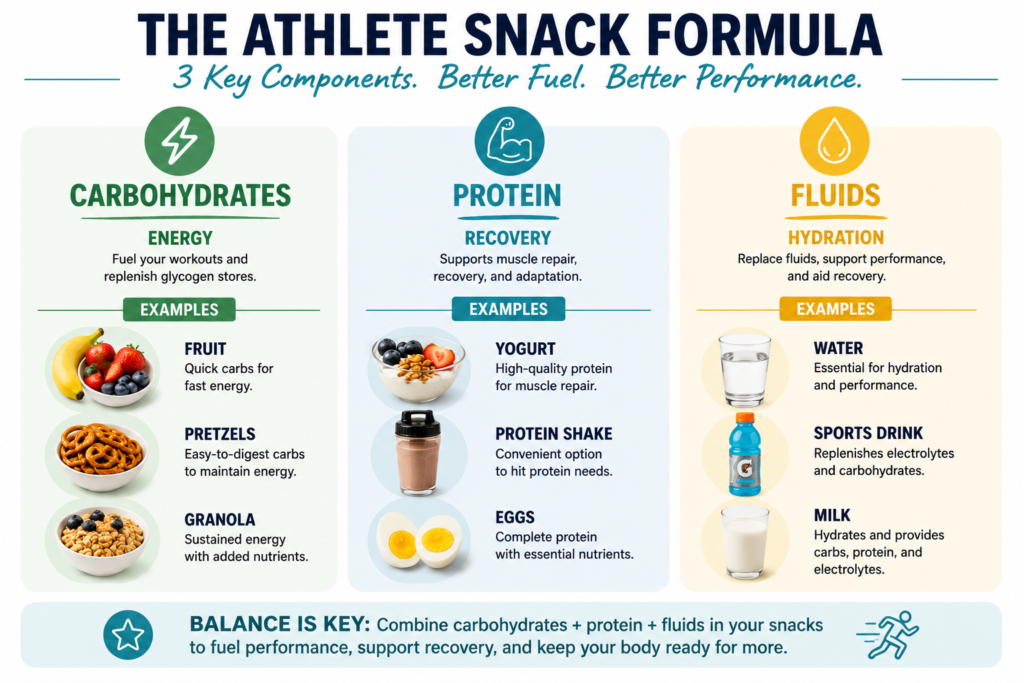
A simple way to think about snacks is:
- carbohydrates for energy
- protein for recovery
- fluids for hydration when needed
This combination helps support both immediate performance and post-exercise recovery.
Carbohydrate Sources
Examples include:
- fruit
- granola
- oatmeal
- pretzels
- crackers
- cereal
- bread
Protein Sources
Examples include:
- Greek yogurt
- milk
- protein powder
- eggs
- turkey
- cottage cheese
- edamame
Hydration Sources
Especially important after sweating heavily.
Examples:
- water
- sports drinks
- electrolyte beverages
- milk
Athletes do not need perfect snacks every single time. Consistency matters far more than perfection.
Best Snacks Before Workouts
Pre-workout snacks do not need to be complicated.
Honestly, many athletes overthink this.
The goal is simply to provide digestible energy that supports training without causing stomach discomfort.
In my experience, athletes often make one of two mistakes:
- eating almost nothing before practice
- eating a large heavy meal too close to training
Neither usually feels great.
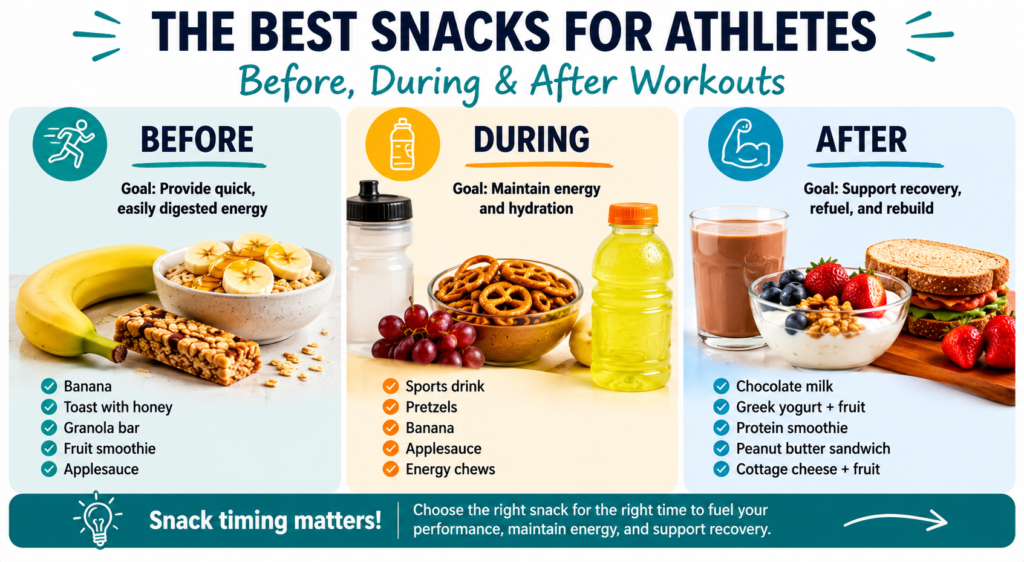
For athletes training within about 30–60 minutes, simpler carbohydrate-focused snacks are often tolerated best.
Examples include:
- banana
- pretzels
- granola bar
- toast with honey
- applesauce
- fruit smoothie
I’ve personally found this especially important before volleyball. During faster-paced sessions or long beach days, showing up underfueled noticeably affects energy, movement, and focus later in training.
The closer the snack is to exercise, the more important digestion tolerance becomes.
For more guidance, see:
“Pre-Workout Nutrition for Athletes.”
Best Snacks During Training
For training sessions lasting longer than 60–90 minutes, snacks or carbohydrates during exercise may help maintain performance.
This becomes especially relevant during:
- tournaments
- long practices
- endurance events
- beach volleyball in the heat
The goal during training is usually to provide quickly digestible carbohydrates that help maintain carbohydrate availability and exercise performance.
Examples include:
- sports drinks
- bananas
- applesauce
- pretzels
- dried fruit
- energy chews
- low-fiber granola bars
Many athletes wait until they feel exhausted before trying to fuel during long sessions. Usually by then, energy levels have already dropped significantly.
Best Snacks After Workouts
Post-workout snacks help support:
- glycogen replenishment
- muscle repair
- hydration
- recovery adaptation
The best recovery snacks generally combine carbohydrates and protein.
Good options include:
- chocolate milk
- protein smoothie with fruit
- Greek yogurt with granola
- peanut butter sandwich
- turkey wrap
- cottage cheese with fruit
- protein oatmeal
Recovery becomes even more important when:
- another workout occurs later the same day
- tournaments last all weekend
- training volume is high
- recovery time is limited
Honestly, many athletes finish practice and wait far too long before eating again. Even a simple snack shortly after training can make a noticeable difference in recovery and energy later in the day.
For more recovery guidance, see:
“Post-Workout Recovery Nutrition.”
Best Snacks for Morning Workouts
Morning workouts can be difficult because athletes often:
- wake up with low appetite
- have limited time
- train shortly after getting out of bed
In these situations, even a small snack may improve workout quality.
Good morning workout snacks include:
- banana
- toast with honey
- applesauce
- sports drink
- granola bar
- smoothie
- crackers
Some athletes tolerate fasted training during lighter sessions. But for higher intensity workouts, many athletes perform better with at least some carbohydrate intake beforehand.
Best Snacks for Athletes Trying to Gain Weight or Muscle
Athletes trying to gain muscle or body weight often underestimate how much total energy intake is actually required.
Large meals alone are not always enough.
Strategic snacks help increase calorie intake more consistently throughout the day without forcing extremely large meals.
Good high-calorie athlete snacks include:
- peanut butter sandwiches
- trail mix
- smoothies with protein powder
- chocolate milk
- Greek yogurt with granola
- nuts and dried fruit
- overnight oats
Liquid calories are often especially useful for athletes with lower appetite because they are easier to consume consistently.
Easy Grab-and-Go Snack Ideas
Convenience strongly affects food choices.
If athletes do not have food available, they often:
- skip fueling opportunities
- rely on fast food
- underfuel unintentionally
Portable snacks help reduce this problem.
Some easy athlete snack ideas include:
- protein bars
- trail mix
- fruit with nuts
- jerky with pretzels
- hummus with pita
- string cheese with crackers
- peanut butter packets
- roasted edamame
Many experienced athletes keep snacks in:
- gym bags
- cars
- backpacks
- lockers
because convenience often determines whether fueling actually happens.
How Hydration and Snacks Work Together
Athletes often separate fueling and hydration into two completely different categories, but in reality they work together constantly.
This becomes very obvious during beach volleyball tournaments or long outdoor training sessions in Florida heat.
One thing I notice during long tournament days is that athletes often stop feeling hungry once the heat becomes intense. The problem is that sweat losses continue increasing even while appetite decreases.
That combination can lead to:
- fatigue
- headaches
- cramping
- low energy
- poor recovery between matches
In these situations, smaller portable snacks paired with fluids are often much more realistic than trying to eat a large meal.
Examples that usually work well include:
- fruit
- pretzels
- sports drinks
- granola bars
- electrolyte beverages
- smoothies
Sometimes athletes think they need highly specialized sports products, but honestly, simple foods often work just as well when used consistently.
For more hydration strategies, see:
“Hydration for Athletic Performance.”
Snack Timing Table for Athletes
| Timing | Goal | Snack Examples |
| Before Workout | Quick energy | Banana, toast, granola bar |
| During Training | Maintain energy | Sports drink, pretzels, fruit |
| After Workout | Recovery | Chocolate milk, yogurt, smoothie |
Volleyball Tournament Example
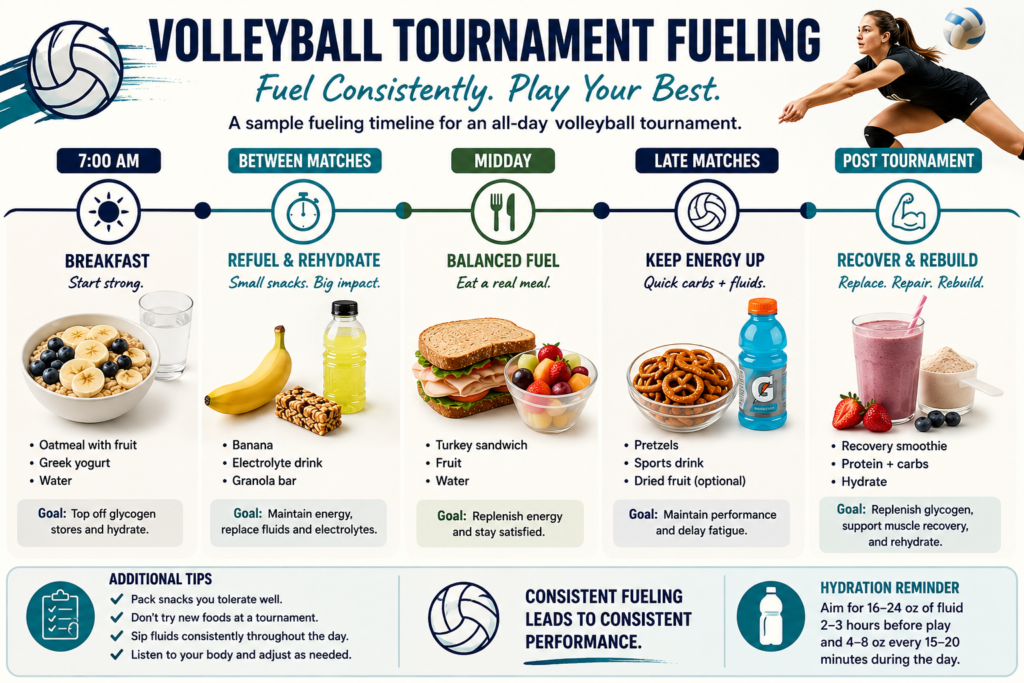
Volleyball tournaments are one of the clearest examples of why snack planning matters.
I’ve seen athletes arrive at all-day tournaments with:
- only water
- no snacks
- no electrolyte plan
- one large meal planned for later
Then by the last few matches, energy levels completely fall apart.
And honestly, it is not always a conditioning issue.
Sometimes the athlete is simply underfueled after several hours of competition.
Beach volleyball adds another layer because:
- heat suppresses appetite
- sweat losses increase
- matches may be spread out over hours
- opportunities to eat can be inconsistent
Personally, I’ve found smaller snacks between matches work much better than trying to eat one heavy meal during competition.
Things like:
- bananas
- pretzels
- sports drinks
- granola bars
- yogurt
- fruit
are often easier to tolerate and help maintain energy throughout the day.
Common Snacking Mistakes
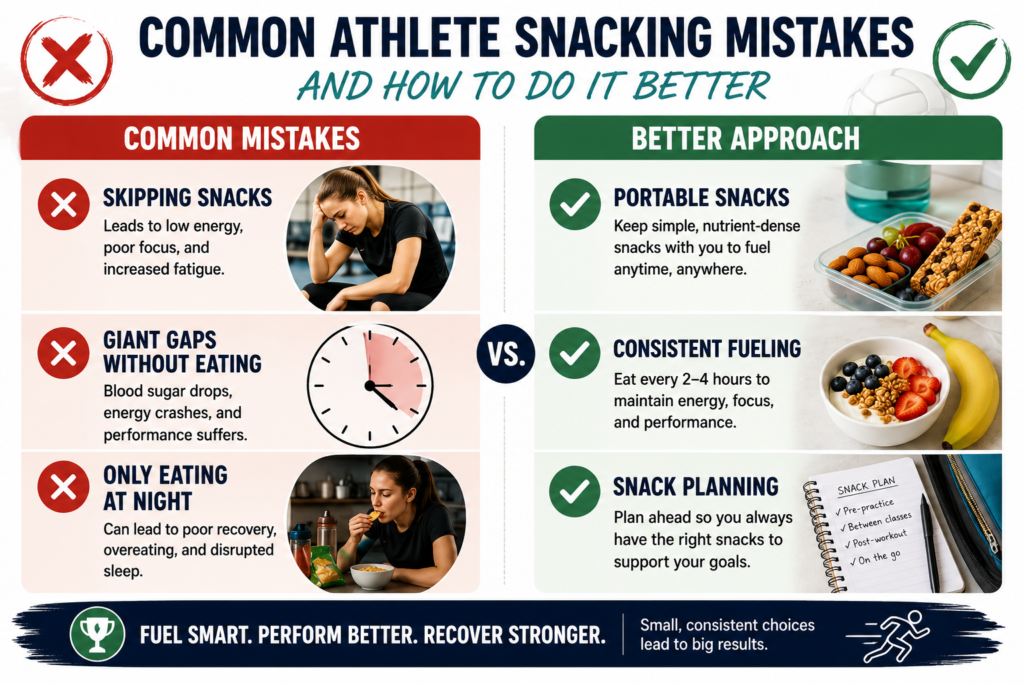
Skipping Snacks Entirely
This often contributes to:
- energy crashes
- excessive hunger later
- poor workout quality
- inconsistent recovery
Choosing Only Low-Nutrient Snack Foods
Foods like candy, pastries, and chips can occasionally fit into sports nutrition, but relying on them consistently may reduce overall nutrition quality.
Poor Timing
Eating too much too close to exercise may cause discomfort.
Eating too little too far from training may leave athletes underfueled.
Not Planning Ahead
Many athletes simply do not have fuel available when they need it. Honestly, planning ahead is one of the most underrated performance nutrition habits athletes can develop
Practitioner Insight: What I See in Real Athletes
One of the biggest nutrition patterns I see with athletes is inconsistent fueling during the earlier part of the day.
Many athletes are surprised when we review their schedule closely and realize how little fuel they are actually getting before training.
For example:
- skipping breakfast
- eating a light lunch
- going straight into a hard practice
- finally eating a large dinner late at night
That pattern is extremely common.
And honestly, many athletes assume fatigue during training is just part of working hard.
But in many cases, energy intake simply does not match training demands.
Once athletes improve snack consistency and start fueling more intentionally throughout the day, the difference is often noticeable relatively quickly.
I commonly hear athletes report:
- more stable energy
- better practices
- improved recovery
- fewer cravings later at night
- improved focus during workouts
Sometimes the solution is not a complicated supplement or advanced strategy.
Sometimes the athlete simply needs more consistent fuel throughout the day.
Action Steps
- Plan snacks around your training schedule
- Keep portable snacks available
- Include carbohydrates and protein regularly
- Avoid long gaps without eating
- Practice fueling during longer training sessions
- Bring snacks to tournaments and long practices
- Adjust snack size based on workout intensity and timing
Frequently Asked Questions
What are the best healthy snacks for athletes?
Some of the best healthy snacks for athletes include:
- fruit and yogurt
- trail mix
- protein smoothies
- peanut butter toast
- granola bars
- hummus with pita
The best option depends on training timing and energy needs.
Are protein bars good for athletes?
Protein bars can be useful during:
- busy schedules
- travel
- tournaments
- post-workout recovery
However, not all bars are nutritionally equal. Some are closer to candy bars with added protein, while others provide a more balanced nutrient profile.
How often should athletes snack?
Many athletes benefit from eating every 3–4 hours depending on:
- training load
- schedule
- appetite
- recovery needs
- total calorie requirements
Should athletes snack on rest days?
Yes. Recovery continues even on non-training days.
Athletes still require:
- protein for muscle repair
- carbohydrates to replenish glycogen
- adequate total energy intake
Are homemade snacks better than packaged snacks?
Not necessarily.
Homemade snacks may offer:
- lower cost
- more ingredient control
- higher nutrient density
However, packaged snacks can still be extremely useful for convenience and consistency.
The best snack is often the one an athlete can realistically use consistently.
Conclusion
For athletes, snacks are far more than casual eating habits—they are part of the overall fueling strategy that supports training, recovery, and performance.
Many athletes focus only on major meals while overlooking the long gaps between practices, workouts, school, work, and competition. Over time, those gaps can contribute to inconsistent energy levels, poor recovery, excessive hunger, and reduced training quality.
Strategic snacks help athletes:
- maintain energy availability
- support muscle recovery
- replenish glycogen stores
- improve workout quality
- stay fueled during busy schedules
The “best” snack depends on:
- timing
- training intensity
- digestion tolerance
- personal preference
- sport demands
For some athletes, a simple banana before practice may be enough. For others, especially those with higher training volumes, more structured snacks containing carbohydrates, protein, and fluids may be necessary throughout the day.
Within the M3 Performance Framework, snacks are not random food choices. They are intentional tools that help athletes consistently support performance through Mind, Meals, and Motion.
Need Help Fueling Your Performance?
If you are struggling with:
- low energy during training
- recovery between practices
- tournament fueling
- inconsistent eating habits
- sports nutrition planning
working with a sports dietitian can help you build a fueling strategy that supports your training, recovery, and performance goals.
Schedule a performance assessment to get started!
References
- Academy of Nutrition and Dietetics, Dietitians of Canada, & American College of Sports Medicine. (2016). Nutrition and athletic performance. Journal of the Academy of Nutrition and Dietetics, 116(3), 501–528. https://doi.org/10.1016/j.jand.2015.12.006
- Kerksick, C. M., Arent, S., Schoenfeld, B. J., Stout, J. R., Campbell, B., Wilborn, C. D., Taylor, L., Kalman, D., Smith-Ryan, A. E., Kreider, R. B., & Antonio, J. (2017).
- International society of sports nutrition position stand: Nutrient timing. Journal of the International Society of Sports Nutrition, 14(1), 33. https://doi.org/10.1186/s12970-017-0189-4
- Burke, L. M. (2021). Practical sports nutrition (2nd ed.). Human Kinetics.
- Phillips, S. M. (2014). A brief review of critical processes in exercise-induced muscular hypertrophy. Sports Medicine, 44(Suppl 1), 71–77. https://doi.org/10.1007/s40279-014-0152-3
- National Strength and Conditioning Association. (2021). Essentials of strength training and conditioning (4th ed.). Human Kinetics.