
Quick Answer
Carbohydrates are the body’s preferred fuel source during moderate- to high-intensity exercise. Athletes who consume enough carbohydrates generally have better energy levels, maintain performance longer, recover more effectively, and are better prepared for future training sessions.
Key Takeaways
- Carbohydrates are the primary fuel source for high-intensity exercise
- Glycogen (stored carbohydrates) plays a major role in athletic performance
- Low carbohydrate intake can contribute to fatigue, poor recovery, and decreased performance
- Carbohydrate needs vary based on training volume and intensity
- Many athletes unintentionally underfuel carbohydrates
- Strategic carbohydrate timing can improve both performance and recovery
Introduction
If there is one nutrient athletes seem most confused about, it’s carbohydrates.
I can’t tell you how many times I’ve worked with athletes who were training hard, feeling exhausted, and wondering why their performance wasn’t improving, only to discover they were barely eating any carbohydrates.
Usually it starts with good intentions.
They want to:
- lose body fat
- eat “cleaner”
- avoid processed foods
- follow a low-carb trend they saw online
A few weeks later, they’re telling me:
“I feel tired all the time.”
“My legs feel heavy during practice.”
“I’m recovering slower than I used to.”
“My performance has dropped, but my training hasn’t changed.”
Honestly, it’s usually not a mystery.
For most athletes, carbohydrates are the fuel that powers training and competition.
Yet carbs continue to be one of the most misunderstood nutrients in sports nutrition.
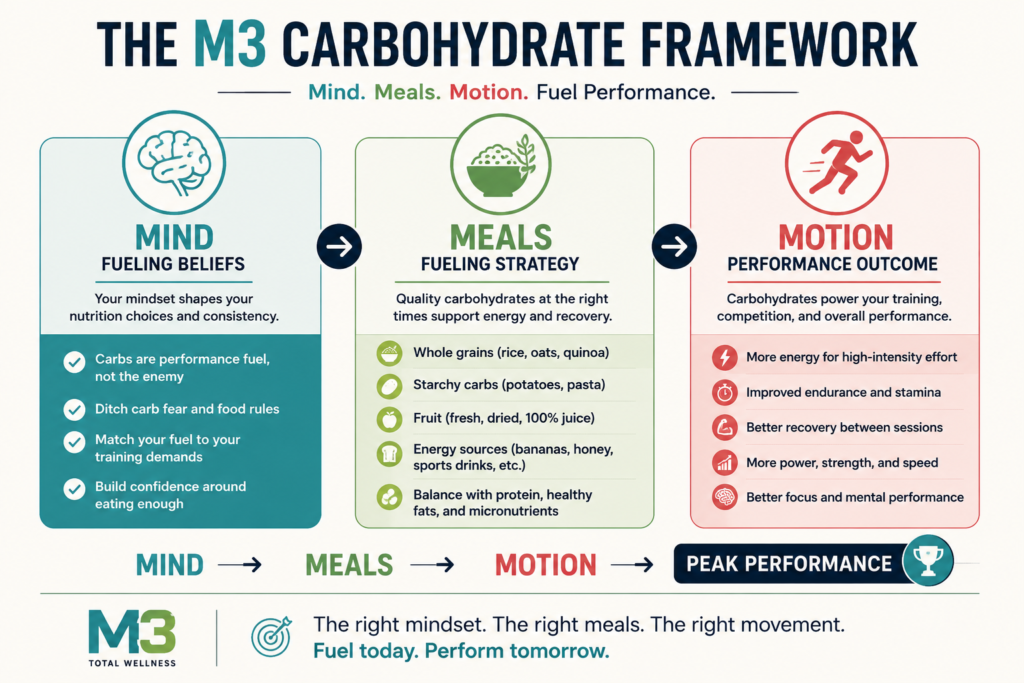
Within the M3 Performance Framework:
- Mind influences how athletes think about carbohydrates
- Meals provide the carbohydrates needed for performance
- Motion determines how much fuel the body requires
The reality is simple:
If you’re consistently underfueling carbohydrates, you’re probably limiting your athletic performance.
For a broader overview of how all nutrients work together to support performance, start with:
👉 How Athletes Should Eat for Performance: The M3 Fueling Framework
Table of Contents
The M3 Carbohydrate Framework
Mind
One of the biggest barriers to proper fueling isn’t physiology.
It’s belief.
Many athletes have been told:
- carbs make you gain weight
- carbs are unhealthy
- athletes should eat low-carb
- carbs should be avoided after a certain time of day
Unfortunately, many of these ideas create unnecessary fear around one of the body’s most important fuel sources.
I often see athletes become so focused on eating “healthy” that they unintentionally stop eating enough fuel to support their training.
The goal isn’t to eat as few carbs as possible.
The goal is to fuel appropriately for your activity level.
Athletes who understand how carbohydrates support performance often develop more confidence around fueling and make better nutrition decisions.
Meals
Carbohydrates are the foundation of most sports nutrition plans.
That doesn’t mean every meal needs to be loaded with carbs.
It means carbohydrates should be viewed as an important part of the performance equation rather than something to avoid.
Good sports nutrition is usually built around:
- carbohydrates for fuel
- protein for recovery
- healthy fats for overall health
Athletes often spend a lot of time worrying about supplements while overlooking the foods that provide the majority of their training energy.
Motion
This is where carbohydrate needs become highly individualized.
The athlete training six days per week generally needs more carbohydrates than the athlete training twice per week.
The athlete playing multiple volleyball matches in the Florida heat typically needs more carbohydrates than someone taking a casual walk.
As training volume increases, carbohydrate needs usually increase as well.
Simply put:
More work generally requires more fuel.
And for many sports, that fuel comes primarily from carbohydrates.
Why Carbohydrates Matter for Athletes
One thing I notice with athletes is that they often understand the importance of protein, but underestimate the importance of carbohydrates.
Protein tends to get all the attention.
Carbohydrates are usually the first thing people cut.
The problem is that carbohydrates fuel much of the work athletes are actually trying to do.
Think about sports like:
- volleyball
- basketball
- soccer
- CrossFit
- tennis
- football
These sports require repeated bursts of high-intensity effort.
Jumping.
Sprinting.
Accelerating.
Changing direction.
Reacting quickly.
All of these activities rely heavily on carbohydrate availability.
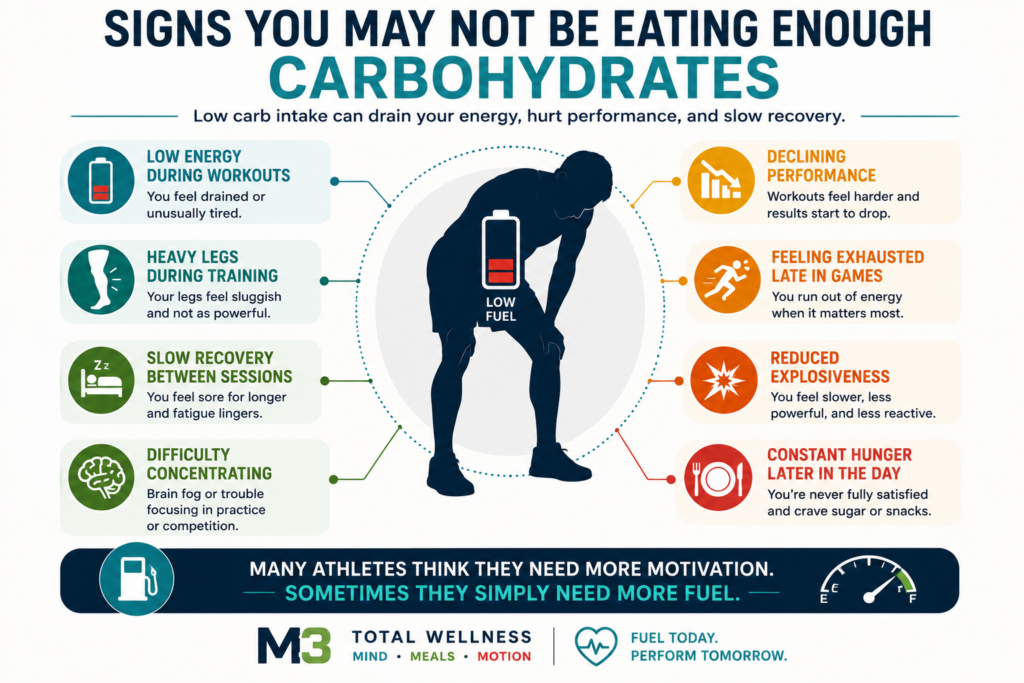
When carbohydrate stores begin running low, athletes often notice:
- lower energy
- decreased explosiveness
- slower reaction times
- reduced endurance
- increased perceived effort
I’ve seen athletes spend hundreds of dollars on supplements while completely overlooking the fact that they simply weren’t eating enough carbohydrates.
Sometimes the biggest performance improvement doesn’t come from a new supplement.
Sometimes it comes from eating enough fuel.
The Science of Carbohydrates and Performance
Glycogen: Stored Carbohydrates
When athletes eat carbohydrates, the body stores a portion of them as glycogen in the muscles and liver.
You can think of glycogen as your body’s performance fuel tank.
During exercise, glycogen is broken down and used to produce energy.
The harder the activity, the more important glycogen becomes.
This is one reason athletes often feel great at the beginning of training sessions but struggle later on.
As glycogen stores decline, fatigue becomes more noticeable.
Anyone who has played multiple volleyball matches in a day has probably experienced this.
The first match feels great.
The third or fourth match feels very different.
Sometimes conditioning plays a role.
But sometimes glycogen stores are simply running low.
Carbohydrates and Exercise Intensity
The body can use both fat and carbohydrates for energy.
However, the fuel source changes depending on exercise intensity.
Generally:
- Lower-intensity activity relies more heavily on fat
- Higher-intensity activity relies more heavily on carbohydrates
This is important because most sports are not performed at low intensity.
Volleyball players don’t casually jog to the ball.
Basketball players don’t slowly move during fast breaks.
Athletes often need rapid energy production.
Carbohydrates are uniquely suited for providing that energy quickly.
That’s why athletes involved in high-intensity sports often benefit from prioritizing carbohydrate intake.
Central Fatigue and Brain Function
Carbohydrates don’t just support muscles.
They also support the brain.
Athletes often focus on physical fatigue while overlooking mental fatigue.
Low carbohydrate availability may contribute to:
- decreased concentration
- slower decision-making
- reduced reaction time
- poorer coordination
This becomes increasingly important later in games and tournaments when both physical and mental fatigue begin to accumulate.
Sometimes what athletes describe as “mental exhaustion” is partially a fueling issue.
What Happens When Athletes Don’t Eat Enough Carbs?
This is where things start getting interesting.
Most athletes don’t wake up one morning and suddenly feel terrible because they skipped carbohydrates for a day.
Usually it’s more subtle than that.
Performance starts slipping little by little.
Recovery takes longer.
Workouts feel harder.
Energy becomes less predictable.
The athlete may not immediately connect those changes to nutrition.
In fact, many athletes blame:
- poor sleep
- stress
- lack of motivation
- overtraining
- getting older
Sometimes those factors play a role.
But often carbohydrate intake is part of the conversation.
Short-Term Effects
When carbohydrate intake is too low, athletes commonly experience:
- low energy
- earlier fatigue
- decreased workout quality
- reduced endurance
- poor concentration
- slower reaction times
One thing I notice often with volleyball players is that low carbohydrate intake tends to show up later in practices or tournaments.
Athletes might look fine early on.
Then midway through a session:
- movement slows down
- jumps become less explosive
- decision-making becomes slower
- frustration increases
Many athletes assume this is simply fatigue from training.
Sometimes it is.
But sometimes they’re running low on fuel.
Long-Term Effects
When low carbohydrate intake is part of inadequate overall energy intake, chronic underfueling can contribute to low energy availability and its associated health and performance consequences.
Potential consequences include:
- reduced training quality
- slower recovery
- decreased performance adaptations
- increased injury risk
- low energy availability (LEA)
- hormonal disruptions
- reduced immune function
I see this most often in athletes who are simultaneously trying to:
- lose weight
- improve performance
- train hard
Unfortunately, many athletes cut carbohydrates aggressively while maintaining a demanding training schedule.
The body usually doesn’t respond well to that combination.
For a deeper discussion on underfueling and performance, read:
👉 Why You’re Not Performing at Your Best (Even If You Train Hard)
How Many Carbs Do Athletes Need?
One of the most common questions athletes ask is:
“How many carbs should I eat?”
The honest answer is:
It depends.
Carbohydrate needs vary based on:
- body size
- training volume
- exercise intensity
- competition schedule
- goals
- sport
A recreational athlete training a few times per week will have very different needs than a competitive athlete practicing almost daily.
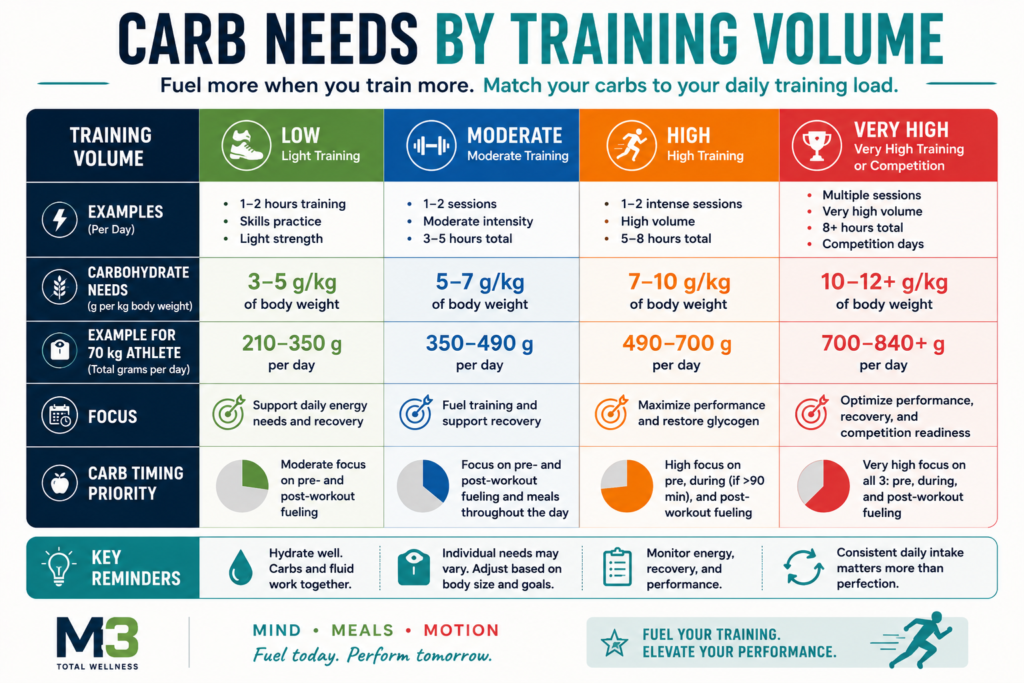
General Guidelines
Most sports nutrition organizations recommend approximately:
Light Activity
~3–5 grams per kilogram of body weight per day
Examples:
- recreational exercise
- lighter training periods
- active recovery phases
Moderate Training
~5–7 grams per kilogram
Examples:
- regular team practices
- moderate training schedules
- multiple training days per week
High-Intensity or Endurance Training
~6–10 grams per kilogram
Examples:
- tournament play
- endurance sports
- multiple daily sessions
- heavy training blocks
These numbers are guidelines, not rules.
The goal is not hitting a perfect number every day.
The goal is making sure energy intake matches training demands.
Best Carbohydrate Sources for Athletes
One misconception I hear frequently is:
“Which carbohydrates are the best?”
The truth is that different carbohydrate sources serve different purposes.
Instead of labeling carbs as “good” or “bad,” I prefer helping athletes understand when certain foods work best.
Everyday Fuel
These foods work well as the foundation of most athlete meal plans:
- rice
- potatoes
- oats
- whole grain bread
- pasta
- fruit
- beans
- quinoa
These foods provide energy while also contributing vitamins, minerals, and fiber.
For many athletes, these foods make up the majority of daily carbohydrate intake.
Quick Energy Sources
Sometimes athletes need carbohydrates that digest quickly.
Examples include:
- bananas
- sports drinks
- applesauce
- honey
- pretzels
- granola bars
These foods can be especially useful:
- before exercise
- during long training sessions
- during tournaments
- between matches
Recovery Carbohydrates
After training, carbohydrates help replenish glycogen stores.
Some simple examples include:
- rice with protein
- fruit and yogurt
- chocolate milk
- smoothies
- sandwiches
- oatmeal
Recovery nutrition does not need to be complicated.
In fact, athletes often do best with simple, repeatable options.
For more recovery strategies, read:
👉 Post-Workout Recovery Nutrition for Athletes
Timing Carbohydrates for Performance
Athletes often focus on what they eat.
Timing also matters.
Especially during periods of heavy training or competition.
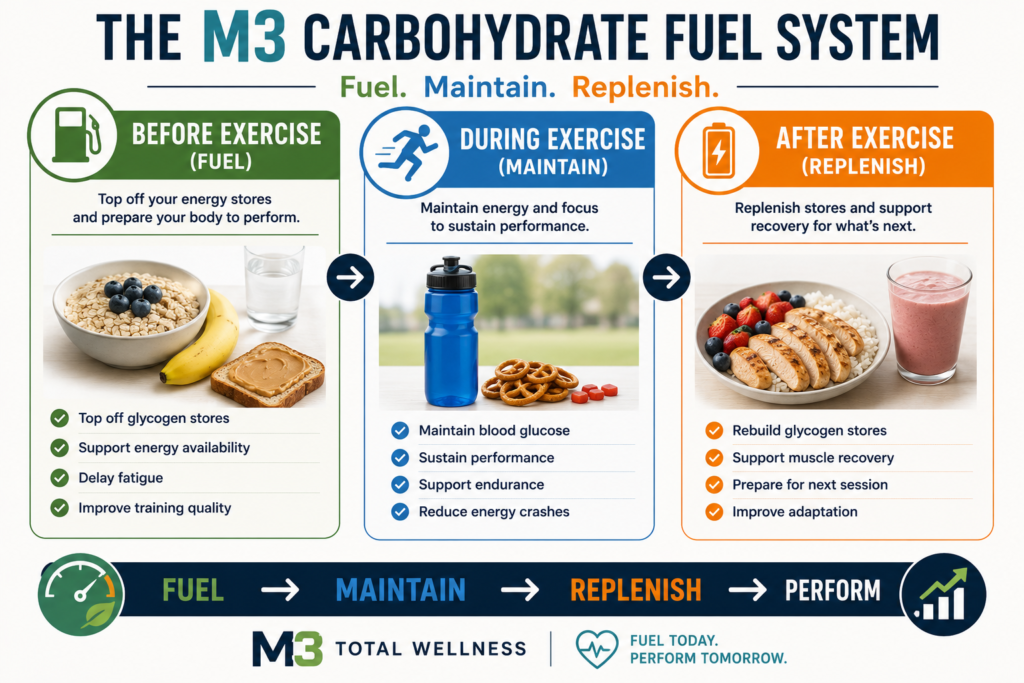
Before Exercise
Carbohydrates before training help:
- provide energy
- support performance
- delay fatigue
This becomes especially important when:
- training lasts longer than an hour
- workouts are high intensity
- previous meals were several hours earlier
For a detailed breakdown, read:
👉 Pre-Workout Nutrition for Athletes
During Exercise
Not every workout requires carbohydrates during activity.
However, they may be helpful when:
- exercise exceeds 60–90 minutes
- tournament play lasts several hours
- training volume is high
Examples include:
- sports drinks
- bananas
- energy chews
- pretzels
- dried fruit
After Exercise
This is where many athletes miss opportunities.
After exercise, carbohydrates help:
- replenish glycogen
- support recovery
- prepare for future training sessions
This becomes even more important when another workout is scheduled later the same day or the following morning.
FAQ
Are Carbs Bad for Athletes?
No.
For most athletes, carbohydrates are one of the most important performance nutrients.
The fear of carbohydrates often comes from weight-loss messaging that isn’t designed for competitive athletes.
Athletes are not sedentary individuals.
Training creates different nutritional demands.
When used appropriately, carbohydrates support:
- performance
- recovery
- training quality
- adaptation
Can Athletes Perform Well on Low-Carb Diets?
Some athletes can function reasonably well on lower-carbohydrate diets.
However, most athletes participating in:
- volleyball
- soccer
- basketball
- CrossFit
- sprint sports
- high-intensity training
will typically perform better with adequate carbohydrate availability.
The higher the intensity, the more important carbohydrates generally become.
Do Athletes Need Carbs Even If They’re Trying to Lose Weight?
Absolutely.
The goal should usually be creating an appropriate calorie deficit while maintaining enough carbohydrates to support training.
One of the biggest mistakes I see is athletes trying to lose weight by eliminating carbohydrates while continuing to train hard.
Performance often suffers quickly.
A better approach is usually strategic carbohydrate management rather than carbohydrate elimination.
Sport-Specific Example: Volleyball
Volleyball is a great example of why carbohydrates matter.
People sometimes underestimate how physically demanding volleyball can be.
A typical match involves:
- repeated jumping
- explosive movement
- rapid direction changes
- quick reactions
- sustained concentration
During tournaments, these demands repeat over and over.
Low carbohydrate intake often shows up as:
- slower movement
- lower jump performance
- decreased concentration
- earlier fatigue
I’ve experienced this myself.
Some of my worst volleyball days weren’t because I trained poorly.
They were because I fueled poorly.
On the flip side, when athletes consistently fuel with adequate carbohydrates, they often notice:
- better endurance
- more consistent performance
- improved recovery
- better energy late in matches
Hydration also plays a major role here:
👉 Hydration for Athletic Performance
Practitioner Insight: What I See in Real Athletes
One of the biggest nutrition patterns I see in athletes is simple:
They under-eat carbohydrates.
Not intentionally.
Just consistently.
Many athletes focus heavily on protein.
Protein is important.
But sometimes athletes become so focused on protein that they accidentally neglect the nutrient providing most of their training fuel.
I regularly hear things like:
“I’m eating plenty of protein.”
Then we review their intake and discover they’re barely eating enough carbohydrates to support training.
When carbohydrate intake improves, performance often improves surprisingly quickly.
Usually athletes notice:
- better energy
- improved recovery
- better workouts
- fewer energy crashes
- more consistency
Not because carbohydrates are magical.
Because fuel matters.
From the Field:
As both a Registered Dietitian Nutritionist and competitive volleyball athlete, I've seen firsthand how quickly performance can decline when carbohydrate intake doesn't match training demands. Some of the biggest improvements I've seen in athletes aren't from supplements or complicated nutrition plans—they come from consistently eating enough carbohydrates to support the work they're asking their bodies to do.
Action Steps
If you’re an athlete looking to improve performance:
- Include carbohydrates in each main meal.
- Adjust intake based on training volume.
- Fuel before training.
- Replenish carbohydrates after workouts.
- Stop viewing carbohydrates as the enemy.
- Monitor your energy, recovery, and performance.
Monitor patterns in your energy, recovery, training quality, health, and performance rather than relying on any single sign.
Conclusion
Carbohydrates remain one of the most important nutrients for athletic performance.
They support:
- energy production
- training quality
- recovery
- endurance
- concentration
- overall performance
Within the M3 Performance Framework, carbohydrates are not just another nutrient.
They are one of the primary tools athletes use to fuel performance.
Train hard.
But make sure you’re giving your body the fuel it needs to support that work.
Because even the best training program becomes harder when the fuel tank is running low.
Take the Next Step
If you’re constantly feeling tired during training, struggling to recover, or finding that your performance drops off late in workouts or competition, your carbohydrate intake may be part of the problem.
Many athletes focus on training harder when the real issue is fueling better.
At M3 Total Wellness, I help athletes build practical, evidence-based nutrition strategies that support energy, recovery, and long-term performance.
Whether you’re a volleyball player, CrossFit athlete, endurance athlete, or active adult, the goal is the same:
Fuel smarter. Recover better. Perform consistently.
👉 Schedule a Performance Assessment to receive personalized guidance based on your sport, training schedule, and performance goals.
References
Burke, L. M., Costa, R. J. S., Garthe, I., Desbrow, B., Farthing, L., Minehan, M., & Shaw, G. (2021). Contemporary nutrition strategies to optimize performance in distance runners and race walkers. International Journal of Sport Nutrition and Exercise Metabolism, 31(5), 433–447.
Burke, L. M., Hawley, J. A., Jeukendrup, A., Morton, J. P., Stellingwerff, T., & Maughan, R. J. (2023). Toward a common understanding of diet-exercise strategies to manipulate fuel availability for training and competition preparation in endurance sport. International Journal of Sport Nutrition and Exercise Metabolism, 33(1), 1–15.
Kerksick, C. M., Arent, S., Schoenfeld, B. J., Stout, J. R., Campbell, B., Wilborn, C. D., … Antonio, J. (2022). International Society of Sports Nutrition position stand: Nutrient timing. Journal of the International Society of Sports Nutrition, 19(1), 1–32.
Mountjoy, M., Ackerman, K. E., Bailey, D. M., Burke, L. M., Constantini, N., Lebrun, C., … Budgett, R. (2023). International Olympic Committee consensus statement on Relative Energy Deficiency in Sport (REDs): 2023 update. British Journal of Sports Medicine, 57(17), 1073–1098. https://doi.org/10.1136/bjsports-2023-106994
Thomas, D. T., Erdman, K. A., & Burke, L. M. (2016). Nutrition and athletic performance. Medicine & Science in Sports & Exercise, 48(3), 543–568. https://doi.org/10.1249/MSS.0000000000000852
Witard, O. C., Betts, J. A., & Gonzalez, J. T. (2022). Practical nutrition strategies to support training adaptation and performance in athletes. Sports Medicine, 52(Suppl 1), 47–61.