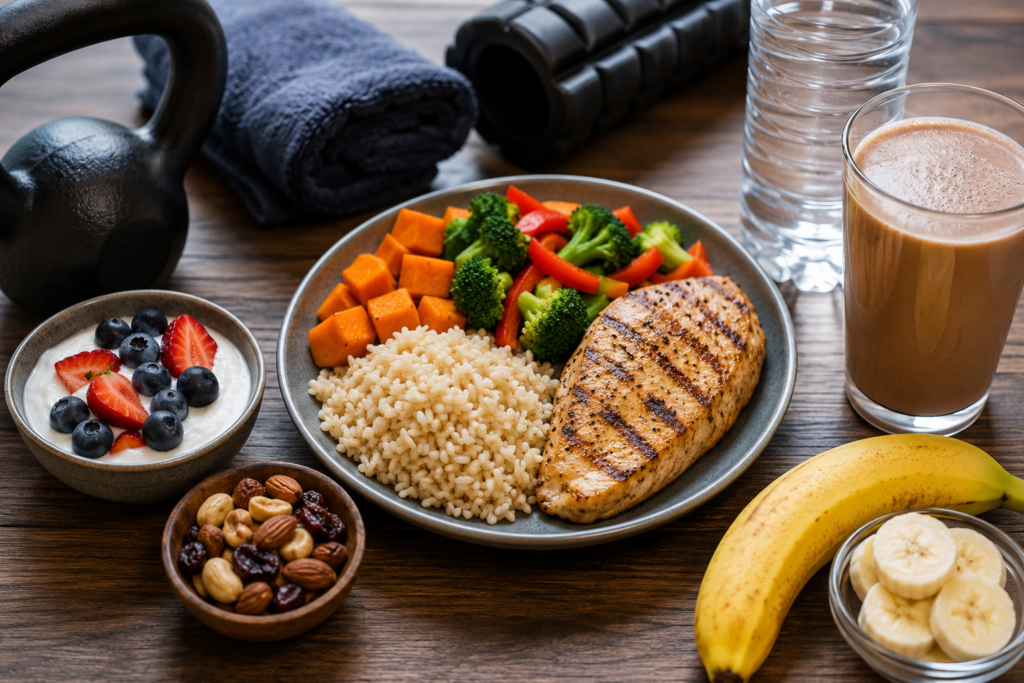
Quick Answer
Recovery nutrition focuses on replenishing energy stores, repairing muscle tissue, restoring hydration, and supporting adaptation after training. Athletes who consistently consume carbohydrates, protein, fluids, and adequate calories after exercise are often better prepared for future training sessions and competition. Recovery is not something that simply happens on its own—it is something athletes actively support through their daily habits.
Key Takeaways
- Recovery nutrition helps athletes adapt to training and perform consistently.
- Carbohydrates help replenish glycogen stores used during exercise.
- Protein supports muscle repair and recovery.
- Hydration restores fluid balance and supports recovery processes.
- Sleep plays a critical role in recovery and adaptation.
- Recovery becomes increasingly important as training volume and intensity increase.
- Small recovery habits performed consistently often produce better results than occasional perfect recovery strategies.
Introduction
Most athletes love to train.
Very few athletes get excited about recovery.
They look forward to practices, workouts, competitions, and testing their limits.
Recovery often feels like the boring part.
But here’s the reality:
Training creates the stimulus.
Recovery creates the adaptation.
Without recovery, the benefits of training are limited.
I’ve worked with athletes who believed they needed a harder workout, a better supplement, or a more advanced training program when the real issue was inadequate recovery.
They were:
- skipping post-workout meals
- underhydrating
- underfueling
- sleeping poorly
- rushing from one session to the next
As a result, they felt tired, sore, and inconsistent.
Within the M3 Performance Framework:
- Mind helps athletes prioritize recovery and build consistent habits.
- Meals provide the nutrients needed to restore energy and repair muscle.
- Motion creates the training stress that recovery is designed to support.
Many athletes focus heavily on training.
The athletes who continue improving over time usually learn how to recover just as intentionally as they train.
For a broader overview of athlete fueling, check out:
👉 How Athletes Should Eat for Performance: The M3 Athlete Fueling Framework
Table of Contents
What Is Recovery Nutrition?
Recovery nutrition refers to the foods, fluids, and nutrients consumed after training or competition to help the body recover and prepare for future performance.
The goal is not simply to stop feeling hungry.
The goal is to support the body’s ability to:
- replenish energy stores
- repair muscle tissue
- restore hydration
- reduce excessive fatigue
- prepare for future training sessions
Recovery nutrition is especially important when athletes train frequently or have limited time between sessions.
The harder you train, the more important recovery tends to become.
The M3 Recovery Framework
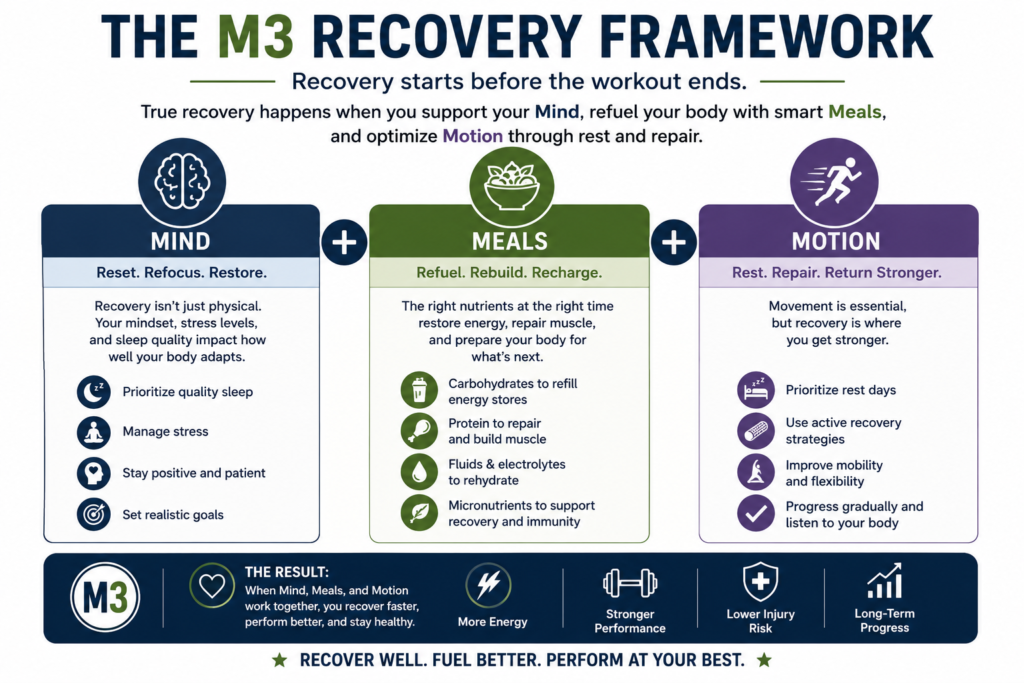
Mind
Recovery starts before the workout ends.
Athletes who recover well often plan ahead.
They know:
- what they will eat afterward
- where they will get food
- how they will rehydrate
- how they will support sleep
Many recovery mistakes happen because athletes simply aren’t prepared.
A little planning often goes a long way.
Meals
Nutrition provides the building blocks for recovery.
After exercise, athletes generally need:
- carbohydrates
- protein
- fluids
- electrolytes
- sufficient calories
No single food creates recovery.
Consistently meeting overall nutrition needs is what drives results.
Motion
Training creates stress.
That stress is necessary.
Without stress, there is no adaptation.
However, recovery needs increase as:
- training volume increases
- training intensity increases
- competition schedules become more demanding
The goal is not eliminating fatigue completely.
The goal is recovering well enough to continue adapting and performing.
What Happens During Recovery?
Many athletes think recovery simply means resting.
In reality, a lot is happening behind the scenes.
After training, the body is working to:
Replenish Glycogen
Glycogen is the stored form of carbohydrate found in muscle and liver tissue.
Hard training can significantly reduce glycogen stores.
Recovery nutrition helps restore those energy reserves.
Repair Muscle Tissue
Exercise creates microscopic damage within muscle fibers.
This is a normal part of training adaptation.
Protein provides the amino acids needed to repair and rebuild those tissues.
Restore Hydration
Sweat losses can lead to dehydration.
Recovery includes replacing fluids and electrolytes lost during exercise.
Support Adaptation
The purpose of recovery is not simply returning to baseline.
The purpose is helping the body become stronger, faster, and more resilient than before.
This process is what allows athletes to improve over time.
Why Recovery Nutrition Matters
Recovery nutrition helps bridge the gap between one training session and the next.
When athletes recover well, they often experience:
- improved training quality
- better energy levels
- reduced fatigue
- greater consistency
- improved readiness for future sessions
Poor recovery may contribute to:
- lingering soreness
- decreased performance
- low energy
- increased injury risk
- difficulty adapting to training
Recovery does not guarantee success.
However, inadequate recovery often limits progress.
The Recovery Formula for Athletes
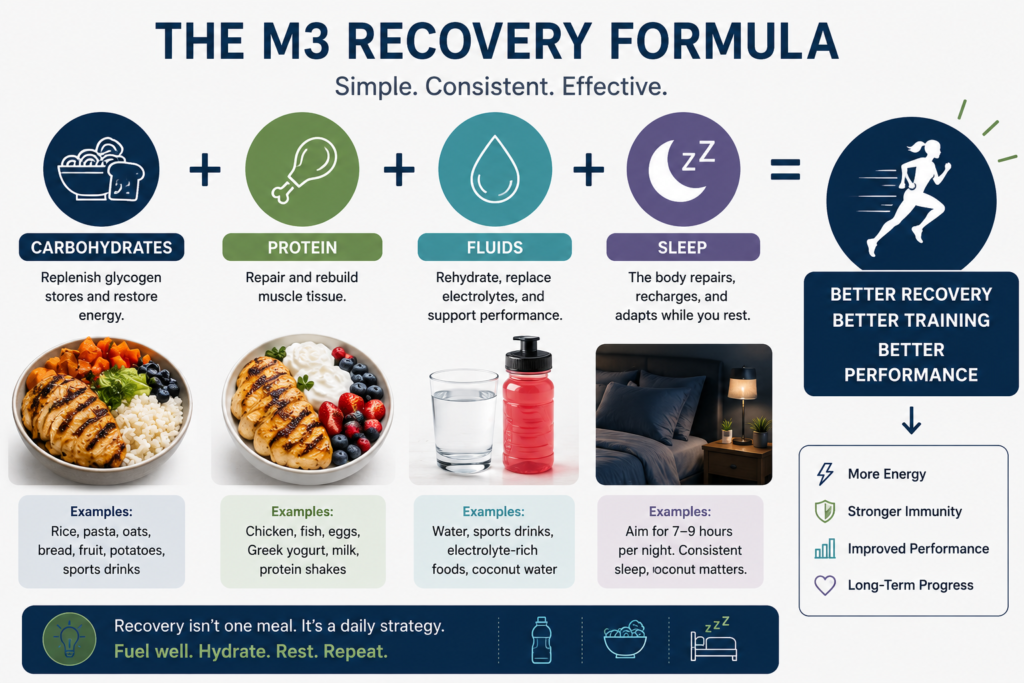
If recovery nutrition feels complicated, start with a simple formula:
👉 Carbohydrates + Protein + Fluids + Sleep
Most recovery strategies can be built around these four pillars.
Athletes often look for the perfect supplement, recovery gadget, or shortcut.
In reality, consistent attention to these fundamentals typically has a much greater impact on performance and recovery.
Carbohydrates: Refill the Tank
Carbohydrates are the body’s preferred fuel source for moderate- to high-intensity exercise.
During training, muscles use stored carbohydrate, known as glycogen, to help power movement.
The longer and harder the session, the more glycogen is typically used.
Recovery nutrition should include carbohydrates to help replenish these stores and prepare for future training sessions.
Examples include:
- fruit
- rice
- potatoes
- oatmeal
- pasta
- bread
- cereal
- sports drinks
Athletes who regularly perform intense training sessions, tournaments, or multiple workouts per day often have greater carbohydrate recovery needs.
Without adequate carbohydrate intake, athletes may notice:
- reduced energy
- increased fatigue
- slower recovery
- decreased performance during subsequent training sessions
For a deeper dive into carbohydrate needs, check out:
👉 Carbohydrates and Athletic Performance
Protein: Repair and Rebuild
Training creates microscopic damage to muscle tissue.
This is a normal and necessary part of adaptation.
Protein provides the amino acids needed to repair, rebuild, and strengthen those tissues after exercise.
Most athletes benefit from including a quality protein source after training.
Examples include:
- chicken
- fish
- eggs
- Greek yogurt
- cottage cheese
- milk
- tofu
- protein shakes
Rather than focusing solely on one post-workout meal, athletes should aim to distribute protein consistently throughout the day.
Recovery is an ongoing process, not a single meal.
For more information:
Fluids: Rehydrate and Restore
Sweat loss occurs during almost every training session.
Even mild dehydration can negatively affect performance, recovery, and how athletes feel the next day.
Many athletes focus heavily on food but underestimate the importance of rehydration.
A simple recovery strategy is to begin replacing fluids immediately after training and continue drinking throughout the day.
Depending on training conditions and sweat losses, electrolytes may also be helpful.
This becomes particularly important during:
- summer training
- tournaments
- endurance events
- multiple training sessions per day
For a deeper look at hydration strategies:
👉 Hydration for Athletic Performance
Sleep: The Ultimate Recovery Tool
If I could choose only one recovery strategy for most athletes, it would be sleep.
Sleep is when many of the body’s recovery processes are most active.
During sleep, the body works to:
- repair tissues
- support immune function
- regulate hormones
- consolidate learning and skill development
- support physical recovery
Unfortunately, sleep is often the first thing athletes sacrifice.
Late-night practices.
Homework.
Work schedules.
Travel.
Screen time.
All can interfere with recovery.
Nutrition matters.
Hydration matters.
But athletes who consistently sleep poorly often struggle to fully recover regardless of how well they eat.
While individual needs vary, many athletes benefit from aiming for approximately 7–9 hours of quality sleep per night, with some younger athletes requiring even more.
What Is the Best Recovery Meal After Exercise?
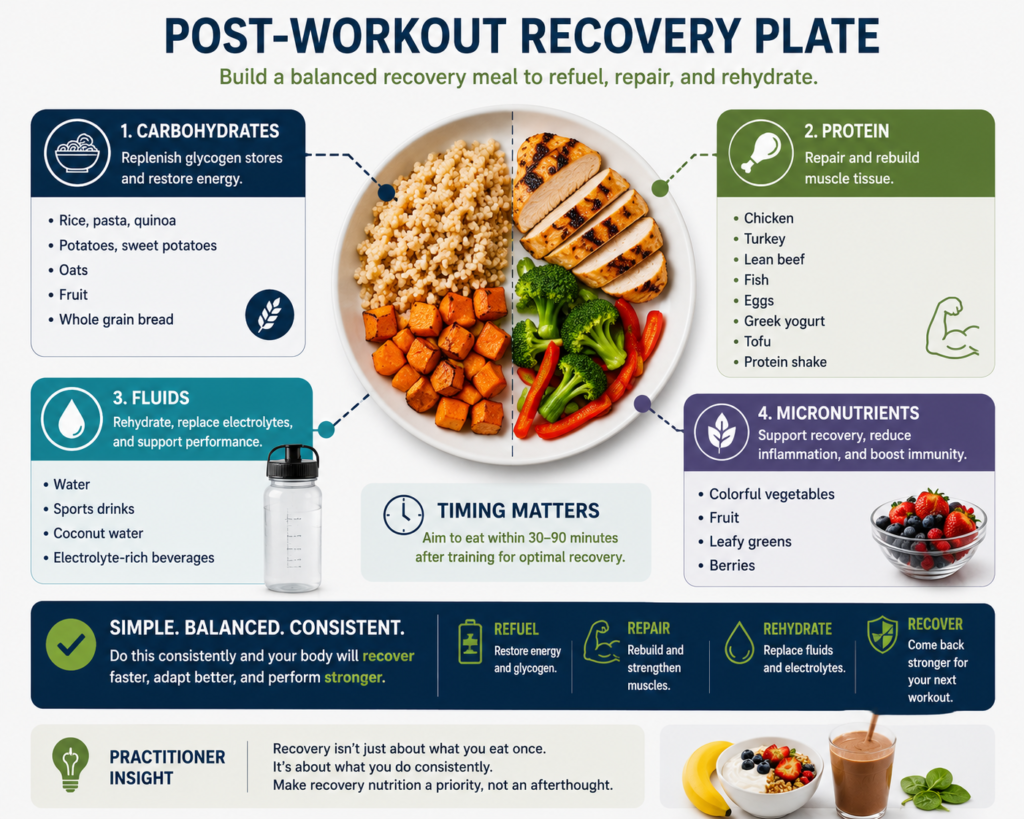
One of the most common questions athletes ask is:
“What should I eat after a workout?”
The answer depends on:
- training intensity
- session duration
- time until the next workout
- personal preferences
However, a good recovery meal generally includes:
✅ Carbohydrates
✅ Protein
✅ Fluids
Examples include:
Option 1
- Grilled chicken
- Rice
- Vegetables
- Water
Option 2
- Turkey sandwich
- Fruit
- Milk
Option 3
- Greek yogurt
- Granola
- Berries
Option 4
- Recovery smoothie with:
- milk
- fruit
- oats
- protein powder
The best recovery meal is often the one that is realistic, convenient, and consistently consumed.
Perfect nutrition occasionally is less valuable than good nutrition consistently.
Timing Your Recovery Nutrition
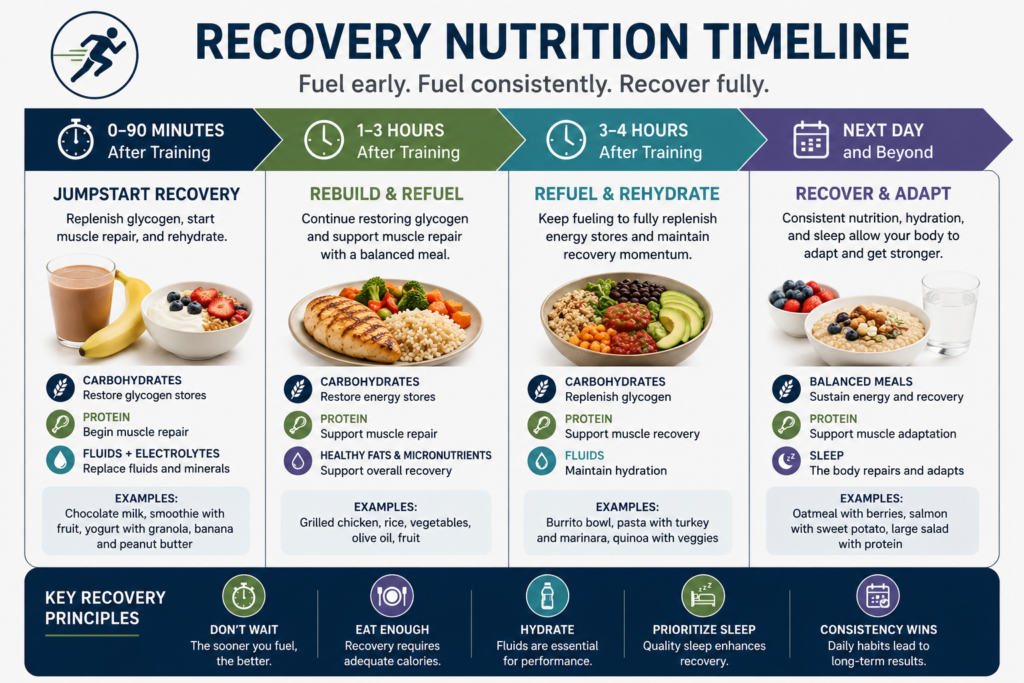
Athletes often hear about the “anabolic window” and wonder whether recovery nutrition must happen immediately after exercise.
Current evidence suggests that the recovery window is larger than many people once believed.
However, that does not mean timing is irrelevant.
A practical goal is to begin recovery nutrition within approximately 30–90 minutes after training.
This becomes particularly important when:
- training multiple times per day
- competing in tournaments
- preparing for another session within 24 hours
Athletes do not need to panic if they cannot eat immediately after exercise.
The larger concern is routinely waiting several hours before consuming food and fluids.
Recovery works best when athletes consistently provide their body with the resources needed to adapt.
What If I’m Not Hungry After Training?
This is especially common after:
- intense workouts
- competitions
- training in hot environments
In these situations, liquid nutrition can be extremely helpful.
Examples include:
- chocolate milk
- protein shakes
- smoothies
- drinkable yogurt
Starting with something small is often better than waiting until hunger returns.
Recovery does not need to begin with a large meal.
It simply needs to begin.
Daily Recovery Strategies
Recovery is not determined by a single post-workout meal.
It’s influenced by everything that happens throughout the day.
One of the biggest mistakes athletes make is treating recovery as a short window immediately after exercise and then ignoring nutrition for the rest of the day.
In reality, recovery is continuous.
Every meal, snack, glass of water, and hour of sleep contributes to how well the body adapts to training.
Athletes who recover well typically focus on consistency rather than perfection.
Eat Consistently Throughout the Day
Many athletes unknowingly create large gaps between meals.
For example:
- skipping breakfast
- eating a late lunch
- training after work or school
- waiting until dinner to eat again
By the time training begins, they may already be underfueled.
Recovery becomes much more difficult when energy intake is inconsistent throughout the day.
For many athletes, eating every 3–4 hours can help support:
- stable energy levels
- recovery
- training quality
- adequate calorie intake
A sample day might look like:
7:00 AM – Breakfast
10:00 AM – Snack
1:00 PM – Lunch
4:00 PM – Snack
6:00 PM – Training
7:30 PM – Recovery Meal
This isn’t a rigid schedule.
It’s simply an example of how athletes can create regular opportunities to fuel and recover.
Don’t Let Recovery Wait Until Dinner
Athletes often tell me:
“I’ll just eat when I get home.”
The problem is that “when I get home” can sometimes become two or three hours after training.
Life gets busy.
Traffic happens.
Errands come up.
By then, recovery nutrition has been delayed unnecessarily.
Planning ahead can make recovery much easier.
Examples include:
- packing a recovery snack
- bringing chocolate milk
- keeping a protein shake available
- packing fruit or a sandwich
Small amounts of preparation often lead to much better recovery habits.
Hydration and Electrolytes
Recovery isn’t just about food.
Hydration is a critical part of the recovery process.
Even modest levels of dehydration can negatively affect:
- performance
- recovery
- concentration
- mood
- training quality
Athletes often underestimate how much fluid they lose during training, particularly in hot or humid environments.
Why Hydration Matters for Recovery
After exercise, the body is working to:
- restore fluid balance
- regulate body temperature
- transport nutrients
- support recovery processes
If dehydration persists after training, these processes may become less efficient.
Many athletes notice symptoms such as:
- headaches
- fatigue
- reduced performance
- muscle cramps
- poor recovery
when hydration needs are not being met.
When Are Electrolytes Helpful?
Electrolytes are minerals lost through sweat.
The primary electrolytes lost during exercise include:
- sodium
- potassium
- magnesium
- chloride
Electrolyte replacement may be especially helpful when:
- training lasts longer than 60–90 minutes
- training occurs in hot environments
- sweat losses are high
- multiple training sessions occur in one day
- athletes are preparing for tournaments
Examples include:
- sports drinks
- electrolyte tablets
- electrolyte powders
- foods containing sodium and potassium
Not every athlete needs large amounts of electrolytes after every workout.
However, athletes with high sweat losses often benefit from replacing both fluids and electrolytes.
Recovery for High Training Loads
Recovery becomes increasingly important as training demands increase.
A recreational athlete exercising three times per week has different recovery needs than an athlete training twice per day.
When training volume rises, recovery mistakes become more noticeable.
Small deficits can quickly accumulate.
Two-A-Day Training Sessions
Athletes participating in:
- swimming
- soccer
- volleyball
- basketball
- CrossFit
- endurance sports
may occasionally train multiple times in a single day.
In these situations, recovery nutrition serves two purposes:
- Recover from the previous session.
- Prepare for the next session.
Athletes often have only a few hours between sessions.
This makes carbohydrates, protein, and hydration particularly important.
Tournament and Competition Recovery
Tournaments create unique recovery challenges.
Athletes may compete:
- multiple times in one day
- over several consecutive days
- with limited breaks between events
Recovery strategies should focus on:
- frequent carbohydrate intake
- hydration
- recovery snacks
- maintaining overall energy intake
Athletes who wait until the tournament ends to recover often experience declining energy and performance as the day progresses.
Recovery Is More Important Than Most Athletes Think
Many athletes focus almost exclusively on the workout itself.
However, recovery often determines how much benefit they actually receive from that workout.
The training session may last one or two hours.
Recovery influences the other twenty-two.
The athletes who consistently improve over time are often the athletes who consistently recover well.
Frequently Asked Questions
Do I Always Need a Post-Workout Meal?
For most athletes, yes.
After moderate to intense exercise, your body has increased demands for carbohydrates, protein, fluids, and energy.
That doesn’t mean you need a large meal immediately after every workout.
However, consistently providing your body with nutrients after training helps support recovery and prepares you for future sessions.
Even a simple recovery snack is often better than waiting several hours to eat.
What If I’m Trying to Lose Weight?
Recovery nutrition still matters.
One of the biggest mistakes athletes make during weight loss is underfueling recovery.
While creating a calorie deficit may be necessary for fat loss, recovery nutrition helps maintain:
- training quality
- muscle mass
- energy levels
- performance
The goal is not eliminating recovery nutrition.
The goal is matching recovery nutrition to your goals while still supporting training adaptation.
Can Recovery Nutrition Reduce Muscle Soreness?
Recovery nutrition cannot eliminate soreness completely.
Some soreness is a normal response to training.
However, adequate carbohydrates, protein, hydration, and overall calorie intake may help reduce excessive fatigue and support the recovery process.
Athletes who consistently underfuel often report feeling more sore and taking longer to recover between sessions.
Are Protein Shakes Necessary?
Not necessarily.
Protein shakes can be convenient, but they are not required.
Whole foods can provide the same nutrients.
Examples include:
- Greek yogurt
- eggs
- milk
- cottage cheese
- chicken
- fish
- lean meats
Protein shakes are simply another tool that may be helpful when:
- time is limited
- appetite is low
- travel is involved
- food access is limited
The best option is the one that helps you consistently meet your needs.
How Long Does Recovery Take?
Recovery timelines vary based on:
- training intensity
- training volume
- age
- sleep quality
- nutrition habits
- hydration status
A light workout may require only a short recovery period.
A hard competition, tournament, or intense training block may require several days of focused recovery.
Recovery is not a single event.
It’s an ongoing process that occurs between every training session.
Sport-Specific Example: CrossFit Athlete
Consider a CrossFit athlete training five to six days per week.
A typical workout may include:
- Olympic lifts
- strength training
- gymnastics movements
- metabolic conditioning
These sessions can place significant demands on both glycogen stores and muscle recovery.
After a hard workout, the athlete heads to work and doesn’t eat until several hours later.
By the next day, they feel:
- unusually fatigued
- sore
- sluggish during training
The problem may not be the workout itself.
The problem may be inadequate recovery.
A more supportive recovery strategy might include:
Within 30–90 minutes after training:
- recovery smoothie with fruit and protein powder
- chocolate milk and a banana
- Greek yogurt with granola and berries
Followed by a balanced meal containing:
- carbohydrates
- protein
- fluids
For athletes participating in high-intensity training programs such as CrossFit, recovery nutrition helps support:
- glycogen restoration
- muscle repair
- training consistency
- readiness for future sessions
The goal isn’t simply recovering from today’s workout.
The goal is preparing for tomorrow’s workout as well.
Athletes who consistently recover well often experience better training quality and greater long-term progress than athletes who focus only on the workout itself.
Common Recovery Mistakes
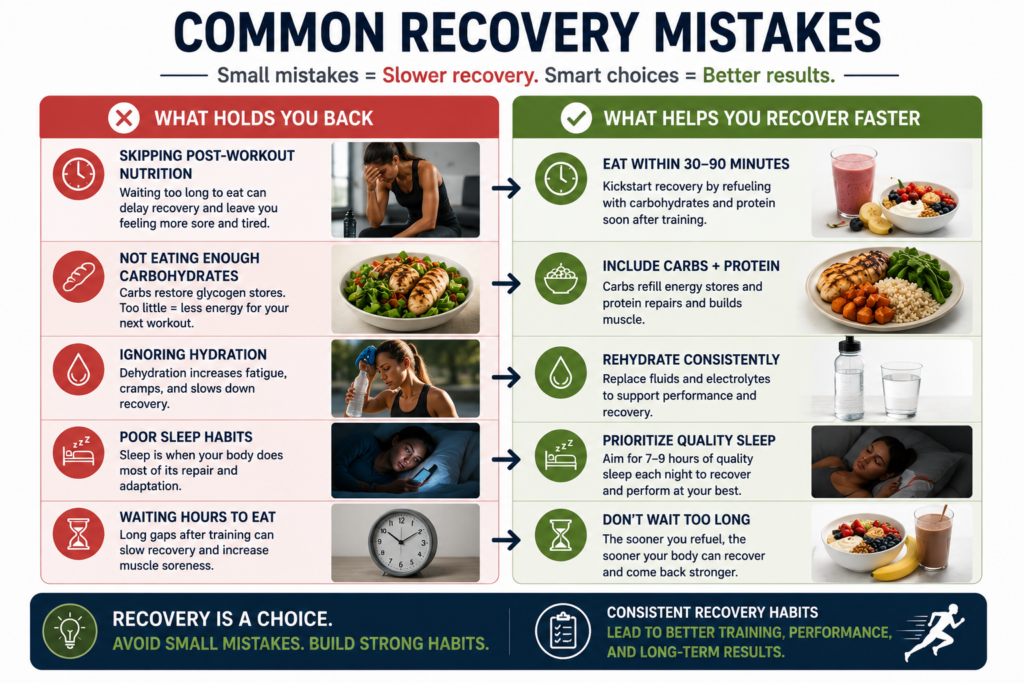
Mistake #1: Skipping Recovery Nutrition
Many athletes finish training and tell themselves they’ll eat later.
Later often becomes several hours later.
Delaying recovery nutrition regularly can make it harder to replenish energy stores and prepare for future sessions.
Mistake #2: Not Eating Enough Carbohydrates
Protein receives a lot of attention in sports nutrition.
Carbohydrates are equally important for recovery.
Without adequate carbohydrates, glycogen restoration may be incomplete and energy levels may suffer.
Mistake #3: Ignoring Hydration
Many athletes focus on food and forget that fluid losses also need to be replaced.
Recovery nutrition includes both food and hydration.
Mistake #4: Treating Recovery as a Single Meal
Recovery does not begin and end with one post-workout snack.
Recovery occurs throughout the day through:
- meals
- snacks
- hydration
- sleep
- overall energy intake
Mistake #5: Neglecting Sleep
Athletes often search for advanced recovery strategies while overlooking one of the most effective tools available.
Poor sleep can undermine recovery even when nutrition is excellent.
Consistent sleep habits remain one of the most powerful performance enhancers available.
Practitioner Insight: What I See in Real Athletes
One of the most common patterns I see among athletes is that they work incredibly hard during training but pay very little attention to what happens afterward.
They finish practice.
They rush to work.
They rush to class.
They sit in traffic.
Before they know it, several hours have passed without eating or rehydrating.
Then they wonder why they feel sore, tired, or sluggish during the next session.
The reality is that recovery is not separate from training.
Recovery is part of training.
Athletes who consistently prioritize carbohydrates, protein, hydration, and sleep often notice meaningful improvements in energy, recovery, and performance without changing their workout program at all.
The goal isn’t perfection.
The goal is building recovery habits that are realistic enough to repeat consistently.
Action Steps
- Eat carbohydrates and protein within 30–90 minutes after training.
- Rehydrate consistently throughout the day.
- Include electrolytes when sweat losses are significant.
- Aim to eat balanced meals every 3–4 hours.
- Prioritize sleep as part of your recovery plan.
- Plan recovery nutrition before training begins.
- Treat recovery as part of training—not something separate from it.
Conclusion
Training provides the stimulus for improvement.
Recovery is what allows that improvement to occur.
Athletes who consistently support recovery through nutrition, hydration, and sleep place themselves in a better position to adapt, perform, and remain healthy throughout the season.
Within the M3 Performance Framework:
- Mind helps athletes prioritize recovery.
- Meals provide the nutrients needed to repair and refuel.
- Motion creates the training stress that recovery is designed to support.
Recovery is not passive.
It is an active process that helps transform hard work into meaningful results.
Take the Next Step
Most athletes spend countless hours focusing on training.
Far fewer spend the same amount of effort focusing on recovery.
Yet recovery is where many of the adaptations from training actually occur.
If you’re constantly feeling sore, struggling with energy levels, recovering slowly between workouts, or wondering whether your nutrition is supporting your performance goals, it may be time to take a closer look at your recovery strategy.
At M3 Total Wellness, I help athletes create personalized nutrition plans that support performance, recovery, and long-term athletic development using the M3 Performance Framework:
Mind • Meals • Motion
Whether you’re preparing for a tournament, training for a new personal best, balancing multiple practices each week, or simply trying to feel better between workouts, a structured recovery plan can help you get more from the training you’re already doing.
If you’re ready to stop guessing and start recovering with purpose, schedule a Performance Nutrition Assessment and receive individualized guidance based on your sport, training schedule, and goals.
Train hard. Recover smarter. Perform consistently.
References
Kerksick, C. M., Arent, S., Schoenfeld, B. J., Stout, J. R., Campbell, B., Wilborn, C. D., Taylor, L., Kalman, D., Smith-Ryan, A. E., Kreider, R. B., Willoughby, D., Arciero, P. J., VanDusseldorp, T. A., Ormsbee, M. J., Wildman, R., Greenwood, M., Ziegenfuss, T. N., Aragon, A. A., & Antonio, J. (2017). International Society of Sports Nutrition position stand: Nutrient timing. Journal of the International Society of Sports Nutrition, 14, 33. https://doi.org/10.1186/s12970-017-0189-4
Jäger, R., Kerksick, C. M., Campbell, B. I., Cribb, P. J., Wells, S. D., Skwiat, T. M., Purpura, M., Ziegenfuss, T. N., Ferrando, A. A., Arent, S. M., Smith-Ryan, A. E., Stout, J. R., Arciero, P. J., Ormsbee, M. J., Taylor, L. W., Wilborn, C. D., Kalman, D. S., Kreider, R. B., Willoughby, D. S., & Antonio, J. (2017). International Society of Sports Nutrition position stand: Protein and exercise. Journal of the International Society of Sports Nutrition, 14, 20. https://doi.org/10.1186/s12970-017-0177-8
Burke, L. M., van Loon, L. J. C., & Hawley, J. A. (2017). Postexercise muscle glycogen resynthesis in humans. Physiological Reviews, 97(4), 2065–2113. https://doi.org/10.1152/physrev.00009.2016
Mountjoy, M., Ackerman, K. E., Bailey, D. M., Burke, L. M., Constantini, N., Lebrun, C., Lundy, B., Melin, A. K., Meyer, N. L., Sherman, R. T., Tenforde, A. S., Budgett, R., & Sundgot-Borgen, J. (2023). International Olympic Committee (IOC) consensus statement on Relative Energy Deficiency in Sport (REDs): 2023 update. British Journal of Sports Medicine, 57(17), 1073–1098. https://doi.org/10.1136/bjsports-2023-106994
Thomas, D. T., Erdman, K. A., & Burke, L. M. (2016). Position of the Academy of Nutrition and Dietetics, Dietitians of Canada, and the American College of Sports Medicine: Nutrition and athletic performance. Journal of the Academy of Nutrition and Dietetics, 116(3), 501–528. https://doi.org/10.1016/j.jand.2015.12.006