
Quick Answer
CrossFit athletes need enough total food to support training, with particular attention to carbohydrate for demanding workouts, protein for recovery and adaptation, dietary fat, fluids, and overall nutrient quality.
But there is no single “CrossFit diet.” A day built around heavy squats and a short metcon is different from a long conditioning session, two-a-day training, or a competition with several events.
The better approach is to match your nutrition to what you are actually asking your body to do.
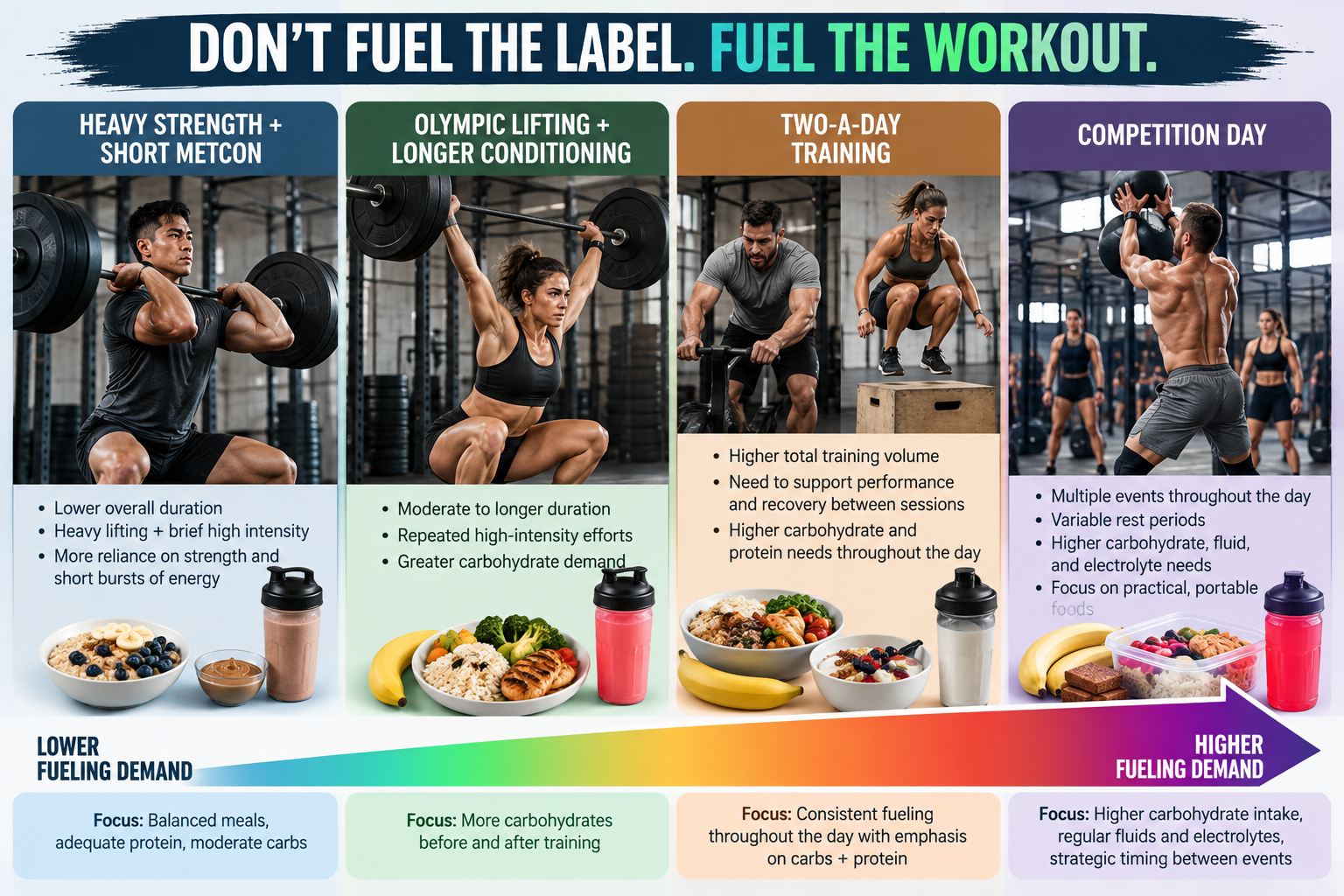
Don’t fuel the label. Fuel the workout.
Key Takeaways
- CrossFit combines strength, power, skill, and conditioning, so fueling needs can change considerably from one workout to another.
- Eating enough overall is the foundation. You can choose nutritious foods and still underfuel.
- Carbohydrate is especially useful for demanding, repeated, and high-intensity exercise.
- Protein supports muscle repair, remodeling, and adaptation to training.
- A normal CrossFit class does not automatically require gels, sports drinks, or food during the workout.
- Long sessions, multiple daily sessions, and competitions can create greater fueling and recovery needs.
- Hydration should be individualized rather than based on one universal ounces-per-hour rule.
- Creatine and caffeine can be useful in the right situation, but supplements do not replace food, sleep, hydration, or recovery.
- Body-composition goals can coexist with performance goals, but aggressive restriction can make those goals compete with each other.
- Repeated underfueling may contribute to low energy availability and, when problematic, can affect health and performance.
Table of Contents
Why CrossFit Nutrition Deserves Its Own Strategy
CrossFit can be difficult to fuel with one simple rule because the training changes so much.
One day might include heavy back squats followed by a six-minute metcon. Another could include Olympic lifting, gymnastics, and 25 minutes of conditioning. A competitive athlete might train for two hours or complete more than one session in a day.
Those days should not automatically be fueled the same way.
That is one of the biggest ideas to keep in mind throughout this article: CrossFit is the training style, but the actual workout determines what needs to be supported.
CrossFit-specific nutrition research is still developing. Reviews of the literature show that carbohydrate intake has often been relatively low in studied CrossFit participants, while protein intake tends to be more adequate. The research also does not support turning one diet or supplement into a universal prescription for every athlete.
So instead of looking for a perfect CrossFit meal plan, start with a better question:
What am I doing today, and does my nutrition support it?
What Are the Demands of CrossFit?
CrossFit can combine:
- Resistance training
- Olympic-style weightlifting
- Gymnastics
- Running
- Rowing
- Cycling
- Jumping
- Loaded carries
- High-intensity intervals
- Longer conditioning efforts
That variety is part of what makes CrossFit challenging. It is also why nutrition needs can be difficult to reduce to a single formula.
Think about these four athletes:
- Athlete 1: Heavy squats + a short 7-minute metcon
- Athlete 2: Olympic lifting + a 25-minute conditioning workout
- Athlete 3: A 90-minute competitive training session with several pieces
- Athlete 4: Four competition events spread across most of the day
All four are doing CrossFit, but their immediate fueling and recovery needs are not identical.
The harder, longer, and more frequent the training becomes, the more important it is to pay attention to total energy intake, carbohydrate availability, hydration, and recovery between sessions.
The M3 CrossFit Fueling Framework
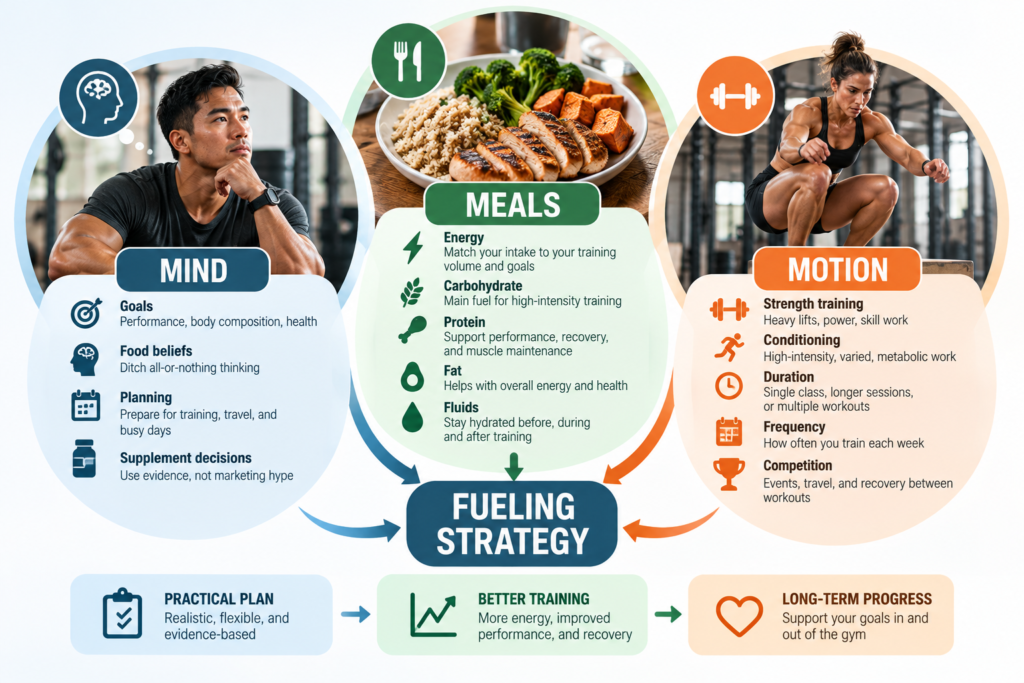
A simple way to organize CrossFit nutrition is through the M3 Performance Framework: Mind • Meals • Motion.
Mind
Nutrition decisions are not made in a vacuum. Ask yourself:
- Am I avoiding carbohydrate because I think it will prevent fat loss?
- Am I trying to train harder while simultaneously eating less?
- Am I following a diet because it supports my goals, or because it is popular in my gym or online?
- Do I avoid eating before training because I am worried about feeling heavy?
- Am I spending more time thinking about supplements than basic meals?
The goal is not to follow a nutrition identity. It is to make decisions that support your training, health, recovery, and goals.
Meals
Look at the actual foundation of your diet. Are you getting enough:
- Total energy
- Carbohydrate
- Protein
- Dietary fat
- Fruits and vegetables
- Vitamins and minerals
- Fluids
- Electrolytes when appropriate
You can eat plenty of “healthy” foods and still fail to eat enough to support training.
Motion
Now look at the workout:
- How long will I train?
- How hard is the conditioning portion?
- Am I lifting too?
- Is this primarily a strength, skill, conditioning, or mixed day?
- Do I have another session later?
- Am I training hard again tomorrow?
- Is this a normal class or a competition?
When Motion changes, Meals may need to change too.
How Much Should CrossFit Athletes Eat?
There is no universal calorie target for CrossFit.
A recreational athlete attending three classes per week does not have the same needs as a competitive athlete training for several hours most days.
Energy needs are influenced by body size, age, sex, training volume, training intensity, daily activity, goals, and competition schedule.
Before worrying about the perfect macro split, ask the most basic question:
Am I eating enough overall?
This gets overlooked surprisingly often. An athlete may focus heavily on protein, creatine, meal timing, or body composition while total energy intake remains too low.
If training volume increases, food intake may need to increase with it.
Carbohydrates for CrossFit Performance
Carbohydrate deserves particular attention because many CrossFit workouts involve repeated moderate- and high-intensity efforts.
Your muscles can store carbohydrate as glycogen, which helps provide fuel for demanding exercise. That does not mean you need to eat the same amount of carbohydrate every day.
Instead, think about matching carbohydrate to the training demand.
You may want more carbohydrate around:
- Longer conditioning workouts
- High-volume training days
- Strength work followed by a demanding metcon
- Two-a-day training
- Competition days
- Several hard training days in a row
On a rest day or light skill day, your needs may be different.
Useful carbohydrate foods include rice, potatoes, pasta, bread, oats, cereal, tortillas, fruit, beans, milk, yogurt, and sports foods when they serve a practical purpose.
The point is not to eat as much carbohydrate as possible. It is to have enough available when the training actually benefits from it.
This also explains why CrossFit research can look confusing at first. Eating adequate carbohydrate across the day is different from asking whether drinking carbohydrate during one short workout will improve performance. Studies using carbohydrate immediately before or during individual CrossFit sessions have not consistently shown an advantage.
So you do not need to turn every class into an intra-workout fueling event.
Protein for Strength, Recovery, and Adaptation
Protein gets plenty of attention in CrossFit, and for good reason. Resistance training and high-intensity exercise create a need for muscle repair and remodeling.
For many exercising adults, roughly 1.4–2.0 grams of protein per kilogram of body weight per day is a useful evidence-based range, although individual needs can vary.
You do not need to eat all of it at dinner.
Spread protein across several eating opportunities using foods such as:
- Eggs
- Greek yogurt
- Milk
- Cottage cheese
- Chicken
- Turkey
- Fish
- Lean beef
- Tofu or tempeh
- Beans and lentils
- Soy foods
- Protein powder when convenient
A protein shake can be useful when you finish training late, have little appetite, or need something portable.
But a shake is not more “athletic” than a regular meal. Food still works.
Dietary Fat Still Matters
Carbohydrate and protein tend to dominate the conversation, but dietary fat still contributes energy, essential fatty acids, cell structure, and absorption of fat-soluble vitamins.
Useful sources include nuts, seeds, nut butters, avocado, olive oil, fatty fish, eggs, and dairy foods.
Very large or high-fat meals immediately before a hard metcon may feel uncomfortable for some people. That is a timing issue, not a reason to remove dietary fat from the diet.
What Should CrossFit Athletes Eat Before Training?
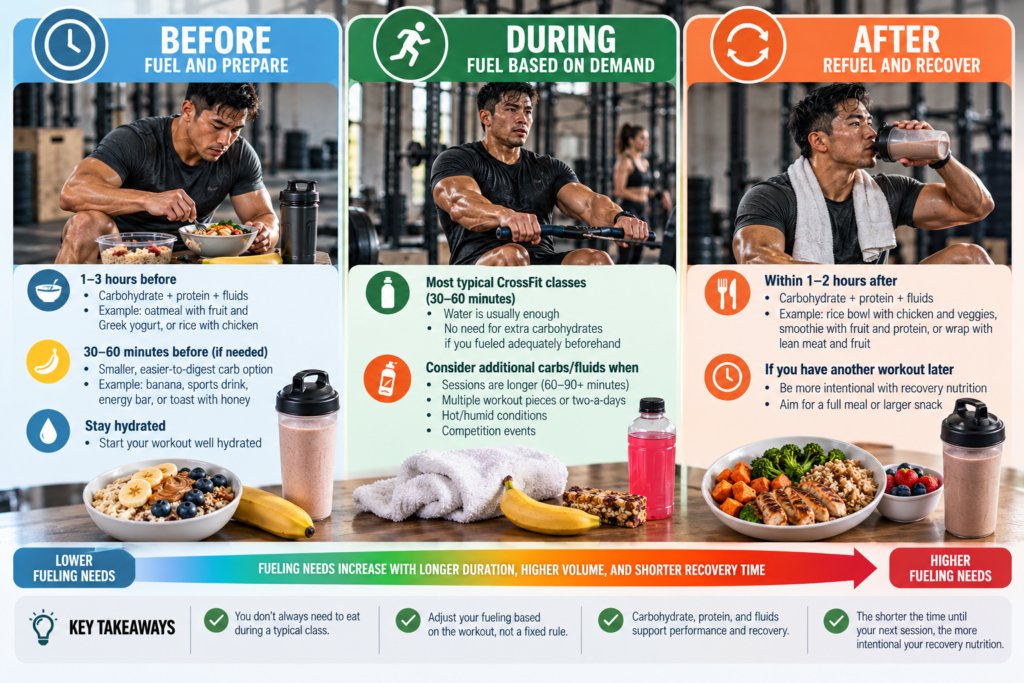
The goal before training is simple: arrive fueled, hydrated, and comfortable enough to perform.
About 2–4 Hours Before
A larger meal can include carbohydrate, protein, fluids, and amounts of fat and fiber you know you tolerate.
Examples:
- Rice + chicken or tofu + vegetables
- Pasta + lean protein
- Turkey sandwich + fruit + yogurt
- Oatmeal + fruit + Greek yogurt
- Bagel + eggs + fruit
- Burrito bowl with rice and protein
About 30–60 Minutes Before
If you need something closer to training, smaller and easier-to-digest carbohydrate foods may work better.
- Banana
- Applesauce
- Pretzels
- Toast with honey or jam
- Granola bar
- Crackers
- Dried fruit
- Sports drink when useful
Not everyone needs a snack right before class.
If you ate a substantial meal two hours earlier, you may be fine. If lunch was at noon and class starts at 6:00 PM, that is a very different situation.
What About Early-Morning CrossFit?
You do not have to force down a large breakfast at 5:30 AM.
If a full meal feels uncomfortable, experiment with something smaller such as a banana, toast, applesauce, cereal, yogurt, or a sports drink, then eat a more substantial breakfast afterward.
The right strategy is the one you can tolerate and consistently use.
Do CrossFit Athletes Need to Eat During a Workout?
For most typical CrossFit classes, probably not.
If you ate adequately beforehand and you are completing one normal session, you generally do not need to sip carbohydrate or eat a gel simply because the workout feels hard.
The situation changes when training gets longer.
Fuel during or between training pieces becomes more worth considering when you are doing:
- A long training session
- Several workout pieces
- Two sessions in one day
- A competition
- Prolonged conditioning
- Training after an inadequate pre-workout meal
The takeaway is straightforward:
Do not add intra-workout fuel simply because the workout is intense. Use it when the length and structure of training actually justify it.
What Should CrossFit Athletes Eat After Training?
After training, think about what you need to replace and what you need to prepare for next.
A useful starting point is:
Carbohydrate + Protein + Fluids
Examples:
- Rice bowl + chicken or tofu
- Greek yogurt + granola + fruit
- Chocolate milk + banana
- Smoothie with fruit and protein
- Turkey sandwich + fruit
- Cereal + milk + fruit
- Pasta + lean protein
- Burrito bowl
How quickly you need to recover depends on what happens next.
If you are done for the day, your normal meal pattern may be enough. If you have another session in a few hours, the recovery window becomes much more important.
Hydration for CrossFit Athletes
There is no single fluid target that works for every CrossFit athlete.
Sweat rate can change with body size, genetics, workout intensity, duration, temperature, humidity, clothing, acclimatization, and the individual.
Start training reasonably well hydrated. Keep fluids accessible. Continue replacing losses afterward, particularly when another session is coming soon.
If you finish every hot workout drenched in sweat, your strategy probably deserves more attention than someone completing a short class in a cool gym.
Do CrossFit Athletes Need Electrolytes?
Sometimes.
Electrolyte-containing drinks can be useful when you are sweating heavily, training for a long time, exercising in hot conditions, competing, or replacing substantial fluid losses.
For a normal one-hour class in a comfortable environment, you may not need a special electrolyte product.
More is not automatically better. Match the product to the situation.
Do CrossFit Athletes Need Sports Drinks?
Sports drinks are tools, not requirements.
They provide carbohydrate, fluid, and sodium together. That combination can be useful during long sessions, competitions, hot conditions, or when solid food is difficult to tolerate.
For a shorter class after adequate meals, water may be perfectly appropriate.
Instead of asking whether sports drinks are healthy or unhealthy, ask:
Would this actually help me in this situation?
How Should You Fuel Different CrossFit Training Days?
This is where the idea of fueling the workout becomes practical.
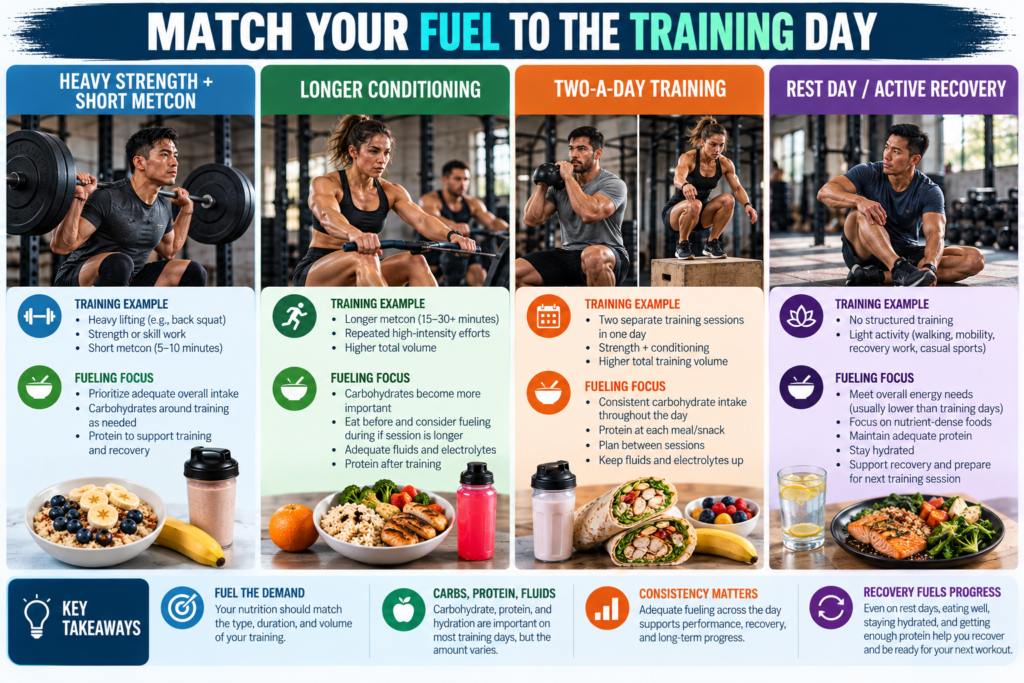
Heavy Strength Day + Short Metcon
You still need enough total energy and protein, but you probably do not need an elaborate intra-workout fueling plan. Eat adequately before training, include carbohydrate as part of the day, and have a normal recovery meal afterward.
Olympic Lifting + Longer Conditioning
Now carbohydrate before training becomes more important because total work is increasing. If the session is long, think ahead instead of waiting until you feel depleted halfway through.
Long Conditioning Day
Longer workouts increase the importance of carbohydrate availability and hydration. Depending on duration, intra-workout carbohydrate may become useful.
Two-a-Day Training
This is where recovery nutrition matters much more.
If you train in the morning and again later, the food you eat between sessions is part of the second workout’s preparation. Include carbohydrate, protein, fluids, and enough total food rather than treating the first session as the end of the nutrition plan.
Rest Day
A rest day is not a fasting day.
Your energy and carbohydrate needs may be lower than on a demanding training day, but recovery is still occurring. Protein, dietary fat, micronutrients, hydration, and enough overall food remain important.
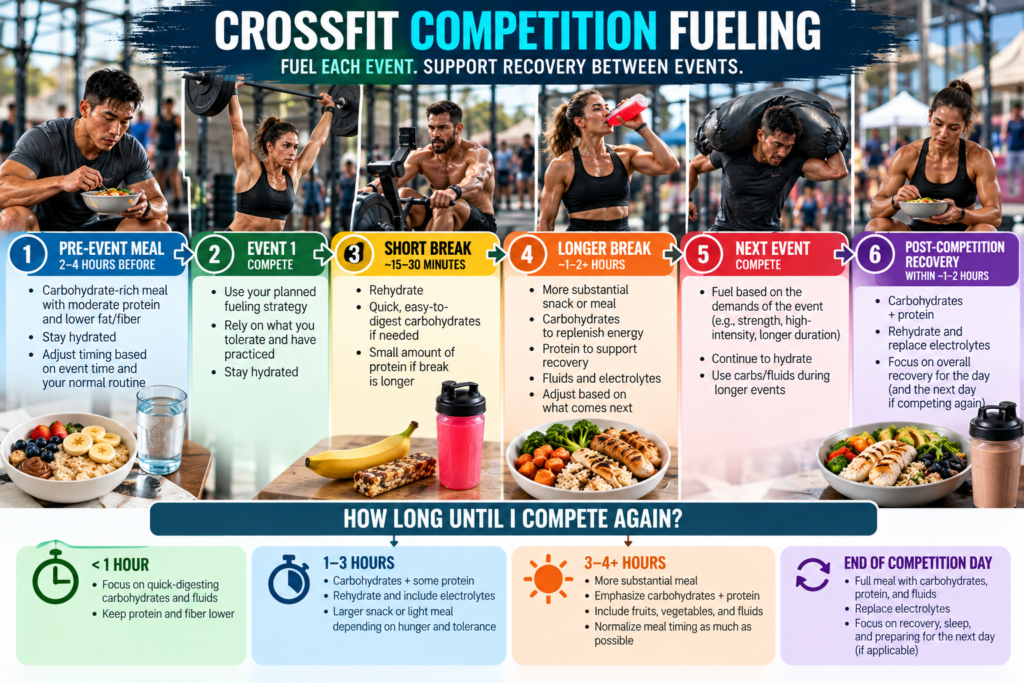
How to Fuel a CrossFit Competition
Competition changes the problem.
Instead of one workout, you may have several events with unpredictable start times, warm-ups, long waits, and limited opportunities to eat.
The biggest mistake is preparing for Event 1 and forgetting about Events 2, 3, and 4.
Before the First Event
Eat a familiar meal with carbohydrate, protein, and fluids with enough time to digest.
Examples could include oatmeal with fruit and Greek yogurt, a bagel with eggs and fruit, or rice with eggs or lean protein.
Between Events
Ask:
How long until I have to perform again?
If the turnaround is short, use familiar foods that are easy to digest: banana, applesauce, pretzels, crackers, dried fruit, or a sports drink.
If you have more time, eat something more substantial: a sandwich, wrap, rice bowl, yogurt with granola and fruit, or another familiar meal.
The goal is not to spend the entire day grazing on a few bites of food if your energy needs are substantial.
After the Final Event
Have a complete meal, include carbohydrate and protein, and continue rehydrating.
Most importantly, practice the plan before competition day. The middle of an event is not the ideal time to test a new pre-workout, gel, supplement, or meal.
What If You Want to Build Muscle?
Muscle gain requires more than increasing protein.
You also need enough total energy to support training and growth.
A useful plan considers:
- Adequate total energy
- Protein
- Carbohydrate to support training
- Progressive resistance training
- Sleep and recovery
- Consistency over time
If you are chronically under-eating, simply adding another protein shake may not solve the problem.
What If You Want to Lose Body Fat?
CrossFit athletes can pursue body-composition goals, but the plan should not make it increasingly difficult to train.
A large calorie deficit combined with high-volume training can create a conflict between fat loss and performance.
Fat loss does not require eliminating carbohydrate or intentionally training hungry.
A better strategy considers the size of the energy deficit, protein intake, carbohydrate around important sessions, resistance training, recovery, competition schedule, and current health.
Ask:
Can I move toward this body-composition goal while still supporting the athlete I am trying to become?
For a deeper discussion, see Balancing Performance and Body Composition: How Athletes Can Fuel for Both.
Underfueling in CrossFit Athletes
Underfueling is not always intentional.
It can happen when you:
- Skip meals
- Train early and never make up the missed intake
- Avoid carbohydrate
- Restrict food to change body composition
- Increase training without increasing food
- Complete multiple sessions without adequate recovery nutrition
- Rely on small snacks or supplements instead of enough food
One hard workout leaving you tired does not mean you have low energy availability or RED-S.
But repeated underfueling can contribute to low energy availability (LEA). Exposure to problematic LEA—which can involve prolonged and/or severe LEA—may contribute to Relative Energy Deficiency in Sport (RED-S).
Patterns that deserve attention can include persistent fatigue, declining training quality, poor recovery, recurrent injuries, frequent illness, significant food restriction, increasing anxiety around food, menstrual or reproductive changes, or unexplained changes in health or performance.
One symptom does not diagnose LEA or RED-S. Persistent or concerning symptoms should be evaluated appropriately.
For more information, see Signs of Underfueling in Athletes, Low Energy Availability in Athletes, and Relative Energy Deficiency in Sport (RED-S): What Athletes Need to Know.
What About Low-Carb or Keto Diets for CrossFit?
This is an area where simple answers are tempting.
Can someone do CrossFit while eating a low-carbohydrate or ketogenic diet? Yes.
Does that mean low-carbohydrate eating is the best way to maximize CrossFit performance? The current evidence does not establish that.
Small CrossFit studies suggest that some performance measures can be maintained during short ketogenic interventions, but the research is limited. At the same time, CrossFit often includes repeated high-intensity efforts for which carbohydrate is an important fuel.
So instead of arguing about whether low-carb is “good” or “bad,” ask:
Does this way of eating support my training volume, performance, recovery, health, goals, and food preferences?
For someone doing a few recreational classes each week, the answer may look different than it does for a competitive athlete completing high-volume training.
Supplements for CrossFit Athletes
CrossFit has no shortage of supplements. Most athletes will get more from fixing the foundation before building a complicated supplement stack.
Creatine
Creatine monohydrate is one of the better-supported sports supplements, particularly for resistance training and repeated high-intensity exercise.
A common maintenance approach is about 3–5 grams per day. A loading phase can saturate muscle creatine faster, but it is not required.
Creatine is not mandatory, but it can be a useful option for many healthy adult athletes.
Caffeine
Caffeine may help some CrossFit athletes, but the effect is not guaranteed.
A recent CrossFit-specific meta-analysis found a small overall performance benefit, while individual CrossFit trials have produced mixed results. That is a good reminder that a supplement can have evidence behind it without working dramatically in every workout or every athlete.
Also consider the tradeoff. If caffeine before a 6:00 PM class keeps you awake at midnight, the small potential performance benefit may not be worth the hit to sleep and recovery.
Protein Powder
Useful? Sometimes. Required? No.
Protein powder is convenient when it helps you meet your needs. It is not superior to a balanced meal simply because it comes in a shaker bottle.
Sports Drinks, Gels, and Carbohydrate Powders
These can be useful for long sessions, competitions, two-a-days, or situations where portable carbohydrate is valuable.
They are usually unnecessary for someone who ate adequately and is completing one typical class.
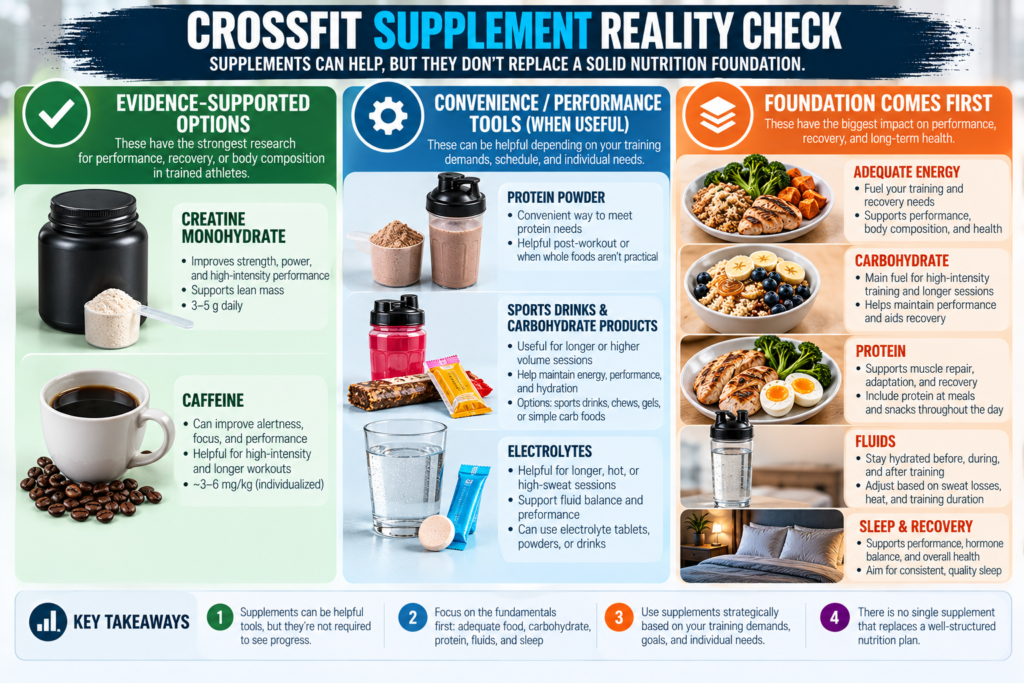
Electrolytes
Electrolytes can be helpful for heavy sweaters, hot environments, long sessions, and substantial fluid replacement. Use them because they solve a problem—not because every workout needs a packet.
Common CrossFit Nutrition Mistakes
Mistake 1: Avoiding Carbohydrate Because You Want to Get Leaner
Body-composition goals do not erase the need to fuel training. You can adjust total intake while still placing carbohydrate around the sessions where it is most useful.
Mistake 2: Eating Plenty of Protein but Not Enough Food
A high protein intake does not automatically mean you are well fueled. Total energy, carbohydrate, dietary fat, micronutrients, and fluids still matter.
Mistake 3: Training More While Eating Less
This can look productive on paper but become difficult to sustain. If training quality, recovery, mood, health, or performance starts deteriorating, the plan deserves another look.
Mistake 4: Treating Every Training Day the Same
Your long conditioning day and recovery day do not create identical demands. Your nutrition does not need to pretend they do.
Mistake 5: Building a Supplement Stack Before Building a Meal Pattern
Creatine, caffeine, protein powder, electrolytes, and sports foods can all have appropriate uses. None of them replaces adequate meals.
Mistake 6: Copying the Fittest Person in the Gym
That athlete may have a different body size, training volume, schedule, goals, preferences, and nutrition needs.
Their diet is not automatically your prescription.
Sports Dietitian Insight: Don’t Fuel Every Workout the Same
One of the easiest ways to make CrossFit nutrition more practical is to stop treating every day as though it creates the same demand.
Imagine this week:
- Monday: Heavy squats + short metcon
- Tuesday: Olympic lifting + 25 minutes of conditioning
- Wednesday: Recovery
- Thursday: Strength + longer mixed workout
- Saturday: Several competition events
You do not need five completely different diets.
But you should recognize that Tuesday, Thursday, and Saturday may require more attention to carbohydrate, hydration, and recovery than Wednesday.
That is what matching nutrition to training actually looks like.
You do not need perfect macros every day. You need a fueling pattern flexible enough to support the work you are doing.
The M3 CrossFit Fueling Check-In
Before your next workout, run through Mind • Meals • Motion.
Mind
- Am I making food decisions based on performance needs or diet rules?
- Am I afraid of carbohydrate?
- Am I restricting because I want to get leaner?
- Do I know what foods work well before training?
- Am I relying too heavily on supplements?
Meals
- Did I eat enough today?
- Have I included carbohydrate?
- Am I getting protein across the day?
- Have I included dietary fat and nutrient-dense foods?
- Am I hydrated?
- Do I have a recovery option afterward?
- If I train again later, do I have enough food between sessions?
Motion
- What is today’s workout?
- How long will I train?
- How demanding is the conditioning?
- Am I lifting too?
- Is this one session or several?
- Is it hot or humid?
- What training do I have tomorrow?
Then ask:
Does my fueling plan actually match the training I am about to do?
Frequently Asked Questions
What Should CrossFit Athletes Eat Before a Workout?
A useful pre-workout meal generally includes carbohydrate, protein, fluids, and foods you tolerate well. Examples include rice with chicken, oatmeal with fruit and Greek yogurt, a sandwich with fruit, or a bagel with eggs. Closer to training, smaller carbohydrate-rich foods may be easier to tolerate if you need additional fuel.
Do CrossFit Athletes Need Carbohydrates?
Carbohydrate is an important fuel for many of the moderate- and high-intensity efforts used in CrossFit. How much you need depends on your training volume, goals, body size, and the rest of your diet. You do not necessarily need the same amount every day.
Should CrossFit Athletes Eat During a Workout?
Not always. Most typical classes do not automatically require food during training if you arrived adequately fueled. Carbohydrate during exercise becomes more relevant as training gets longer, when you complete multiple sessions, or during competition.
What Should CrossFit Athletes Eat After Training?
Start with carbohydrate, protein, and fluids. A regular meal works well: rice with chicken or tofu, yogurt with granola and fruit, a sandwich with fruit, cereal with milk, pasta with lean protein, or a smoothie paired with additional carbohydrate.
How Much Protein Do CrossFit Athletes Need?
For many exercising adults, approximately 1.4–2.0 g/kg/day is a useful evidence-based range, although needs vary. Total daily intake matters, and spreading protein across several meals and snacks can make it easier to meet that target.
Do CrossFit Athletes Need Creatine?
No supplement is required to do CrossFit, but creatine monohydrate has strong evidence for supporting repeated high-intensity exercise and resistance-training adaptations. It can be appropriate for many healthy adult athletes.
Is Caffeine Good for CrossFit?
It can be useful for some athletes. Recent CrossFit-specific evidence suggests a small overall performance benefit, but individual studies have been mixed. Dose, tolerance, timing, sleep, anxiety, and gastrointestinal response all matter.
Can You Do CrossFit on a Low-Carb Diet?
Yes. The more useful question is whether that carbohydrate intake supports your particular training volume, high-intensity performance, recovery, health, and goals. Current CrossFit-specific evidence does not establish ketogenic diets as superior for performance.
Can CrossFit Athletes Lose Fat Without Hurting Performance?
Sometimes. Whether it is appropriate depends on your starting point, health, training volume, competition schedule, current fueling status, and the size of the desired change. Aggressive restriction creates a greater risk that the body-composition plan begins interfering with training.
What Should CrossFit Athletes Eat on Rest Days?
Rest days still support recovery and adaptation. Energy and carbohydrate needs may differ from a demanding training day, but protein, dietary fat, micronutrients, hydration, and overall nutrition remain important.
Conclusion
CrossFit nutrition does not need to be complicated, but it does need to be flexible.
A heavy strength day, short metcon, long conditioning session, two-a-day, and competition do not create identical demands.
The foundation remains the same:
- Enough total energy
- Carbohydrate matched to training demand
- Adequate protein
- Dietary fat
- Micronutrients
- Hydration
- Recovery nutrition
Within the M3 Performance Framework — Mind • Meals • Motion:
Mind prepares the strategy.
Meals provide the fuel.
Motion determines what needs to be supported.
Before your next workout, do not just ask:
“What should a CrossFit athlete eat?”
Ask:
“What does my body need to support the training I am actually doing today?”
That is where individualized sports nutrition begins.
Need Help Building Your CrossFit Nutrition Strategy?
If you are training hard but struggling with energy, recovery, body-composition goals, hydration, competition fueling, or figuring out how much you should actually eat, an individualized sports nutrition plan can help connect your nutrition to your training.
Learn more about M3 Performance Nutrition Coaching.
You can also start with the M3 Performance Assessment to evaluate how your current nutrition, training, recovery, and lifestyle habits are supporting your performance.
Disclaimer
This article is for educational purposes and is not intended to diagnose or treat a medical condition. Athletes experiencing persistent fatigue, recurrent injuries, menstrual or reproductive changes, significant food restriction, disordered eating behaviors, unexplained performance decline, or other concerning health changes should seek evaluation from an appropriately qualified healthcare professional. Supplement use should be individualized, and athletes subject to anti-doping rules should consider third-party tested products and applicable sport regulations.
References
1. de Souza, R. A. S., da Silva, A. G., de Souza, M. F., et al. (2021). A systematic review of CrossFit® workouts and dietary and supplementation interventions to guide nutritional strategies and future research in CrossFit®. International Journal of Sport Nutrition and Exercise Metabolism, 31(2), 187–205. DOI: 10.1123/ijsnem.2020-0223.
2. Nutrition in CrossFit® – scientific evidence and practical perspectives: a systematic scoping review. (2025). Journal of the International Society of Sports Nutrition. PMID: 40471841.
3. Thomas, D. T., Erdman, K. A., & Burke, L. M. (2016). Position of the Academy of Nutrition and Dietetics, Dietitians of Canada, and the American College of Sports Medicine: Nutrition and athletic performance. Journal of the Academy of Nutrition and Dietetics, 116(3), 501–528. DOI: 10.1016/j.jand.2015.12.006.
4. Jäger, R., Kerksick, C. M., Campbell, B. I., et al. (2017). International Society of Sports Nutrition position stand: Protein and exercise. Journal of the International Society of Sports Nutrition, 14, 20. DOI: 10.1186/s12970-017-0177-8.
5. Kreider, R. B., Kalman, D. S., Antonio, J., et al. (2017). International Society of Sports Nutrition position stand: Safety and efficacy of creatine supplementation in exercise, sport, and medicine. Journal of the International Society of Sports Nutrition, 14, 18. DOI: 10.1186/s12970-017-0173-z.
6. Xiao, J., Zheng, J., Lin, Q., et al. (2026). Effects of acute caffeine supplementation on performance and physiological responses in CrossFit: A systematic review and three-level meta-analysis. Nutrients, 18(18), 2969. DOI: 10.3390/nu18182969.
7. Acute effects of intra-training carbohydrate ingestion in CrossFit® trained adults: a randomized, triple-blind, placebo-controlled crossover trial. PMID: 39671024.
8. Kephart, W. C., Pledge, C. D., Roberson, P. A., et al. (2018). The three-month effects of a ketogenic diet on body composition, blood parameters, and performance metrics in CrossFit trainees: A pilot study. Sports, 6(1), 1. DOI: 10.3390/sports6010001.
9. Mountjoy, M., Ackerman, K. E., Bailey, D. M., et al. (2023). 2023 International Olympic Committee’s (IOC) consensus statement on Relative Energy Deficiency in Sport (REDs). British Journal of Sports Medicine, 57(17), 1073–1097. DOI: 10.1136/bjsports-2023-106994.