
Quick Answer
Signs of underfueling in athletes can show up in energy, recovery, performance, health, and eating behaviors. Underfueling happens when an athlete doesn’t consume enough energy or nutrients to adequately support training, recovery, and everyday needs.
And it isn’t always obvious.
You may be eating nutritious foods, maintaining your body weight, and even performing reasonably well while still falling short of what your training demands.
Possible signs of underfueling include:
- Persistent fatigue or low energy
- Workouts feeling harder than they normally should
- Poor recovery between training sessions
- Declining or inconsistent performance
- Persistent soreness
- Frequent illness or injuries
- Intense hunger or cravings later in the day
- Difficulty concentrating
- Menstrual changes or reduced libido
- Routinely skipping meals or going long periods without eating
No single symptom proves that an athlete is underfueling. Fatigue, poor performance, injuries, and hormonal changes can have many causes.
What matters is the pattern.
If several of these signs are showing up alongside a demanding training schedule or inconsistent food intake, your fueling deserves a closer look.
Key Takeaways
- Underfueling can happen intentionally or unintentionally.
- Eating nutritious foods doesn’t necessarily mean you’re eating enough.
- Signs can show up in energy, recovery, performance, health, and eating behaviors.
- You don’t have to be losing weight to be underfueled.
- Athletes may continue performing well for some time despite inadequate fueling.
- Increasing training without increasing food intake is a common way athletes unintentionally fall behind.
- Persistent underfueling may contribute to problematic low energy availability and increase concern for Relative Energy Deficiency in Sport (RED-S).
- Hunger alone isn’t a perfect measure of whether an athlete is eating enough.
- Fatigue isn’t automatically a sign that you need to train harder.
- Persistent symptoms, recurrent injuries, reproductive or hormonal changes, or restrictive eating behaviors deserve professional evaluation.
Introduction: You May Be Underfueling Without Realizing It
You’re training consistently.
You’re choosing nutritious foods.
Maybe you’re even paying attention to protein, hydration, and recovery.
But lately, something doesn’t feel right.
Your workouts seem harder.
Your legs feel heavy earlier than usual.
You’re sore for longer.
Your energy crashes in the afternoon.
Maybe you’re extremely hungry by the time dinner comes around—or constantly looking for something to eat at night.
You might assume:
I need better conditioning.
I need to sleep more.
Maybe I’m just training hard.
I should probably push through it.
Sometimes one of those explanations is correct.
But there’s another possibility athletes often overlook:
You may not be eating enough to support what you’re asking your body to do.
Underfueling doesn’t always look like extreme dieting.
Sometimes it looks like skipping breakfast because you’re rushing to work.
Sometimes it’s eating a small lunch before a two-hour practice.
Sometimes it’s increasing from three workouts per week to six while continuing to eat exactly the same way.
And sometimes it’s an athlete trying so hard to “eat healthy” that their diet simply doesn’t provide enough total energy.
That’s why recognizing the signs matters.
Within the M3 Performance Framework—Mind, Meals, and Motion, underfueling can develop when these areas stop working together:
Mind influences your beliefs, habits, planning, and decisions around food.
Meals provide the energy and nutrients needed to train and recover.
Motion creates the demand that your nutrition has to support.
When Motion increases but Meals don’t keep up—or Mind creates barriers to eating enough—the athlete can gradually fall behind without realizing it.
Table of Contents
What Does Underfueling Mean?
Underfueling is a practical way of describing a situation in which an athlete’s food intake isn’t adequately supporting their training and recovery demands.
Sometimes the mismatch is obvious.
An athlete may intentionally reduce food intake while continuing to train heavily because they’re trying to lose weight or change their body composition.
But often it’s much less deliberate.
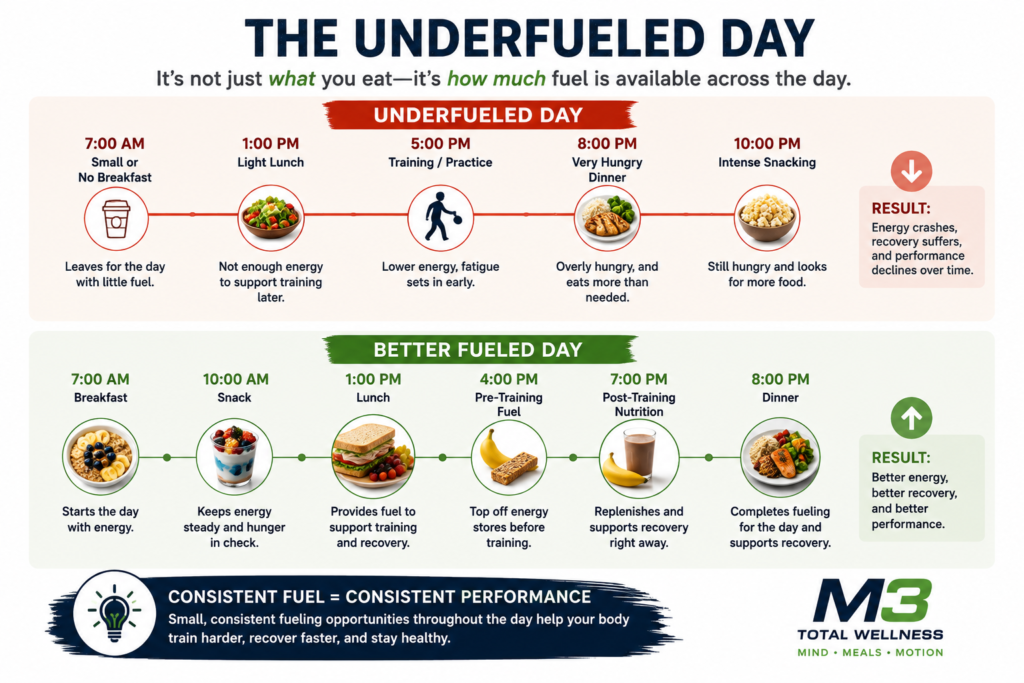
Consider an athlete who:
- Skips breakfast
- Eats a small lunch
- Goes several hours without a snack
- Trains for two hours after work
- Finally eats a substantial dinner
They may feel like they ate normally.
But once you compare their food intake with everything their body had to support that day, a different picture may emerge.
The same thing can happen when training changes.
Suppose you’re accustomed to three workouts per week and suddenly begin five practices, two strength sessions, and weekend competition.
If your eating habits stay exactly the same, the nutrition plan that previously worked may no longer be enough.
That’s an important principle:
As training demands change, fueling needs may change too.
Your energy needs as an athlete aren’t necessarily the same every day or throughout every phase of your season.
Underfueling therefore isn’t always about eating an obviously tiny amount of food.
It’s about whether your intake adequately supports your current demands.
Underfueling vs. Low Energy Availability: What’s the Difference?
Underfueling and low energy availability are related, but they aren’t exactly interchangeable.
Underfueling is a practical term describing inadequate food or nutrient intake relative to an athlete’s needs.
Low energy availability (LEA) is a more specific sports-science concept.
Energy availability describes the dietary energy remaining for the body’s physiological functions after accounting for the energy used during exercise.
When insufficient energy remains to adequately support those functions, energy availability can become low.
This distinction matters because you shouldn’t diagnose yourself with LEA simply because you skipped lunch or had one poorly fueled workout.
Likewise, not every athlete who underfuels occasionally has Relative Energy Deficiency in Sport (RED-S).
The concern becomes greater when inadequate fueling is persistent, substantial, or occurring alongside signs that health, recovery, or performance may be affected.
Problematic low energy availability is the underlying exposure associated with RED-S, a syndrome that can affect multiple aspects of health and athletic performance.
For a deeper explanation of the physiology, health consequences, and relationship between LEA and RED-S, read Low Energy Availability in Athletes: Signs, Risks, and Why It Matters.
For now, we’re going to focus on a more practical question:
What might underfueling actually look and feel like in an athlete’s everyday life?
Why Athletes Underfuel Without Realizing It
One of the biggest misconceptions about underfueling is that it only happens when someone intentionally restricts food.
It doesn’t.
Some athletes deliberately eat less because they’re pursuing weight loss or body-composition changes.
Others simply don’t realize how much food their training requires.
1. Training Increased but Food Intake Didn’t
This is one of the first things I’d look at.
Maybe you recently:
- Added another practice
- Started strength training
- Increased running mileage
- Began preseason
- Added conditioning
- Started two-a-day sessions
- Entered a period with more competitions
When your workload increases substantially, continuing to eat exactly as you did during a lower-volume training period may leave you underfueled.
If you’re training multiple times per day, see Fueling for Two-a-Day Training Sessions for more specific strategies.
2. You’re Too Busy to Eat Consistently
Athletes still have lives outside of sport.
School.
Work.
Commuting.
Meetings.
Family responsibilities.
Travel.
You might finish breakfast at 7:00 AM and suddenly realize it’s 2:00 PM and you haven’t eaten again.
Then practice starts at 5:00.
You weren’t intentionally restricting food.
There simply wasn’t a plan.
Repeated often enough, those gaps can make meeting your needs difficult.
This is where nutrient timing can be useful—not because athletes need to eat according to a stopwatch, but because strategically planning meals and snacks can reduce long stretches without fuel.
3. You’re Trying to Eat “Healthy”
Food quality matters.
But there’s a problem when the pursuit of healthy eating becomes so restrictive that an athlete struggles to consume enough total energy.
An athlete might build most meals around:
- Lean protein
- Vegetables
- Low-fat foods
- Low-calorie products
Those foods can absolutely be part of a nutritious diet.
But if portions are consistently small and energy-dense foods or carbohydrates are heavily restricted, the athlete may struggle to meet high training demands.
Eating healthy and eating enough aren’t always the same thing.
4. You’re Trying to Change Your Body Composition
Some athletes intentionally reduce food intake because they believe becoming lighter or leaner will improve performance.
Body composition can matter in certain sports and circumstances.
But aggressive restriction during demanding training can work against the performance you’re trying to improve.
If the energy deficit becomes too large, training quality, recovery, health, and eventually performance may suffer.
5. You Don’t Feel Hungry
Athletes sometimes use hunger as their only guide:
I’m not hungry, so I must not need to eat.
Hunger can provide useful information, but it isn’t a perfect measurement of an athlete’s energy needs.
Training, heat, stress, caffeine, travel, schedules, and eating patterns can all influence appetite.
A lack of strong hunger doesn’t automatically mean your fueling is adequate.
6. You’re Saving Most of Your Food for Later
Another common pattern looks like:
Small breakfast → light lunch → workout → enormous dinner → evening snacking
The athlete may ultimately consume a substantial amount of food.
But much of it arrives after the period when they were trying to work, concentrate, train, and begin recovering.
Total intake matters, but how nutrition is distributed throughout the day can matter too—especially for athletes training frequently.
The M3 Underfueling Framework
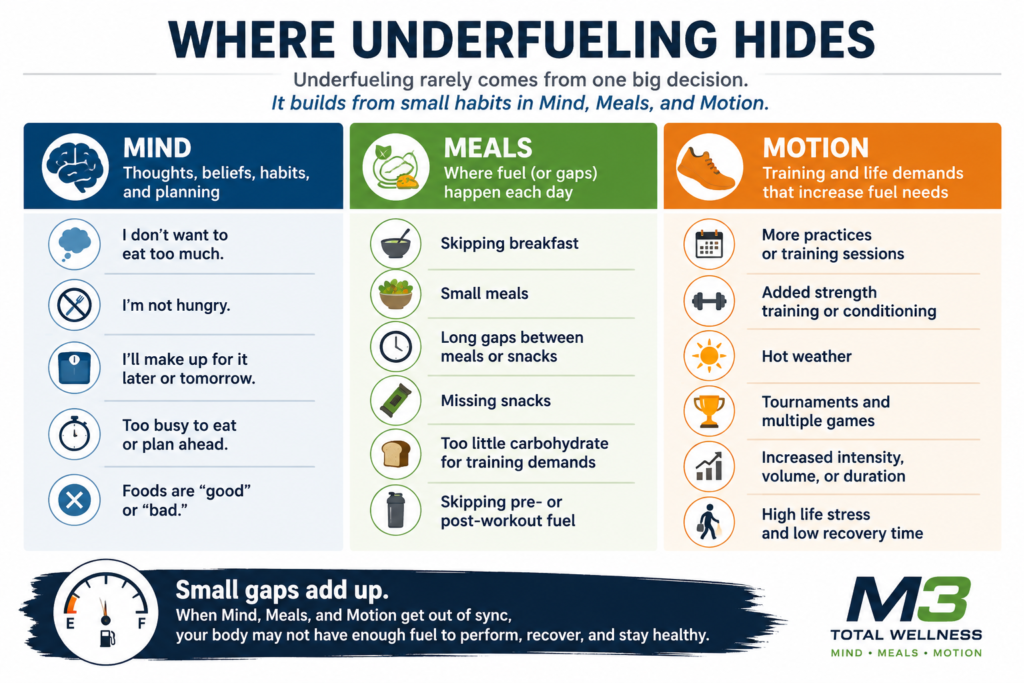
Underfueling rarely comes down to one food or one meal.
Looking at Mind, Meals, and Motion can help identify where the mismatch is developing.
Mind
Mind includes the thoughts, beliefs, habits, and planning that influence how you fuel.
Potential barriers include:
- Fear of eating too much
- Fear of gaining weight
- Believing lighter always means better
- Labeling foods as “good” or “bad”
- Feeling guilty about eating on rest days
- Poor planning
- Not recognizing how much fuel training requires
Sometimes the problem is restriction.
Other times it’s simply a lack of awareness.
Meals
Meals are where the athlete actually receives the energy and nutrients needed to support training.
Potential gaps include:
- Skipping breakfast
- Small meals
- Long periods without eating
- Missing snacks
- Inadequate carbohydrate intake
- Skipping pre-workout fuel
- Delaying recovery nutrition
- Eating the same amount regardless of training demand
You don’t need to eat perfectly.
You need an eating pattern that provides enough fuel consistently.
Motion
Motion determines much of the demand.
Consider:
- Training frequency
- Training duration
- Intensity
- Strength and conditioning
- Practices
- Games and matches
- Tournaments
- Multiple sessions in one day
- Physical activity outside formal exercise
The more you’re asking your body to do, the more important it becomes to make sure your nutrition is keeping up.
Mind shapes the behavior. Meals provide the fuel. Motion creates the demand.
When those three become misaligned, signs of underfueling may begin to appear.
Physical and Recovery Signs of Underfueling
The body doesn’t have a dashboard light that turns on and says:
LOW FUEL. EAT MORE.
Instead, underfueling may show up through a collection of less-specific symptoms.
None of the following proves that inadequate nutrition is the cause.
But if several are occurring repeatedly—particularly alongside high training demands or inconsistent eating—they deserve attention.
1. You’re Tired All the Time
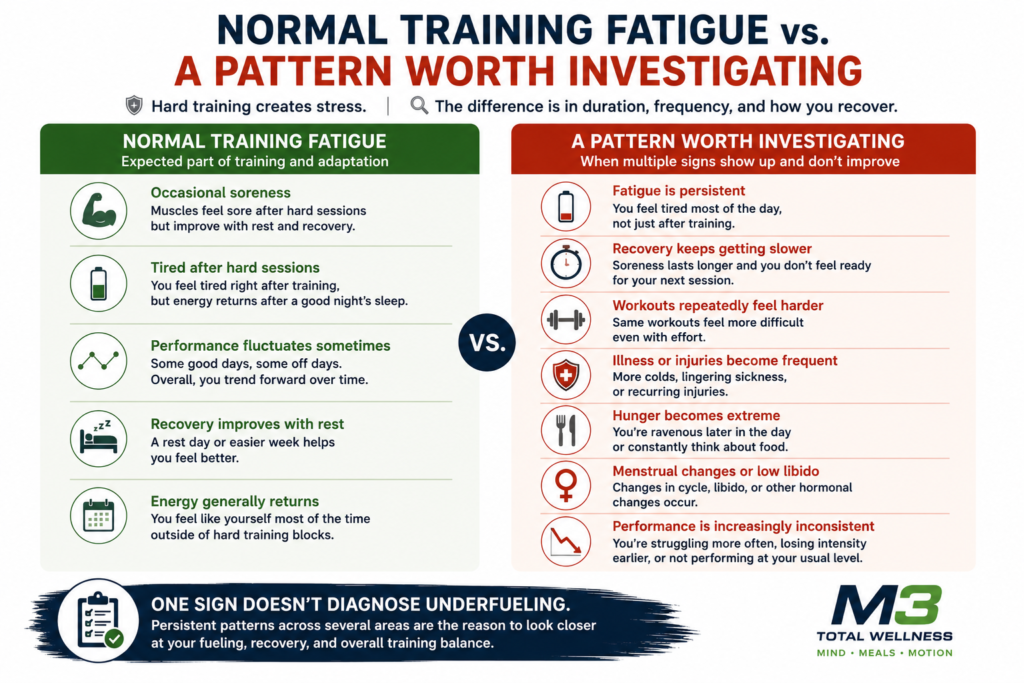
Training should create some fatigue.
That’s normal.
Feeling exhausted throughout the entire day is different.
You may notice:
- Difficulty getting going in the morning
- Afternoon energy crashes
- Feeling drained before practice even begins
- Relying heavily on caffeine to get through the day
- Feeling unusually tired on days that shouldn’t be difficult
Persistent fatigue has many possible causes, so it shouldn’t automatically be blamed on food.
But your fueling pattern belongs on the list of things to evaluate.
2. You’re Not Recovering Like You Used To
Maybe you used to feel ready for your next session.
Now you’re still dragging.
You may notice:
- Soreness lasting longer
- Heavy legs
- Difficulty recovering between sessions
- Feeling depleted the following day
- Needing longer than usual to feel ready again
Training creates the stimulus for adaptation.
Recovery requires resources.
If you’re repeatedly asking the body to repair and adapt without providing adequate energy and nutrients, recovery may become more difficult.
3. You’re Extremely Hungry Later in the Day
An athlete may say:
I do fine all day, but at night I can’t stop eating.
Before assuming that’s a lack of discipline, look at what happened earlier.
Did you eat breakfast?
Was lunch substantial?
Did you have an afternoon snack?
Did you fuel before training?
Did you eat afterward?
Sometimes intense evening hunger is the body responding to a day of inadequate intake.
The problem isn’t necessarily what happened at 9:00 PM.
It may have started at 8:00 AM.
4. You’re Getting Sick More Often
Frequent illness can have many causes, including exposure, stress, sleep, and other health factors.
However, persistent inadequate energy availability can affect immune function.
If you’re repeatedly getting sick while also struggling with fatigue, poor recovery, and inadequate food intake, that’s worth discussing with an appropriate healthcare professional.
5. You’re Getting Injured More Often
One injury doesn’t mean you’re underfueled.
Sports involve injury risk.
But recurrent injuries—particularly bone stress injuries—deserve a closer look at the entire picture, including:
- Training load
- Recovery
- Sleep
- Nutrition
- Bone health
- Hormonal and reproductive function
Persistent underfueling and problematic low energy availability can be part of that picture.
6. You’re Experiencing Menstrual or Libido Changes
Changes in reproductive function can be an important warning sign.
Female athletes may experience menstrual disturbances.
Male athletes may experience reduced libido or other changes related to reproductive hormone function.
These symptoms should not simply be accepted as normal consequences of serious training.
They warrant appropriate evaluation, particularly when they occur alongside other signs of inadequate fueling.
Performance Signs of Underfueling
Athletes often interpret potential signs of underfueling as a training problem.
A workout feels harder than usual, so they add conditioning.
Performance stalls, so they train more.
They feel tired, so they assume they need to become mentally tougher.
But sometimes the training program isn’t the first thing that needs attention.
The athlete may not be adequately fueled for the work they’re already doing.
1. Your Workouts Feel Harder Than They Should
Every athlete has difficult training days.
But pay attention when workouts that were previously manageable consistently begin to feel unusually difficult.
You might notice:
- Your normal pace feels harder
- Your legs feel heavy early
- You struggle to maintain intensity
- You need longer rest periods
- Your perceived effort is higher at the same workload
- You feel depleted before the session is over
Training load, sleep, stress, illness, hydration, and many other factors can affect how a workout feels.
But if this happens repeatedly, look at nutrition before automatically assuming you need to become fitter.
2. You’re Fatiguing Earlier
Think about when fatigue normally appears during your sport.
Maybe you typically feel strong through an entire practice but now begin fading halfway through.
Or perhaps your first few matches feel good, but your energy and explosiveness drop much earlier than they used to.
That pattern matters.
Carbohydrates provide important fuel for moderate- to high-intensity exercise, and athletes who consistently fail to consume enough total energy or carbohydrate may have more difficulty supporting demanding training.
For a deeper explanation, read Carbohydrates and Athletic Performance.
Ask yourself:
Am I actually losing fitness—or am I asking my body to perform without enough fuel?
Sometimes both can be true.
But fueling is an important variable to investigate.
3. Your Performance Has Become Inconsistent
One day you feel great.
The next session is terrible.
Then you have another good workout and assume everything is fine.
Performance doesn’t always decline in a straight line.
You may still have excellent practices or competitions while struggling with inadequate fueling.
Look for trends:
- Are more sessions feeling difficult?
- Is your energy less predictable?
- Are you fading earlier?
- Are you recovering adequately?
- Has your training quality become less consistent?
Patterns over several weeks are usually more informative than one bad workout.
4. Your Strength, Power, or Endurance Is Declining
Depending on your sport, this might look like:
- Slower running or swimming times
- Reduced endurance
- Lower training output
- Difficulty maintaining strength
- Reduced explosiveness
- Decreased jumping ability
- Trouble sustaining repeated efforts
- Difficulty maintaining intensity late in competition
These changes have many possible causes.
But when they’re occurring alongside fatigue, poor recovery, skipped meals, restrictive eating, or increasing training demands, fueling deserves closer attention.
5. You’re Having Trouble Concentrating During Training
Sports aren’t only physical.
Athletes need to:
- Read situations
- Make decisions
- Communicate
- React quickly
- Remember strategies
- Maintain concentration
If you’re routinely entering training depleted, staying mentally engaged may become more difficult.
Poor concentration isn’t specific to underfueling, but mental performance is still part of athletic performance.
6. You’ve Plateaued Despite Training Hard
Plateaus happen.
They’re a normal part of training.
But when progress stalls, many athletes immediately think:
I need to do more.
More cardio.
More lifting.
More practice.
More conditioning.
Sometimes additional training is appropriate.
But there’s another question worth asking:
Do I have the nutritional resources to adapt to the training I’m already doing?
Training provides the stimulus.
The body still needs adequate energy, nutrients, sleep, and recovery to respond to it.
If your workload keeps increasing while your fueling doesn’t, simply adding more exercise may widen the gap.
Eating and Behavioral Signs of Underfueling
Underfueling doesn’t only show up in the body or on the scoreboard.
Sometimes the clearest clues are found in your daily eating behaviors.
1. You Regularly Skip Meals
Missing a meal occasionally isn’t a crisis.
The concern is when skipping meals becomes routine.
For example:
No breakfast → small lunch → practice → dinner
or:
Breakfast → no lunch → afternoon workout → evening meal
Athletes with high energy demands have fewer opportunities to meet those demands when entire meals repeatedly disappear from the day.
2. You Frequently Go Long Periods Without Eating
Maybe you technically eat three meals.
But breakfast is at 7:00 AM, lunch is at 1:30 PM, and dinner isn’t until 8:30 PM after training.
Depending on your individual needs and schedule, strategically placed snacks can make adequate fueling more manageable.
For portable ideas, see Best Snacks for Athletes.
This doesn’t mean every athlete has to eat every two hours.
It means your eating schedule should make it realistically possible to meet your needs.
3. You Don’t Adjust Your Food Intake When Training Changes
Ask yourself:
Do I eat differently on a demanding training day than I do on a low-activity day?
You don’t necessarily need a completely different diet.
But a rest day and a 90-minute practice plus strength training don’t place identical demands on the body.
If training increases substantially while intake remains unchanged, you may gradually fall behind.
4. You’re Routinely Avoiding Carbohydrates
Carbohydrates are sometimes the first thing athletes reduce when trying to “eat healthier” or change body composition.
But carbohydrate is an important fuel source for many athletic activities, particularly moderate- and high-intensity exercise.
A meal pattern of mostly:
Protein + vegetables
may look nutritious.
But depending on the athlete and session, where is the fuel for training?
Meals may also need foods such as:
- Rice
- Potatoes
- Pasta
- Bread
- Oatmeal
- Fruit
- Cereal
- Tortillas
- Other carbohydrate-rich foods
The goal isn’t to add carbohydrates indiscriminately.
It’s to match your intake appropriately to your training demands.
5. You Feel Like You Have to “Earn” Your Food
Thoughts such as:
I didn’t train today, so I shouldn’t eat much.
I need to burn this off.
I didn’t work hard enough to deserve that meal.
can interfere with adequate fueling and a healthy relationship with food.
Your body requires energy even when you aren’t exercising.
Rest days are also when recovery and adaptation continue.
Food isn’t something athletes have to earn through exercise.
6. You’re Afraid to Increase Your Intake
An athlete may recognize that they’re tired and struggling but still feel uncomfortable with the idea of eating more.
They may worry about:
- Gaining weight
- Losing definition
- Eating “too many” carbohydrates
- Eating on rest days
- Increasing portion sizes
- Adding snacks
Those concerns deserve attention rather than dismissal.
If fear around food, body weight, or body composition is preventing you from adequately fueling, working with a sports dietitian—and when appropriate, other qualified healthcare professionals—can help.
Signs Athletes Commonly Ignore
Sports culture often rewards pushing through discomfort.
You may hear:
Everyone is tired.
That’s what hard training feels like.
Being sore means the workout worked.
I’m hungry because I have no discipline.
My performance is dropping because I need more conditioning.
Hard training does create fatigue.
Challenging workouts can cause soreness.
Performance naturally fluctuates.
Athletes sometimes do need better conditioning.
The problem is assuming that every negative symptom is simply the price of getting better.
There is a difference between productive training stress and repeatedly struggling to recover from the work you’re doing.
Instead of always asking:
Can I push through this?
sometimes the better question is:
Why am I having to push through this so often?
That opens the door to evaluating training load, sleep, stress, hydration, health—and nutrition.
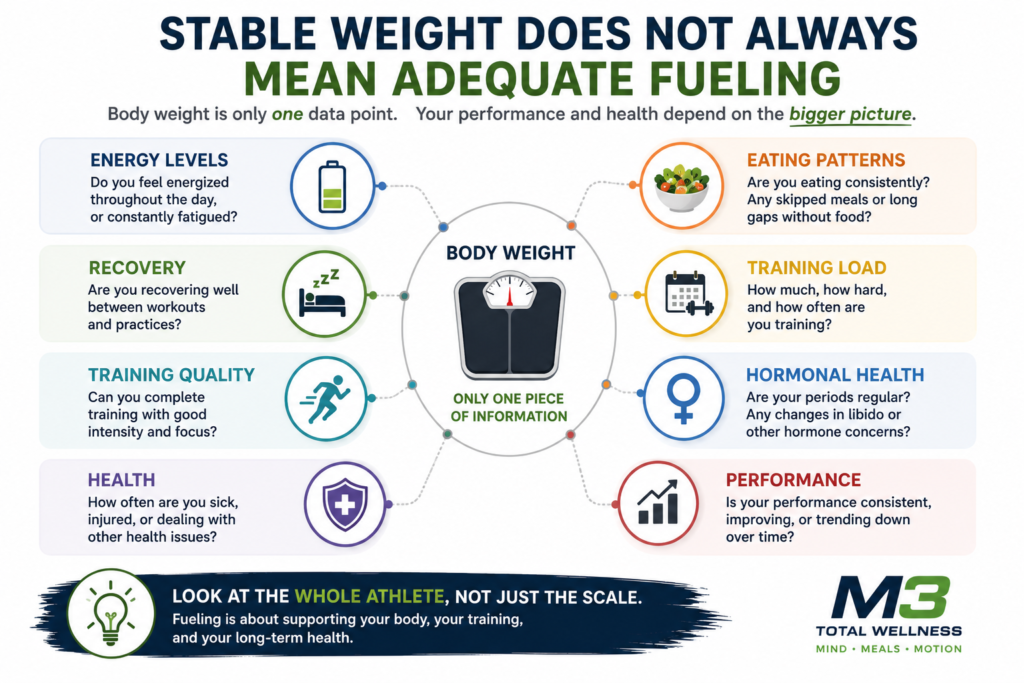
Can You Be Underfueled Even If Your Weight Isn’t Changing?
Yes.
Stable body weight does not automatically mean your fueling pattern adequately supports health, training, and recovery.
The body can adapt to inadequate intake in ways that aren’t immediately obvious on the scale.
Body weight also fluctuates for many reasons, including hydration, glycogen stores, food in the digestive tract, and other physiological factors.
A better evaluation looks at the broader picture:
- What are you eating?
- How consistently are you eating?
- How much are you training?
- Has your workload changed?
- How is your recovery?
- How is your performance?
- How are your energy levels?
- Are there health or hormonal concerns?
- Are restrictive eating behaviors present?
The scale provides one piece of information.
It doesn’t provide the entire answer.
Can You Still Perform Well While Underfueling?
Yes—and this is another reason inadequate fueling may be difficult to recognize early.
Underfueling doesn’t necessarily mean performance immediately collapses.
An athlete may continue to:
- Hit personal records
- Win matches
- Complete difficult workouts
- Maintain strength
- Train at a high level
for some time.
A successful workout doesn’t prove that your fueling strategy is adequate.
Look at the broader pattern.
Are you performing well and recovering well?
Do you have enough energy outside of training?
Are you staying healthy?
Is your eating pattern sustainable?
Can you support the same training again tomorrow?
Those questions tell us more than:
Did I survive today’s workout?
What Can Happen If Underfueling Continues?
One poorly fueled day doesn’t mean you’ve damaged your health.
An occasional missed snack doesn’t mean you have RED-S.
The concern is a persistent mismatch between what your body requires and what your nutrition provides.
Over time, chronic inadequate fueling may contribute to:
- Persistent fatigue
- Poorer recovery
- Reduced training quality
- Declining or inconsistent performance
- Increased susceptibility to illness
- Greater injury concerns
- Impaired bone health
- Reproductive or hormonal disturbances
- Difficulty adapting to training
Persistent underfueling can also contribute to problematic low energy availability, which is associated with the health and performance consequences described within the RED-S framework.
The important point is simple:
Underfueling is easier to address before it becomes a bigger problem.
You don’t need to wait until performance collapses or a serious health concern appears before evaluating whether you’re eating enough.
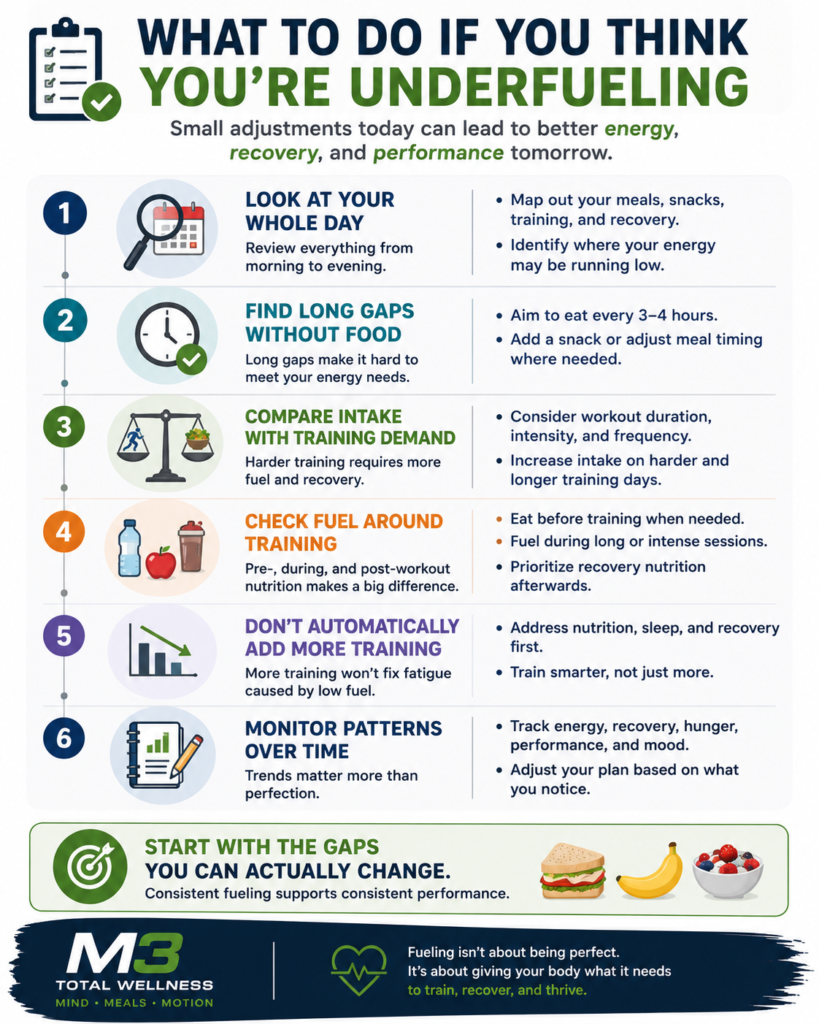
What to Do If You Think You’re Underfueling
Recognizing yourself in this article doesn’t mean you should immediately double your food intake or start tracking every calorie.
Start by looking at your patterns.
1. Look at Your Entire Day
Don’t judge your nutrition based on dinner alone.
Walk through the day:
Breakfast → Morning → Lunch → Afternoon → Training → Recovery → Dinner → Evening
Where are the gaps?
Sometimes the problem becomes obvious once you see the whole timeline.
2. Compare Food Intake With Training Demand
Ask:
What did I ask my body to do today?
A rest day and a tournament day don’t create the same demands.
Neither do a 30-minute easy workout and a 90-minute practice followed by strength training.
Your nutrition should have enough flexibility to account for meaningful changes in workload.
3. Identify Long Gaps Without Food
If you routinely go five, six, or seven hours without eating while training heavily, ask whether another eating opportunity would help.
That could mean:
- A larger breakfast
- A morning snack
- A more substantial lunch
- An afternoon snack
- Pre-workout fuel
- Recovery nutrition
You don’t necessarily need all of them.
The goal is to identify where your current routine is falling short.
4. Look at Fueling Around Training
Ask yourself:
What did I eat before training?
Did this session require fuel during training?
What did I eat afterward?
Improving these periods can sometimes be easier than overhauling your entire diet.
Your post-training routine is especially important during demanding schedules. See Post-Workout Recovery Nutrition for Athletes for practical recovery strategies.
5. Don’t Automatically Add More Training
If you’re fatigued, recovering poorly, and performing inconsistently, your first reaction might be:
I need to get in better shape.
Maybe.
But before adding another conditioning session, ask whether you’re adequately supporting the training already on your schedule.
More training isn’t always the solution to poor performance.
Sometimes the athlete needs better recovery.
Sometimes they need more sleep.
And sometimes they need more fuel.
6. Monitor Patterns, Not Perfection
You don’t need one perfect day of eating.
After making changes, monitor trends in:
- Training energy
- Recovery
- Hunger
- Soreness
- Concentration
- Mood
- Performance consistency
- Overall daily energy
Nutrition isn’t the only factor affecting those outcomes, but the pattern can provide useful information.
When Should an Athlete Seek Professional Help?
Some situations deserve more than a do-it-yourself fueling adjustment.
Consider working with a sports dietitian and appropriate healthcare professionals if you experience persistent or concerning issues such as:
- Ongoing fatigue despite adequate rest
- Recurrent injuries
- Bone stress injuries
- Menstrual disturbances
- Reduced libido or other reproductive concerns
- Unintentional weight loss
- Significant performance decline
- Frequent illness
- Persistent gastrointestinal problems interfering with eating
- Difficulty eating enough despite trying
- Restrictive eating patterns
- Significant anxiety around food or body weight
- Fear of increasing intake despite high training demands
These symptoms can have causes unrelated to nutrition.
That’s precisely why persistent problems deserve proper assessment rather than self-diagnosis.
A sports dietitian can evaluate your fueling pattern and training demands, while a physician or other healthcare professional can investigate medical causes when appropriate.
The goal isn’t to tell every tired athlete to “eat more.”
The goal is to determine why you’re struggling and what actually needs to change.
Sport-Specific Example: The Underfueled Beach Volleyball Athlete
Consider a beach volleyball athlete playing for several hours on a hot weekend.
The day starts with a light breakfast because they don’t want to feel too full before playing.
They arrive at the courts around 9:30 AM.
Matches begin shortly afterward.
Between games, they drink water and maybe have a few bites of fruit or a small snack—but nothing substantial.
By early afternoon, several hours of play have passed.
The athlete starts noticing:
- Heavy legs
- Less explosive jumping
- Slower reactions
- More difficulty concentrating
- Irritability
- Longer recovery between matches
- Strong hunger later in the day
Their first thought might be:
“My conditioning isn’t good enough.”
But before adding more conditioning, it’s worth looking at the fueling pattern.
A better approach might include:
Before play:
A substantial breakfast with carbohydrates, protein, and fluids
Between early matches:
Easy-to-digest carbohydrates such as fruit, pretzels, a granola bar, or a sports drink when appropriate
During a longer break:
A more substantial snack or meal containing carbohydrates and protein
Between later matches:
Additional carbohydrate-rich fuel and fluids
After play:
A recovery meal or snack containing carbohydrates, protein, fluids, and adequate total energy
For a deeper tournament strategy, see Tournament Day Nutrition.
The point isn’t that every athlete should eat the exact same foods.
It’s that several hours of beach volleyball require more than water and a few bites of food.
If energy consistently drops late in play, fueling deserves attention before assuming the solution is simply more training.
Common Misconceptions About Underfueling
“I’m Eating Enough Because I’m Not Hungry”
Not necessarily.
Hunger can be useful, but it isn’t a perfect measure of an athlete’s energy needs.
Appetite can be influenced by:
- Heat
- Stress
- Busy schedules
- High-intensity exercise
- Travel
- Caffeine
- Eating patterns earlier in the day
Instead of relying on hunger alone, look at your overall fueling pattern and how you’re performing and recovering.
“Fatigue Is Just Part of Training”
Some fatigue is normal.
Hard training is supposed to challenge you.
But persistent fatigue that affects your entire day, training quality, recovery, or motivation deserves attention.
Training load, sleep, stress, hydration, medical issues, and nutrition all deserve consideration.
“Eating Less Will Make Me Perform Better”
Sometimes athletes associate a lower body weight with better performance.
In certain sports and circumstances, body composition can influence performance.
But aggressively reducing food intake can also compromise:
- Training quality
- Recovery
- Strength
- Endurance
- Concentration
- Health
A lower number on the scale is not automatically a performance advantage.
“If My Weight Is Stable, I Must Be Fueling Enough”
Not necessarily.
Body weight is one data point.
It cannot tell you by itself whether your eating pattern is supporting your health, training, and recovery.
“I Can Just Make Up for It at Dinner”
Total daily intake matters, but waiting until the end of the day may leave you inadequately fueled during the hours when you’re trying to work, think, train, and begin recovering.
For many athletes, spreading food more consistently across the day is more practical.
Frequently Asked Questions
What are the most common signs of underfueling in athletes?
Possible signs include persistent fatigue, poor recovery, declining or inconsistent performance, prolonged soreness, intense hunger later in the day, frequent illness or injury, menstrual changes, reduced libido, and restrictive or inconsistent eating patterns.
No single sign proves that underfueling is the cause, so patterns matter.
Can I be underfueled even if I eat healthy foods?
Yes.
Food quality matters, but so does total energy intake.
An athlete can eat nutritious foods and still consume too little overall to support training and recovery.
Can you be underfueled without losing weight?
Yes.
Stable body weight does not guarantee that fueling is adequate.
Health, recovery, performance, training demand, and eating patterns should also be considered.
Can you still perform well while underfueling?
Yes, at least for some period of time.
Athletes may continue training or competing well despite an inadequate fueling pattern.
That’s why performance alone shouldn’t be used to rule out a problem.
Does underfueling always mean low energy availability?
No.
Underfueling is a practical term describing inadequate intake relative to needs.
Low energy availability is a more specific physiological concept involving insufficient dietary energy remaining after exercise to adequately support the body’s other physiological functions.
Persistent underfueling can contribute to low energy availability, but the terms aren’t identical.
Should I eat more on harder training days?
Generally, harder or longer training increases energy and recovery demands.
That may mean larger portions, additional snacks, more carbohydrate around training, or more recovery nutrition.
The exact adjustment depends on the athlete and training session.
What if I’m not hungry after training?
Start with something easy to tolerate.
Examples include:
- Smoothies
- Chocolate milk
- Yogurt
- Fruit
- Cereal with milk
- A sandwich
- A recovery drink
Then follow with a more substantial meal when your appetite returns.
When should I talk to a sports dietitian?
Consider professional guidance if you’re dealing with persistent fatigue, recurrent injuries, bone stress injuries, menstrual changes, reduced libido, unintended weight loss, restrictive eating, or difficulty eating enough to support your training.
Sports Dietitian Insight
One of the biggest mistakes athletes make is waiting until performance completely falls apart before taking their nutrition seriously.
Underfueling often shows up more subtly.
The athlete may still be training.
They may still be competing.
They may still hit personal records occasionally.
But they’re also constantly tired, sore for longer than expected, extremely hungry at night, skipping meals, or struggling to recover between sessions.
That’s why I don’t look at one meal or one workout in isolation.
I look at the whole pattern.
How often are you eating?
How much are you training?
Are there long gaps without food?
Are you fueling before training?
Are you recovering afterward?
Has your training increased without a change in your intake?
Those questions often reveal much more than simply asking:
“How many calories are you eating?”
Another important pattern is the athlete who responds to poor performance by increasing training.
If inadequate fueling is part of the problem, that can widen the mismatch.
Before adding more conditioning, more lifting, or another practice, make sure your body has enough energy to benefit from the training you’re already doing.
M3 Underfueling Checklist
Use this as a practical check-in, not as a diagnostic test.
Mind
- I don’t feel like I have to earn food through exercise.
- I’m not afraid to increase my intake when training gets harder.
- I recognize that fueling is part of performance.
Meals
- I eat consistently throughout the day.
- I don’t routinely skip meals.
- I include carbohydrates regularly.
- I eat before demanding training when appropriate.
- I prioritize recovery nutrition after training.
- I increase my intake when my training volume increases.
Motion
- I account for harder or longer training days.
- I monitor how well I’m recovering between sessions.
- I don’t automatically respond to fatigue by adding more training.
Overall
- My energy is generally stable.
- I recover reasonably well between sessions.
- I’m not repeatedly dealing with illness or injury.
- My fueling pattern supports my training rather than making it harder.
If several of these are consistently off track, it may be worth taking a closer look at your fueling routine.
Conclusion
Underfueling doesn’t always look dramatic.
You may still train.
You may still compete.
You may maintain your weight.
You may even perform well for a while.
That’s what makes it easy to miss.
The more useful question isn’t:
“Am I eating perfectly?”
It’s:
“Am I eating enough to support what I’m asking my body to do?”
Pay attention to patterns in your energy, recovery, performance, health, and eating habits.
If your workload increases, your fueling may need to increase too.
If you’re repeatedly tired, recovering poorly, or struggling to perform consistently, don’t automatically assume you need to train harder.
Sometimes the athlete doesn’t need another workout.
They need more support.
Within the M3 Performance Framework, the goal is to keep Mind, Meals, and Motion working together.
Fuel consistently. Recover intentionally. Train with purpose.
Concerned You May Be Underfueling?
If you’re training consistently but struggling with fatigue, poor recovery, inconsistent performance, or difficulty figuring out whether you’re eating enough, an individualized assessment can help.
At M3 Total Wellness, I help athletes and active individuals build practical fueling strategies around their sport, training schedule, lifestyle, and performance goals.
A Performance Nutrition Assessment can help you:
- Review your current fueling habits
- Identify long gaps or missed fueling opportunities
- Improve pre- and post-training nutrition
- Adjust intake to harder and easier training days
- Support recovery
- Build meals and snacks that fit your schedule
Ready to see whether your nutrition is keeping up with your training?
Book a Performance Nutrition Assessment with M3 Total Wellness.
References
Gallant, T. L., Ong, L. F., Wong, L., et al. (2025). Low Energy Availability and Relative Energy Deficiency in Sport: A Systematic Review and Meta-analysis. Sports Medicine, 55(2), 325–339.
https://doi.org/10.1007/s40279-024-02130-0
Logue, D. M., Madigan, S. M., Delahunt, E., Heinen, M., Mc Donnell, S. J., & Corish, C. A. (2018). Low Energy Availability in Athletes: A Review of Prevalence, Dietary Patterns, Physiological Health, and Sports Performance. Sports Medicine, 48(1), 73–96.
https://doi.org/10.1007/s40279-017-0790-3
Mountjoy, M., Ackerman, K. E., Bailey, D. M., et al. (2023). 2023 International Olympic Committee’s (IOC) consensus statement on Relative Energy Deficiency in Sport (RED-S). British Journal of Sports Medicine, 57(17), 1073–1097.
https://doi.org/10.1136/bjsports-2023-106994
Thomas, D. T., Erdman, K. A., & Burke, L. M. (2016). Position of the Academy of Nutrition and Dietetics, Dietitians of Canada, and the American College of Sports Medicine: Nutrition and Athletic Performance. Journal of the Academy of Nutrition and Dietetics, 116(3), 501–528.
https://doi.org/10.1016/j.jand.2015.12.006