Quick Answer
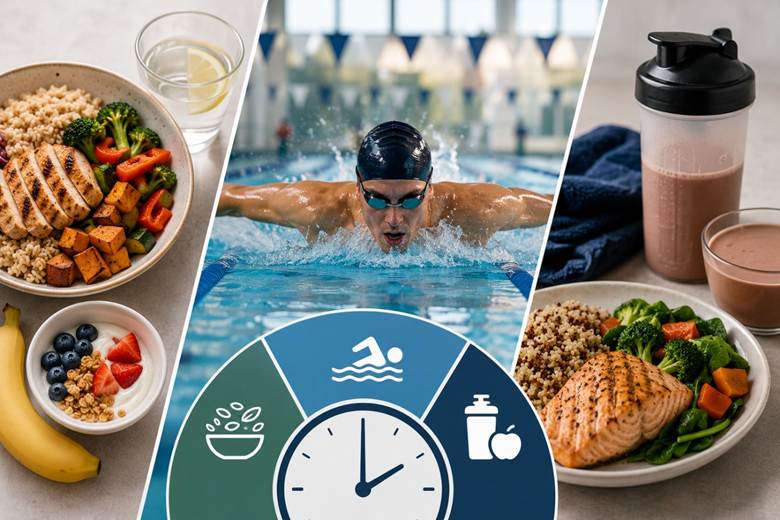
Nutrient timing refers to when athletes eat in relation to training and competition. While overall nutrition is most important, strategically eating before, during, and after exercise can help support energy levels, performance, recovery, and consistency. The goal is not perfect timing—it’s creating a fueling routine that matches your training demands. Nutrient timing for athletes can play an important role in supporting performance.
Key Takeaways
- Nutrient timing helps connect nutrition to training and recovery.
- Eating before exercise can improve energy and training quality.
- Recovery nutrition supports muscle repair and glycogen replenishment.
- Carbohydrates and protein are the nutrients most affected by timing.
- Consistency matters more than perfection.
- Timing becomes more important as training volume and intensity increase.
- Many athletes struggle with timing, not necessarily food choices.
Introduction
Have you ever started a workout feeling unusually tired even though you thought you were eating well?
Or finished a hard training session and then gone several hours before eating because life got busy?
These situations are incredibly common among athletes.
Most athletes spend a lot of time thinking about what foods they should eat. They focus on:
- protein intake
- carbohydrates
- hydration
- supplements
But many athletes pay far less attention to when they eat.
The reality is that timing can influence:
- energy levels
- training quality
- recovery
- consistency
I’ve worked with athletes who had solid food choices but were still struggling with fatigue, recovery, or performance because their meals weren’t aligned with their training schedule.
Within the M3 Performance Framework:
- Mind helps athletes plan ahead and avoid accidental underfueling.
- Meals provide the nutrients needed to fuel training and recovery.
- Motion creates the demand that determines when those nutrients are needed.
Nutrition isn’t only about what you eat.
It’s also about when you eat it.
For a broader overview of athlete fueling, check out:
👉 How Athletes Should Eat for Performance: The M3 Athlete Fueling Framework
Table of Contents
What Is Nutrient Timing?
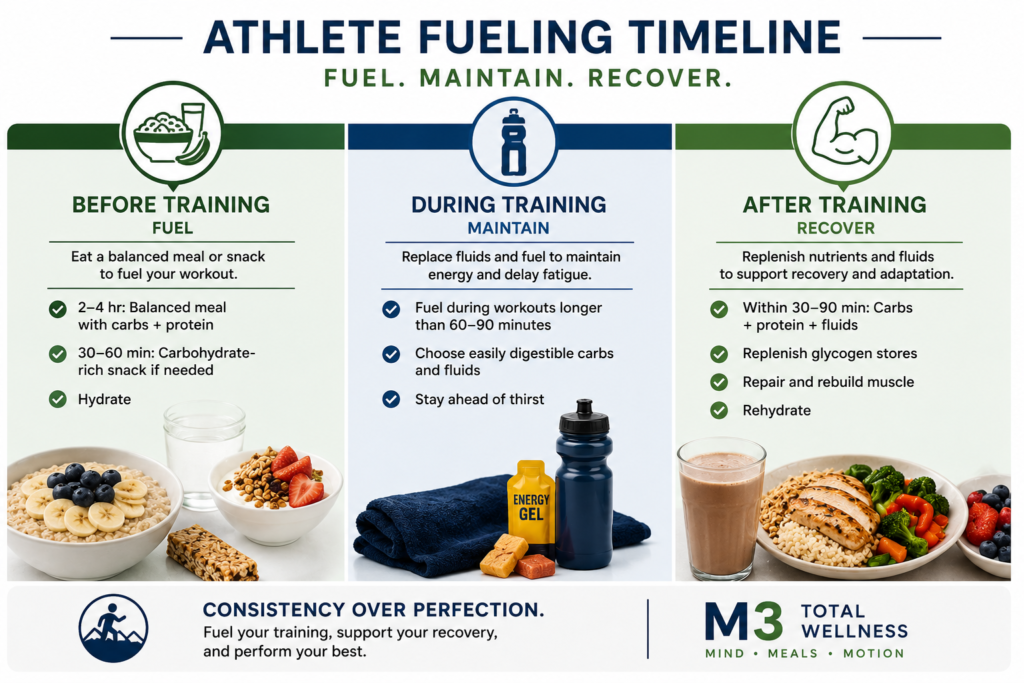
Nutrient timing refers to when you eat in relation to exercise.
It focuses on three primary goals:
Before Exercise
Fuel training and competition.
During Exercise
Maintain energy when training sessions are long or demanding.
After Exercise
Support recovery and preparation for the next session.
The purpose of nutrient timing isn’t to obsess over the clock.
The purpose is to make sure your body has access to the nutrients it needs when it needs them most.
The M3 Timing Framework
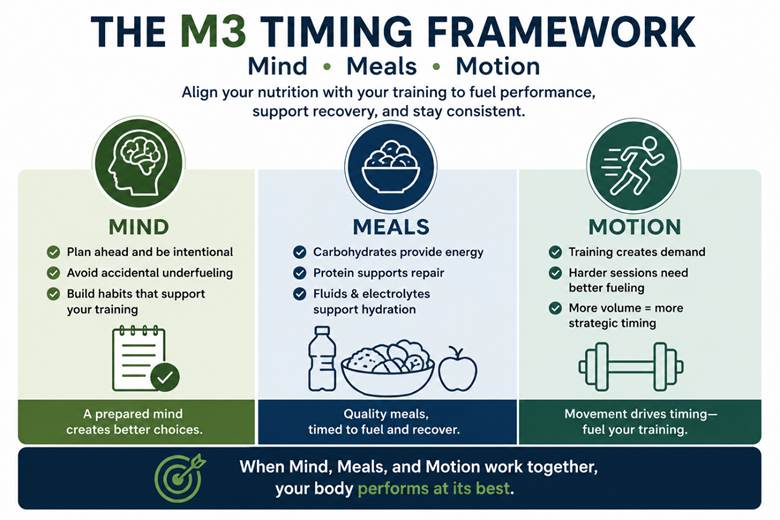
Mind
Many athletes don’t intentionally underfuel.
It happens because they get busy.
Classes.
Work.
Meetings.
Travel.
Practice.
Life gets in the way.
One of the most important aspects of nutrient timing is planning ahead.
Athletes who think ahead tend to make better fueling decisions and experience fewer energy crashes throughout the day.
Meals
Meals provide the fuel.
Different nutrients play different roles.
Carbohydrates help support training and replenish glycogen.
Protein helps repair and adapt muscle tissue.
Fluids and electrolytes help support hydration.
The goal is not eating at perfect times.
The goal is consistently matching nutrition with training demands.
Motion
Training creates nutritional demand.
A recreational athlete exercising three times per week has different timing needs than an athlete training twice per day.
As training volume increases, nutrient timing becomes increasingly important.
The harder you train, the more strategic your fueling often needs to become.
Why Nutrient Timing Matters
Nutrient timing won’t compensate for a poor diet.
However, it can help athletes get more out of the nutrition they’re already consuming.
Proper timing may help:
- improve training quality
- support recovery
- maintain energy levels
- reduce fatigue
- prepare for future training sessions
Poor timing can contribute to:
- low energy
- sluggish workouts
- inconsistent performance
- delayed recovery
The difference is often not dramatic after a single workout.
The difference accumulates over weeks and months of training.
Why Athletes Feel Tired Even When They’re Eating Enough
This is one of the most common concerns I hear from athletes.
Sometimes the issue isn’t what they’re eating.
It’s when they’re eating.
For example:
An athlete may consume enough calories throughout the day but:
- skip breakfast
- train several hours after lunch
- wait hours after training to eat
By the end of the day, total intake may look fine on paper.
Yet energy levels may suffer because the timing doesn’t support training demands.
This is especially common among student-athletes and busy professionals who squeeze training into already packed schedules.
When athletes improve timing, they often notice:
- better training energy
- improved focus
- better recovery
even when the foods they’re eating don’t change substantially.
Pre-Workout Nutrition Timing
One of the primary goals of pre-workout nutrition is ensuring that fuel is available when training begins.
2–4 Hours Before Exercise
A balanced meal is usually ideal.
Examples:
- Chicken, rice, and vegetables
- Turkey sandwich with fruit
- Oatmeal with Greek yogurt and berries
- Rice bowl with lean protein
This meal provides time for digestion while supplying carbohydrates and protein.
30–60 Minutes Before Exercise
A smaller snack may be helpful.
Examples:
- Banana
- Applesauce pouch
- Granola bar
- Sports drink
- Pretzels
These foods provide easily accessible carbohydrates that can support training.
Why Pre-Workout Nutrition Matters
Training with adequate fuel may help support:
- energy levels
- workout quality
- focus
- performance
Athletes don’t always need a large meal before training.
However, consistently starting workouts underfueled can negatively affect training quality over time.
For more on this topic:
👉 Pre-Workout Nutrition for Athletes
Nutrition During Exercise
Many athletes don’t need to eat during every workout.
A 45-minute lifting session may not require additional nutrition.
However, longer or more demanding sessions can benefit from fueling during exercise.
Situations Where It May Help
- Endurance training
- Long practices
- Multiple games or matches
- Training sessions lasting longer than 60–90 minutes
- Tournament days
Common Options
- Sports drinks
- Fruit
- Applesauce
- Energy chews
- Energy gels
The goal is simple:
Maintain energy and delay fatigue.
Post-Workout Nutrition Timing
Training creates stress on the body.
Recovery nutrition helps the body adapt to that stress.
One of the biggest myths in sports nutrition is that athletes must consume a protein shake within 30 minutes of finishing exercise or they’ll lose all of the benefits of their workout.
The reality is more nuanced.
Current evidence suggests that the recovery window is larger than many people think.
However, that doesn’t mean recovery nutrition is unimportant.
Waiting several hours after training to eat is rarely ideal, especially for athletes who have another training session later that day or the following morning.
What Should Athletes Eat After Training?
Recovery meals should generally include:
Carbohydrates
Carbohydrates help replenish glycogen stores that were used during training.
Examples:
- rice
- potatoes
- fruit
- oatmeal
- pasta
- bread
Protein
Protein supports muscle repair and adaptation.
Examples:
- chicken
- fish
- eggs
- Greek yogurt
- cottage cheese
- protein shakes
Fluids
Replacing fluid losses supports recovery and hydration.
For more information:
👉 Post-Workout Recovery Nutrition
Do I Need to Eat Within 30 Minutes?
Not necessarily.
Aiming to eat within approximately 30–90 minutes after exercise is a practical guideline for most athletes.
The bigger concern is not whether you eat at minute 28 or minute 62.
The bigger concern is whether you routinely go three, four, or five hours without eating after training.
Consistency beats perfection.
Daily Meal Timing for Athletes
Nutrient timing isn’t only about workouts.
It’s also about how meals are distributed throughout the day.
Many athletes accidentally create large gaps between meals.
They may:
- skip breakfast
- miss lunch
- eat very little during the day
- consume most of their calories late at night
This often results in:
- energy crashes
- cravings
- poor recovery
- inconsistent training quality
Consistent meal timing works best when built upon a foundation of adequate carbohydrate, protein, hydration, and healthy fat intake.
For more information on those topics:
- Carbohydrates and Athletic Performance
- Protein Needs for Athletes
- Healthy Fats for Athletes
- Hydration for Athletic Performance
A Simple Daily Meal Pattern

For many athletes, eating every 3–4 hours works well.
Example:
7:00 AM — Breakfast
10:00 AM — Snack
1:00 PM — Lunch
4:00 PM — Pre-workout snack
6:00 PM — Training
7:30 PM — Recovery meal
This isn’t a rigid schedule.
It’s simply an example of how athletes can spread nutrition throughout the day to better support performance and recovery.
Does Nutrient Timing Matter for Weight Loss?
Many athletes wonder whether nutrient timing affects body composition goals.
The short answer:
Not as much as overall calorie intake.
If the goal is weight loss, total energy balance remains the primary driver of results.
However, timing can still be helpful.
Strategically timing meals and snacks may help:
- manage hunger
- support training quality
- reduce overeating later in the day
- maintain energy levels
Athletes generally achieve better results when they fuel training appropriately rather than trying to exercise on an empty tank.
When Timing Matters Most
Nutrient timing becomes increasingly important when:
- training multiple times per day
- competing in tournaments
- participating in endurance events
- training at high intensities
- recovery time between sessions is limited
For athletes training recreationally a few times per week, precise timing is often less important.
For athletes with demanding schedules, nutrient timing can become a valuable performance tool.
Frequently Asked Questions
Is Nutrient Timing More Important Than Total Nutrition?
No.
Meeting overall calorie, carbohydrate, protein, fat, and hydration needs remains the foundation.
Nutrient timing helps optimize performance, but it cannot compensate for inadequate overall nutrition.
Do All Athletes Need Strict Nutrient Timing?
No.
Most athletes do not need to schedule meals down to the minute.
The goal is creating consistent eating patterns that support training.
What Happens If I Skip Recovery Nutrition?
Occasionally missing a recovery meal is unlikely to cause major issues.
However, repeatedly delaying recovery nutrition may contribute to:
- slower glycogen replenishment
- increased fatigue
- poorer recovery
- reduced readiness for the next training session
Can I Train Fasted?
Some athletes choose to train fasted.
For lower-intensity exercise, this may be well tolerated.
However, many athletes perform better when some fuel is available before training, especially for:
- high-intensity workouts
- long training sessions
- competitive events
Sport-Specific Example: Competitive Swimming
Consider a swimmer training before school.
Practice begins at 5:30 AM.
The athlete wakes up at 4:45 AM and heads directly to the pool without eating.
After practice, they rush to school and don’t eat breakfast until nearly three hours later.
This pattern is surprisingly common.
The athlete may still consume enough energy by the end of the day, but fuel availability around training and early recovery may be limited.
A more supportive approach might include:
Before practice:
- banana
- granola bar
- sports drink
- applesauce pouch
After practice:
- chocolate milk
- breakfast sandwich
- Greek yogurt and fruit
- oatmeal with protein
These small adjustments can help improve:
- training quality
- recovery
- energy levels throughout the day
This is especially important for swimmers who often train multiple times per day and accumulate substantial training volume throughout the week.
Common Nutrient Timing Mistakes
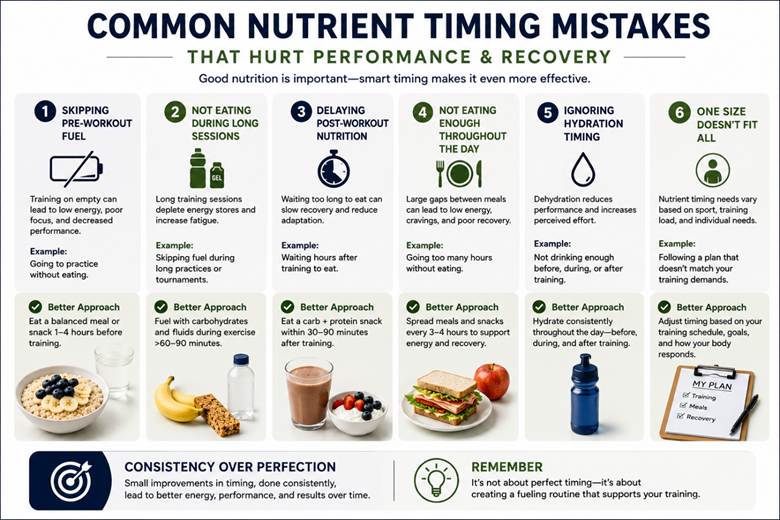
Mistake #1: Skipping Pre-Workout Nutrition
Many athletes underestimate how much better training can feel when they start fueled.
Mistake #2: Delaying Recovery Nutrition
Waiting several hours after training can slow the recovery process.
Mistake #3: Going Long Periods Without Eating
Large gaps between meals often lead to energy fluctuations and underfueling.
Mistake #4: Overcomplicating Nutrient Timing
Many athletes become overwhelmed by trying to optimize every detail.
A consistent plan is usually more effective than a perfect plan that isn’t sustainable.
Practitioner Insight: What I See in Real Athletes
One of the most common patterns I see with athletes is not a lack of nutrition knowledge.
It’s a lack of nutrition timing.
Many athletes already understand that they need carbohydrates, protein, hydration, and recovery.
The challenge is fitting those things into busy schedules.
I’ve worked with athletes who improved their energy levels by adjusting when they were eating, even when their overall food choices changed very little.
By adding a pre-workout snack, improving recovery nutrition, or reducing long gaps between meals, training often becomes more consistent.
That’s why I encourage athletes to focus on consistency before precision.
Small improvements in timing can add up over time.
Action Steps
- Eat a balanced meal 2–4 hours before training when possible.
- Add a carbohydrate-rich snack 30–60 minutes before exercise if needed.
- Fuel during longer training sessions when appropriate.
- Include carbohydrates, protein, and fluids after exercise.
- Avoid going long periods without eating.
- Focus on consistency before trying to perfect nutrient timing.
Conclusion
Nutrient timing for athletes is about matching nutrition with training demands.
While overall nutrition remains the foundation, strategically timing meals and snacks can help support:
- energy
- performance
- recovery
- consistency
Athletes do not need perfect timing.
They need a plan that fits their schedule and supports their training.
Within the M3 Performance Framework, nutrient timing connects Meals and Motion through intentional planning and execution.
When athletes consistently fuel before, during, and after training, they place themselves in a better position to perform, recover, and adapt.
Take the Next Step
Many athletes spend years trying to improve performance by focusing on training harder.
But one of the simplest ways to improve energy, recovery, and consistency is often overlooked:
Fueling at the right times.
You don’t need a complicated nutrition schedule or a stopwatch telling you when to eat.
You need a practical plan that fits your training, lifestyle, and performance goals.
Whether you’re training for a tournament, preparing for a swim meet, building strength in the gym, or simply trying to recover better between workouts, strategic nutrient timing can help you get more from the work you’re already doing.
At M3 Total Wellness, I help athletes create personalized nutrition plans that support performance, recovery, and long-term success using the M3 Performance Framework:
Mind • Meals • Motion
If you’re ready to stop guessing and start fueling with purpose, schedule a Performance Nutrition Assessment and receive individualized guidance based on your sport, training schedule, and goals.
Fuel smarter. Recover better. Perform consistently.
References
Kerksick, C. M., Arent, S., Schoenfeld, B. J., Stout, J. R., Campbell, B., Wilborn, C. D., Taylor, L., Kalman, D., Smith-Ryan, A. E., Kreider, R. B., Willoughby, D., Arciero, P. J., VanDusseldorp, T. A., Ormsbee, M. J., Wildman, R., Greenwood, M., Ziegenfuss, T. N., Aragon, A. A., & Antonio, J. (2017). International society of sports nutrition position stand: Nutrient timing. Journal of the International Society of Sports Nutrition, 14, 33. https://doi.org/10.1186/s12970-017-0189-4
Kerksick, C. M., Wilborn, C. D., Roberts, M. D., Smith-Ryan, A. E., Kleiner, S. M., Jäger, R., Collins, R., Cooke, M., Davis, J. N., Galvan, E., Greenwood, M., Lowery, L. M., Wildman, R., Antonio, J., & Kreider, R. B. (2018). ISSN exercise & sports nutrition review update: Research & recommendations. Journal of the International Society of Sports Nutrition, 15, 38. https://doi.org/10.1186/s12970-018-0242-y
Mountjoy, M., Ackerman, K. E., Bailey, D. M., Burke, L. M., Constantini, N., Lebrun, C., Lundy, B., Melin, A. K., Meyer, N. L., Sherman, R. T., Tenforde, A. S., Budgett, R., & Sundgot-Borgen, J. (2023). International Olympic Committee consensus statement on Relative Energy Deficiency in Sport (REDs): 2023 update. British Journal of Sports Medicine, 57(17), 1073–1097. https://doi.org/10.1136/bjsports-2023-106994
Amawi, A., Aljamal, A., Alshamrani, M., Alzahrani, M., Alsolami, M., Almehmadi, M., & Alqahtani, A. (2024). Athletes’ nutritional demands: A narrative review of nutritional requirements and strategies for optimal performance. Frontiers in Nutrition, 11, 1331854. https://doi.org/10.3389/fnut.2023.1331854
Thomas, D. T., Erdman, K. A., & Burke, L. M. (2016). Position of the Academy of Nutrition and Dietetics, Dietitians of Canada, and the American College of Sports Medicine: Nutrition and athletic performance. Journal of the Academy of Nutrition and Dietetics, 116(3), 501–528. https://doi.org/10.1016/j.jand.2015.12.006