Nutrition for swimmers should provide enough energy, carbohydrate, protein, fluids, and other nutrients to support training, competition, recovery, and long-term health.
But there is no single “swimmer diet” that works for everyone.
A 45-minute technique session, a demanding two-hour practice, dryland plus pool training, two practices in one day, and a full swim meet do not create the same nutritional demands.
That is why a useful swimming nutrition strategy should start with a simple question:
What am I asking my body to do today, and does my nutrition support it?
Swimming-specific sports nutrition guidance emphasizes adjusting nutrition to the swimmer’s training cycle and individual sessions rather than following the same intake every day.
Quick Answer
Swimmers need enough total energy and nutrients to support the work they are doing.
Carbohydrate becomes especially important as training volume and intensity increase, while adequate protein supports muscle repair and adaptation. Fluids, dietary fat, micronutrients, and consistent eating opportunities also contribute to health and performance.
Fueling needs may change considerably depending on whether the swimmer is completing a short recovery session, high-volume training, strength work plus swimming, two-a-day training, or several races during a competition.
The goal is not to follow one rigid swimming meal plan. The goal is to build a fueling pattern that matches the swimmer’s actual training demands.
Key Takeaways
Swimmers can have substantial energy needs because training may include long pool sessions, repeated high-intensity sets, strength training, dryland work, and multiple daily practices.
Carbohydrate intake should generally reflect training demand rather than remain identical every day.
Protein should be consumed throughout the day to support muscle repair and training adaptation.
Early-morning practices often require a practical fueling strategy rather than an all-or-nothing choice between eating a large breakfast and training with nothing.
Recovery nutrition becomes increasingly important when another workout or race follows within several hours.
Swimmers still lose fluid through sweat even though it may be less noticeable while training in water.
Meet-day fueling should be strongly influenced by how much time is available before the next race.
Sports drinks, supplements, and other sports nutrition products can be useful tools, but they are not requirements for every swimmer.
Repeated underfueling may contribute to low energy availability and, in some athletes, increase the risk of Relative Energy Deficiency in Sport.
Open-water swimming introduces different fueling challenges than most pool swimming, especially as event duration increases.
Table of Contents
Why Nutrition for Swimmers Requires an Individualized Strategy
Swimming can be deceptive from a nutrition standpoint.
A race may last only seconds or a few minutes, which can make it seem as though swimmers should not need much fuel.
But the race is only one small part of the athlete’s workload.
Competitive swimmers may spend several hours each week performing:
aerobic training
threshold sets
repeated high-intensity intervals
sprint work
race-pace training
starts and turns
strength training
dryland conditioning
mobility work
multiple practices in the same day
Elite aquatic athletes may spend several hours per day training and preparing, with frequent periods of high-intensity exercise.
That creates an important distinction:
The nutrition demands of swimming are often influenced more by the athlete’s training program than by the duration of the race itself.
A 50-meter swimmer may compete for less than a minute but still complete demanding training sessions throughout the week.
A distance swimmer may require even greater attention to carbohydrate availability and recovery because of training volume.
A developing swimmer may also need enough food to support growth in addition to training.
That is why simply telling someone to “eat like a swimmer” is not particularly useful.
A better approach is to ask:
What does this swimmer’s actual training schedule require?
Swimming-specific nutrition guidance emphasizes adjusting fueling strategies to the demands of training rather than following one fixed nutrition plan.
What Are the Physical Demands of Swimming?
Swimming relies on a combination of aerobic and anaerobic energy systems.
The relative contribution of each changes depending on:
event distance
stroke
race duration
training intensity
workout structure
recovery between efforts
A sprint set and a high-volume endurance practice clearly do not create identical demands.
Training can also vary substantially from one day to the next.
One practice might emphasize technique and recovery.
Another might include repeated race-pace intervals.
Another might combine strength training with a demanding pool session.
This matters because the nutrition strategy should change with the workload.
Swimming-specific sports nutrition literature has described carbohydrate recommendations spanning approximately 3–10 grams per kilogram of body weight per day, reflecting substantial differences in training volume and intensity.
However, this is a broad range rather than a universal prescription. A recreational swimmer completing several shorter sessions per week may have very different carbohydrate requirements than a competitive swimmer performing prolonged or multiple daily practices.
Carbohydrate needs should be individualized according to the training schedule, overall energy intake, performance goals, and the time available for recovery.
A swimmer’s nutrition needs are not fixed.
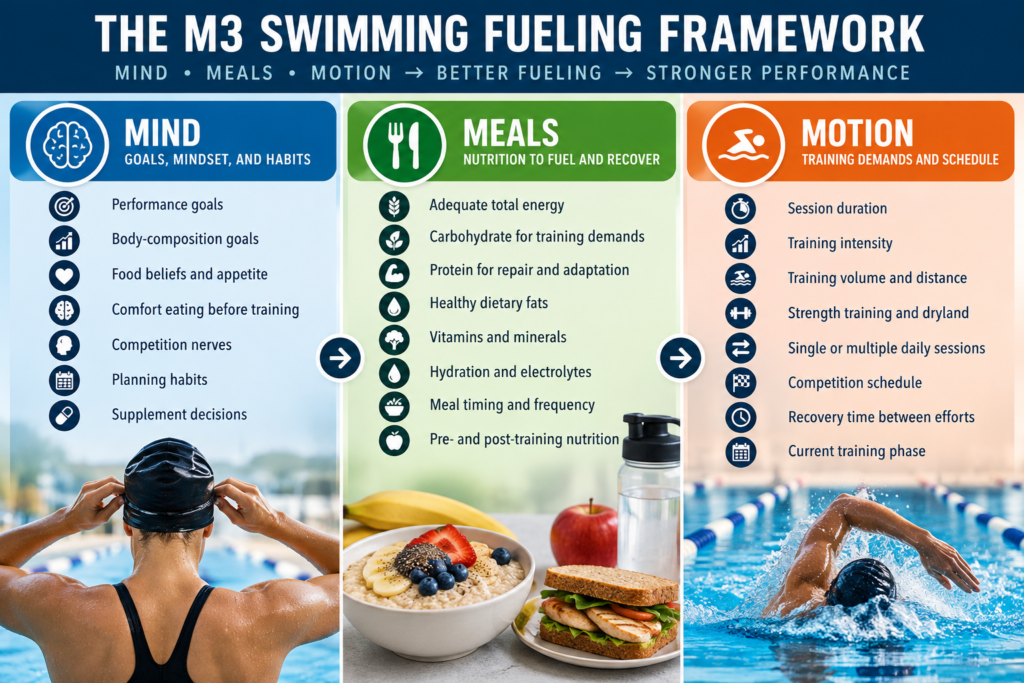
The M3 Swimming Fueling Framework
At M3 Total Wellness, performance nutrition is not just about calculating macronutrients.
For example, a swimmer who struggles to eat before a 5:30 AM practice may need a different strategy than someone who comfortably eats breakfast beforehand.
The goal is not to force every athlete into the same routine.
It is to find a strategy the athlete can actually execute.
Meals
Look at the swimmer’s:
overall energy intake
carbohydrate intake
protein intake
dietary fat
micronutrients
hydration
meal frequency
snack opportunities
pre-training nutrition
recovery nutrition
A good plan should provide enough nutrition across the entire day—not just immediately around workouts.
Motion
Then consider what the athlete is actually doing:
How long is practice?
How intense is it?
How much distance is being covered?
Is there strength or dryland training?
Is this the first or second session?
Is the swimmer competing?
How soon do they need to perform again?
When Motion changes, Meals may need to change too.
M3 Check-In
Does my fueling plan actually match the swimming I am doing today?
How Much Should Swimmers Eat?
There is no universal calorie target for swimmers.
A swimmer completing two demanding workouts in one day may require considerably more energy than the same athlete during a recovery week.
This is especially important for younger swimmers.
Adolescent athletes are not only fueling training. They may also be supporting normal growth, development, bone health, and maturation.
Swimming-specific guidance emphasizes maintaining appropriate energy availability while adjusting intake as training demand changes.
That does not mean athletes need to precisely match every calorie they burn.
Instead, look at the bigger picture.
Is the swimmer:
recovering well?
maintaining training quality?
progressing appropriately?
maintaining normal health?
regularly hungry?
struggling with fatigue?
unintentionally losing weight?
constantly trying to “catch up” on food later in the day?
Those patterns can tell us much more than a single calorie number.
Carbohydrates for Swimming Performance
Carbohydrate deserves particular attention for swimmers.
Many swimming practices involve repeated moderate- and high-intensity efforts. Carbohydrate stored as muscle glycogen provides an important source of fuel for demanding training.
Understanding carbohydrate availability can help swimmers adjust their fueling strategies as training volume and intensity change.
But this does not mean every swimmer should eat the same amount of carbohydrate every day.
A better approach is to match carbohydrate availability to training demand.
Lower-Demand Training Days
Examples might include:
recovery swimming
shorter technical sessions
lower-volume practice
rest days
Carbohydrate still belongs in the diet, but the swimmer may not require the same intake as they would during a demanding training day.
Higher-Demand Training Days
Examples include:
long pool sessions
high-volume training
threshold sets
repeated race-pace efforts
dryland plus swimming
two-a-day training
competition
These are situations where carbohydrate deserves greater attention.
Practical carbohydrate-rich foods include:
oatmeal
cereal
bread
rice
pasta
potatoes
fruit
granola
tortillas
yogurt with fruit
crackers
pretzels
Sports foods may also be useful in certain situations.
The point is not to eat enormous portions of carbohydrate at every opportunity.
The point is:
Carbohydrate intake should reflect the work being performed.
Protein for Swimmers
Protein supports muscle repair, remodeling, and adaptation to training.
Swimming may not always be viewed as a strength-oriented sport, but swimmers still repeatedly stress muscular tissue through training. Many also perform resistance and dryland training.
The higher end of this range is not automatically necessary for every swimmer. Protein needs may differ depending on total training demands, resistance training, energy intake, age, and individual goals.
Meeting an appropriate daily protein intake is generally more important than following an overly rigid meal-timing schedule. Distributing protein across meals and snacks can be a practical way to support this goal.
Examples include:
eggs
Greek yogurt
milk
cottage cheese
chicken
turkey
fish
lean beef
tofu
tempeh
beans
lentils
protein powder when convenient
Swimming-specific guidance has also emphasized consuming high-quality protein around important sessions and distributing protein throughout the day.
Protein matters.
But more protein is not automatically better.
If the athlete consumes large amounts of protein while consistently under-consuming carbohydrate or total energy, the overall fueling strategy may still be poorly matched to training.
Dietary Fat Still Matters
Carbohydrate and protein tend to receive most of the attention in sports nutrition.
The main consideration around training is often gastrointestinal comfort.
A very large meal high in fat shortly before a demanding practice may digest more slowly and feel uncomfortable for some swimmers.
That does not make fat “bad before swimming.”
It simply means amount, timing, and individual tolerance matter.
What Should Swimmers Eat Before Practice?
Pre-workout nutrition should help the swimmer arrive at practice adequately fueled without creating unnecessary gastrointestinal discomfort.
The closer an athlete gets to training, the more practical it may be to choose smaller and easier-to-digest foods.
Several Hours Before Practice
A more complete meal could include:
oatmeal + banana + Greek yogurt
cereal + milk + fruit
eggs + toast + fruit
rice + eggs
bagel + yogurt
sandwich + fruit
The meal does not need to look like a traditional “sports meal.”
It needs to provide food the athlete tolerates well and that supports the upcoming workout.
Closer to Practice
A smaller carbohydrate-containing option may be easier:
banana
toast
applesauce pouch
cereal
crackers
granola bar
small smoothie
sports drink when appropriate
Someone with a sensitive stomach may prefer smaller portions and lower amounts of fat and fiber close to training.
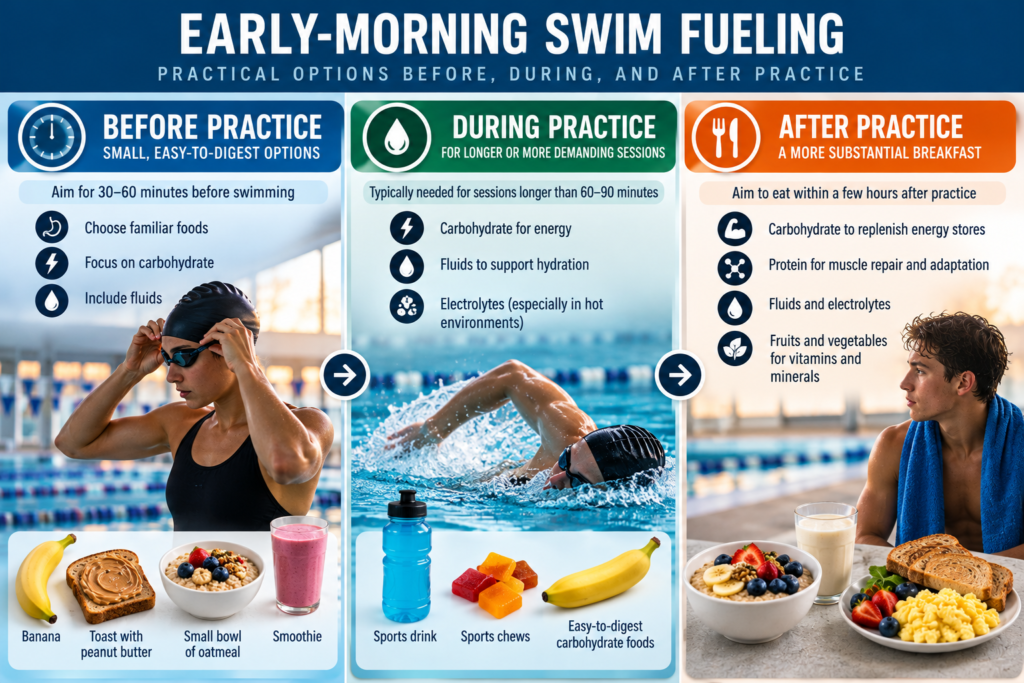
What About Early-Morning Swim Practice?
Early practices are one of the most practical challenges in swimming nutrition.
A swimmer waking at 4:45 or 5:00 AM may have little appetite and may not want to eat a complete breakfast.
That does not mean the only options are:
Eat a large meal or Eat absolutely nothing
There is a middle ground.
A swimmer might tolerate:
half a banana
toast
applesauce
a small amount of cereal
a few crackers
a small smoothie
some sports drink
Then they can eat a more substantial meal after practice.
Whether pre-practice food is particularly important depends on:
how long the swimmer is training
how demanding the session is
what they ate the previous evening
their gastrointestinal tolerance
their overall daily intake
whether another session follows later
A short easy session and a demanding two-hour practice should not automatically receive the same strategy.
Practical Takeaway
Instead of asking whether every swimmer must eat before morning practice, ask whether the swimmer’s overall fueling strategy adequately supports the session and the rest of the day.
Early-morning swimmers can adjust their fueling around appetite, practice demands, and recovery needs rather than forcing a large breakfast before every session.
Do Swimmers Need to Eat During Practice?
For many normal swimming sessions, probably not.
A swimmer who has eaten adequately before a typical practice may not need carbohydrate during the workout.
Water may be all that is necessary.
Intra-workout fueling becomes more relevant as the training demand increases.
Examples include:
prolonged practices
particularly high-volume sessions
several training components
two-a-day schedules
demanding training camps
long competition days
situations where the swimmer could not eat adequately beforehand
In these situations, a carbohydrate-containing beverage or another easily consumed source of carbohydrate may become useful.
The key point is:
Do not add intra-workout fuel simply because swimming feels difficult. Consider it when the duration, volume, schedule, or surrounding nutrition makes it useful.
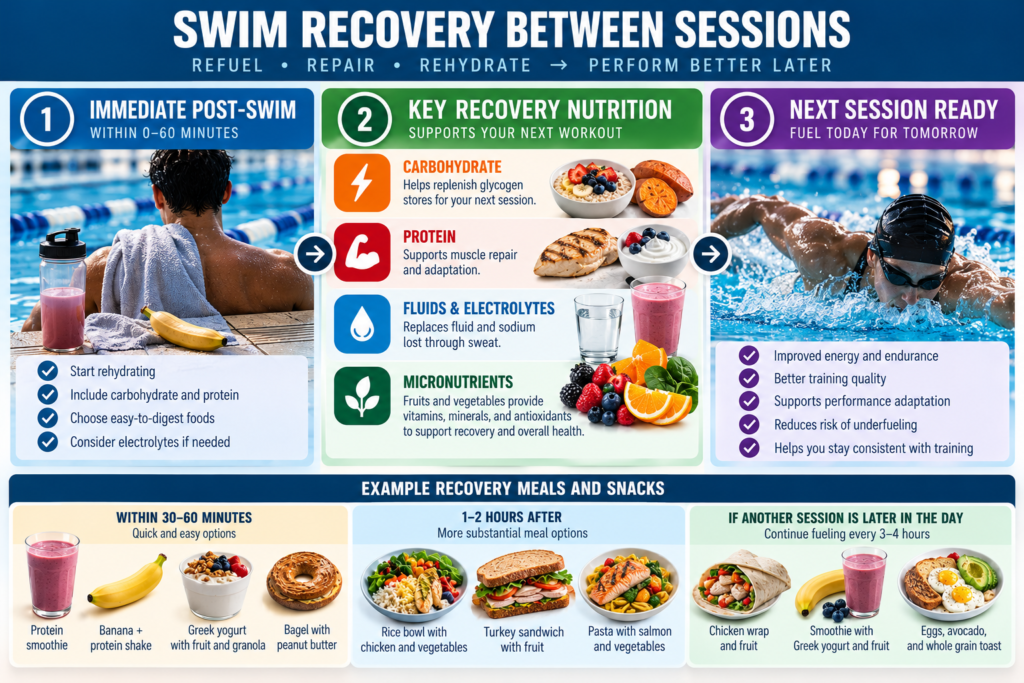
What Should Swimmers Eat After Practice?
Recovery nutrition should be influenced by one major question:
What comes next?
A consistent post-workout recovery nutrition strategy becomes especially important when another demanding session follows within several hours.
If the swimmer finishes practice and has plenty of time before the next demanding workout, a normal meal may provide everything needed.
That meal might include:
carbohydrate
protein
fluids
fruits or vegetables
dietary fat
There is no need to panic about consuming a recovery shake within a tiny “anabolic window.”
Recovery nutrition does not depend on a single narrow window after exercise. Adequate total energy, carbohydrate, and protein intake across the day remain important.
However, when a swimmer has another demanding session within a relatively short period, consuming carbohydrate soon after the first workout may help accelerate glycogen replenishment. Including protein can support muscle repair and adaptation.
When the next demanding session is not until the following day or later, there is generally more flexibility in how recovery nutrition is distributed across subsequent meals and snacks.
Example: Morning Swim + Afternoon Practice
In this situation, breakfast after the morning session has two jobs:
help the swimmer recover from Session 1
begin preparing the swimmer for Session 2
Useful combinations might include:
cereal + milk + eggs + fruit
oatmeal + Greek yogurt + banana
breakfast sandwich + fruit
rice bowl with eggs or chicken
smoothie + toast
yogurt + granola + fruit
Recovery literature in aquatic sports emphasizes that the urgency of refueling, rehydrating, and supporting muscle repair should depend partly on how quickly the athlete must perform again.
That gives us a useful performance principle:
Recovery from one session can become preparation for the next.
Hydration for Swimmers
One of the unique challenges in swimming is that sweat can be difficult to notice.
Swimmers are surrounded by water, but that does not mean they cannot lose fluid through sweating.
Fluid losses can vary based on:
pool temperature
air temperature
humidity
training intensity
practice duration
individual sweat rate
Instead of following one universal ounces-per-hour recommendation, swimmers should develop practical hydration habits.
That may include:
arriving at practice reasonably hydrated
keeping a water bottle accessible
drinking during appropriate breaks
paying more attention during long or demanding practices
replacing meaningful fluid losses afterward
Thirst, urine color, and changes in body weight across training sessions can provide useful information about hydration, but none should be interpreted in isolation.
For example, changes in body weight during exercise may reflect fluid losses, but they can also be influenced by food and fluid intake, urine output, and other factors. Comparing body weight before and after similar training sessions may help estimate individual fluid needs when interpreted appropriately.
The goal is to develop a hydration strategy that supports training without encouraging excessive fluid consumption. Drinking beyond individual needs can also be harmful, particularly during prolonged exercise.
Being in the pool does not eliminate the need for hydration.
But it also does not mean every swimmer needs a rigid drinking schedule.
Do Swimmers Need Electrolytes?
Sometimes.
Electrolyte-containing drinks or foods can be useful when:
practice is prolonged
sweat losses are substantial
the environment is warm
the swimmer has multiple workouts
competition lasts many hours
fluid replacement needs are relatively high
But electrolytes are not automatically required for every swim practice.
Someone completing a comfortable 45-minute swim may have very different needs than an athlete completing two hours of demanding training.
Electrolytes should be treated as another performance tool—not as a requirement simply because someone exercises.
Sports Drinks for Swimmers
Sports drinks can provide three useful components:
fluid
carbohydrate
sodium
That combination can be useful during:
long practices
demanding training
two-a-day schedules
meets
situations where solid food is inconvenient
But a sports drink is not automatically superior to water.
For many shorter sessions, normal meals, snacks, and water may provide everything the swimmer needs.
For longer sessions or competition, a sports drink can become a convenient way to provide both fuel and fluid.
M3 Perspective
Sports drinks are tools, not requirements.
Use them when they solve a real fueling or hydration problem.
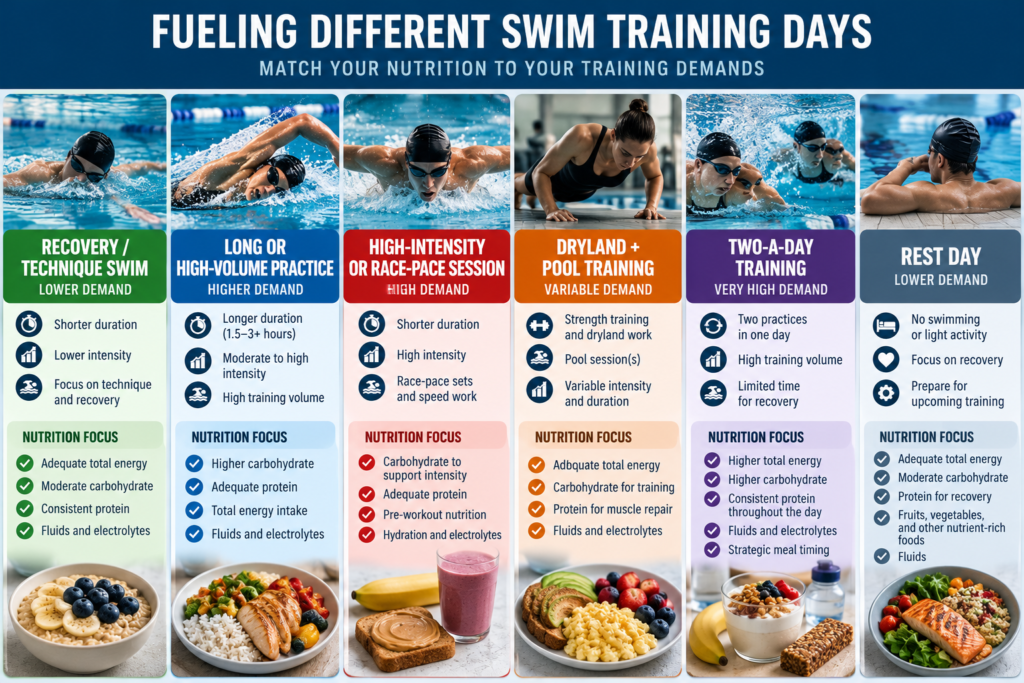
How Should Swimmers Fuel Different Training Days?
Swimmers should not necessarily fuel every day exactly the same way.
Training demand changes.
Nutrition can change with it.
Short Technique or Recovery Swim
Primary focus:
normal meals
adequate protein
general hydration
overall energy intake
There is usually no need to manufacture an elaborate sports nutrition strategy for a relatively light session.
Long or High-Volume Practice
Pay more attention to:
carbohydrate before training
adequate total energy
hydration
recovery nutrition afterward
As workload increases, underfueling becomes easier to do unintentionally.
High-Intensity or Race-Pace Session
Arrive appropriately fueled.
Carbohydrate availability may become especially useful when the workout contains repeated demanding efforts.
Recovery afterward should reflect both the difficulty of the session and what training remains later in the day or week.
Dryland + Pool Training
Now the swimmer is supporting more than one training stimulus.
A swimmer may need to eat several times throughout the day without feeling overly full before racing.
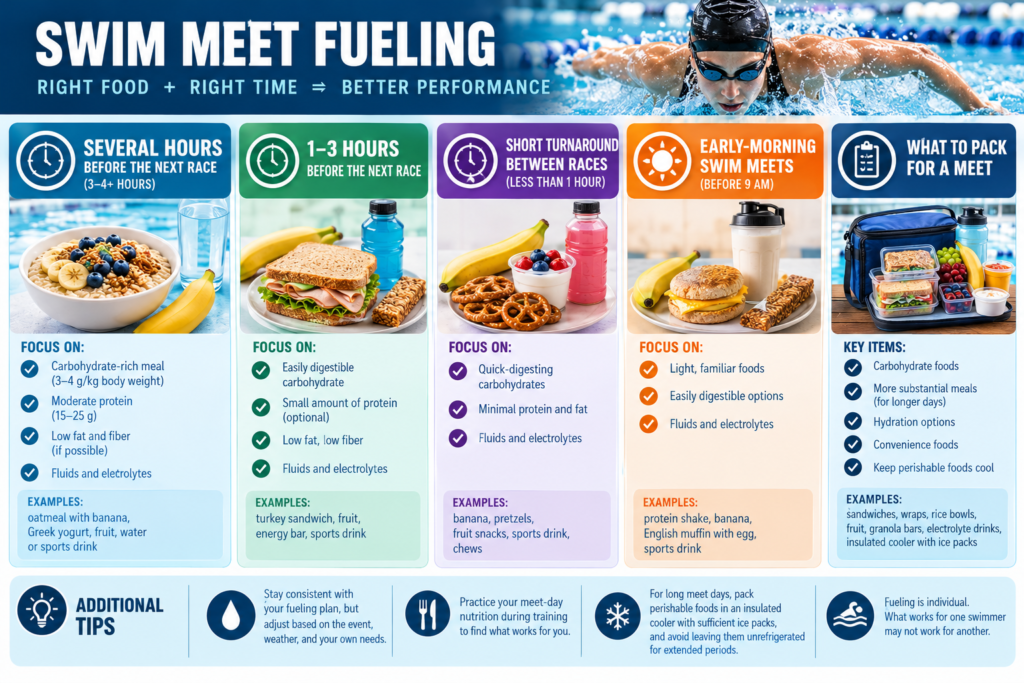
The most useful question is:
How long until I race again?
Several Hours Before the Next Race
There is more time to digest a substantial meal.
Examples might include:
rice + chicken
pasta + lean protein
turkey sandwich + fruit
oatmeal + yogurt + fruit
bagel + eggs + fruit
Keep the meal familiar.
Competition day is rarely the best time to experiment with unfamiliar foods.
One to Three Hours Before the Next Race
A smaller meal or snack may work better:
yogurt + granola
cereal + milk
sandwich
smoothie
fruit + crackers
bagel
Short Turnaround Between Races
When little recovery time is available, prioritize foods that are:
easy to digest
carbohydrate-rich
portable
familiar
Examples include:
banana
applesauce pouch
pretzels
crackers
sports drink
small granola bar
other simple carbohydrate foods
The goal is not to eat a complete meal between every race.
It is to continue providing useful fuel without creating gastrointestinal discomfort.
Simple Meet-Day Framework
Longer break → more complete eating opportunity
Shorter break → smaller, easier-to-digest fuel
After the final race, shift from between-race fueling to full recovery.
What About Early-Morning Swim Meets?
Early warm-ups can make breakfast difficult.
Instead of forcing a huge meal immediately after waking, some swimmers may do better by dividing breakfast into stages.
For example:
Wake up → small snack + fluid → travel → additional food → warm-up → race
A swimmer might have:
banana + toast when waking
yogurt or cereal later
fluids throughout the morning
another small carbohydrate option closer to racing if needed
The goal is to arrive adequately fueled without feeling uncomfortably full.
Competition fueling should be practiced before competition day whenever possible.
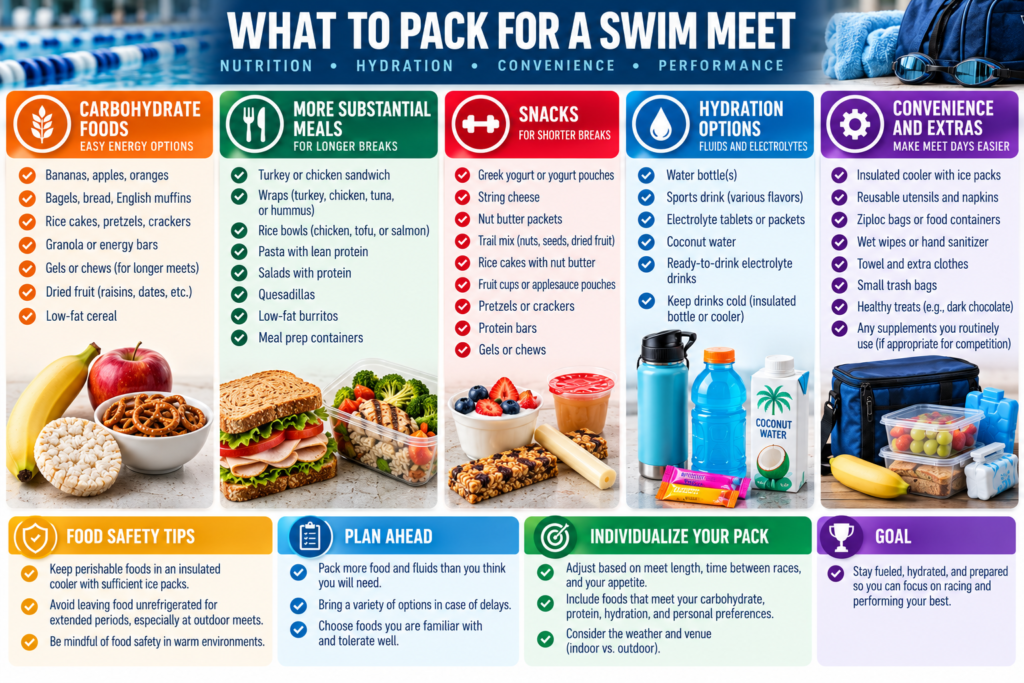
What Should Swimmers Pack for a Meet?
A good swim bag should contain foods the athlete knows they tolerate well.
Possible options include:
Carbohydrate Foods
bananas
applesauce pouches
pretzels
crackers
cereal
bagels
granola
rice cakes
dried fruit
More Substantial Foods
sandwiches
wraps
yogurt
overnight oats
rice bowls
pasta
fruit
Hydration Options
water
sports drink when appropriate
electrolyte drink when useful
Convenience Foods
protein shake
shelf-stable milk
granola bar
packaged snacks
The best meet-day food is not necessarily the food that looks most “athletic.”
It is food that:
supports the athlete’s needs
travels well
fits the available recovery window
is easy to eat
is familiar
is tolerated well
For long meet days, pack perishable foods in an insulated cooler with sufficient ice packs, and avoid leaving them unrefrigerated for extended periods, particularly at outdoor competitions.
Pool Swimming vs. Open-Water Swimming
Pool swimming and open-water swimming should not automatically use the same nutrition strategy.
Open-water races can last much longer than pool events.
Long-distance races may also expose swimmers to:
changing water temperatures
ambient heat
solar exposure
currents
waves
variable race duration
limited opportunities to consume food and fluid
Open-water races may last several hours, making in-race carbohydrate and fluid intake much more relevant than during typical pool competition.
For longer open-water events, athletes may need a carefully practiced plan for:
pre-race fueling
carbohydrate during racing
fluid intake
electrolytes
feeding opportunities
environmental conditions
That deserves its own detailed article.
For most of this guide, however, the primary focus is pool swimming.
Body Composition for Swimmers
Some swimmers want to lose body fat, gain muscle, or change their physique.
Body composition can be part of an athlete’s performance plan.
But leaner does not automatically mean faster.
Aggressive restriction can interfere with:
training quality
recovery
adaptation
strength
mood
immune function
nutrient intake
long-term health
If fat loss is appropriate, the goal should generally be a gradual strategy that continues to support important training.
The question should not simply be:
“How can I weigh less?”
A better question is:
Can I move toward my desired body composition while continuing to train, recover, remain healthy, and perform well?
Body composition should not be managed separately from the rest of the swimmer’s performance plan.
Understanding how to balance body composition for athletes with adequate fueling can help swimmers pursue appropriate physique goals without unnecessarily compromising performance.
A swimmer can simply have difficulty keeping up with the amount of food required by training.
This can happen because of:
early practices
long training sessions
multiple daily workouts
limited time between school, work, and training
low appetite
body-composition goals
food restrictions
lack of preparation
For example:
5:30 AM swim → school → afternoon practice → homework
can create a lot of opportunities for meals and snacks to be missed.
One skipped snack is not automatically a serious problem.
The concern is the repeated pattern.
Low Energy Availability and RED-S
Repeated underfueling can increase the likelihood of low energy availability (LEA), particularly when dietary energy intake is insufficient relative to the demands of exercise.
LEA describes a state in which the energy remaining after exercise is inadequate to optimally support the body’s other physiological functions.
Problematic LEA, particularly when sufficiently severe or prolonged, can contribute to Relative Energy Deficiency in Sport (RED-S), a syndrome involving potential health and performance consequences in both female and male athletes.
However, LEA does not inevitably progress to RED-S, and neither condition can be diagnosed simply by identifying a missed meal, a difficult workout, or an isolated day of low food intake.
Possible warning signs that deserve further evaluation can include:
persistent fatigue
declining training tolerance
poor recovery
recurrent injury
frequent illness
changes in menstrual function
changes in reproductive health
unexplained performance decline
significant or unintended weight changes
distress around food or body image
These symptoms are not specific enough to diagnose RED-S on their own.
Look at the pattern.
Supplements for Swimmers
Supplements can sometimes support performance.
They should not replace a strong nutrition foundation.
Creatine
Creatine monohydrate is one of the most well-studied sports supplements.
It may be particularly relevant to swimmers completing:
strength training
repeated high-intensity work
sprint-oriented training
Not every swimmer needs creatine.
Caffeine
Caffeine may improve performance in some athletes.
Response is highly individual.
Swimmers should consider:
dose
timing
tolerance
anxiety
gastrointestinal symptoms
sleep
A supplement that slightly improves one workout but consistently damages sleep may not be helping the athlete overall.
Beta-Alanine
Beta-alanine may have potential value during certain high-intensity exercise situations, particularly where repeated or sustained high-intensity work contributes to performance.
It is not universally useful for every swimmer.
Sodium Bicarbonate
Sodium bicarbonate can potentially support certain high-intensity efforts.
However, gastrointestinal side effects can be substantial.
Athletes considering it should test a strategy during training well before using it in competition.
Protein Powder
Protein powder is primarily a convenience tool.
It can make it easier to meet protein needs when:
the athlete has limited time
appetite is low
food is unavailable
a portable recovery option is useful
It is not inherently superior to protein from food.
Sports Foods
Sports drinks, gels, carbohydrate powders, and other sports foods may be useful during:
prolonged sessions
competition
high-volume training
two-a-days
They are performance tools—not requirements.
Supplement Quality and Third-Party Testing
Competitive swimmers should consider supplement safety and quality before using any product.
Dietary supplements may contain ingredients that are not accurately represented on the label, including substances prohibited under anti-doping rules.
When supplementation is appropriate, choosing products independently certified through programs such as NSF Certified for Sport or Informed Sport can help reduce contamination risk.
However, third-party certification does not guarantee that a supplement is completely risk-free or that it will improve performance.
Athletes subject to anti-doping rules should review supplement decisions with a qualified sports dietitian or appropriate sports medicine professional.
Foundation First
Before building an elaborate supplement routine, ask whether the swimmer is consistently getting:
enough food
adequate carbohydrate
adequate protein
appropriate hydration
sufficient sleep
adequate recovery
A supplement cannot compensate for chronically inadequate fueling.
Common Nutrition Mistakes Swimmers Make
1. Training Early and Then Delaying Breakfast for Hours
The issue is not simply that the athlete trained without breakfast.
The bigger concern is completing a demanding session and then continuing through the morning without meaningful recovery nutrition.
2. Eating the Same Amount Every Day
Training demand changes.
Nutrition can change with it.
A light recovery day and a demanding two-a-day should not automatically have identical fueling strategies.
3. Underestimating Carbohydrate Needs
Athletes sometimes prioritize protein while substantially reducing carbohydrate.
Protein matters, but it does not replace carbohydrate’s role in supporting many demanding training sessions.
4. Assuming Hydration Does Not Matter in the Pool
Being surrounded by water does not prevent sweat loss.
5. Saving Most Food for Late at Night
Eating more later can certainly contribute to meeting daily nutrition needs.
But it cannot retroactively fuel a demanding practice that already happened.
6. Underestimating Total Energy Needs
High-volume swimming can create substantial energy requirements.
Some athletes may simply struggle to eat enough.
7. Overcomplicating Meet-Day Nutrition
A swim meet does not require an enormous bag of expensive sports products.
Familiar, portable foods often work very well.
8. Trying New Foods or Supplements on Competition Day
Meet-day nutrition should generally be practiced ahead of time.
9. Aggressively Restricting Food to Become Leaner
A body-composition strategy that consistently reduces training quality and recovery may interfere with the performance it was intended to improve.
10. Treating Supplements as the Foundation
Creatine, caffeine, sports drinks, and protein powder cannot fix an eating pattern that consistently fails to meet the athlete’s basic needs.
Sports Dietitian Insight
One important consideration in swimming nutrition is that the race itself does not tell you the entire story.
A swimmer might race for less than a minute but spend hours each week swimming, strength training, completing dryland work, and recovering between sessions.
That is why I would not build a swimmer’s nutrition plan around race distance alone. I would start with the training schedule.
Ask:
How much work am I actually doing today?
When do I need to perform again?
Do I have enough opportunities to eat between sessions?
Am I consistently recovering from the work I am doing?
Those questions tell us much more than simply saying:
“Swimmers need to eat more carbohydrates.”
The goal is not perfect nutrition every day.
The goal is a fueling pattern flexible enough to support the athlete’s actual training.
M3 Swimming Nutrition Check-In
Use the Mind • Meals • Motion framework to evaluate your current strategy.
Mind
Ask yourself:
Am I intentionally avoiding food before training?
Is that based on actual gastrointestinal tolerance or a belief that eating before exercise is bad?
Am I anxious about eating more on hard training days?
Am I pursuing body-composition goals that may be interfering with training?
Am I relying on supplements instead of addressing my basic nutrition?
Meals
Ask:
Am I eating enough overall?
Do I regularly have carbohydrate available around demanding sessions?
Am I getting adequate protein throughout the day?
Do I eat after morning practices?
Do I have food available between practices?
Do I pack appropriate foods for meets?
Am I drinking enough?
Am I trying to “catch up” on most of my food at night?
Motion
Ask:
How long is today’s practice?
How hard is it?
How much volume am I completing?
Am I also strength training?
Is this my first workout or my second?
How soon do I need to perform again?
Am I competing today?
Has my training volume recently increased?
Then bring the three together:
Does my fueling plan actually match the swimming I am about to do?
Frequently Asked Questions About Nutrition for Swimmers
What should swimmers eat before practice?
A carbohydrate-containing meal or snack usually makes sense before demanding swim training, with some protein when practical. The amount and composition should depend on how much time remains before practice and what the swimmer tolerates well.
Examples include oatmeal with fruit and yogurt several hours before training or a smaller option such as banana, toast, cereal, or applesauce closer to practice.
Should swimmers eat before early-morning practice?
Not every swimmer needs a complete breakfast immediately before an early practice.
Some may tolerate a smaller carbohydrate-containing snack better.
The need for pre-practice food depends on the workout, overall daily intake, gastrointestinal tolerance, and what the athlete ate previously.
What should swimmers eat after practice?
A recovery meal should generally include carbohydrate, protein, and fluids.
Examples include oatmeal with yogurt and fruit, cereal with milk and eggs, a rice bowl with protein, a sandwich with fruit, or a smoothie paired with additional food.
Recovery becomes more time-sensitive when another demanding workout follows within several hours.
Do swimmers need sports drinks?
Not necessarily.
Water may be sufficient for many shorter practices.
Sports drinks can become useful during longer or more demanding sessions, multiple daily workouts, and long competition days because they can provide carbohydrate, sodium, and fluid simultaneously.
Do swimmers need electrolytes?
Sometimes.
Electrolytes may be helpful during prolonged training, high sweat losses, hot environments, multiple daily sessions, or long meets.
They are not automatically necessary for every practice.
How much protein do swimmers need?
Many athletes can meet their needs within approximately 1.4–2.0 grams of protein per kilogram of body weight per day, although individual requirements vary.
Protein should generally be distributed across several eating opportunities rather than concentrated in one meal.
Do swimmers need a lot of carbohydrates?
It depends on the workload.
A high-volume competitive swimmer may require considerably more carbohydrate than someone swimming recreationally several times per week.
Carbohydrate intake should generally reflect training volume and intensity.
What should swimmers eat between races?
The answer depends largely on how much time exists before the next event.
With several hours available, a more substantial meal may be appropriate.
With a short turnaround, smaller easy-to-digest carbohydrate foods and fluids may be more comfortable.
Can swimmers train fasted?
They can.
That does not mean fasted training is automatically beneficial.
Whether it is appropriate depends on the session, athlete, overall intake, performance goals, and recovery strategy.
Is protein powder good for swimmers?
Protein powder can be convenient, especially after practice or when normal food is not readily available.
It is not required and is not inherently superior to protein-rich foods.
What is the best diet for swimmers?
There is no single best swimmer diet.
A strong nutrition plan provides enough overall energy and nutrients while adjusting carbohydrate, protein, fluids, meal timing, and recovery strategies to the athlete’s actual training schedule and goals.
Conclusion
Nutrition for swimmers should not be built around one rigid meal plan.
A short technical practice, a demanding high-volume workout, dryland plus swimming, a two-a-day training schedule, and a full swim meet do not create the same nutritional demands.
The goal is to provide enough energy and nutrients to support:
training
performance
recovery
adaptation
health
long-term development
Then adjust the strategy as the workload changes.
Swimmers do not need perfect nutrition.
They need a fueling pattern that consistently supports the work they are asking their bodies to perform.
Instead of asking:
“What should swimmers eat?”
Ask:
“What does my body need to support the swimming I am actually doing today?”
That is where a practical performance nutrition strategy begins.
Ready to Build a Nutrition Strategy Around Your Training?
Your nutrition plan should reflect your sport, training schedule, goals, recovery needs, and lifestyle—not a generic meal plan.
M3 Performance Nutrition Coaching uses the Mind • Meals • Motion framework to help athletes build practical nutrition strategies around the demands of their training.
Shaw G, Boyd KT, Burke LM, Koivisto A. Nutrition for swimming. International Journal of Sport Nutrition and Exercise Metabolism. 2014;24(4):360–372. doi: 10.1123/ijsnem.2014-0015.
Pyne DB, Sharp RL. Physical and energy requirements of competitive swimming events. International Journal of Sport Nutrition and Exercise Metabolism. 2014;24(4):351–359. doi: 10.1123/ijsnem.2014-0047.
Burke LM, Mujika I. Nutrition for recovery in aquatic sports. International Journal of Sport Nutrition and Exercise Metabolism. 2014;24(4):425–436. doi: 10.1123/ijsnem.2014-0022.
Shaw G, Koivisto A, Gerrard D, Burke LM. Nutrition considerations for open-water swimming. International Journal of Sport Nutrition and Exercise Metabolism. 2014;24(4):373–381. doi: 10.1123/ijsnem.2014-0018.
Thomas DT, Erdman KA, Burke LM. Position of the Academy of Nutrition and Dietetics, Dietitians of Canada, and the American College of Sports Medicine: Nutrition and Athletic Performance. Journal of the Academy of Nutrition and Dietetics. 2016;116(3):501–528. doi: 10.1016/j.jand.2015.12.006.
Jäger R, Kerksick CM, Campbell BI, et al. International Society of Sports Nutrition position stand: protein and exercise. Journal of the International Society of Sports Nutrition. 2017;14:20. doi: 10.1186/s12970-017-0177-8.
Mountjoy M, Ackerman KE, Bailey DM, et al. 2023 International Olympic Committee’s consensus statement on Relative Energy Deficiency in Sport (REDs). British Journal of Sports Medicine. 2023;57(17):1073–1097. doi: 10.1136/bjsports-2023-106994.
Disclaimer: This article is for general educational purposes and is not intended to diagnose or treat a medical condition or replace individualized medical or nutrition care. Athletes with medical conditions, suspected RED-S, disordered eating concerns, or other complex nutrition needs should work with an appropriate healthcare professional and registered dietitian nutritionist.
About the Author
Jesse Franco, RDN, NASM-CPT is a registered dietitian nutritionist and founder of M3 Total Wellness. His work focuses on helping athletes and active individuals optimize performance through evidence-based nutrition strategies that support training, recovery, and long-term health.
Quick Answer CrossFit athletes need enough total food to support training, with particular attention to carbohydrate for demanding workouts, protein for recovery and adaptation, dietary
Quick Answer Nutrition for volleyball players starts with consuming enough total energy, carbohydrate, protein, fluids, and other nutrients to support repeated jumping, explosive movement, training,
Quick Answer Athletes can improve body composition while still supporting performance, but body composition for athletes should be approached individually and should not compromise training