
Quick Answer
Athletes can improve body composition while still supporting performance, but body composition for athletes should be approached individually and should not compromise training quality, recovery, health, or adequate fueling.
For athletes who want to reduce body fat, this may involve a modest and carefully planned energy deficit rather than aggressive restriction. Adequate protein can help support lean mass, while carbohydrate should still be available around important training sessions. Resistance training, recovery, sleep, and the timing of the body-composition phase also matter.
For athletes trying to gain muscle, adequate energy, protein, progressive resistance training, and sufficient recovery become especially important.
The goal isn’t simply to make the scale move.
It’s to ask:
Can the athlete move toward the desired body composition while continuing to support the training and health needed to perform?
Key Takeaways
- Performance and body composition are related, but they are not the same thing.
- A lower body weight or body-fat percentage does not automatically mean better athletic performance.
- Some athletes can appropriately pursue fat loss, muscle gain, or another body-composition goal.
- Aggressive energy restriction can make it harder to maintain training quality, recovery, and lean mass.
- When fat loss is appropriate, gradual changes are generally preferable to rapid weight loss.
- Protein becomes particularly important when athletes are trying to preserve lean mass during energy restriction.
- Carbohydrate should not automatically be eliminated during a fat-loss phase; training demands still matter.
- Resistance training can help support lean mass during body-composition changes.
- Body weight alone provides limited information about whether a nutrition strategy is working.
- Persistent underfueling can contribute to low energy availability (LEA), and problematic prolonged or severe LEA may contribute to RED-S.
- There is no single ideal body composition for every athlete or sport.
- The best strategy considers the athlete, sport, training phase, health, performance demands, and reason for changing body composition.
Introduction: Athletes Often Want Two Things at Once
Many athletes want to perform better.
They also may want to change how their body looks or performs mechanically.
They may want to:
- Reduce body fat
- Gain muscle
- Improve strength relative to body mass
- Feel lighter during movement
- Increase power
- Change weight for a particular sport
- Improve confidence in their body
Those goals aren’t automatically inappropriate.
The problem begins when the pursuit of body composition starts working against the training that is supposed to improve performance.
An athlete decides they want to get leaner.
So they dramatically reduce calories.
Then carbohydrate gets cut.
Meals get smaller.
Snacks disappear.
Training continues at the same intensity.
At first, the scale may move.
But the athlete may eventually notice that training feels harder, recovery is worse, hunger increases, or their ability to consistently execute high-quality sessions declines.
The solution isn’t to tell every athlete:
Forget about body composition and only care about performance.
That’s overly simplistic too.
A better question is:
How can we pursue an appropriate body-composition goal without unnecessarily sacrificing the athlete’s ability to train, recover, stay healthy, and perform?
That’s the balance we’re looking for.
Within the M3 Performance Framework — Mind • Meals • Motion, all three pieces matter.
Mind considers expectations, body image, motivation, and why the athlete wants the change.
Meals provide the energy and nutrients needed to support both training and the desired adaptation.
Motion creates the training stimulus that ultimately drives athletic development.
Body composition shouldn’t be managed separately from the rest of the athlete’s performance plan.
Table of Contents
What Does Body Composition Mean for Athletes?
Body composition describes the different tissues that contribute to total body mass.
In sports, conversations about body composition commonly focus on:
- Fat mass
- Fat-free mass
- Skeletal muscle mass
This is different from body weight.
Two athletes can weigh the same amount while having very different amounts of muscle and fat.
Likewise, an athlete can experience meaningful changes in body composition without seeing dramatic changes on the scale.
That’s one reason scale weight alone is a limited measure of athletic progress.
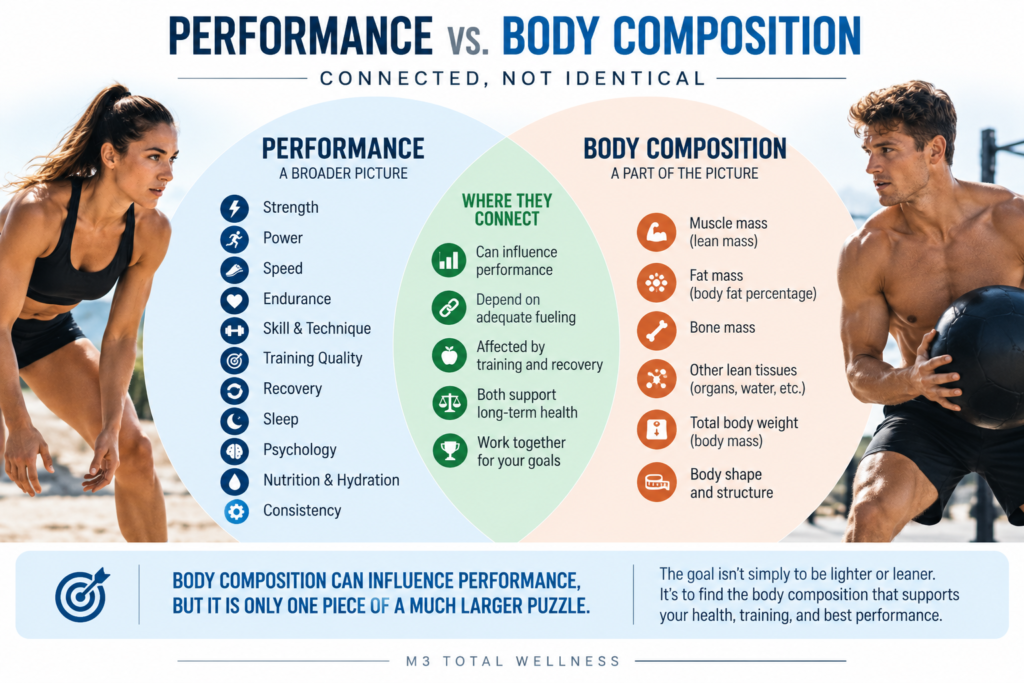
Performance vs. Body Composition
Athletic performance can depend on many factors, including:
- Strength
- Power
- Speed
- Endurance
- Skill
- Coordination
- Mobility
- Training quality
- Recovery
- Sleep
- Nutrition
- Hydration
- Psychology
- Sport-specific technique
Body composition can influence some of these factors, but it is only one part of a much larger performance picture.
For example, additional muscle may benefit an athlete who needs greater force production.
Reducing excess body fat may improve power-to-weight considerations in certain circumstances.
But becoming lighter doesn’t automatically make someone faster.
And becoming leaner doesn’t automatically make someone jump higher.
The body-composition change has to be considered alongside what happens to the athlete’s actual performance.
Does Being Leaner Make You a Better Athlete?
Not necessarily.
This is one of the most important misconceptions in sports nutrition.
Athletes sometimes assume:
If lean is good, leaner must be better.
But athletic performance doesn’t improve indefinitely as body fat decreases.
At some point, pursuing additional leanness may require dietary restriction that becomes increasingly difficult to reconcile with training demands, recovery, health, or psychological well-being.
This means the relevant question isn’t:
How lean can I get?
It’s:
What body composition allows me to train, recover, remain healthy, and perform effectively in my sport?
That answer will differ between athletes.
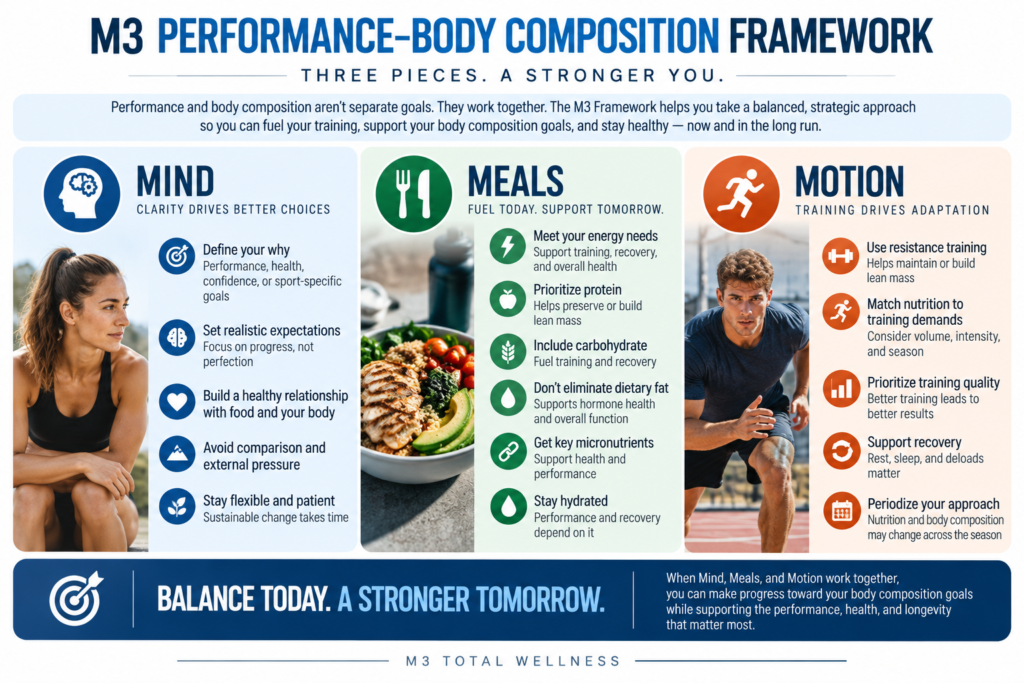
The M3 Performance-Body Composition Framework
Instead of starting with calories or a target weight, I would first evaluate body-composition goals through Mind • Meals • Motion.
Mind
Ask why the goal exists.
Is the athlete pursuing a change because of:
- A legitimate performance objective?
- A health recommendation?
- Sport-specific demands?
- Personal preference?
- Pressure from social media?
- Comparison with teammates?
- Fear of gaining weight?
- A belief that lighter automatically means better?
The reason matters.
Meals
Then consider whether the nutrition plan can support:
- Adequate energy availability
- Training carbohydrate
- Protein needs
- Dietary fat
- Micronutrients
- Hydration
- Recovery
A body-composition plan shouldn’t simply be:
Eat as little as possible until the scale changes.
Motion
Finally, look at what the athlete is actually asking their body to do.
Consider:
- Training volume
- Training intensity
- Competition schedule
- Resistance training
- Conditioning
- Recovery demands
- Current phase of the season
A nutrition strategy appropriate during a lower-volume off-season period may not be appropriate during the most demanding competition block of the year.
Why Athletes Struggle to Balance These Goals
Athletes are surrounded by messages about body composition.
They may hear:
“You need to get leaner.”
“Carbs make you gain fat.”
“You need to cut weight.”
“You’d jump higher if you lost ten pounds.”
“You need to look more athletic.”
Sometimes those messages come from social media.
Sometimes teammates.
Sometimes coaches.
And sometimes from the athlete themselves.
This creates pressure to pursue fast results.
The athlete begins focusing primarily on what the scale says rather than what is happening in training.
That’s where body-composition goals can become disconnected from performance.
When Body-Composition Goals May Be Appropriate
Body-composition manipulation isn’t inherently bad.
There are situations in which an athlete may reasonably want to:
- Reduce fat mass
- Increase lean mass
- Change strength-to-mass characteristics
- Prepare for the demands of a specific sport
- Address a medically appropriate health goal
The important word is individualized.
The appropriate strategy depends on factors including:
- Current body composition
- Sport
- Position or event
- Training phase
- Competition schedule
- Medical history
- Eating behavior
- Previous dieting history
- Age
- Sex
- Performance goals
Recent reviews of expert sports-nutrition guidance emphasize individualized, realistic and health-focused body-composition targets rather than universal body-weight or body-fat goals.
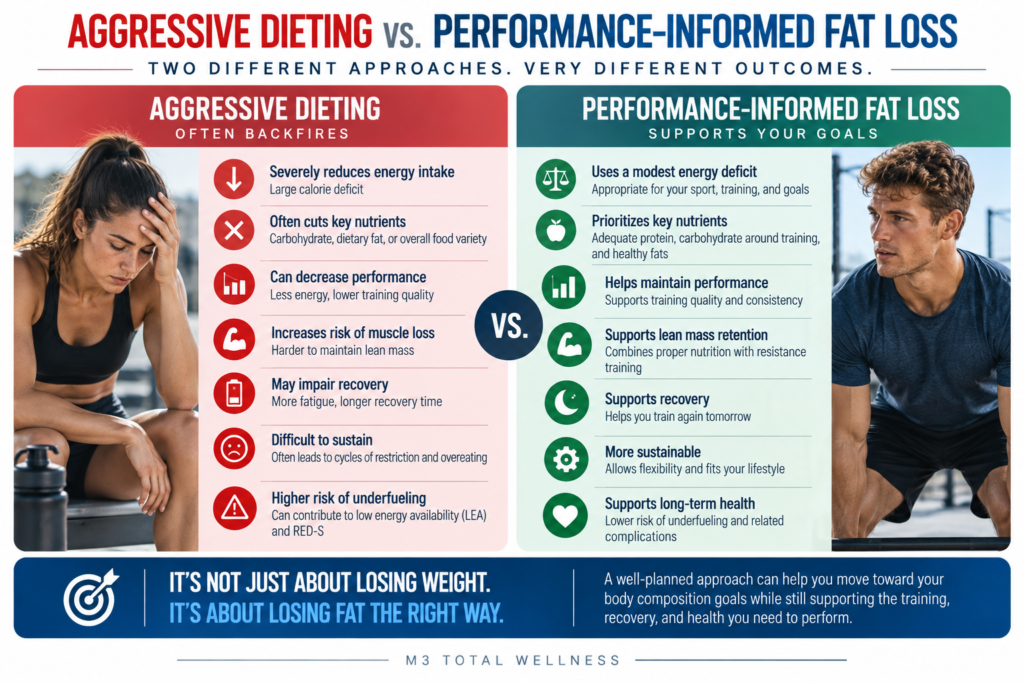
The Problem With Aggressive Dieting
Suppose an athlete wants to lose body fat.
They dramatically reduce food intake while maintaining the same training load.
Now there is less energy coming in while training continues to create substantial demand.
The athlete may also unintentionally reduce:
- Carbohydrate
- Protein
- Dietary fat
- Vitamins and minerals
- Overall food variety
Aggressive restriction can also make it more difficult to support high-quality training and preserve lean tissue.
This doesn’t mean an athlete can never intentionally eat below their energy needs.
A planned energy deficit can be appropriate for some athletes pursuing fat loss.
The distinction is between strategic energy restriction and simply underfueling training.
Can Athletes Lose Fat Without Sacrificing Performance?
Sometimes, yes.
But there is no guarantee that every athlete can lose any amount of body fat while maintaining every aspect of performance unchanged.
The goal is to minimize unnecessary tradeoffs.
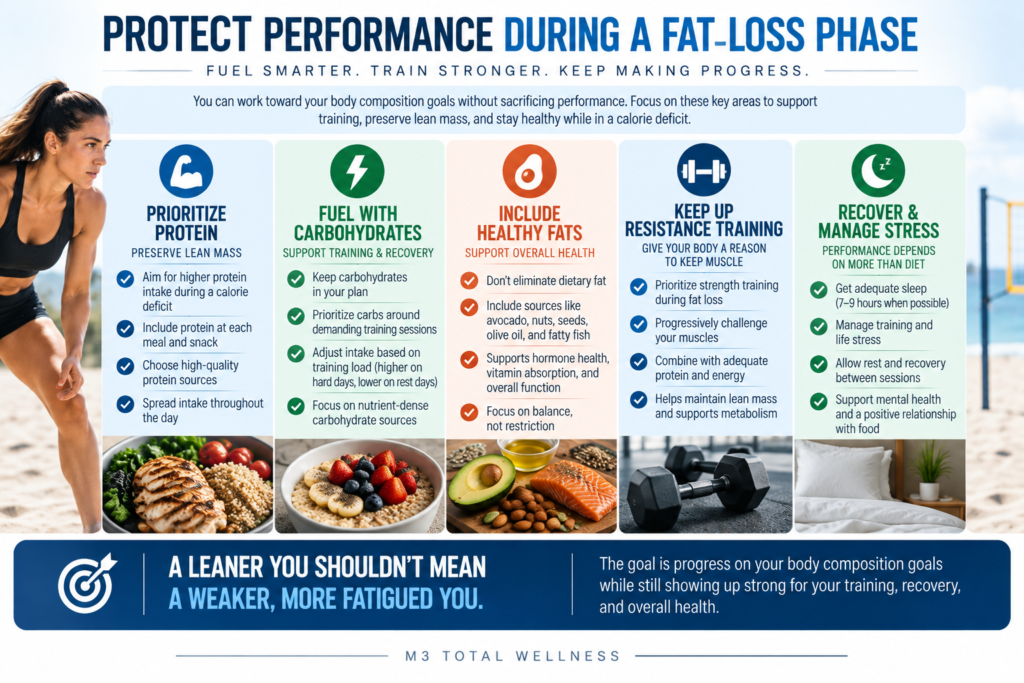
A performance-informed fat-loss strategy generally considers:
1. The size of the energy deficit
A larger deficit may produce faster scale changes, but faster isn’t necessarily better.
2. Protein intake
Adequate protein becomes especially important when trying to preserve lean mass during energy restriction.
3. Carbohydrate availability
Important training sessions still require fuel.
4. Resistance training
Muscle needs a reason to be retained.
5. Recovery
Sleep and recovery remain part of the adaptation process.
6. Timing
Trying to achieve aggressive body-composition changes during the hardest competition period may create unnecessary conflict between goals.
How Quickly Should Athletes Lose Weight?
There is no universal rate that is appropriate for every athlete.
However, research in elite athletes provides a useful lesson: slower weight loss can be more favorable than aggressive weight loss when preservation of lean mass and performance is important.
In one intervention, athletes assigned to slower versus faster weight loss lost similar amounts of total body mass, while the slower approach produced more favorable changes in lean body mass and strength-related outcomes.
That does not mean every athlete should target an exact percentage of body weight each week.
Instead, it supports a broader principle:
When fat loss is appropriate, there is usually little performance advantage to making the process unnecessarily aggressive.
The leaner the athlete becomes, the more cautious the approach may need to be.
Protein During a Fat-Loss Phase
Protein is important for all athletes, but it becomes particularly relevant during energy restriction.
When calories are reduced, the goal usually isn’t simply:
lose weight.
It’s more often:
reduce fat mass while preserving as much lean mass and performance capacity as possible.
Research in energy-restricted, resistance-trained athletes suggests that protein needs may increase as the energy deficit becomes larger and the athlete becomes leaner.
Practical strategies include:
- Include protein across multiple meals
- Prioritize high-quality protein sources
- Consume protein around resistance training
- Maintain adequate total daily protein
- Avoid creating such an aggressive deficit that preserving lean mass becomes unnecessarily difficult
For a broader discussion, see Protein Needs for Athletes.
Don’t Automatically Cut Carbohydrates
One of the first things athletes often remove when trying to lose body fat is carbohydrate.
That’s not automatically necessary.
Carbohydrate is an important fuel for many moderate- and high-intensity sports.
That includes activities such as:
- Volleyball
- Soccer
- Basketball
- Tennis
- Swimming
- Running
- CrossFit
- High-intensity conditioning
- Demanding resistance training
During a body-composition phase, carbohydrate intake can be adjusted according to training demands rather than indiscriminately eliminated.
For example, an athlete might prioritize carbohydrate around:
- Hard practices
- Long sessions
- High-intensity training
- Competition
- Two-a-day sessions
while having different requirements on lighter training or rest days.
Sports nutrition recommendations emphasize matching energy and nutrient intake to training demands rather than applying one static diet regardless of the training being performed.
For more, see Carbohydrates and Athletic Performance.
Dietary Fat Still Matters
Fat sometimes gets aggressively reduced when athletes attempt to create an energy deficit.
But dietary fat serves important functions.
It contributes to:
- Overall energy intake
- Essential fatty acids
- Absorption of fat-soluble vitamins
- Cell structure
- Hormone-related physiological processes
A body-composition strategy should therefore focus on overall dietary structure rather than trying to eliminate an entire macronutrient.
For more, see Healthy Fats for Athletes.
Resistance Training and Lean-Mass Retention
Nutrition is only part of body-composition management.
Training provides the stimulus for adaptation.
If an athlete wants to preserve or build muscle, resistance training remains important.
During fat loss, resistance training helps provide a reason for the body to maintain lean tissue.
This is particularly important because the goal of an athletic fat-loss phase generally isn’t:
Become smaller at any cost.
It’s:
Reduce fat mass while preserving the physical qualities needed for sport as much as possible.
What About Athletes Trying to Gain Muscle?
Not every body-composition goal involves fat loss.
Some athletes want to increase lean mass.
That requires a different strategy.
Muscle development depends on factors including:
- Progressive resistance training
- Adequate protein
- Sufficient energy
- Carbohydrate to support training
- Recovery
- Sleep
- Time
Simply eating enormous amounts of food doesn’t guarantee that all additional weight will be muscle.
Likewise, expecting substantial muscle gain while chronically underfueling may work against the athlete’s goal.
A muscle-gain phase should therefore be deliberate rather than simply:
Eat everything possible and hope the weight is muscle.
How to Monitor Whether the Plan Is Working
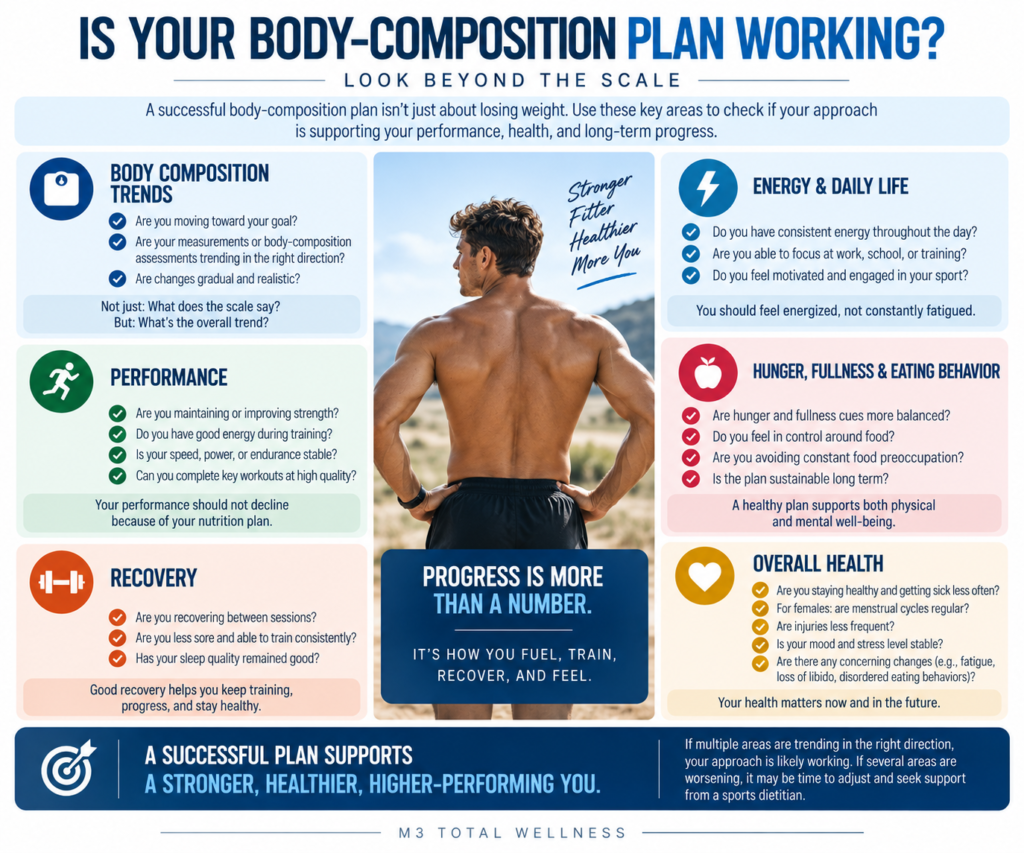
The scale is only one piece of information.
A more useful evaluation might include:
Body-composition direction
Is the athlete moving toward the intended goal?
Training performance
Are strength, power, endurance, speed, or sport-specific performance being maintained or improving?
Recovery
Is the athlete recovering between sessions?
Energy
Is normal training becoming unusually difficult?
Hunger and eating behavior
Is the strategy creating excessive hunger, food preoccupation, binge-restrict patterns, or increasing rigidity?
Health
Are there concerning changes in:
- Menstrual or reproductive function
- Injury frequency
- Illness
- Sleep
- Mood
- GI function
A body-composition strategy isn’t successful simply because body weight decreases.
Body Composition, Underfueling, LEA, and RED-S
This distinction is especially important.
Trying to change body composition does not automatically mean an athlete is underfueling.
And intentional fat loss does not automatically mean an athlete has low energy availability or RED-S.
However, aggressive or prolonged energy restriction can increase the risk that energy intake becomes insufficient relative to exercise demands.
A simplified relationship might look like:
Aggressive or poorly managed energy restriction → may contribute to inadequate fueling → may contribute to LEA
Problematic prolonged and/or severe LEA can contribute to the development of Relative Energy Deficiency in Sport (RED-S).
RED-S can affect multiple aspects of physiological and psychological functioning as well as performance. The current IOC framework distinguishes adaptable LEA from problematic LEA rather than treating every short-term energy mismatch as RED-S.
For a deeper explanation, see:
Signs of Underfueling in Athletes
Low Energy Availability in Athletes: Signs, Risks, and Why It Matters
Relative Energy Deficiency in Sport (RED-S): What Athletes Need to Know
When NOT to Prioritize Fat Loss
There are situations where pursuing additional fat loss may deserve reconsideration.
Examples may include an athlete experiencing:
- Persistent fatigue
- Declining performance
- Recurrent injuries
- Frequent illness
- Menstrual or reproductive changes
- Significant food restriction
- Increasing fear or anxiety around eating
- Compulsive exercise
- Significant body-image distress
- Signs of inadequate energy availability
This doesn’t mean one symptom automatically makes fat loss unsafe.
It means the athlete’s health and fueling status deserve evaluation before further restriction is encouraged.
Timing Body-Composition Changes Around the Season
Athletes don’t train the same way year-round.
Nutrition goals shouldn’t necessarily remain identical year-round either.
An athlete may have more flexibility to pursue body-composition changes during a period with:
- Lower competition demands
- More predictable training
- Greater recovery time
- A strong resistance-training emphasis
During competition, priorities may shift toward:
- Fueling performance
- Recovery
- Maintaining body composition
- Staying healthy
- Preparing for the next event
This is one reason body composition should be periodized alongside training, rather than treated as a permanent diet.
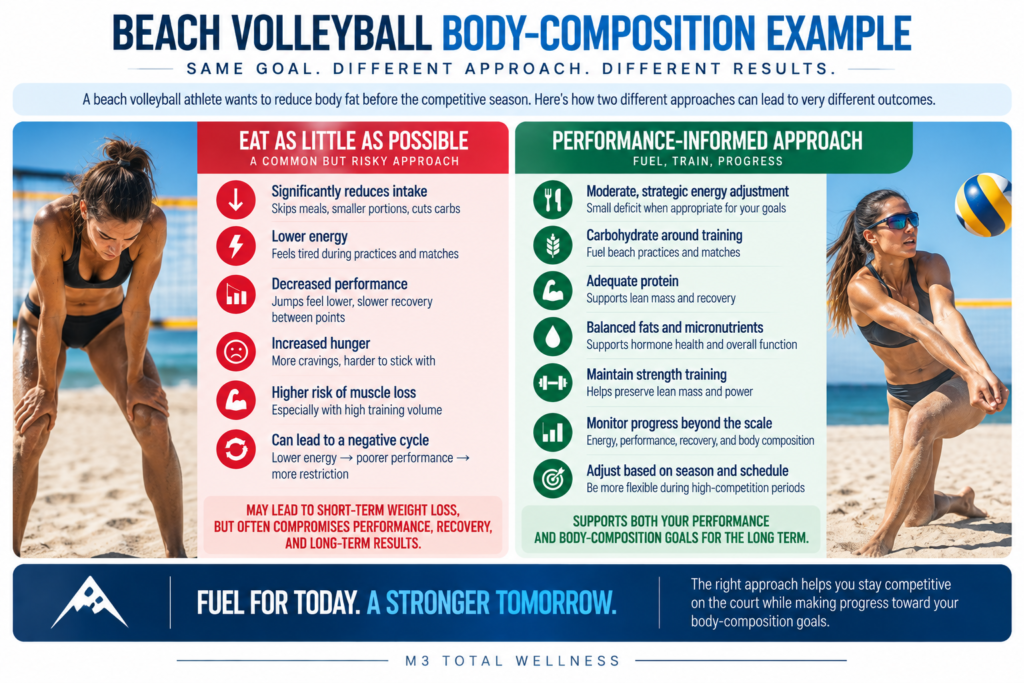
Sport-Specific Example: Beach Volleyball
Consider a beach volleyball athlete who wants to reduce body fat before the competitive season.
They initially decide to eat much less.
Breakfast becomes coffee.
Lunch gets smaller.
Carbohydrate is reduced because they believe it prevents fat loss.
But beach training continues several days per week.
Over time, the athlete notices:
- Less energy late in sessions
- Repeated jumps feel harder
- Longer recovery between practices
- Increased evening hunger
- Difficulty maintaining training quality
The answer isn’t necessarily to abandon the body-composition goal.
Instead, the strategy may need to change.
A more performance-informed approach could involve:
- A more modest energy adjustment
- Adequate protein throughout the day
- Carbohydrate before demanding beach sessions
- Carbohydrate and protein after training
- Resistance training to support lean mass
- Less aggressive nutrition adjustments around tournaments
- Monitoring jump performance, energy, recovery, hunger, and health
Now the athlete isn’t asking:
How little can I eat?
They’re asking:
What’s the smallest effective adjustment that moves me toward my body-composition goal while still allowing me to train well?
That is a much more useful performance question.
Common Body-Composition Myths
Myth 1: “Losing Weight Will Make Me Faster or Jump Higher”
Reality: Not automatically.
If weight decreases but strength, power, training quality, or health deteriorate, the change may not improve performance.
Myth 2: “The Bigger the Calorie Deficit, the Better”
Reality: A larger deficit may accelerate weight loss, but faster weight loss isn’t automatically better for preserving lean mass or performance.
Myth 3: “I Need to Cut Carbs to Get Lean”
Reality: Fat loss requires an appropriate energy balance over time. Athletes still need to consider carbohydrate requirements for training.
Myth 4: “If the Scale Isn’t Moving, Nothing Is Happening”
Reality: Body weight can fluctuate because of hydration, glycogen, GI contents and other factors. Changes in body composition and performance aren’t always reflected immediately by scale weight.
Myth 5: “More Protein Will Automatically Build More Muscle”
Reality: Protein is important, but muscle development also requires an appropriate training stimulus, sufficient overall nutrition, recovery, and time.
Myth 6: “Every Athlete Should Be as Lean as Possible”
Reality: There is no universal body-fat percentage that optimizes performance for every athlete.
Sports Dietitian Insight: Don’t Let the Secondary Goal Undermine the Primary Goal
When an athlete tells me they want to lose body fat, I don’t think the first question should be:
How many calories can we remove?
I would first want to understand:
Why does the athlete want this change, and what are they unwilling to sacrifice to achieve it?
For an athlete, body composition usually exists inside a larger performance goal.
If the athlete becomes lighter but can’t train effectively, what was gained?
If they become leaner but recovery deteriorates, was the strategy successful?
If the diet produces the desired number on the scale but becomes impossible to maintain, what happens next?
That doesn’t mean body composition shouldn’t matter.
It means we should define success more carefully.
A successful body-composition phase should move the athlete toward their goal while preserving the health and performance qualities that matter whenever possible.
That’s very different from chasing the lowest possible number on the scale.
The M3 Performance-Body Composition Check-In
Before changing your diet, work through Mind • Meals • Motion.
Mind
Ask:
- Why do I want to change my body composition?
- Is this goal coming from me or someone else?
- Do I believe I need to look a certain way to be a “real athlete”?
- Am I afraid of gaining weight?
- Am I becoming increasingly rigid around food?
- What would make this goal successful besides a number on the scale?
Meals
Consider:
- Am I eating enough to support important training?
- Am I getting adequate protein?
- Am I consuming carbohydrate around demanding sessions?
- Have I eliminated foods unnecessarily?
- Am I frequently skipping meals?
- Am I constantly hungry?
- Is my eating becoming harder to sustain?
Motion
Look at training:
- Is my performance stable?
- Am I maintaining strength?
- How is my endurance?
- How am I recovering?
- Is my training volume increasing?
- Am I currently competing?
- Would another phase of the season be better for this goal?
Then ask:
Is my body-composition strategy supporting the athlete I’m trying to become—or interfering with it?
When to Seek Professional Help
Body-composition changes can become complicated quickly because they involve performance, physiology, nutrition, and sometimes body image.
Professional guidance may be particularly useful when an athlete:
- Has high training demands
- Competes at a high level
- Has repeatedly dieted without success
- Is already relatively lean
- Has a history of disordered eating
- Experiences menstrual or reproductive changes
- Has recurrent injuries
- Experiences declining performance
- Is unsure how much to eat
- Is becoming increasingly anxious or restrictive around food
An appropriately qualified sports dietitian can help determine whether the goal itself is appropriate and, if so, how to pursue it while accounting for training and health.
Frequently Asked Questions
Can Athletes Lose Fat and Still Perform Well?
Yes, some athletes can reduce fat mass while maintaining or even improving aspects of performance. The outcome depends on factors such as the size of the energy deficit, training program, protein and carbohydrate intake, starting body composition, recovery, and rate of change.
Should Athletes Be in a Calorie Deficit?
A calorie deficit may be appropriate when fat loss is an appropriate goal, but it should not automatically be prescribed to every athlete who wants to become leaner.
The size and timing of the deficit should account for training and health.
How Fast Should an Athlete Lose Weight?
There is no universal rate. In athlete research, slower weight-loss approaches have produced more favorable lean-mass and strength outcomes than faster restriction in some circumstances.
Should Athletes Cut Carbs When Trying to Lose Fat?
Not automatically.
Carbohydrate requirements should be considered in relation to training demands. Reducing overall energy intake doesn’t require eliminating the primary fuel used for many demanding training sessions.
How Much Protein Do Athletes Need During Fat Loss?
Needs vary. Research suggests that protein requirements can increase during energy restriction, particularly in lean, resistance-trained athletes. The appropriate target depends on the athlete, degree of restriction, training, and body composition.
Does Lower Body Fat Always Improve Performance?
No.
The relationship between body composition and performance depends on the athlete and sport. Becoming leaner at the expense of strength, training quality, recovery, or health may not improve performance.
Can I Gain Muscle and Lose Fat at the Same Time?
It can occur, particularly in some newer trainees, athletes returning to structured resistance training, or certain individuals with sufficient energy stores. But the likelihood and magnitude depend on training status, nutrition, starting body composition, and other factors.
Trying to maximize muscle gain and maximize fat loss simultaneously may create competing priorities.
Conclusion
Athletes don’t necessarily have to choose between performance and body composition.
But they do need to decide which goal drives the plan.
If body-composition changes are appropriate, they should be pursued in a way that accounts for:
- Training demands
- Energy availability
- Protein
- Carbohydrate
- Resistance training
- Recovery
- Health
- Competition timing
- Sustainability
Within the M3 Performance Framework — Mind • Meals • Motion, body composition isn’t treated as an isolated number.
Mind helps establish realistic goals and a healthier relationship with the process.
Meals provide the energy and nutrients needed to support training and adaptation.
Motion creates the stimulus that ultimately determines what the athlete needs to fuel.
The goal isn’t to become as light or lean as possible.
It’s to find an approach that supports the athlete’s performance, health, and individual goals at the same time.
Need Help Balancing Performance and Body-Composition Goals?
If you’re trying to improve body composition without sacrificing your training, an individualized sports nutrition strategy can help determine how much to eat, how to fuel important sessions, and how to monitor whether the plan is actually supporting your goals.
Learn more about M3 Performance Nutrition Coaching.
If you’re unsure whether your current nutrition, training, and recovery habits are aligned with your goals, you can also start with the M3 Performance Assessment.
This article is for educational purposes and is not intended to diagnose or treat a medical condition. Athletes experiencing persistent fatigue, recurrent injuries, significant food restriction, menstrual or reproductive changes, disordered eating behaviors, or other concerning symptoms should seek evaluation from an appropriately qualified healthcare professional.
References
Thomas, D. T., Erdman, K. A., & Burke, L. M. (2016). Position of the Academy of Nutrition and Dietetics, Dietitians of Canada, and the American College of Sports Medicine: Nutrition and athletic performance. Journal of the Academy of Nutrition and Dietetics, 116(3), 501–528. DOI: 10.1016/j.jand.2015.12.006.
Garthe, I., Raastad, T., Refsnes, P. E., Koivisto, A., & Sundgot-Borgen, J. (2011). Effect of two different weight-loss rates on body composition and strength and power-related performance in elite athletes. International Journal of Sport Nutrition and Exercise Metabolism, 21(2), 97–104. DOI: 10.1123/ijsnem.21.2.97.
Helms, E. R., Zinn, C., Rowlands, D. S., & Brown, S. R. (2014). A systematic review of dietary protein during caloric restriction in resistance trained lean athletes: A case for higher intakes. International Journal of Sport Nutrition and Exercise Metabolism, 24(2), 127–138. DOI: 10.1123/ijsnem.2013-0054.
Murphy, C. H., & Koehler, K. (2022). Energy deficiency impairs resistance training gains in lean mass but not strength: A meta-analysis and meta-regression. Scandinavian Journal of Medicine & Science in Sports, 32(1), 125–137. DOI: 10.1111/sms.14075.
Mountjoy, M., Ackerman, K. E., Bailey, D. M., et al. (2023). 2023 International Olympic Committee’s (IOC) consensus statement on Relative Energy Deficiency in Sport (REDs). British Journal of Sports Medicine, 57(17), 1073–1097. DOI: 10.1136/bjsports-2023-106994.
Delany, L. V., Costello, N., Jones, B., & Backhouse, S. H. (2025). Dietary recommendations for body mass and composition manipulation in male and female athletes: A scoping review of consensus statements, position stands and practice guidelines from international expert groups. Sports Medicine, 55, 2445–2487. DOI: 10.1007/s40279-025-02285-4