
Quick Answer
Low energy availability (LEA) occurs when an athlete does not consume enough energy to adequately support both exercise and the body’s other physiological needs.
It can happen intentionally, such as during aggressive dieting, or unintentionally when training increases but food intake doesn’t keep up.
Over time, problematic low energy availability can affect recovery, bone health, hormonal and reproductive function, immune function, metabolism, and athletic performance. It is also the underlying exposure associated with Relative Energy Deficiency in Sport (RED-S).
And it doesn’t only affect female athletes. Male and female athletes can both experience LEA and RED-S.
The important takeaway is simple: training creates a demand for energy. If you’re consistently asking your body to do more without providing enough fuel, eventually something may have to give.
Key Takeaways
- Low energy availability in athletes occur when dietary energy intake is insufficient relative to exercise demands and the energy needed to support normal physiological function.
- LEA can be intentional, but many athletes underfuel without realizing it.
- Both male and female athletes can be affected.
- Problematic LEA can negatively affect health, recovery, training adaptation, and performance.
- Possible warning signs include persistent fatigue, poor recovery, recurrent illness or injury, declining performance, menstrual changes, reduced libido, and changes in mood or concentration.
- Athletes can maintain performance for a period of time despite underfueling, so performance alone isn’t enough to rule out a problem.
- RED-S is broader than LEA. Problematic LEA is the underlying exposure that can contribute to the health and performance consequences associated with RED-S.
- Increasing training without increasing fuel is a common way athletes unintentionally fall behind.
- Adequate energy intake, consistent meals and snacks, and adjusting food intake with training demand are central to prevention.
- Persistent signs of underfueling deserve attention rather than simply pushing through them.
Introduction
You’re training consistently.
You’re eating what you consider a healthy diet.
You’re putting in the work.
But something feels off.
You’re tired more often than you should be. Recovery takes longer. Your performance has become inconsistent. Maybe you’re getting sick more frequently, dealing with recurring injuries, or simply feeling run down.
The natural response for many athletes is to look at the training plan.
Maybe I need better conditioning.
Maybe I need another supplement.
Maybe I need to train harder.
Sometimes the problem isn’t the workout.
Sometimes the athlete simply isn’t eating enough to support it.
That’s what makes low energy availability so important to understand.
Underfueling isn’t always obvious. You don’t have to be starving yourself, following an extreme diet, or visibly losing weight to experience inadequate energy availability.
An athlete can eat nutritious foods and still not eat enough.
You can also begin a season eating adequately, increase your training substantially, and suddenly find that the same amount of food no longer meets your needs.
Within the **M3 Performance Framework—Mind, Meals, and Motion—**I look at low energy availability as a mismatch among all three:
Motion increases the demand.
Meals have to provide enough energy to meet that demand.
Mind influences the beliefs, habits, schedules, and decisions that determine whether fueling actually happens.
When those pieces become misaligned for too long, both health and performance can suffer.
Table of Contents
What Is Low Energy Availability?
Energy availability describes the dietary energy remaining for the body’s physiological functions after accounting for the energy used during exercise.
In practical terms, your body needs energy for much more than your workout.
It also needs energy to support:
- Brain function
- Bone remodeling
- Immune function
- Hormonal and reproductive function
- Cardiovascular function
- Tissue repair
- Metabolism
- Normal daily physiological processes
When exercise expenditure is high and dietary intake doesn’t provide enough energy to cover both training and these other needs, energy availability can become low.
The International Olympic Committee defines low energy availability as a mismatch between dietary energy intake and exercise energy expenditure that leaves the body’s total energy needs unmet.
That doesn’t mean every brief period of reduced energy availability automatically causes harm.
Current sports medicine guidance recognizes a continuum.
A short, carefully managed period of lower energy availability may sometimes produce mild and reversible adaptations without necessarily resulting in adverse health or performance outcomes. The greater concern is problematic LEA—a level or duration of inadequate energy availability associated with harmful effects on health, well-being, or performance.
This distinction matters because LEA isn’t an on/off switch.
The duration, severity, frequency, and individual athlete all matter.
Low Energy Availability vs. Underfueling
You’ll often hear the words underfueling and low energy availability used together.
They’re related, but they’re useful in slightly different ways.
Underfueling is the practical term I often use with athletes. It describes a situation where food intake isn’t adequately supporting the demands being placed on the body.
Energy availability is the more specific sports-science concept describing the dietary energy remaining after exercise for the body’s other physiological functions.
You don’t need to calculate your energy availability every morning to understand the lesson.
The important question is:
Are you consistently providing enough energy to support your training and everything your body needs to do outside of training?
If you’re unsure how your overall energy needs change with training, read Energy Needs for Athletes: How Much Should You Be Eating?
The M3 Energy Framework
Low energy availability provides a good example of why I don’t look at sports nutrition in isolation.
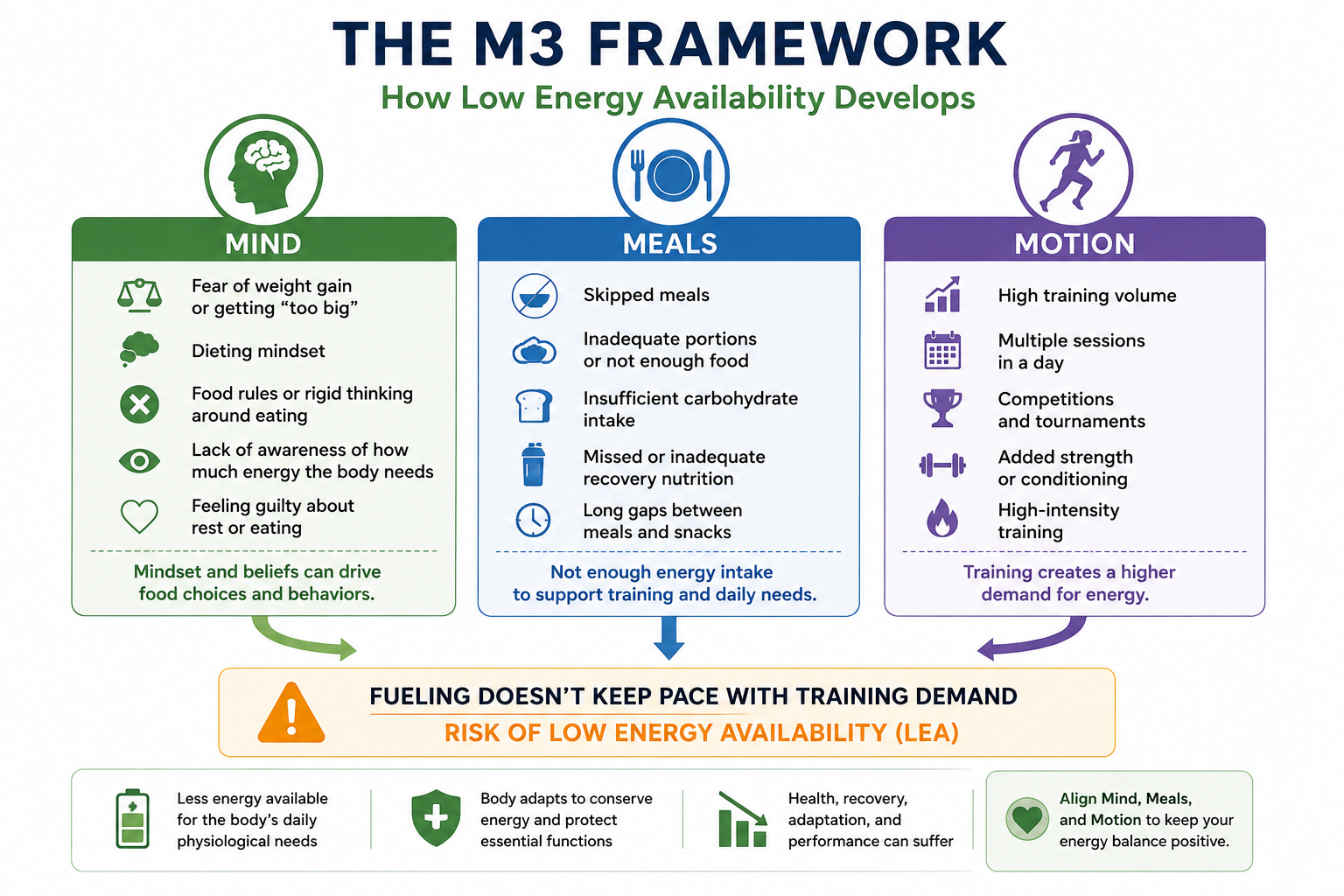
Within the M3 Performance Framework, Mind, Meals, and Motion interact.
Mind
An athlete’s beliefs and behaviors can influence fueling.
Examples include:
- Fear of gaining weight
- Pressure to become leaner
- Believing lighter always means faster
- Labeling foods as “good” or “bad”
- Trying to eat as little as possible while still performing
- Not recognizing how much fuel training requires
But intentional restriction isn’t the only issue.
An athlete may genuinely believe they’re eating enough and simply underestimate their needs.
Meals
Food intake may fall short because of:
- Skipped meals
- Small portions
- Long gaps without eating
- Inadequate carbohydrate intake
- Limited recovery nutrition
- Low-energy-density food choices
- Lack of portable foods during busy days
- Poor planning around practices and competitions
Eating nutritious foods is important.
But food quality cannot compensate for chronically inadequate food quantity.
Motion
Then we have training demand.
Risk can increase when athletes add:
- Longer practices
- Higher training intensity
- Additional conditioning
- Strength sessions
- Two-a-day workouts
- Tournament weekends
- More competition
- High levels of activity outside formal training
If Motion increases while Meals stay the same, the athlete may gradually fall behind.
Mind influences the decisions. Meals provide the fuel. Motion determines much of the demand.
Keeping those three aligned is a major part of preventing chronic underfueling.
What Is RED-S?
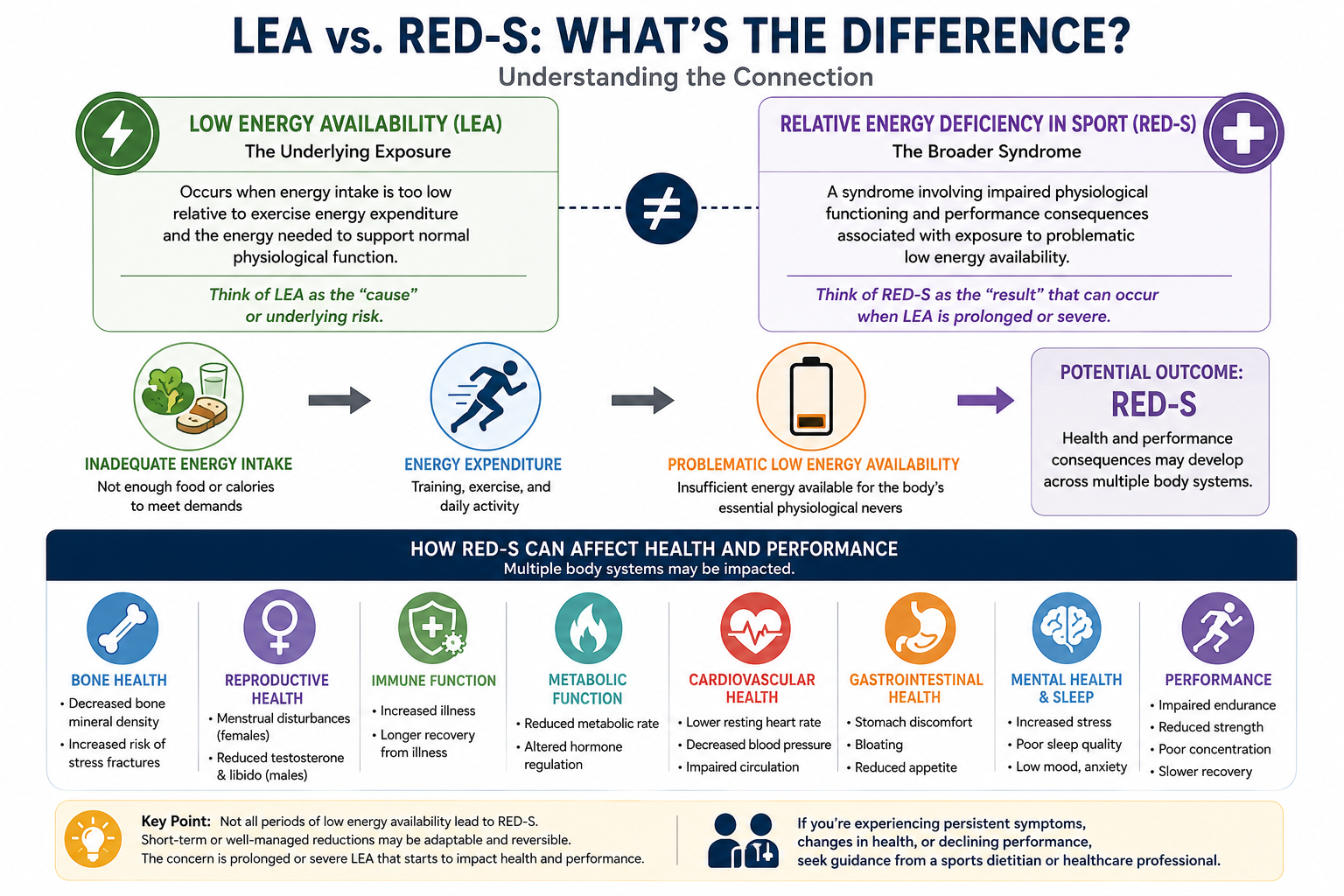
Relative Energy Deficiency in Sport, or RED-S, describes a syndrome involving impaired physiological functioning and performance consequences associated with exposure to problematic low energy availability.
The concept was developed by the International Olympic Committee and has continued to evolve as research has expanded.
RED-S can affect both female and male athletes.
Potential health consequences can involve multiple systems, including:
- Bone health
- Reproductive function
- Metabolic function
- Immune function
- Cardiovascular health
- Gastrointestinal function
- Hematological health
- Sleep
- Mental health
Performance consequences may also occur, including impaired training response, reduced endurance, decreased strength or power, reduced concentration, impaired coordination, and increased time lost from training because of illness or injury.
Is LEA the Same as RED-S?
No.
This distinction is important.
Low energy availability describes the underlying exposure.
RED-S describes the broader syndrome of health and performance consequences that may develop with problematic LEA.
Not every athlete who experiences a brief period of low energy availability has RED-S.
Likewise, you shouldn’t diagnose yourself with RED-S because you had a few tired workouts.
Diagnosis and clinical assessment require much more context.
How Low Energy Availability Can Affect the Body
When energy becomes consistently scarce, the body has to prioritize.
Think about it from a survival perspective.
Your body needs enough energy to keep essential systems functioning while you’re simultaneously asking it to run, jump, lift, sprint, practice, compete, and recover.
If enough energy isn’t available, the body can begin adapting its physiology.
That may include changes involving:
Bone Health
Inadequate energy availability can negatively affect bone metabolism and is associated with impaired bone health and increased concern for bone stress injuries.
Hormonal and Reproductive Function
Female athletes may experience menstrual disturbances.
Male athletes may experience changes such as reduced testosterone or libido.
These aren’t simply inconvenient side effects. They can be clues that the body isn’t receiving what it needs.
Metabolism
The body may adapt to prolonged energy deficiency by altering metabolic and endocrine function.
This is one reason I don’t like describing underfueling as simply “burning more calories than you eat.”
The physiological response is much more complex.
Immune Function
Athletes experiencing problematic LEA may become more susceptible to illness or find themselves repeatedly missing training because they don’t feel well.
Recovery and Adaptation
Training is only the stimulus.
The athlete still needs adequate energy and nutrients to recover and adapt to that stimulus.
If recovery resources are consistently limited, doing more training doesn’t necessarily produce more improvement.
Signs and Symptoms of Low Energy Availability
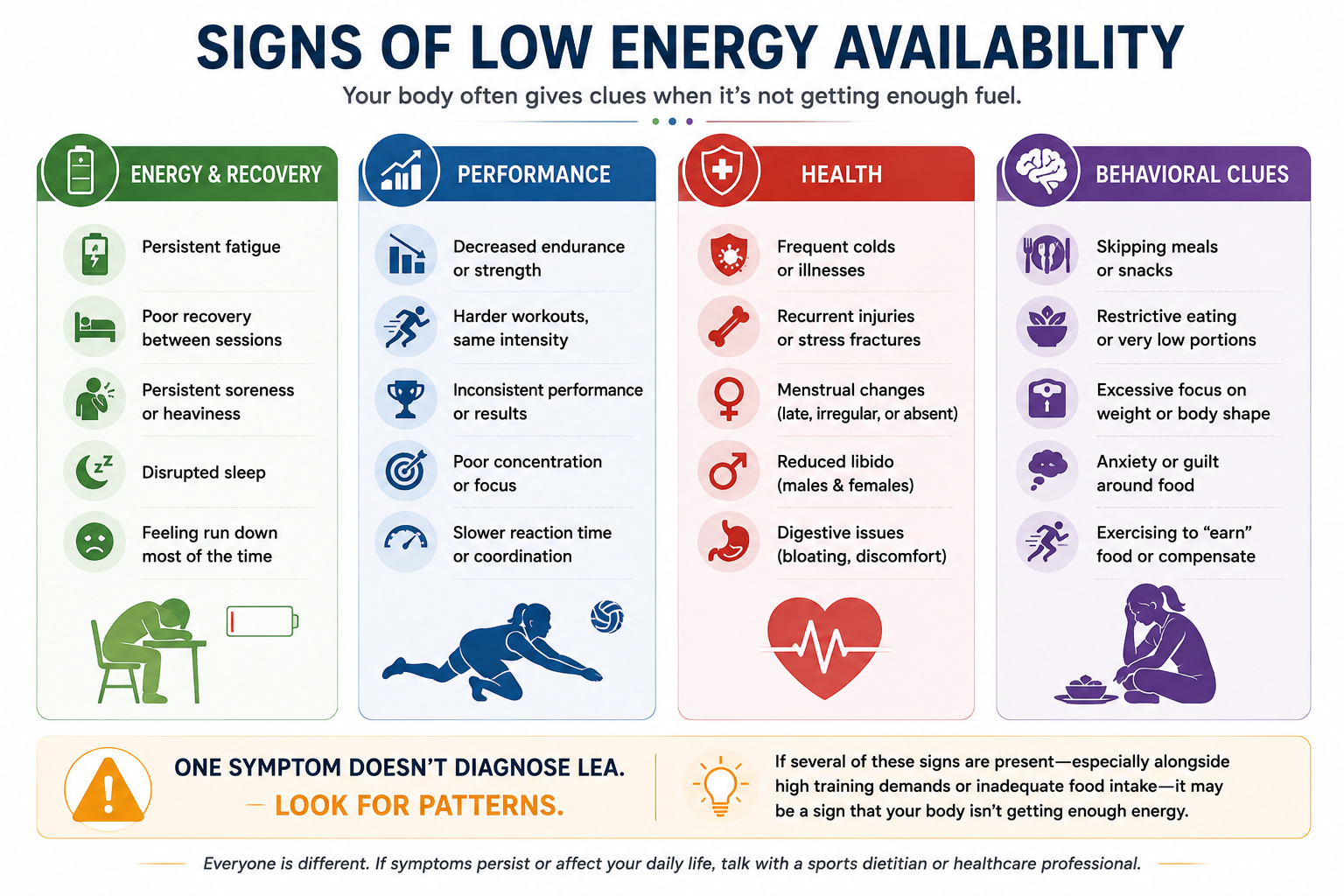
There isn’t one symptom that proves an athlete has LEA or RED-S.
That’s important.
Fatigue can come from poor sleep.
Performance can decline because of excessive training.
An injury can happen for many reasons.
Mood can change because of stress.
What becomes more concerning is a pattern of signs occurring alongside inadequate intake or high training demands.
Possible warning signs include:
Energy and Recovery
- Persistent fatigue
- Feeling run down
- Poor recovery between sessions
- Persistent soreness
- Difficulty maintaining energy throughout the day
- Sleep disturbances
Performance
- Declining training quality
- Reduced endurance
- Decreased strength or power
- Difficulty concentrating
- Reduced coordination or reaction
- Plateauing despite consistent training
- Workouts feeling harder than expected
Health
- Frequent illness
- Recurrent injuries
- Bone stress injuries
- Menstrual disturbances
- Reduced libido
- Hormonal changes
- Gastrointestinal issues
Behavioral Clues
- Frequently skipping meals
- Anxiety about eating more
- Restrictive eating
- Avoiding entire food groups without medical need
- Feeling guilty about rest days
- Exercising specifically to compensate for eating
None of these should be used as a self-diagnostic checklist.
But they are reasons to look more closely at the athlete’s training, nutrition, recovery, and overall health.
How LEA Can Affect Athletic Performance
Athletes sometimes think they can separate health from performance.
They’ll tolerate being exhausted, constantly sore, or frequently sick as long as they’re still competing well.
The problem is that the systems supporting health are also supporting performance.
A 2025 systematic review and meta-analysis found that athletes with LEA showed impairments across several performance-related outcomes, including endurance performance, training response, coordination, concentration, judgment, explosive power, and agility compared with athletes with adequate energy availability.
That matters whether you’re an endurance athlete or an explosive court athlete.
For a volleyball player, for example, those effects could potentially show up as:
- Less explosive jumping
- Slower reactions
- Reduced concentration
- Poorer decision-making late in matches
- Difficulty maintaining intensity
- Slower recovery between matches or training days
You can have the best training program in the world.
But training can only produce the adaptations your body has the resources to support.
Can You Have LEA and Still Perform Well?
Yes.
And this is one of the reasons LEA can be difficult to recognize.
An athlete doesn’t necessarily stop performing well the moment energy availability becomes inadequate.
You may continue training.
You may continue winning.
You may even improve for a period of time.
Performance responses to LEA vary, and not every athlete experiences the same consequences on the same timeline.
That’s why:
“I’m still performing well, so I must be eating enough.”
isn’t a reliable way to evaluate fueling.
Performance is one piece of the picture.
Health, recovery, energy, injuries, illness, hormonal function, eating behaviors, and training demands matter too.
Who Is at Risk for Low Energy Availability?
LEA can occur in almost any sport.
However, certain situations deserve particular attention.
Athletes Trying to Lose Weight
Reducing energy intake while maintaining a heavy training load can create a mismatch quickly, particularly when the calorie deficit becomes aggressive.
Endurance Athletes
Long training sessions can create very high energy demands, and appetite doesn’t always increase enough to compensate.
Weight-Class Athletes
Sports that require athletes to “make weight” can encourage intentional restriction.
Aesthetic or Leanness-Focused Sports
Athletes may experience pressure to maintain a particular appearance or body composition.
Athletes With High Training Volumes
Sometimes the problem isn’t restriction at all.
The athlete simply has a very large energy requirement and struggles to physically eat enough.
Athletes Following Restrictive Diets
Eliminating multiple food groups can make meeting energy and nutrient needs more difficult if appropriate substitutions aren’t made.
Busy Athletes
This group is easy to overlook.
Work.
School.
Commuting.
Practice.
Strength training.
Homework.
Suddenly an athlete has gone six hours without eating—not because they’re dieting, but because there was never a convenient opportunity.
That can add up quickly.
Intentional vs. Unintentional Underfueling
One of the biggest misconceptions about LEA is that it only happens to athletes deliberately restricting food.
It doesn’t.
Intentional Underfueling
This may occur when an athlete:
- Is aggressively trying to lose weight
- Wants to become leaner
- Believes a lower body weight will improve performance
- Restricts certain foods or food groups
- Uses exercise to compensate for eating
These situations deserve careful attention, particularly when food anxiety or disordered eating behaviors are involved.
Unintentional Underfueling
This may be even easier to miss.
An athlete might:
- Skip breakfast because practice is early
- Have a small lunch because classes are busy
- Train for several hours
- Forget a recovery snack
- Eat dinner and assume they’ve fueled adequately
Nothing about that pattern necessarily looks like “dieting.”
But total intake may still be insufficient.
This is why prevention isn’t only about telling athletes not to diet.
It’s also about helping them build practical systems for eating enough.
Low Energy Availability in Male Athletes
Historically, much of the conversation around inadequate energy availability focused on female athletes and the Female Athlete Triad.
That history is important, but our understanding has expanded.
Male athletes can experience LEA and RED-S too.
Potential concerns in male athletes include:
- Reduced testosterone
- Reduced libido
- Impaired bone health
- Poor recovery
- Reduced training capacity
- Changes in metabolic function
- Performance impairment
Male athletes may also be less likely to recognize underfueling because menstrual changes—a warning sign available in many female athletes—obviously aren’t present.
That makes other clues such as persistent fatigue, poor recovery, recurrent injuries, declining performance, changes in libido, and restrictive eating patterns particularly important to recognize.
How to Reduce the Risk of Low Energy Availability
Preventing LEA isn’t about eating the exact same number of calories every day.
It’s about keeping nutrition reasonably aligned with training demand.
1. Adjust Food Intake When Training Increases
If you add another workout, increase practice duration, begin preseason, or enter a tournament-heavy period, your food intake may need to increase too.
Don’t assume yesterday’s nutrition plan automatically fits today’s workload.
2. Eat Consistently
Long gaps without food make it harder to meet high energy needs.
For many athletes, nutrient timing doesn’t need to be complicated. A structure such as:
Breakfast → Snack → Lunch → Pre-training fuel → Recovery nutrition → Dinner
is more manageable than trying to catch up with one enormous evening meal.
3. Include Carbohydrates
Carbohydrates are a major fuel source for moderate- to high-intensity exercise.
Athletes sometimes reduce carbohydrates while simultaneously increasing training—exactly when carbohydrate needs may be greater.
Read Carbohydrates and Athletic Performance for a deeper explanation of how carbohydrates support training.
4. Don’t Forget Dietary Fat
Fat is energy-dense and provides essential fatty acids while helping athletes meet overall energy needs.
Very low-fat eating patterns can make adequate intake more difficult, particularly for athletes with high energy requirements.
5. Prioritize Recovery Nutrition
What happens after training matters, especially when another workout or competition is coming soon.
Recovery nutrition should help replace energy and carbohydrate while providing protein to support muscle repair.
Read Post-Workout Recovery Nutrition for practical recovery strategies.
6. Plan for Busy Days
Keep portable options available:
- Trail mix
- Fruit
- Granola
- Yogurt
- Sandwiches
- Bagels
- Nut butter
- Milk
- Smoothies
- Sports drinks when appropriate
The perfect meal you never have time to eat isn’t useful.
For more portable fueling ideas, see Best Snacks for Athletes: Smart Fueling Options for Energy, Performance, and Recovery.
7. Avoid Aggressive Dieting During Heavy Training
Body-composition goals need to be balanced against training demands, health, and performance.
Trying to dramatically reduce energy intake while simultaneously asking your body to perform at its highest level can work against you.
When Should an Athlete Seek Help?
Persistent symptoms deserve attention.
Consider speaking with a sports dietitian and appropriate healthcare professional if you experience combinations of:
- Persistent fatigue
- Unexplained decline in performance
- Recurrent injuries
- Bone stress injuries
- Frequent illness
- Menstrual changes
- Reduced libido
- Significant or unintended weight loss
- Restrictive eating behaviors
- Anxiety around food or body weight
- Difficulty eating enough to support training
RED-S is a clinical issue, and symptoms can overlap with many other medical conditions.
The goal isn’t to diagnose yourself from an article.
It’s to recognize when something isn’t right and get appropriate evaluation.
Sport-Specific Example: The Underfueled Volleyball Athlete
Consider a beach volleyball athlete playing several hours in hot weather.
They wake up late and eat a small breakfast.
Matches begin around 10:00 AM.
They snack occasionally but avoid eating much because they don’t want to feel heavy while playing.
Lunch gets pushed back because another match is scheduled.
By late afternoon, they’ve played several matches but consumed very little food.
They start noticing:
- Heavy legs
- Less explosive jumping
- Slower reactions
- Difficulty concentrating
- Irritability
- Poor decision-making
- Significant fatigue late in matches
Their first thought might be:
“My conditioning isn’t good enough.”
Maybe.
But before adding more conditioning, I’d want to know what they ate.
If the athlete responds to feeling exhausted by adding another cardio session while continuing to underfuel, they may make the mismatch worse.
A better approach would be to plan fuel throughout the tournament:
Before play: substantial breakfast
Between early matches: carbohydrates and fluids
Longer break: more substantial meal or snack
Between later matches: easy-to-digest carbohydrate
After competition: recovery meal with carbohydrate, protein, fluids, and adequate total energy
That’s the difference between simply training harder and supporting the training you’re already doing.
Frequently Asked Questions
Can you have low energy availability without trying to lose weight?
Yes.
Many athletes experience LEA unintentionally because their training demands increase while their food intake stays the same.
Busy schedules, low appetite, poor meal planning, restrictive food choices, and high training volumes can all contribute.
Is low energy availability the same as RED-S?
No.
Low energy availability is the underlying exposure in which dietary intake doesn’t adequately meet exercise and physiological demands.
RED-S describes the broader health and performance syndrome associated with problematic LEA.
Can I have LEA if my weight is stable?
Potentially.
Body weight alone cannot tell you whether energy availability is adequate.
The body can make physiological adaptations during periods of inadequate energy availability, and changes in health or performance may occur without dramatic weight loss.
Can you perform well while underfueling?
Yes, at least for some period of time.
Not every athlete experiences an immediate decline in performance. That’s why performance should be considered alongside recovery, health, injuries, illness, hormonal function, energy levels, and eating behaviors.
Does LEA only affect female athletes?
No.
Both male and female athletes can experience low energy availability and RED-S.
Do I need to count calories to prevent LEA?
Not necessarily.
Some athletes benefit from a structured assessment of energy intake, but many can improve fueling through regular meals and snacks, appropriate portions, training nutrition, and adjusting intake as workload changes.
Should I eat more on harder training days?
Generally, higher training demands require more fuel.
That may mean larger portions, additional snacks, more carbohydrate around training, or more recovery nutrition.
Your food intake doesn’t need to be identical every day.
What should I do if I think I’m underfueling?
Start by looking at your overall pattern rather than one meal.
Are you skipping breakfast?
Going long periods without food?
Training without eating beforehand?
Missing recovery nutrition?
Eating the same amount despite a large increase in training?
If symptoms are persistent or significant, especially if you’re experiencing recurrent injuries, menstrual changes, reduced libido, unintended weight loss, or restrictive eating behaviors, seek individualized guidance.
Sports Dietitian Insight
In my work with athletes and highly active individuals, one of the most important things I want athletes to understand about low energy availability is that it doesn’t always look like obvious restriction.
Some of the athletes most at risk may feel like they’re doing everything right.
They train consistently.
They choose nutritious foods.
They stay disciplined.
They avoid “junk.”
And they’re exhausted.
When we look closer, they’re sometimes eating a diet that’s high in nutritional quality but simply too low in total energy for what they’re asking their body to do.
That’s an important distinction.
Eating healthy and eating enough are not always the same thing.
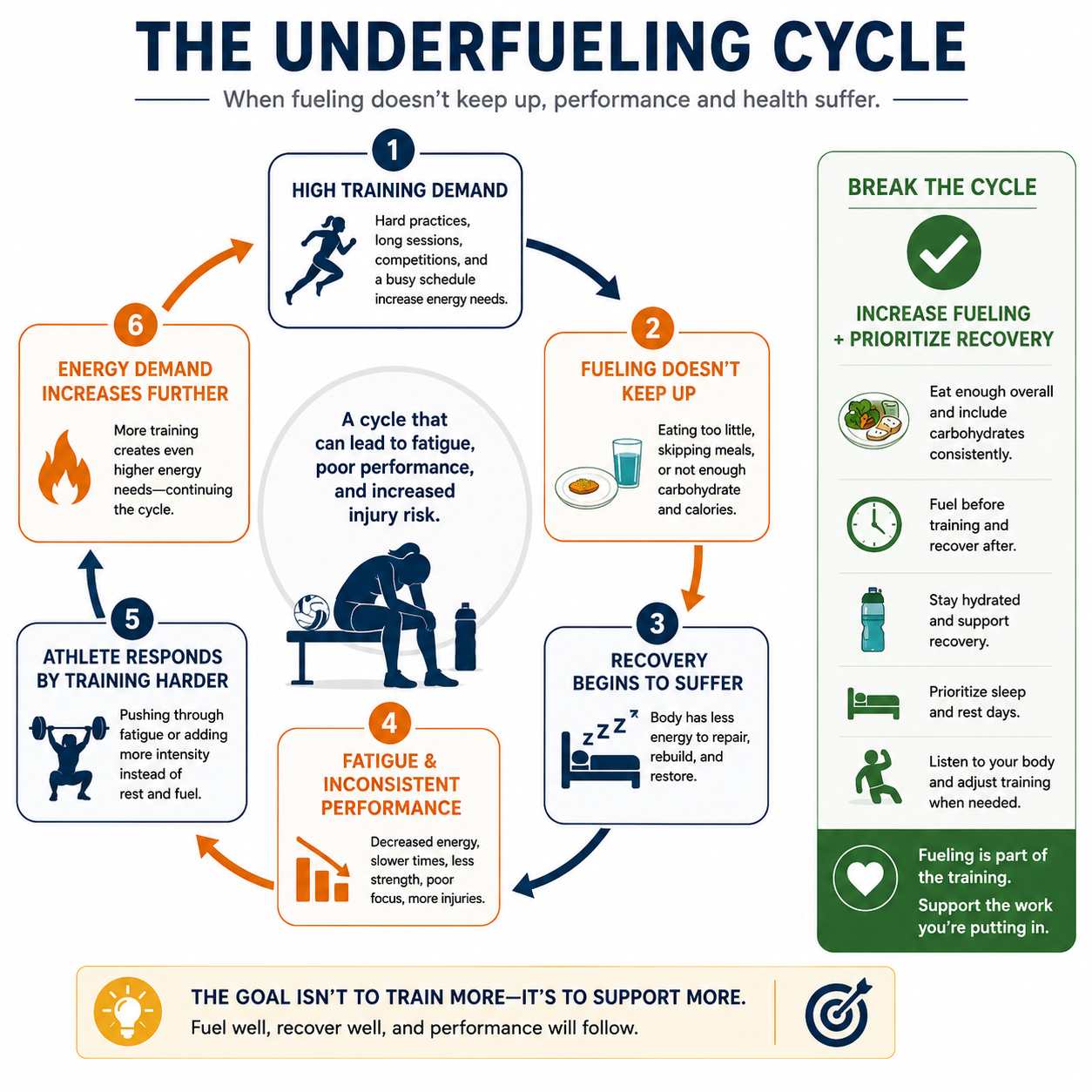
Another pattern I watch for is the athlete who responds to poor performance by adding more training.
They’re tired, so they add conditioning.
They’re losing explosiveness, so they train harder.
Recovery is getting worse, so they look for another supplement.
Sometimes what they actually need isn’t another workout.
They need breakfast.
They need a larger lunch.
They need carbohydrates before practice.
They need recovery nutrition afterward.
They need enough food to support the work they’re already doing.
Before assuming your body needs more training, make sure you’ve given it enough fuel to benefit from the training you already have.
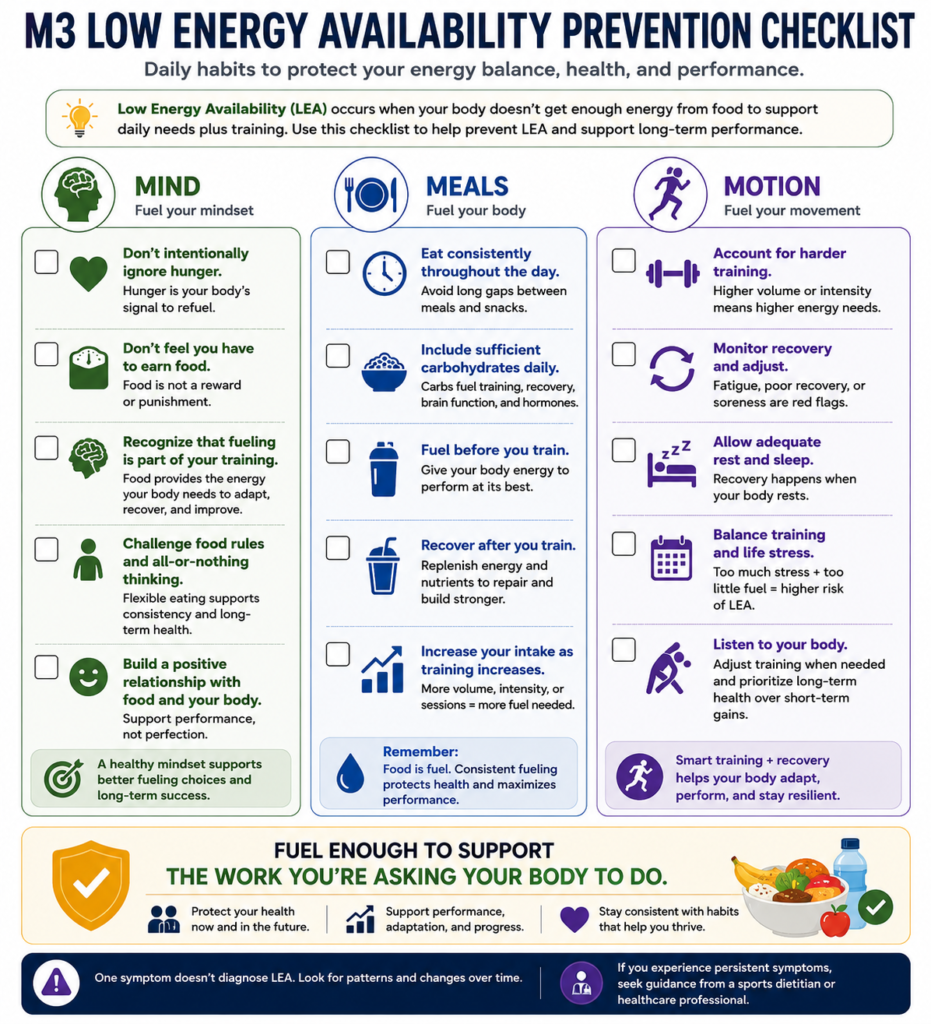
M3 Low Energy Availability Prevention Checklist
Preventing low energy availability isn’t about following a perfect diet. It’s about building consistent habits that keep fueling, recovery, and training demands aligned. Use the M3 checklist below as a practical check-in—not as a diagnostic tool.
Conclusion
Low energy availability is one of the easiest performance problems to overlook because it doesn’t always look dramatic.
An athlete may continue training.
They may continue competing.
They may maintain their weight.
They may even perform well for a while.
But if energy intake repeatedly fails to keep pace with exercise and the body’s physiological needs, health, recovery, and performance can eventually be affected.
That’s why fueling isn’t separate from training.
Fueling is part of training.
Within the M3 Performance Framework, the goal is to keep Mind, Meals, and Motion working together.
Train with purpose.
Recover with purpose.
And provide your body with enough energy to actually benefit from the work you’re putting in.
Concerned You May Be Underfueling?
If you’re training consistently but struggling with fatigue, poor recovery, inconsistent performance, or difficulty figuring out how much you should be eating, an individualized assessment can help identify where your fueling plan may be falling short.
At M3 Total Wellness, I work with athletes and active individuals to build practical nutrition strategies around their training schedule, sport, lifestyle, and performance goals.
A performance nutrition assessment can help you:
- Review your current fueling habits
- Identify potential gaps around training
- Adjust food intake to changing workloads
- Improve pre- and post-training nutrition
- Develop practical meals and snacks
- Support performance without relying on unnecessary restrictions
Ready to see whether your nutrition is keeping up with your training?
Book a Performance Nutrition Assessment with M3 Total Wellness.
References
Gallant, T. L., Ong, L. F., Wong, L., et al. (2025). Low Energy Availability and Relative Energy Deficiency in Sport: A Systematic Review and Meta-analysis. Sports Medicine, 55(2), 325–339.
https://doi.org/10.1007/s40279-024-02130-0
Logue, D. M., Madigan, S. M., Delahunt, E., Heinen, M., Mc Donnell, S. J., & Corish, C. A. (2018). Low Energy Availability in Athletes: A Review of Prevalence, Dietary Patterns, Physiological Health, and Sports Performance. Sports Medicine, 48(1), 73–96.
https://doi.org/10.1007/s40279-017-0790-3
Melin, A. K., Heikura, I. A., Tenforde, A., & Mountjoy, M. (2019). Energy Availability in Athletics: Health, Performance, and Physique. International Journal of Sport Nutrition and Exercise Metabolism, 29(2), 152–164.
https://doi.org/10.1123/ijsnem.2018-0201
Mountjoy, M., Ackerman, K. E., Bailey, D. M., et al. (2023). 2023 International Olympic Committee’s (IOC) consensus statement on Relative Energy Deficiency in Sport (RED-S). British Journal of Sports Medicine, 57(17), 1073–1097.
https://doi.org/10.1136/bjsports-2023-106994
Thomas, D. T., Erdman, K. A., & Burke, L. M. (2016). Position of the Academy of Nutrition and Dietetics, Dietitians of Canada, and the American College of Sports Medicine: Nutrition and Athletic Performance. Journal of the Academy of Nutrition and Dietetics, 116(3), 501–528.
https://doi.org/10.1016/j.jand.2015.12.006