
Quick Answer
Muscle recovery is the process of repairing and adapting after exercise. Every workout places stress on your muscles, uses stored energy, and challenges your body to become stronger. Nutrition plays a vital role in this process by providing protein to repair muscle tissue, carbohydrates to restore glycogen, fluids to maintain normal muscle function, and enough total energy to support recovery. Combined with adequate sleep and consistent training, these habits help athletes recover more effectively and prepare for their next workout.
Key Takeaways
- Muscle recovery begins immediately after exercise and continues for hours to days depending on the training session.
- Protein provides the amino acids needed to repair and rebuild muscle tissue.
- Carbohydrates replenish glycogen stores that fuel future training sessions.
- Hydration supports muscle function, nutrient transport, and recovery.
- Sleep is one of the most powerful recovery tools available to athletes.
- Muscle soreness does not necessarily mean a workout was more effective.
- Consistent nutrition and recovery habits often have a greater impact than searching for the “perfect” recovery supplement.
Introduction
Most athletes believe they get stronger during their workouts.
In reality, the opposite is true.
Every training session temporarily breaks your body down before it builds you back up.
Whether you’re lifting weights, sprinting on the track, swimming laps, playing volleyball, or finishing a challenging CrossFit workout, exercise creates stress within your muscles. Tiny muscle fibers experience microscopic damage, energy stores become depleted, fluids are lost through sweat, and fatigue begins to accumulate.
That sounds negative—but it’s actually a normal and necessary part of becoming a better athlete.
The improvements you’re chasing—greater strength, faster sprint times, higher vertical jumps, improved endurance, or increased power—don’t occur while you’re training.
They happen during recovery.
I’ve worked with athletes who consistently push themselves during practice but pay very little attention to what happens afterward. They train hard, rush to work or class, skip meals, underestimate their hydration needs, and sacrifice sleep to fit everything into their schedule. A few weeks later, they start asking questions like:
- “Why do I always feel sore?”
- “Why am I not getting stronger?”
- “Why do I feel exhausted even though I’m training consistently?”
Most of the time, the answer isn’t that they’re training too little.
It’s that they’re not recovering well enough to adapt to the training they’re already doing.
Recovery isn’t something that happens automatically. While your body is remarkably good at repairing itself, the recovery process depends heavily on having the nutrients, fluids, energy, and rest needed to support that repair.
Within the M3 Performance Framework, recovery is where all three pillars come together.
- Mind helps athletes prioritize recovery, manage stress, and develop habits they can sustain throughout an entire season.
- Meals provide the carbohydrates, protein, fluids, and overall energy needed to repair muscle tissue and prepare for future training.
- Motion creates the training stimulus that challenges the body to adapt and improve.
Think of recovery as the bridge between today’s workout and tomorrow’s performance.
The stronger that bridge becomes, the more consistently you can train, improve, and stay healthy.
If you’re looking for a broader overview of recovery habits—including meal timing, hydration, and sleep—be sure to read Recovery Nutrition Strategies for Athletes. In this article, we’ll take a closer look at what actually happens inside your muscles after exercise and how nutrition supports the repair process.
Table of Contents
The M3 Muscle Recovery Framework
Many athletes think recovery begins after they leave the gym.
I see it differently.
Recovery begins the moment training ends—and sometimes even before.
Athletes who consistently recover well usually don’t rely on motivation or expensive recovery gadgets. They develop simple routines that support recovery day after day.
That’s the foundation of the M3 Muscle Recovery Framework.
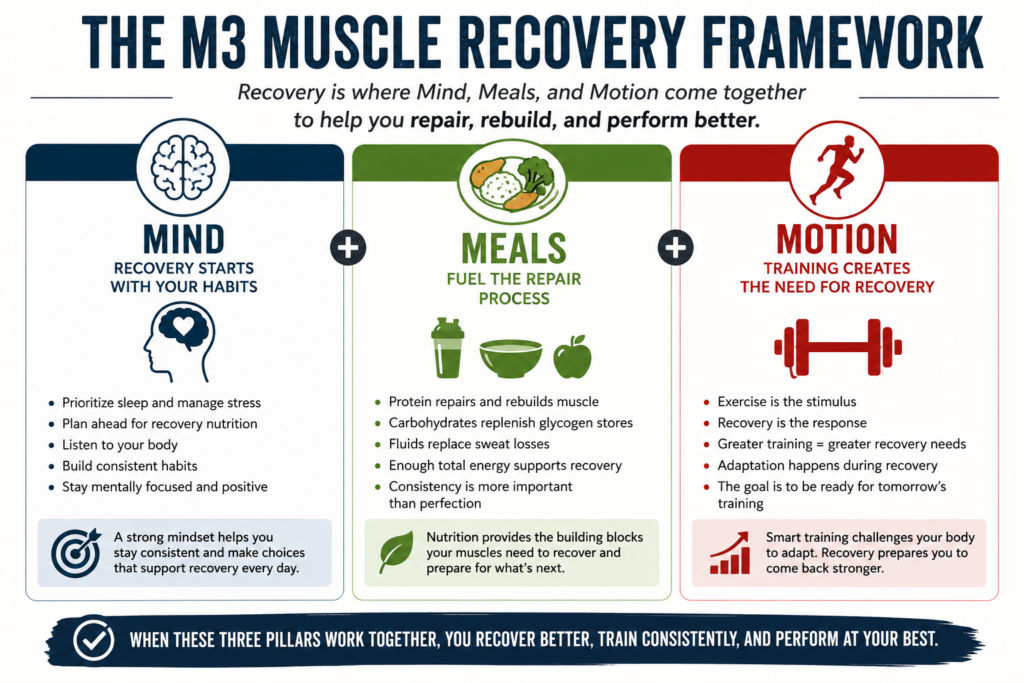
Mind: Recovery Starts with Your Habits
Recovery isn’t just a physical process.
It’s also behavioral.
Athletes who prioritize recovery often plan ahead by asking questions before training even begins:
- What am I going to eat afterward?
- Will I have access to food?
- Do I have a recovery snack packed?
- Am I drinking enough fluids today?
- Am I giving myself enough time to sleep tonight?
These decisions may seem small, but they have a cumulative effect over weeks and months of training.
One missed recovery meal won’t make or break your season.
Repeatedly neglecting recovery often will.
Meals: Fuel the Repair Process
Nutrition supplies the raw materials your body needs to recover.
After exercise, your muscles don’t simply “heal.”
They require amino acids to rebuild damaged proteins, carbohydrates to replenish glycogen stores, fluids to replace sweat losses, and enough total calories to support the energy demands of recovery.
No supplement can replace a consistently balanced diet.
Recovery is built meal by meal, snack by snack, and day by day.
Motion: Training Creates the Need for Recovery
Exercise is the stimulus.
Recovery is the response.
Every workout challenges your muscles to adapt.
As training volume and intensity increase, so do your recovery needs.
Elite athletes don’t necessarily recover because they’re stronger.
They become stronger because they recover well enough to keep training consistently.
The goal isn’t simply to survive today’s workout.
The goal is to be physically prepared for tomorrow’s.
What Happens Inside Your Muscles After Exercise?
When you finish a workout, the work isn’t over.
In many ways, it’s just beginning.
Your muscles immediately shift from producing force to repairing the stress created during exercise.
This process is complex, but understanding the basics can help athletes appreciate why nutrition matters so much.
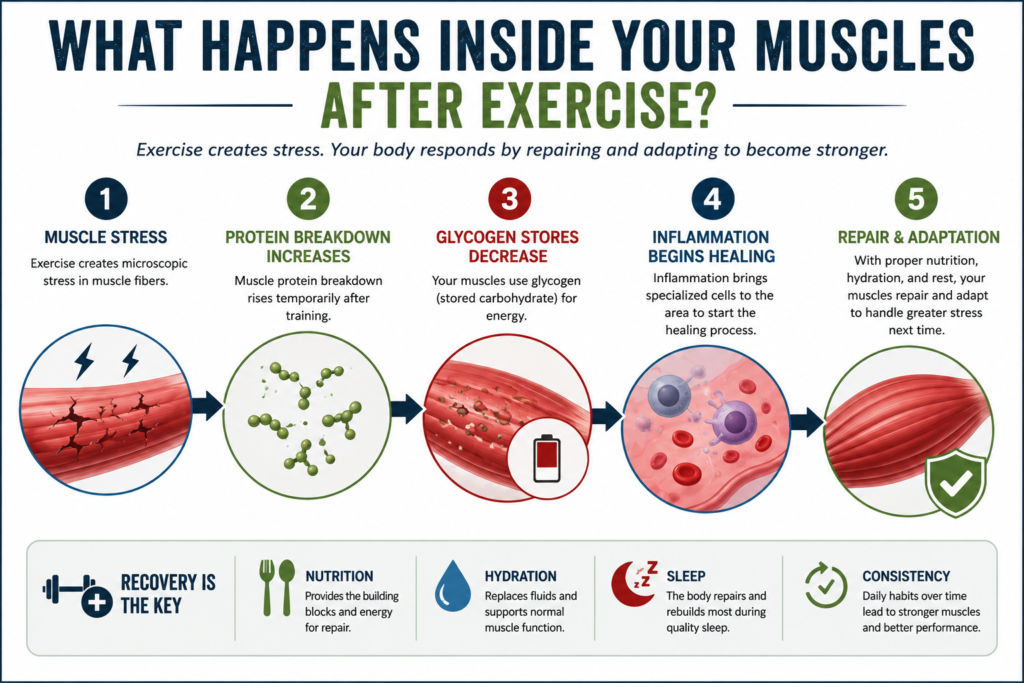
Tiny Muscle Fibers Experience Stress
Contrary to popular belief, resistance training doesn’t “tear your muscles apart.”
Instead, it creates microscopic stress within individual muscle fibers.
This small amount of damage serves as a signal.
Your body recognizes that these tissues were challenged and begins repairing them so they’re better prepared to handle future training.
This repair process is one reason progressive training leads to greater strength, muscle size, and performance over time.
Muscle Protein Breakdown Increases
Exercise temporarily increases the rate at which muscle proteins are broken down.
That sounds concerning, but it’s a normal part of training.
Recovery is all about tipping the balance back in the other direction.
When your body has adequate protein, energy, and time, muscle protein synthesis can exceed muscle protein breakdown, allowing muscles to repair and adapt.
We’ll explore this process in more detail later in the article.
Glycogen Stores Become Depleted
Muscles rely heavily on glycogen—the stored form of carbohydrate—for moderate- to high-intensity exercise.
The longer and harder you train, the more glycogen your body typically uses.
If these energy stores aren’t adequately replenished, future training sessions may feel harder than they should.
That’s one reason carbohydrates remain such an important part of muscle recovery.
Inflammation Begins the Healing Process
Inflammation often gets a bad reputation, but acute inflammation after exercise is a normal part of recovery.
It helps coordinate the repair process by bringing specialized cells to damaged tissue.
Problems arise when inflammation becomes excessive or recovery time is insufficient—not because inflammation exists at all.
Rather than trying to eliminate all inflammation, athletes should focus on supporting the body’s natural recovery processes through good nutrition, hydration, sleep, and appropriate training.
Why Muscle Recovery Matters for Athletes
Recovery isn’t simply about feeling less sore.
It’s about preparing your body to perform again.
Every successful training program follows the same basic cycle:
Training → Recovery → Adaptation → Improved Performance
When recovery is consistently supported, athletes are more likely to:
- maintain higher training quality
- improve strength and power over time
- reduce excessive fatigue
- perform more consistently
- lower their risk of overuse injuries
- tolerate higher training volumes
On the other hand, athletes who repeatedly underfuel, neglect sleep, or ignore recovery may find themselves working just as hard—but seeing fewer results.
One of the biggest misconceptions in sports is that progress comes from training harder than everyone else.
In reality, progress comes from balancing hard training with equally intentional recovery.
The workout creates the opportunity.
Recovery allows your body to take advantage of it.
Muscle Protein Synthesis Explained
One of the most common phrases you’ll hear in sports nutrition is muscle protein synthesis.
It sounds complicated, but the concept is actually straightforward.
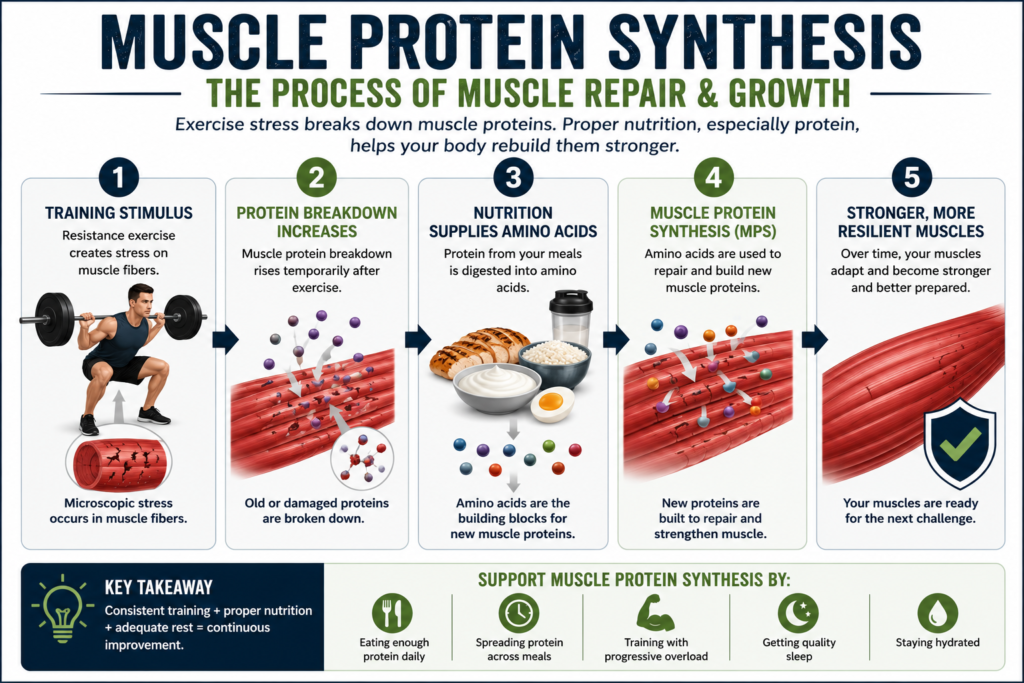
Think of your muscles like a road that experiences heavy traffic every day.
Every workout creates a little wear and tear. The road isn’t destroyed, but it develops small cracks that need repair.
Protein provides the construction materials.
Training tells the body where repairs are needed.
Recovery is when the construction crew gets to work.
This repair process is known as muscle protein synthesis (MPS)—the process of building new muscle proteins to repair and strengthen muscle tissue after exercise.
It’s one of the primary reasons athletes become stronger over time.
The goal isn’t simply to repair muscles back to where they were before.
The goal is to rebuild them so they’re better prepared for the next training session.
Muscle Breakdown vs. Muscle Building
Your muscles are constantly changing.
Even on rest days, your body is simultaneously:
- breaking down old muscle proteins
- building new muscle proteins
Think of it as an ongoing remodeling project.
Exercise temporarily increases muscle protein breakdown.
Recovery nutrition helps shift the balance back toward muscle protein synthesis.
When muscle protein synthesis exceeds muscle protein breakdown over time, muscles adapt by becoming stronger and, with appropriate resistance training, potentially increasing in size.
When the opposite happens—such as during prolonged underfueling, illness, or inadequate recovery—progress may slow or even reverse.
This is one reason why recovery nutrition is just as important as the workout itself.
Why Athletes Should Care About Muscle Protein Synthesis
Muscle protein synthesis isn’t just important for bodybuilders.
It supports recovery and adaptation for athletes in virtually every sport.
Whether you’re:
- sprinting down a soccer field
- performing repeated jumps in volleyball
- swimming intervals
- lifting weights
- completing a CrossFit workout
- training for a marathon
your muscles rely on this repair process to prepare for future training.
Consistently supporting muscle protein synthesis can help athletes:
- recover more effectively
- maintain lean muscle mass
- improve training quality
- tolerate higher training volumes
- continue progressing throughout a season
The body doesn’t distinguish between “strength athletes” and “endurance athletes” when it comes to repairing muscle tissue.
Every athlete benefits from recovering well.
Protein: The Building Blocks of Recovery
If muscle protein synthesis is the construction crew, protein provides the building materials.
Protein is made up of amino acids, which serve as the raw materials your body uses to repair damaged muscle fibers and build new muscle proteins.
Without adequate protein, the body still attempts to recover—but it has fewer resources available to complete the job efficiently.
Why Protein Matters
Protein supports much more than muscle growth.
For athletes, adequate protein intake helps support:
- muscle repair
- muscle maintenance
- training adaptation
- immune function
- recovery between sessions
One of the biggest misconceptions I hear is that protein is only important for people trying to build bigger muscles.
In reality, nearly every athlete benefits from meeting their daily protein needs because every athlete is recovering from training.
Complete vs. Incomplete Proteins
Not all protein sources contain the same combination of amino acids.
Complete proteins provide all nine essential amino acids that the body cannot produce on its own.
Examples include:
- poultry
- fish
- lean beef
- eggs
- dairy products
- soy foods
Plant-based athletes can absolutely meet their protein needs, but doing so often requires eating a wider variety of protein-rich foods throughout the day.
Examples include:
- beans
- lentils
- tofu
- tempeh
- edamame
- quinoa
- nuts and seeds
The overall quality and variety of protein sources matter just as much as the amount.
Is Leucine Really That Important?
One amino acid deserves special attention: leucine.
Leucine plays an important role in signaling muscle protein synthesis.
You don’t need to obsess over counting grams of leucine.
Fortunately, many high-quality protein foods naturally contain plenty of it.
Foods such as:
- milk
- Greek yogurt
- cottage cheese
- chicken
- eggs
- whey protein
are naturally rich sources.
For most athletes, eating adequate protein from a variety of high-quality foods throughout the day is a much more practical strategy than chasing specific amino acid numbers.
Is More Protein Always Better?
Not necessarily.
Protein is essential, but more isn’t always better.
Many athletes assume that if one protein shake is good, two or three must be even better.
Recovery doesn’t work that way.
Your body can only use so much protein effectively at one time for muscle protein synthesis.
Research suggests that spreading protein intake across multiple meals throughout the day is generally more beneficial than consuming nearly all of it in one large meal.
Think of recovery as providing your muscles with a steady supply of building materials rather than delivering everything at once.
For a more detailed discussion about daily protein needs, timing, and food sources, read Protein Needs for Athletes.
Carbohydrates: Restoring the Energy to Recover
Protein often gets most of the attention after exercise.
Carbohydrates deserve just as much credit.
While protein repairs muscle tissue, carbohydrates restore one of your most important performance resources: glycogen.
What Is Glycogen?
Glycogen is the stored form of carbohydrate found primarily in your muscles and liver.
During moderate- to high-intensity exercise, your body relies heavily on these stored carbohydrates for energy.
After training, glycogen stores may be partially depleted.
Recovery nutrition helps replenish those stores so you’re ready for future workouts.
Why Carbohydrates Matter for Muscle Recovery
Imagine trying to drive your car every day without refilling the gas tank.
Eventually, performance suffers.
The same concept applies to your muscles.
Athletes who consistently consume too few carbohydrates may notice:
- lower energy during workouts
- earlier fatigue
- reduced training quality
- slower recovery between sessions
This is especially important for athletes who:
- train daily
- perform multiple sessions in one day
- compete in tournaments
- participate in high-volume training programs
For these athletes, restoring glycogen becomes a key part of preparing for the next training session.
Carbohydrates and Protein Work Better Together
One common misconception is that athletes should focus only on protein after exercise.
In reality, recovery is a team effort.
Protein helps repair muscle tissue.
Carbohydrates replenish glycogen stores.
Together, they support a more complete recovery process.
This is one reason many practical recovery meals naturally include both nutrients.
Examples include:
- Greek yogurt with fruit and granola
- grilled chicken with rice
- turkey sandwich and fruit
- chocolate milk and a banana
- recovery smoothie with milk, oats, berries, and protein powder
These meals don’t need to be complicated.
They simply need to provide your body with the nutrients it needs to recover.
For a deeper discussion about carbohydrate needs for athletes, see Carbohydrates and Athletic Performance.
Hydration and Muscle Function
Nutrition isn’t only about food.
Water plays an essential role in nearly every recovery process occurring inside the body.
Muscles are composed largely of water, and adequate hydration supports everything from nutrient transport to normal muscle contraction.
Even modest levels of dehydration can negatively affect:
- exercise performance
- concentration
- perceived effort
- recovery
- overall well-being
After training, recovery should include replacing the fluids lost through sweat.
Athletes with higher sweat losses—especially those training in hot or humid environments—may also benefit from replacing electrolytes along with fluids.
Hydration isn’t a one-time event after practice.
It’s a habit that should continue throughout the day.
For a complete guide, read Hydration for Athletic Performance.
Sleep: Where Recovery Really Happens
If I asked athletes to choose the single most underrated recovery strategy, my answer would almost always be the same:
Sleep.
Many athletes spend considerable time researching supplements while overlooking one of the most powerful recovery tools available.
During sleep, your body continues many of the repair processes that began after training.
Hormones involved in tissue repair are released, damaged proteins continue to be rebuilt, energy stores are restored, and your nervous system recovers from the demands of exercise.
Poor sleep doesn’t just make you feel tired.
It can also affect:
- recovery quality
- reaction time
- decision-making
- training motivation
- perceived effort during exercise
Nutrition can support recovery.
Hydration can support recovery.
But neither can fully compensate for chronically inadequate sleep.
For most adult athletes, aiming for approximately 7–9 hours of quality sleep each night provides a strong foundation for recovery, while many adolescent athletes may require even more.
Recovery doesn’t end when dinner is over.
For many athletes, some of the most important recovery work happens after they turn off the lights.
Does Muscle Soreness Mean You’re Building Muscle?
One of the biggest myths in fitness is that the more sore you are, the better your workout was.
While muscle soreness can occur after a challenging or unfamiliar workout, it is not a reliable measure of how much muscle you’ve built or how effective your training was.
The soreness many athletes experience one or two days after exercise is called Delayed Onset Muscle Soreness (DOMS).
DOMS is a normal response to exercise, particularly when:
- beginning a new training program
- increasing training intensity
- performing unfamiliar exercises
- emphasizing eccentric (lowering) movements
Although soreness and muscle adaptation can occur together, one does not guarantee the other.
In fact, many experienced athletes continue making excellent progress while experiencing very little soreness because their bodies have adapted to their training.
The goal of training isn’t to chase soreness.
The goal is to stimulate adaptation while recovering well enough to train consistently.
How Long Does Muscle Recovery Take?
There isn’t a single recovery timeline that applies to every athlete.
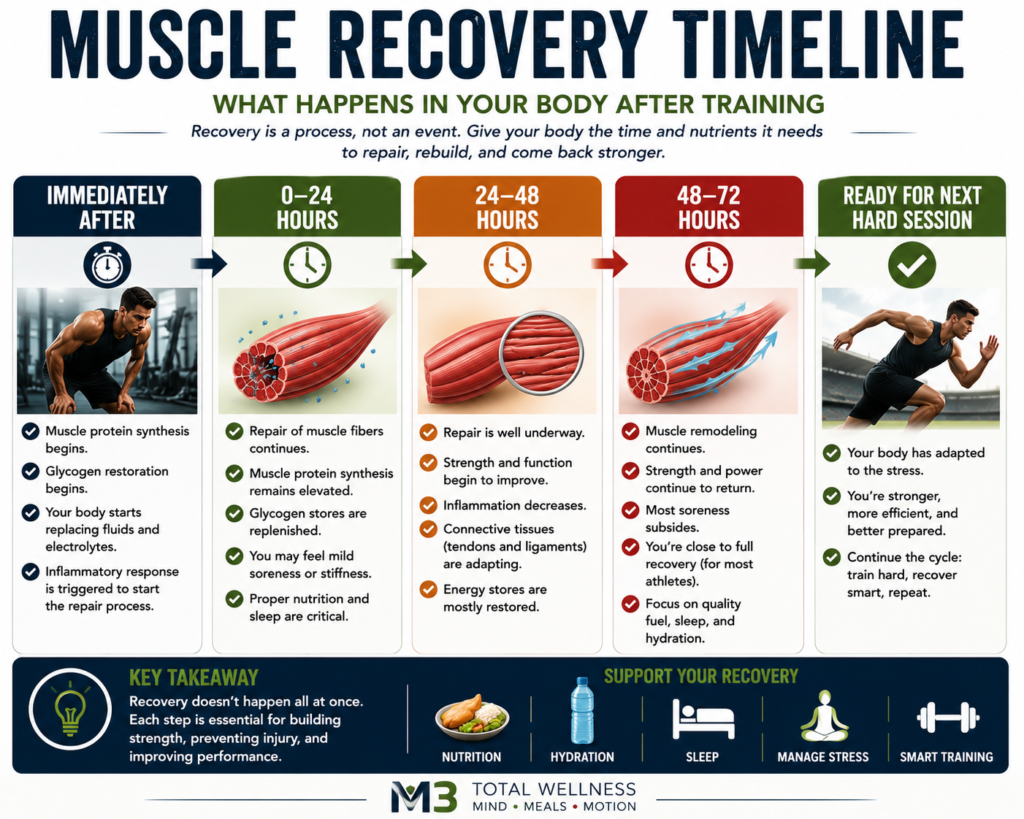
Recovery depends on several factors, including:
- training intensity
- workout duration
- training experience
- nutrition
- hydration
- sleep
- overall stress
- age
- previous injuries
A light recovery run may require less than a day of recovery, while a heavy lower-body strength workout or a multi-day tournament may require several days before you’re fully recovered.
Generally speaking:
Light training
Approximately 24 hours
Moderate to hard training
24–48 hours
Heavy resistance training or unfamiliar exercise
48–72 hours or longer
Recovery isn’t simply waiting until your muscles stop feeling sore.
It’s restoring your body’s ability to perform at a high level again.
The better your recovery habits become, the better prepared you’ll be for your next training session.
Daily Habits That Support Muscle Recovery
Recovery isn’t won or lost by drinking one protein shake.
It’s the result of hundreds of small decisions repeated throughout the week.
Here are some of the habits I encourage athletes to build:
Eat Regularly
Many athletes accidentally underfuel by skipping meals or waiting long periods between eating.
Aim to eat balanced meals and snacks consistently throughout the day to provide your muscles with a steady supply of nutrients.
Match Your Nutrition to Your Training
Your recovery needs change depending on your workload.
A light recovery day doesn’t require the same nutritional strategy as a tournament weekend or a heavy lifting session.
Learning to adjust your intake based on training demands is an important performance skill.
Stay Hydrated
Recovery starts long before you feel thirsty.
Replacing fluids throughout the day supports normal muscle function, circulation, and recovery.
Prioritize Sleep
Good nutrition cannot completely overcome poor sleep.
Treat sleep as part of your training plan rather than something that happens after training.
Stay Consistent
One healthy meal won’t dramatically improve recovery.
Likewise, one missed recovery snack won’t ruin your progress.
What matters most is what you do consistently over weeks, months, and seasons.
Small habits repeated consistently usually outperform perfect habits performed occasionally.
Frequently Asked Questions
Do I Need Protein Immediately After Every Workout?
Not necessarily.
While eating protein after exercise is beneficial, the overall amount of protein you consume throughout the day appears to be more important than consuming it within a narrow time window.
That said, eating a balanced recovery meal or snack within approximately 30–90 minutes after training is a practical strategy for many athletes, especially if another workout is planned later that day.
Can I Build Muscle Without Protein Powder?
Absolutely.
Protein powder is simply a convenient way to increase protein intake.
Athletes can meet their protein needs using whole foods such as:
- eggs
- Greek yogurt
- milk
- chicken
- fish
- lean meats
- tofu
- beans
- lentils
Protein powder is a tool—not a requirement.
Is Muscle Recovery Different for Endurance Athletes?
The principles are the same.
All athletes need to repair muscle tissue, replenish glycogen stores, replace fluids, and recover from training.
However, endurance athletes often place greater emphasis on restoring carbohydrate stores because of the high energy demands of prolonged exercise.
Can I Train While I’m Still Sore?
It depends.
Mild soreness is common and doesn’t necessarily mean you should avoid exercise.
However, severe soreness, persistent fatigue, or declining performance may indicate that additional recovery is needed.
Learning to distinguish normal training fatigue from inadequate recovery is an important skill for athletes.
Sport-Specific Example: Strength Athlete
Imagine a recreational powerlifter preparing for a heavy lower-body training session.
Monday’s workout includes:
- squats
- Romanian deadlifts
- walking lunges
- leg press
By the end of the session, their legs feel exhausted.
The next day, soreness begins to develop.
Instead of assuming soreness means they’ve had a “perfect” workout, they focus on the recovery habits that will prepare them for their next training session.
They prioritize:
- a balanced recovery meal containing carbohydrates and protein
- drinking fluids consistently throughout the day
- eating balanced meals every few hours
- getting adequate sleep that night
By the time their next lower-body session arrives, their muscles have had time to repair and adapt.
The goal wasn’t simply surviving Monday’s workout.
The goal was being ready to perform well again later in the week.
This is what sustainable training looks like.
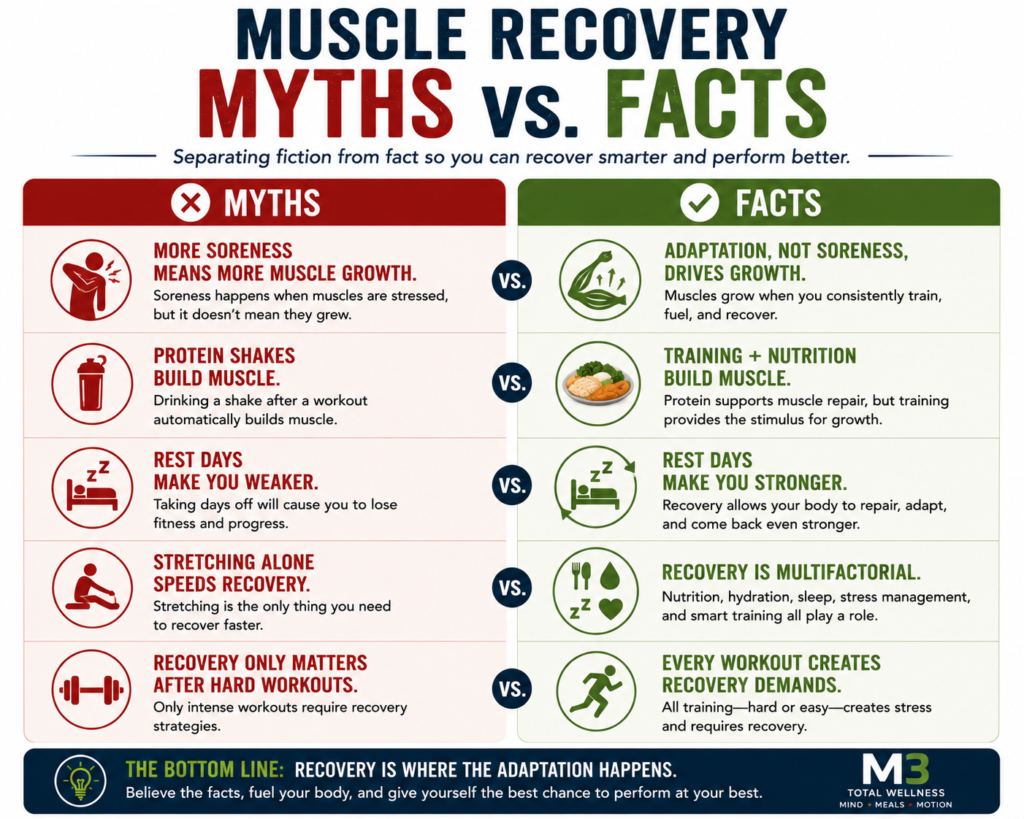
Common Muscle Recovery Myths
Myth: More soreness means more muscle growth.
Reality: Soreness and muscle growth are not the same thing. Athletes can make excellent progress without feeling sore after every workout.
Myth: A protein shake builds muscle by itself.
Reality: Protein supports recovery, but muscle growth also requires progressive training, adequate calories, sufficient sleep, and consistent recovery habits.
Myth: Recovery only matters after difficult workouts.
Reality: Every training session creates some recovery demand. Consistently supporting recovery helps athletes perform better over time.
Myth: Rest days mean you’re losing progress.
Reality: Recovery is when many of the adaptations from training occur. Strategic rest is part of improving performance—not avoiding it.
Practitioner Insight: What I See in Real Athletes
One of the most common conversations I have with athletes goes something like this:
“I’m training harder than ever, but I don’t feel like I’m improving.”
When we start digging deeper, the workout itself usually isn’t the problem.
Instead, we often find gaps in recovery.
Maybe breakfast is skipped because mornings are rushed.
Maybe lunch is delayed until mid-afternoon.
Maybe hydration is inconsistent throughout the day.
Maybe sleep gets pushed aside because life is busy.
None of these habits seem significant on their own.
But together, they create an environment where recovery struggles to keep up with training.
I’ve found that athletes rarely need a completely different workout program.
More often, they need a better recovery plan.
When nutrition, hydration, sleep, and training begin working together, athletes frequently notice improvements in energy, performance, and consistency without dramatically changing what they do in the gym.
Action Steps
- Prioritize balanced meals that include carbohydrates and protein throughout the day.
- Plan your recovery nutrition before training begins.
- Stay hydrated before, during, and after exercise.
- Aim for consistent, high-quality sleep each night.
- Adjust your nutrition to match your training volume and intensity.
- Focus on long-term consistency rather than chasing quick fixes or recovery supplements.
Conclusion
Training may provide the stimulus for improvement, but recovery is where that improvement actually happens.
Every workout creates an opportunity for your body to adapt.
Nutrition, hydration, sleep, and consistent recovery habits determine how well you take advantage of that opportunity.
Within the M3 Performance Framework, recovery is where Mind, Meals, and Motion come together.
Mind helps you build the habits that support consistent recovery.
Meals provide the nutrients your muscles need to repair and rebuild.
Motion creates the training challenge that drives adaptation.
Rather than asking, “How hard can I train?”
A better question is:
“Am I recovering well enough to benefit from the training I’m already doing?”
The athletes who continue improving year after year usually aren’t just the ones who train the hardest.
They’re the ones who recover with purpose.
Take the Next Step
You put in the work during practice, in the weight room, and on the field or court.
Make sure your recovery is working just as hard for you.
If you’re constantly sore, struggling to recover between workouts, plateauing in your performance, or unsure whether your nutrition is supporting your training, individualized guidance can make a meaningful difference.
At M3 Total Wellness, I help athletes develop practical, evidence-based nutrition strategies that support recovery, improve performance, and fit their unique training schedules and goals through the M3 Performance Framework: Mind • Meals • Motion.
Whether you’re training for your next season, preparing for competition, or simply looking to perform at your best, recovery starts with a plan. Schedule a performance assessment here.
Recover smarter. Train consistently. Perform at your highest potential.
References
Jäger, R., Kerksick, C. M., Campbell, B. I., Cribb, P. J., Wells, S. D., Skwiat, T. M., Purpura, M., Ziegenfuss, T. N., Ferrando, A. A., Arent, S. M., Smith-Ryan, A. E., Stout, J. R., Arciero, P. J., Ormsbee, M. J., Taylor, L. W., Wilborn, C. D., Kalman, D. S., Kreider, R. B., Willoughby, D. S., & Antonio, J. (2017). International Society of Sports Nutrition Position Stand: Protein and Exercise. Journal of the International Society of Sports Nutrition, 14, 20. https://doi.org/10.1186/s12970-017-0177-8
Mountjoy, M., Ackerman, K. E., Bailey, D. M., Burke, L. M., Constantini, N., Lebrun, C., Lundy, B., Melin, A. K., Meyer, N. L., Sherman, R. T., Tenforde, A. S., Budgett, R., & Sundgot-Borgen, J. (2023). International Olympic Committee (IOC) Consensus Statement on Relative Energy Deficiency in Sport (REDs): 2023 Update. British Journal of Sports Medicine, 57(17), 1073–1098. https://doi.org/10.1136/bjsports-2023-106994
Nunes, E. A., Colenso-Semple, L., McKellar, S. R., Yau, T., Ali, M. U., Fitzpatrick-Lewis, D., & Phillips, S. M. (2022). Systematic review and meta-analysis of protein intake to support muscle mass and function in healthy adults. Journal of Cachexia, Sarcopenia and Muscle, 13(2), 795–810. https://doi.org/10.1002/jcsm.12922
Pearson, A. G., Haff, G. G., & Hamilton, D. L. (2023). The impact of dietary protein supplementation on recovery from resistance exercise-induced muscle damage: A systematic review and meta-analysis. European Journal of Clinical Nutrition, 77, 287–299. https://doi.org/10.1038/s41430-022-01250-y
Naderi, A., Close, G. L., Jenkins, D. G., O’Halloran, P., & Scott, T. J. (2025). Nutritional Strategies to Improve Post-exercise Recovery and Subsequent Exercise Performance: A Narrative Review. Sports Medicine, 55, 1559–1577. https://doi.org/10.1007/s40279-025-02213-6
Thomas, D. T., Erdman, K. A., & Burke, L. M. (2016). Position of the Academy of Nutrition and Dietetics, Dietitians of Canada, and the American College of Sports Medicine: Nutrition and Athletic Performance. Journal of the Academy of Nutrition and Dietetics, 116(3), 501–528. https://doi.org/10.1016/j.jand.2015.12.006