Quick Answer
Tournament days place unique demands on an athlete’s body. Unlike a typical practice or single game, tournaments often involve multiple matches, long breaks between competition, unpredictable schedules, travel, heat, and mental stress. To perform consistently throughout the day, athletes should begin with a carbohydrate-rich meal 2–4 hours before competition, consume easy-to-digest carbohydrates and fluids between events, adjust their fueling based on the timing of their next competition, and eat a balanced recovery meal containing carbohydrates and protein after their final event. Planning ahead is one of the most effective ways to maintain energy, reduce fatigue, and support recovery throughout single-day and multi-day tournaments.
Key Takeaways
- Tournament nutrition is different from everyday training nutrition because athletes often compete multiple times over several hours—or even several days.
- Starting competition with full glycogen stores helps maintain energy and delay fatigue.
- The amount and timing of food between events should depend on how much time you have before competing again.
- Hydration should begin before the first event and continue throughout the day, especially in hot or humid conditions.
- Every sport has different fueling demands, but consistency is more important than perfection.
- Packing food and drinks ahead of time reduces the temptation to rely on concession stands or fast food.
- Recovery after your final event helps prepare your body for the next training session—or the next day of competition.
Introduction
Tournament days are exciting.
They’re also some of the most demanding days an athlete will experience.
Unlike a typical practice or a single game, tournaments often require athletes to perform at a high level over many hours, with repeated bouts of intense activity separated by unpredictable breaks. Depending on the sport, you may compete several times in one day—or over an entire weekend—with little control over exactly when you’ll play next.
I’ve seen this countless times while working with athletes, and I’ve experienced it myself playing competitive beach volleyball.
The first match usually feels great.
By the third or fourth match, however, many athletes begin to notice subtle changes.
Their legs feel heavier.
Their reaction time slows.
Their focus isn’t quite as sharp.
Late in the day, small mistakes start adding up.
Most athletes assume they’re simply getting tired.
Often, they’re running low on fuel.
One of the biggest mistakes athletes make is treating tournament day like any other day.
They might skip breakfast because they’re nervous, rely on a single protein bar all day, forget to drink enough fluids, or grab whatever food happens to be available between matches.
Unfortunately, your body doesn’t care whether you forgot to pack lunch.
It still needs energy. Underfueling can quietly affect athletic performance.
Tournament nutrition isn’t about eating more.
It’s about eating strategically.
The right foods at the right times can help maintain blood glucose, replenish some of the carbohydrate used during competition, replace fluids lost through sweat, and provide your muscles with the nutrients needed to continue performing throughout the day.
Within the M3 Performance Framework, successful tournament nutrition combines all three pillars:
Mind
Preparation begins before tournament day. Planning meals, packing snacks, and thinking ahead removes unnecessary decisions when your focus should be on competing.
Meals
Carbohydrates provide the primary fuel for repeated high-intensity efforts, protein supports recovery between events, and hydration helps maintain physical and mental performance throughout the day.
Motion
Tournament schedules challenge athletes differently than regular training. Recovery between matches becomes just as important as performance during them.
The athletes who perform their best late in the tournament usually aren’t the ones who simply trained the hardest.
More often, they’re the ones who prepared the best.
Whether you’re competing in a beach volleyball tournament under the Florida sun, swimming multiple preliminary and final races across several days, playing soccer in an all-day showcase, or participating in a CrossFit competition with several workouts, having a fueling plan can help you perform more consistently from the first event to the last.
In this guide, you’ll learn exactly how to fuel before, during, and after tournament competition using practical, evidence-based strategies that you can adapt to your own sport and schedule.
Table of Contents
Why Tournament Nutrition Is Different
Most athletes already understand the importance of eating before practice.
Tournament days are different.
Instead of preparing for one workout or one game, your body may need to perform at a high level repeatedly over several hours—or even multiple consecutive days.
Each match, race, or event gradually uses stored carbohydrate (glycogen), contributes to fluid losses, and increases physical and mental fatigue. If these losses aren’t addressed throughout the day, performance often begins to decline—not because you’ve suddenly become less fit, but because you’re running out of the resources your body depends on.
Different sports create different nutritional challenges.
A beach volleyball player may spend an entire day competing outdoors in extreme heat and humidity, with several matches separated by long breaks. Sweat losses can be substantial, making hydration and electrolyte replacement especially important.
A competitive swimmer might race multiple preliminary events in the morning, return several hours later for finals, and repeat that schedule over three or four consecutive days. Fueling between races becomes critical because recovery time is limited.
A soccer or basketball player may have only 30–60 minutes between games, leaving little opportunity for a full meal before returning to high-intensity competition.
A wrestler or combat sport athlete may also have to balance tournament fueling with weight-class requirements under the guidance of their coach and sports dietitian.
Despite these differences, the principles remain remarkably consistent.
Successful tournament nutrition focuses on four priorities:
- Starting competition with adequate energy stores.
- Maintaining energy and hydration throughout the day.
- Recovering between events whenever possible.
- Preparing for the next day if the tournament continues.
Trying to “catch up” nutritionally after fatigue has already set in rarely works.
Tournament performance is built through consistent fueling from the first event—not emergency fueling after your energy crashes.
One of the biggest advantages athletes can give themselves isn’t a new supplement or sports drink.
It’s simply having a plan before competition begins.
The M3 Tournament Fueling Framework
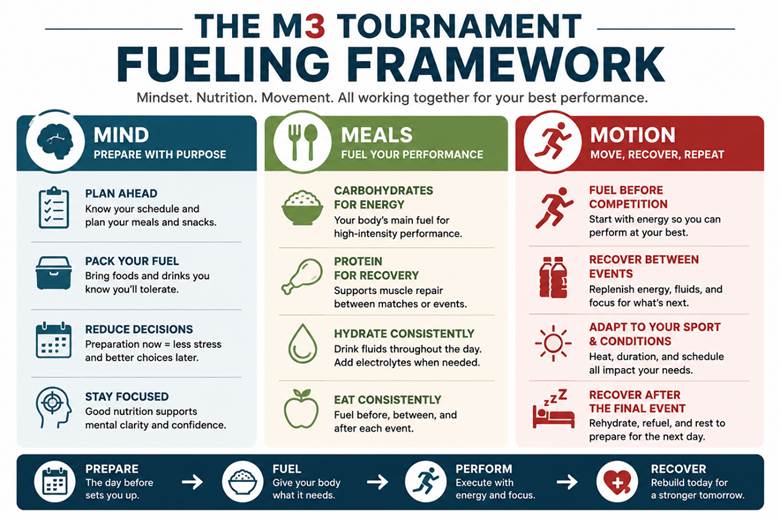
Tournament nutrition isn’t about finding the perfect snack or the newest sports supplement.
It’s about combining preparation, nutrition, and performance into one consistent strategy.
That’s where the M3 Tournament Fueling Framework comes in.
Mind: Prepare Before You Compete
Successful tournament fueling starts long before the first whistle, serve, or starting gun.
Athletes who perform consistently rarely leave nutrition to chance.
Instead, they ask themselves questions the day before:
- What time is my first event?
- How long is the drive?
- Will food be available at the venue?
- What if concessions don’t have healthy options?
- Do I have enough water and electrolyte drinks packed?
- Have I packed enough snacks for the entire day—not just the morning?
Planning ahead reduces stress and helps you avoid making rushed food decisions when you’re focused on competing.
Meals: Fuel Every Stage of Competition
Tournament nutrition isn’t one meal—it’s a series of fueling opportunities.
Depending on your schedule, you may need:
- a carbohydrate-rich dinner the night before
- a balanced breakfast before competition
- a small snack before your first event
- portable snacks between matches
- a lunch during longer breaks
- a recovery meal after your final event
Each meal has a different purpose, but together they help maintain energy, support recovery, and prepare you for your next performance.
Motion: Match Your Fuel to Your Sport
Not every tournament places the same demands on your body.
A swimmer racing multiple events over four days has different nutritional needs than a beach volleyball player competing outdoors in the summer heat or a CrossFit athlete performing several high-intensity workouts in one day.
The best fueling plan is the one that matches the physical demands of your sport, your schedule, and your individual tolerance.
The goal isn’t to eat as much as possible.
The goal is to arrive at every event feeling energized, hydrated, and ready to perform.
What to Eat the Night Before a Tournament
Many athletes focus so much on what they’ll eat on tournament day that they forget the meal that helps set the stage for everything that follows.
The night before a tournament isn’t about “carb loading” for every athlete or eating an enormous dinner. Instead, it’s about topping off your body’s energy stores, staying hydrated, and avoiding anything that could interfere with sleep or digestion.
For most tournaments, dinner should be familiar, balanced, and satisfying.
Your goal is to wake up feeling energized—not overly full or dealing with stomach discomfort.
Build a Balanced Dinner
A simple way to think about your pre-tournament dinner is:
- Carbohydrates to replenish glycogen stores
- Lean protein to support muscle recovery from previous training
- Vegetables and fruit for vitamins, minerals, and antioxidants
- Healthy fats in moderate portions for overall nutrition
Examples include:
- Grilled chicken, rice, roasted vegetables, and fruit
- Pasta with lean turkey meat sauce and a side salad
- Salmon, baked potatoes, and green beans
- Stir-fry with chicken, rice, and mixed vegetables
- Burrito bowl with rice, grilled chicken, black beans, vegetables, and salsa
These meals provide steady energy without being excessively heavy.
Should You Carb Load?
One of the biggest misconceptions I hear is:
“I’m competing tomorrow, so I need to eat a huge plate of pasta tonight.”
For most athletes, that’s unnecessary.
True carbohydrate loading is a specialized strategy primarily used for endurance events lasting longer than about 90 minutes, such as marathons, long-distance cycling, or Ironman triathlons. It isn’t recommended for the average volleyball tournament, swim meet, basketball tournament, wrestling competition, or soccer showcase.
Instead of overeating the night before, focus on eating enough carbohydrate consistently throughout the day and having a balanced dinner.
Hydrate Before Bed
Hydration doesn’t begin the morning of competition.
Aim to drink fluids consistently throughout the afternoon and evening so you wake up well hydrated.
Your urine should generally be pale yellow before going to bed and again when you wake up.
Drinking excessive amounts of water immediately before bed isn’t necessary and may interrupt your sleep with frequent bathroom trips.
Avoid Last-Minute Experiments
The night before a tournament is not the time to try:
- a new restaurant
- unfamiliar foods
- large cheat meals
- excessive alcohol (for adult athletes)
- high doses of caffeine
- supplements you’ve never used before
Competition is about reducing uncertainty.
The more familiar your routine, the more predictable your body’s response is likely to be.
What to Eat for Breakfast Before Competition
Breakfast is often the most important meal of tournament day.
After an overnight fast, your liver glycogen has naturally decreased, and your body needs fuel to prepare for the physical and mental demands ahead.
Unfortunately, breakfast is also one of the meals athletes are most likely to skip.
Some athletes are too nervous to eat.
Others leave home early and don’t have enough time.
Some simply underestimate how much energy they’ll need later in the day.
While nerves are completely normal, skipping breakfast often leads to low energy, increased hunger later in the tournament, and a greater risk of making poor food choices between events.
Aim to Eat 2–4 Hours Before Competition
For most athletes, eating a balanced meal approximately 2–4 hours before the first event allows enough time for digestion while helping maximize available energy.
This meal should emphasize:
- Carbohydrates (the primary fuel source)
- Moderate protein
- Lower amounts of fat and fiber to reduce the risk of gastrointestinal discomfort
Tournament Breakfast Ideas
Some practical options include:
- Oatmeal topped with banana, berries, and a glass of milk
- Whole-grain toast with scrambled eggs and fruit
- Greek yogurt with granola and mixed berries
- Bagel with peanut butter and banana
- Rice, eggs, and fruit
- Breakfast burrito made with eggs, potatoes, and a tortilla (if well tolerated)
The best breakfast is the one you’ve practiced during training—not one you’re trying for the first time on competition day.
If You’re Too Nervous to Eat
Pre-competition nerves can suppress appetite.
Rather than skipping breakfast entirely, choose foods that feel easier to tolerate.
Options may include:
- fruit smoothie with milk or yogurt
- applesauce
- yogurt
- banana
- toast
- liquid meal replacement that you’ve previously tolerated
Even a smaller meal is often better than eating nothing at all.
What to Eat 30–60 Minutes Before Competition
As competition approaches, your goal changes.
You’re no longer trying to eat a full meal.
Instead, you’re simply giving your body an easily digested source of carbohydrate that can help maintain blood glucose and provide readily available energy.
For most athletes, this means choosing foods that are:
- high in carbohydrate
- low in fat
- low in fiber
- familiar
- easy to digest
Examples include:
- banana
- applesauce pouch
- pretzels
- graham crackers
- sports drink
- low-fat granola bar
- dry cereal
- fig bars
Avoid eating a large meal within the hour before competition, as this may increase the likelihood of stomach discomfort during high-intensity activity.
For more information on portable pre-game snacks, read my article Best Snacks for Athletes.
Fueling Between Matches or Events
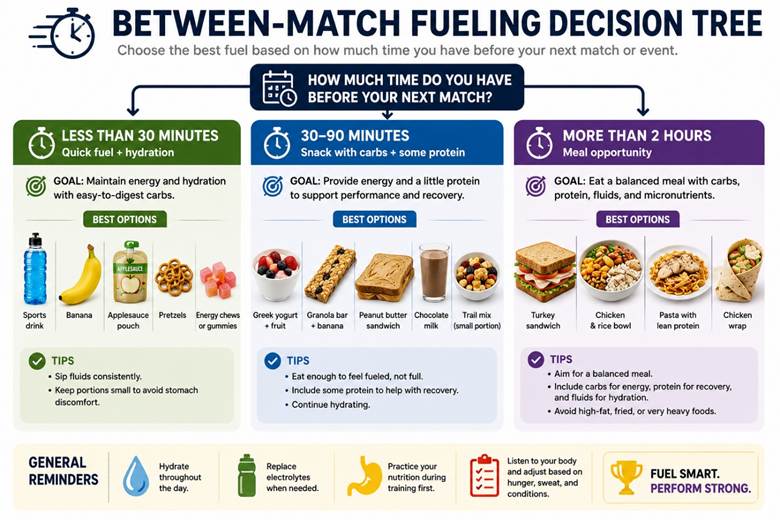
This is where tournament nutrition becomes highly individualized.
The best snack between events depends almost entirely on how much time you have before competing again.
Many athletes make the mistake of eating the same snack regardless of whether their next event is in 15 minutes or two hours.
Your body doesn’t recover on a fixed schedule.
Your nutrition should match your timeline.
If You Have Less Than 30 Minutes
Your focus should be hydration and small amounts of easily digested carbohydrate.
Good options include:
- sports drink
- banana
- applesauce pouch
- chews or sports gummies
- a few pretzels
Avoid heavy meals, high-fat foods, or large amounts of protein that may still be digesting when competition resumes.
If You Have 30–90 Minutes
You have slightly more flexibility.
This is often enough time for a somewhat larger snack that combines carbohydrates with a small amount of protein.
Examples include:
- Greek yogurt and fruit
- granola bar and banana
- peanut butter sandwich
- trail mix (if well tolerated and not immediately before intense activity)
- chocolate milk
These options provide additional energy without being overly filling.
If You Have More Than Two Hours
This may be an opportunity for a balanced meal rather than just a snack.
Examples include:
- turkey sandwich with fruit
- grilled chicken and rice
- burrito bowl
- pasta with lean protein
- rice bowl with vegetables and chicken
Continue sipping fluids during longer breaks rather than trying to drink large amounts all at once before your next match.
Recovery is important between matches or events. For more information, read my article on Recovery Nutrition Strategies for Athletes.
What to Eat for Lunch During a Tournament
Some tournaments last eight, ten, or even twelve hours.
Athletes often pack excellent snacks but forget to plan for an actual meal.
By the afternoon, they’re surviving on sports drinks, protein bars, and whatever happens to be available at the concession stand.
While snacks are important, they rarely provide enough energy to support an entire day of repeated competition.
If your schedule allows for a longer break, take advantage of it by eating a balanced lunch.
Good portable options include:
- turkey or chicken sandwich
- pasta salad with grilled chicken
- rice bowl with lean protein
- wrap with chicken and vegetables
- leftovers packed in an insulated cooler
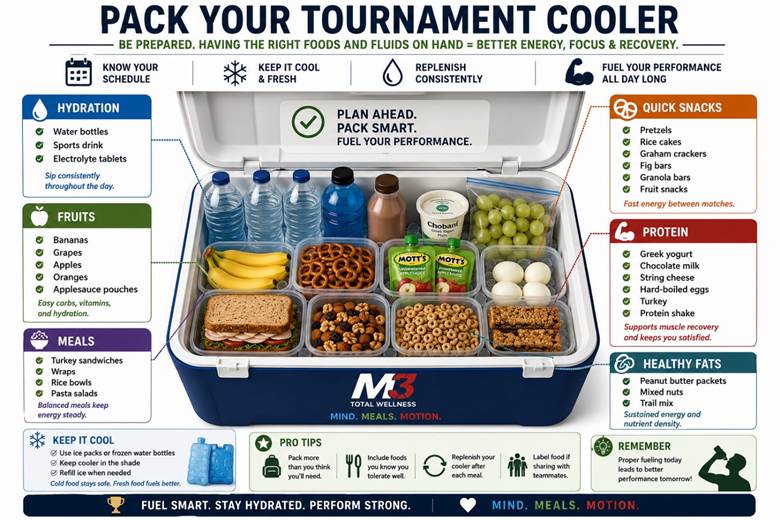
Planning ahead is one of the simplest ways to improve tournament nutrition.
A small cooler stocked with meals, snacks, fruit, electrolyte beverages, and water often provides far better options than relying on convenience foods at the venue.
For athletes competing over multiple days, this consistency becomes even more important. Recovering well between tournament days helps restore glycogen, replace fluids, and prepare your body to perform again the next morning.
Hydration Strategies for Tournament Competition
If there is one recovery strategy that athletes consistently underestimate on tournament day, it’s hydration.
Most athletes recognize the importance of drinking water, but many don’t realize that hydration begins before the first event—not after they start feeling thirsty.
Even mild dehydration can affect physical and mental performance. As fluid losses increase, athletes may experience reduced endurance, slower reaction time, increased perceived effort, difficulty concentrating, and impaired decision-making. In sports that require quick movements and split-second decisions, these changes can make a meaningful difference.
Whether you’re competing indoors or outdoors, hydration should be viewed as part of your performance plan—not something you think about only when you’re thirsty.
Start Hydrating Before Competition
The goal is to begin competition already well hydrated.
Waiting until you’re thirsty usually means you’re already starting to fall behind.
On tournament morning:
- Drink fluids with breakfast.
- Continue sipping fluids during your drive to the venue.
- Avoid consuming large amounts of water all at once immediately before competing.
A simple way to monitor hydration is by checking urine color. While it’s not perfect, urine that is pale yellow generally suggests adequate hydration, whereas dark yellow urine may indicate that you need more fluids.
Drink Throughout the Day
Tournament hydration isn’t about drinking one large bottle of water between matches.
It’s about replacing fluids gradually throughout the day.
Small, frequent sips are usually better tolerated than trying to “catch up” by drinking large amounts at once.
How much you need depends on many factors, including:
- body size
- sweat rate
- weather conditions
- exercise intensity
- tournament duration
- clothing and equipment
Some athletes may lose very little sweat during competition, while others can lose several liters over the course of a hot tournament day.
Learning your individual sweat rate can help you develop a more personalized hydration strategy.
For a complete guide, including sweat rate testing, fluid recommendations, and electrolyte replacement, see Hydration for Athletic Performance.
When Are Electrolytes Helpful?
Electrolytes—particularly sodium—help replace minerals lost through sweat.
Not every athlete needs an electrolyte drink during every tournament.
However, they may be especially beneficial when:
- competing in hot or humid weather
- exercising for several hours
- participating in multiple matches throughout the day
- experiencing heavy sweat losses
- noticing visible salt stains on clothing or skin
- having limited opportunities to eat between events
For shorter competitions or lower sweat losses, water may be all that’s needed.
The best hydration plan depends on both the athlete and the demands of the competition.
Sport Spotlight: Beach Volleyball
As a beach volleyball player, I’ve learned firsthand how challenging tournament hydration can be.
A summer tournament in South Florida is very different from an indoor league match.
You may spend hours exposed to direct sunlight, high humidity, and hot sand while playing multiple matches with long breaks in between.
Even when you’re resting between games, you’re often still sitting in the heat, continuing to lose fluids through sweat.
Many athletes don’t realize how dehydrated they’ve become until they begin experiencing fatigue, headaches, muscle cramps, or declining performance.
Packing multiple water bottles, electrolyte beverages, and plenty of ice can make a significant difference over the course of a long tournament day.
Hydration Tips for Multi-Day Tournaments
If your tournament lasts two or more days, your hydration strategy shouldn’t end after the final match.
Continue drinking fluids during the evening and with dinner so you begin the next day well hydrated.
Trying to replace all of your fluid losses immediately before going to bed is usually less effective than consistently drinking throughout the afternoon and evening.
Recovering well between tournament days is just as important as preparing for the first one.
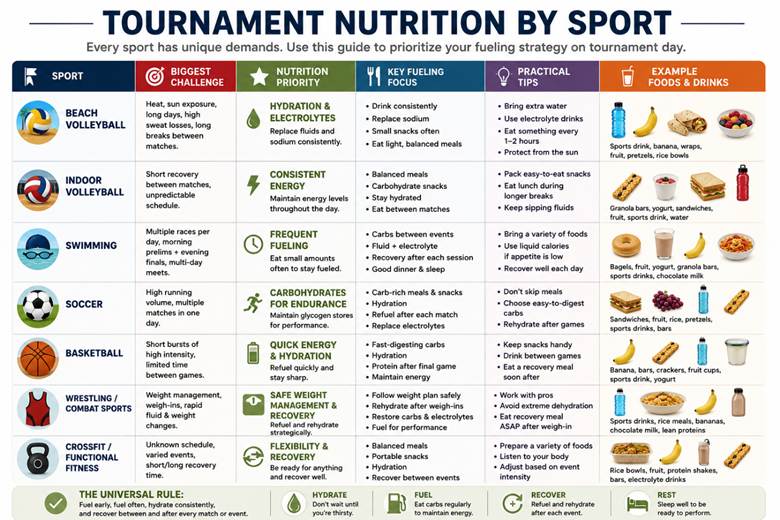
Tournament Nutrition by Sport
While the principles of tournament nutrition are consistent, every sport presents unique challenges.
The timing of meals, opportunities to eat, environmental conditions, and physical demands can all influence your fueling strategy.
The key is adapting the same evidence-based principles to fit your competition schedule.
Beach Volleyball
Beach volleyball tournaments often involve:
- multiple matches spread throughout the day
- long periods between matches
- high temperatures
- significant sweat losses
- limited shade
- unpredictable schedules
Because of these factors, athletes should prioritize:
- consistent hydration
- electrolyte replacement when appropriate
- portable carbohydrate-rich snacks
- a cooler packed with meals and beverages
- eating small amounts throughout the day instead of one large meal
One of the biggest mistakes I see is athletes relying solely on concession stand food or skipping meals because they don’t know when they’ll play next.
Planning ahead removes much of that uncertainty.
Indoor Volleyball
Indoor tournaments share many similarities with beach volleyball but usually involve cooler environments and shorter recovery periods between matches.
Athletes often benefit from:
- balanced breakfast before competition
- portable snacks between matches
- eating lunch during longer breaks
- maintaining hydration throughout the day, even if they don’t feel excessively sweaty
Indoor athletes can still become dehydrated, particularly during long tournaments with repeated matches.
Swimming
Competitive swimming presents one of the most unique tournament schedules in sports.
Many swim meets include:
- morning preliminaries
- afternoon recovery
- evening finals
- multiple events each day
- competitions lasting several consecutive days
Because swimmers frequently race with only limited recovery time between events, nutrition becomes an ongoing process rather than a single meal.
Between races, swimmers may benefit from:
- fruit
- yogurt
- granola bars
- bagels
- sports drinks
- sandwiches during longer breaks
Recovery after each session also becomes especially important to prepare for the next day of competition.
Soccer
Tournament weekends may require soccer players to complete several matches in one day while covering significant running distances.
Maintaining carbohydrate intake becomes especially important as glycogen stores gradually decline throughout the tournament.
Portable options such as fruit, pretzels, sports drinks, sandwiches, and granola bars are often practical choices between games.
Basketball
Basketball tournaments often involve repeated bursts of high-intensity activity separated by relatively short recovery periods.
Players should focus on:
- carbohydrate-rich meals before competition
- quick snacks between games
- hydration throughout the day
- recovery nutrition after the final game
Because schedules frequently change, packing food ahead of time provides much greater flexibility than relying on tournament concessions.
Wrestling and Combat Sports
Tournament nutrition for wrestlers and combat sport athletes can be more complex because of weight-class requirements.
Athletes should avoid extreme dehydration or rapid weight-cutting strategies without appropriate medical supervision.
Once weigh-ins are complete, restoring fluids, electrolytes, and carbohydrates becomes a priority before competition begins.
These athletes should work closely with a qualified sports dietitian and coaching staff to develop individualized competition plans.
CrossFit Competitions
CrossFit competitions often include several workouts separated by varying amounts of recovery time.
The exact schedule may not be known until the day of competition.
Athletes benefit from:
- carbohydrate-rich meals before competition
- portable recovery snacks
- consistent hydration
- balanced meals during longer recovery windows
Flexibility is often one of the most valuable tournament nutrition skills in CrossFit.
Foods to Avoid on Tournament Day
Tournament day is not the time to experiment.
Even foods that are perfectly healthy can become problematic if they cause gastrointestinal discomfort immediately before competition.
Consider limiting foods that are:
- heavily fried
- excessively greasy
- very spicy
- unusually high in fat
- extremely high in fiber immediately before competing
- unfamiliar to you
Likewise, avoid trying new supplements, pre-workout products, or energy drinks on tournament day simply because a teammate recommends them.
Your competition is not the place to discover how your stomach responds to a new product.
Instead, build your tournament nutrition plan around foods you’ve successfully used during training.
One of the most important principles in sports nutrition is:
Never try something new on competition day.
Sample Tournament Nutrition Plans
No two tournaments follow the same schedule.
That’s why athletes should think in terms of fueling windows rather than exact clock times.
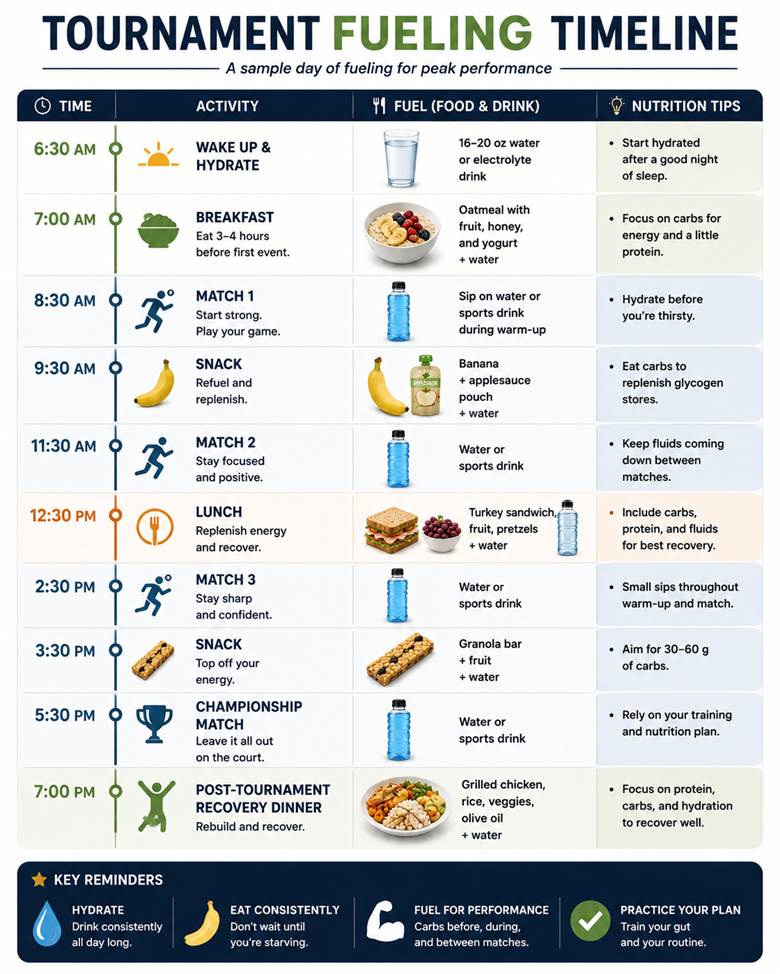
Example 1: Beach Volleyball Tournament
6:30 AM
Breakfast
Oatmeal, banana, scrambled eggs, water
8:30 AM
First Match
9:30 AM
Recovery Snack
Banana + sports drink
11:30 AM
Second Match
12:30 PM
Lunch
Turkey sandwich, grapes, pretzels, water
2:30 PM
Third Match
3:30 PM
Snack
Applesauce pouch + electrolyte drink
5:30 PM
Championship Match
7:00 PM
Recovery Dinner
Grilled chicken, rice, vegetables, fruit
Example 2: Swim Meet
6:00 AM
Breakfast
Bagel, peanut butter, banana, milk
8:00 AM
Preliminary Events
Between Events
Sports drink, fruit, granola bar
12:30 PM
Lunch
Rice bowl with chicken
Afternoon
Rest and hydration
5:00 PM
Finals
After Finals
Recovery meal with carbohydrates and protein
These are examples—not rigid meal plans.
Athletes should adjust food choices, portion sizes, and timing based on their individual preferences, sport, competition schedule, and tolerance.
Frequently Asked Questions
Should I Eat If I’m Nervous Before Competing?
Pre-competition nerves are completely normal and can reduce your appetite.
Rather than skipping food entirely, choose lighter, easy-to-digest options that you’ve tolerated well during training.
Examples include:
- a banana
- applesauce
- a fruit smoothie
- yogurt
- toast
- a sports drink if solid food isn’t appealing
Eating something is usually better than eating nothing, especially if you’ll be competing for several hours.
How Often Should I Eat During a Tournament?
There isn’t one perfect schedule because tournament formats vary.
As a general rule:
- Eat a balanced meal before competition.
- Fuel with small snacks during longer breaks.
- If you have more than two hours between events, consider eating a larger meal.
- Continue drinking fluids consistently throughout the day.
The goal isn’t to eat constantly.
The goal is to avoid long periods without fuel.
Is Fast Food Okay During a Tournament?
Sometimes it’s your only option.
However, relying on fast food during competition often means consuming meals that are high in fat and lower in carbohydrate than what many athletes need before returning to competition.
Whenever possible, pack your own cooler with meals and snacks so you’re not forced to depend on concession stands or nearby restaurants.
Planning ahead usually leads to better food choices and less stress.
Should I Drink Sports Drinks or Just Water?
It depends on your tournament.
Water is appropriate for many shorter competitions.
However, sports drinks may be helpful when:
- you’re competing for several hours
- you’re sweating heavily
- the weather is hot and humid
- you’re playing multiple matches in one day
- you have limited opportunities to eat
Sports drinks provide both fluids and carbohydrates, which can help support performance during prolonged competition.
What If I Lose My Appetite Between Matches?
This is common, particularly after an intense event.
Start with small amounts of food that are easy to digest.
Liquid calories may also be helpful.
Examples include:
- smoothie
- chocolate milk
- yogurt drink
- sports drink
- applesauce
Once your appetite begins returning, continue with more substantial snacks or meals if time allows.
Is Protein More Important Than Carbohydrates During a Tournament?
Both nutrients play important roles, but they serve different purposes.
Carbohydrates are your primary source of energy during repeated bouts of moderate- to high-intensity exercise.
Protein supports muscle repair and recovery between events and after the tournament.
Rather than choosing one over the other, include both throughout the day whenever possible.
Common Tournament Nutrition Mistakes
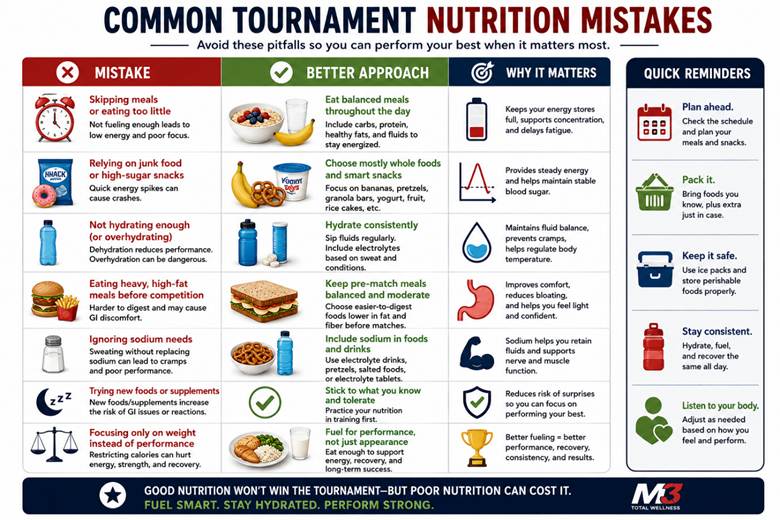
Even experienced athletes sometimes overlook the basics on competition day.
These are some of the most common mistakes I see when working with athletes.
Waiting Until You’re Hungry
By the time you’re extremely hungry during a tournament, your energy stores may already be running low.
Small, planned snacks are often more effective than waiting until you’re starving.
Depending Only on Protein Bars
Protein bars can certainly be part of a tournament nutrition plan.
However, many athletes rely on them as their only source of food all day.
Most tournaments require more total carbohydrate, fluids, and overall energy than a few bars can provide.
Think of protein bars as one tool—not the entire toolbox.
Forgetting to Pack Enough Food
I’ve seen athletes arrive with one banana and one bottle of water for an entire day of competition.
By mid-afternoon, they’re forced to buy whatever happens to be available.
Planning ahead almost always leads to better choices.
Trying Something New
Competition day is never the time to experiment with:
- supplements
- energy drinks
- unfamiliar foods
- new pre-workout products
If you haven’t practiced with it during training, tournament day isn’t the place to test it.
Ignoring Recovery Until the Tournament Ends
Recovery doesn’t begin after the last match.
It begins between events.
Every opportunity to eat, drink, and recover helps prepare you for your next performance.
Dietitian Insight: What I See in Real Athletes
One pattern I’ve noticed over the years is that most athletes don’t intentionally underfuel.
They’re simply busy competing.
Once the tournament begins, nutrition often becomes an afterthought.
I’ve worked with athletes who packed one snack for an entire day because they assumed concession stands would have healthy options.
Others underestimated how much fluid they would lose during long days in the heat.
I’ve also seen swimmers finish morning preliminaries, spend several hours waiting for finals, and unintentionally eat very little because they weren’t sure what they should have between races.
The athletes who tend to perform more consistently usually aren’t following complicated nutrition plans.
They’re simply prepared.
They’ve packed enough food.
They know what they’ll eat between events.
They stay ahead of their hydration instead of trying to catch up.
Most importantly, they treat nutrition as part of their competition strategy rather than something separate from their performance.
That’s one of the biggest mindset shifts I try to help athletes make.
Tournament nutrition isn’t just about eating.
It’s part of competing.
Action Steps
Before your next tournament:
✅ Plan your meals and snacks the day before.
✅ Pack more food than you think you’ll need.
✅ Bring multiple water bottles and, when appropriate, electrolyte beverages.
✅ Eat a balanced breakfast 2–4 hours before your first event.
✅ Adjust your snacks based on how much time you have before competing again.
✅ Continue eating and drinking throughout the day rather than waiting until you’re hungry or thirsty.
✅ Finish the tournament with a balanced recovery meal containing carbohydrates and protein.
Conclusion
Tournament days test more than your athletic ability.
They test your preparation.
From the moment you wake up until your final event, every nutrition decision influences how prepared your body is to perform.
You don’t need a perfect meal plan or expensive supplements to compete well.
You need a consistent strategy that matches the demands of your sport, your schedule, and your individual needs.
Within the M3 Performance Framework, successful tournament nutrition brings together all three pillars.
- Mind means preparing before competition so you aren’t making rushed decisions under pressure.
- Meals provide the carbohydrates, protein, fluids, and electrolytes your body needs to perform throughout the day.
- Motion reminds us that tournament schedules create unique physical demands that require equally intentional recovery and fueling.
Whether you’re playing beach volleyball under the summer sun, racing multiple swimming events over several days, competing in a weekend soccer showcase, or participating in a CrossFit competition, the principles remain the same:
Plan ahead. Fuel consistently. Recover intentionally.
Your performance isn’t determined by one meal.
It’s shaped by the hundreds of nutrition decisions you make before, during, and after competition.
Ready to Fuel Your Next Tournament?
Every athlete is different.
Your tournament schedule, sport, sweat rate, recovery time, and nutrition needs are unique.
If you’re tired of guessing what to eat before competition, struggling to maintain energy throughout long tournament days, or looking for a fueling strategy tailored to your sport, individualized nutrition coaching can help.
At M3 Total Wellness, I work with athletes of all levels to develop practical, evidence-based fueling plans that support performance, recovery, and long-term success using the M3 Performance Framework: Mind • Meals • Motion.
Whether you’re preparing for your first tournament or competing at an elite level, a personalized plan can help you step onto the court, field, pool deck, or competition floor feeling confident that your nutrition is working for you—not against you. Schedule your performance assessment today to get started.
Fuel smarter. Compete stronger. Recover better.
References
Thomas, D. T., Erdman, K. A., & Burke, L. M. (2016). Position of the Academy of Nutrition and Dietetics, Dietitians of Canada, and the American College of Sports Medicine: Nutrition and Athletic Performance. Journal of the Academy of Nutrition and Dietetics, 116(3), 501–528. https://doi.org/10.1016/j.jand.2015.12.006
Burke, L. M., Hawley, J. A., Wong, S. H. S., & Jeukendrup, A. E. (2011). Carbohydrates for Training and Competition. Journal of Sports Sciences, 29(Suppl. 1), S17–S27. https://doi.org/10.1080/02640414.2011.585473
Kerksick, C. M., Arent, S. M., Schoenfeld, B. J., Stout, J. R., Campbell, B. I., Wilborn, C. D., Taylor, L. W., Kalman, D. S., Smith-Ryan, A. E., Kreider, R. B., Willoughby, D. S., Arciero, P. J., VanDusseldorp, T. A., Ormsbee, M. J., Wildman, R., Greenwood, M., & Antonio, J. (2017). International Society of Sports Nutrition Position Stand: Nutrient Timing. Journal of the International Society of Sports Nutrition, 14, 33. https://doi.org/10.1186/s12970-017-0189-4
Jäger, R., Kerksick, C. M., Campbell, B. I., Cribb, P. J., Wells, S. D., Skwiat, T. M., Purpura, M., Ziegenfuss, T. N., Ferrando, A. A., Arent, S. M., Smith-Ryan, A. E., Stout, J. R., Arciero, P. J., Ormsbee, M. J., Taylor, L. W., Wilborn, C. D., Kalman, D. S., Kreider, R. B., Willoughby, D. S., & Antonio, J. (2017). International Society of Sports Nutrition Position Stand: Protein and Exercise. Journal of the International Society of Sports Nutrition, 14, 20. https://doi.org/10.1186/s12970-017-0177-8
Casa, D. J., Stearns, R. L., Lopez, R. M., Ganio, M. S., McDermott, B. P., Yeargin, S. W., Yamamoto, L. M., Mazerolle, S. M., Roti, M. W., Armstrong, L. E., & Maresh, C. M. (2017). National Athletic Trainers’ Association Position Statement: Fluid Replacement for the Physically Active. Journal of Athletic Training, 52(9), 877–895. https://doi.org/10.4085/1062-6050-52.9.02
Burke, L. M., Castell, L. M., Casa, D. J., Close, G. L., Costa, R. J. S., Desbrow, B., Halson, S. L., Lis, D. M., Melin, A. K., Peeling, P., Saunders, P. U., Slater, G. J., Sygo, J., Witard, O. C., Bermon, S., & Stellingwerff, T. (2019). International Association of Athletics Federations Consensus Statement 2019: Nutrition for Athletics. International Journal of Sport Nutrition and Exercise Metabolism, 29(2), 73–84. https://doi.org/10.1123/ijsnem.2019-0065