
Quick Answer
Training twice a day significantly increases your body’s energy, hydration, and recovery demands. Whether you’re preparing for preseason, attending a training camp, or following an intense workout schedule, your nutrition strategy should focus on replacing energy between sessions, supporting muscle recovery, and staying hydrated throughout the day. Athletes who consistently fuel before, between, and after workouts are more likely to maintain energy, recover efficiently, and perform at a higher level during both training sessions.
Key Takeaways
- Training twice a day requires more than simply eating larger portions—it requires strategic fueling throughout the day.
- Carbohydrates are your body’s primary fuel source and should be prioritized between workouts to replenish glycogen stores.
- Protein supports muscle repair and recovery but works best when paired with adequate carbohydrate intake.
- Waiting several hours to eat after your first workout can leave you underfueled for your second session.
- Hydration should be maintained consistently throughout the day rather than “catching up” right before practice.
- Planning meals and snacks ahead of time makes it easier to stay fueled during busy school, work, or training schedules.
- Small, consistent nutrition habits often have a greater impact on performance than relying on supplements or one “perfect” recovery meal.
Introduction
One workout can leave you feeling tired.
Two workouts in the same day place your body under an entirely different level of stress.
Fueling for two-a-day training sessions requires more than simply eating extra calories. Athletes training twice in one day must strategically time carbohydrates, protein, fluids, and recovery nutrition to maintain energy, recover efficiently, and perform at their best.
Whether you’re preparing for high school preseason, competing at the collegiate level, training for a volleyball tournament, attending a summer sports camp, or simply following a demanding exercise program, completing two workouts in one day requires more than determination—it requires a nutrition plan that keeps pace with your training.
I’ve worked with athletes who feel great during their morning workout but struggle to maintain the same energy, focus, or intensity during the second session. They often assume they’re out of shape or that feeling exhausted is simply part of training twice a day.
In many cases, that’s not the real problem.
The issue is that they’re asking their body to perform twice while fueling as though they’re only training once.
After the first workout, many athletes grab a quick protein shake—or skip eating altogether—before rushing off to school, work, or other responsibilities. By the time afternoon practice begins, their muscles haven’t fully restored the energy they used earlier in the day, hydration may already be declining, and recovery is still incomplete.
The result can be:
- Low energy during the second workout
- Reduced power and endurance
- Difficulty concentrating
- Slower recovery
- Lower overall training quality
Over time, consistently underfueling between workouts can make it harder to adapt to training, increase fatigue, and raise the risk of illness or overuse injuries.
I’ve seen this firsthand while working with beach volleyball players during preseason. Morning conditioning is often followed by afternoon skill sessions, and athletes who neglect recovery between workouts frequently notice their jumps become less explosive, their reaction time slows, and their focus begins to fade.
The difference usually isn’t effort.
It’s preparation.
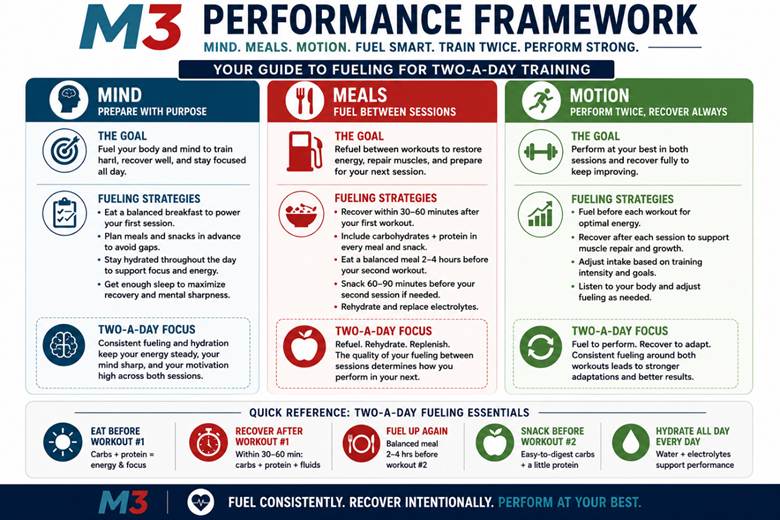
At M3 Total Wellness, I teach athletes to view performance through the M3 Performance Framework, where three essential pillars work together to support long-term success.
Mind
Successful fueling starts before your workout even begins. Planning meals, packing snacks, filling your water bottle, and preparing for a busy day help prevent missed opportunities to recover.
Meals
Your body depends on carbohydrates to restore energy, protein to repair muscle tissue, healthy fats to support overall health, and fluids to replace sweat losses. Meeting these needs consistently becomes even more important when you’re training twice in one day.
Motion
Training creates stress—but recovery is what allows your body to adapt. As your training volume increases, your nutrition strategy needs to increase with it.
The good news is that fueling for two-a-day training doesn’t require expensive supplements or a perfectly planned meal schedule.
It requires understanding what your body needs, eating consistently throughout the day, and making recovery part of your training—not an afterthought.
In this guide, you’ll learn how to fuel before your first workout, recover effectively between sessions, stay hydrated throughout the day, and build practical nutrition habits that support better performance from your first rep to your last.
Table of Contents
Why Two-a-Day Training Is Different
Training twice in one day doesn’t simply double the amount of time you spend exercising.
It changes the way your body uses energy, recovers from exercise, and prepares for the next training session.
During exercise, your muscles rely heavily on glycogen, the stored form of carbohydrate found in your muscles and liver. As your workout continues, these glycogen stores gradually decline. Replacing them takes time—and it depends largely on consuming enough carbohydrates after exercise.
When another workout is scheduled only a few hours later, recovery becomes a race against the clock.
Instead of having an entire day to restore energy, repair muscle tissue, and replace fluids, athletes often have only a short window before they’re expected to perform again.
That limited recovery time makes every nutrition decision more important.
Without adequate fueling between sessions, athletes may experience:
- Lower muscle glycogen stores before the second workout
- Earlier fatigue
- Reduced power and endurance
- Slower reaction time and concentration
- Lower training quality
- Delayed recovery between workouts
One of the biggest misconceptions I hear is that athletes simply need more protein when they’re training twice a day.
Protein certainly plays an important role in muscle repair, but if another workout is only a few hours away, carbohydrates often become the priority because they’re the primary fuel source for moderate- and high-intensity exercise.
Hydration deserves equal attention.
Even mild dehydration after the first workout can carry into the second if fluids aren’t replaced consistently throughout the day.
The goal isn’t simply to recover from your morning workout.
The goal is to recover well enough to perform again later that day.
The M3 Performance Framework
Athletes often think success during two-a-day training comes from pushing harder.
In reality, the hours between your workouts often determine how well you’ll perform during the second session.
That’s why I teach the M3 Performance Framework at M3 Total Wellness. It reminds athletes that performance isn’t built on training alone—it comes from balancing three interconnected pillars:
Mind: Plan Before You’re Hungry
The athletes who consistently perform well don’t leave nutrition to chance.
They prepare by:
- Packing meals and snacks
- Bringing a full water bottle
- Planning recovery after practice
- Keeping convenient foods available for busy days
When healthy choices are already prepared, it’s much easier to stay consistent—even when your schedule gets hectic.
Meals: Fuel Your Next Performance
Every meal between workouts has a purpose.
Your nutrition should help your body:
- Restore muscle glycogen
- Repair muscle tissue
- Replace fluids lost through sweat
- Prepare for the next training session
Rather than asking, “What should I eat after practice?”, ask yourself:
“What do I need to do now so I’m ready for my next workout?”
That simple mindset shift often changes the way athletes approach recovery.
Motion: Recovery Is Part of Training
Training is what challenges your body.
Recovery is what allows your body to adapt.
As your training volume increases, your nutritional needs increase right along with it.
Athletes who continue eating the same amount they consumed when training once per day often find themselves constantly fatigued—not because they’re working too hard, but because they’re not giving their body enough energy to recover.
The best athletes don’t separate training from recovery.
They recognize they’re part of the same process.
Build Your Day Around Both Workouts
When athletes ask me how to fuel for two-a-day training, they’re often looking for the “perfect” pre-workout snack or the ideal recovery shake.
Those meals certainly matter, but I encourage them to think bigger.
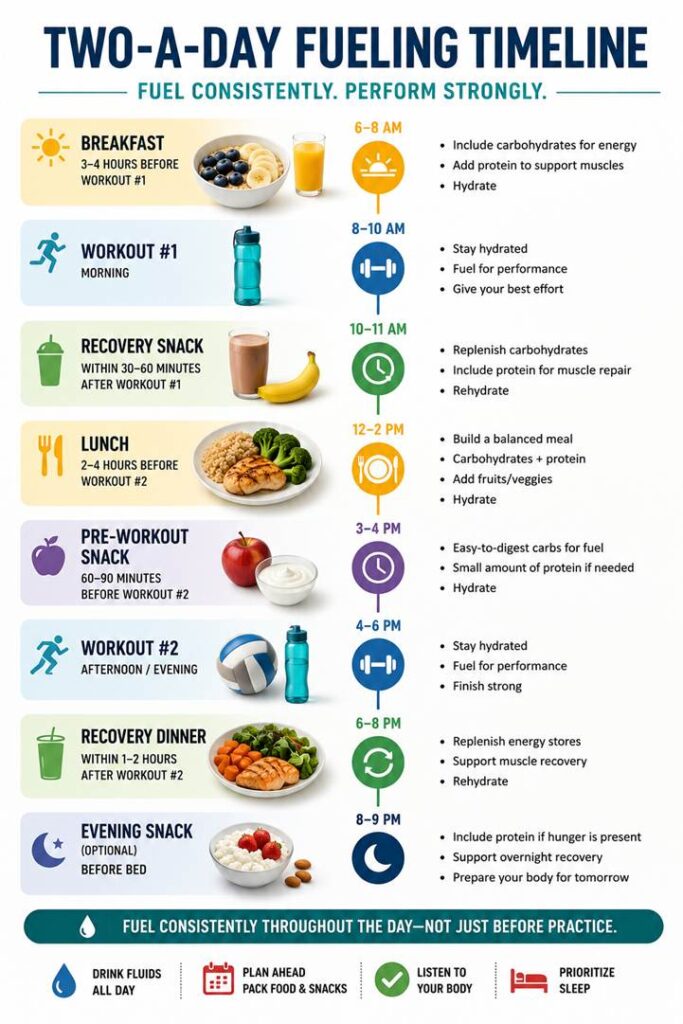
Success during two-a-day training isn’t determined by one meal—it’s determined by how you fuel throughout the entire day.
Every meal has a purpose.
Breakfast prepares you for your first workout.
Your recovery snack jumpstarts the recovery process.
Lunch continues replacing the energy you’ve used.
An afternoon snack prepares you for your second session.
Dinner supports recovery and helps you prepare for tomorrow’s training.
I often tell athletes to think of nutrition like a relay race.
Each meal passes the baton to the next. When you skip one, the rest of your day becomes much harder to recover from.
Rather than wondering what to eat after practice, build a routine that supports your body from the time you wake up until you go to bed.
A typical two-a-day schedule might look like this:
| Time | Goal | Example |
| Before Workout #1 | Start fueled | Breakfast or light pre-workout snack |
| Within 30–60 minutes after Workout #1 | Begin recovery | Carbohydrates, protein, and fluids |
| Midday | Continue refueling | Balanced lunch |
| 30–90 minutes before Workout #2 | Top off energy | Carbohydrate-rich snack |
| After Workout #2 | Recover and prepare for tomorrow | Balanced dinner with carbohydrates, protein, vegetables, and fluids |
Notice that no single meal carries all of the responsibility.
Instead, each meal builds on the previous one, helping you maintain steady energy throughout the day instead of constantly trying to “catch up.”
This approach is far more realistic than searching for one perfect recovery drink or supplement.
When you consistently fuel throughout the day, your second workout often feels much more manageable—and your recovery afterward becomes easier as well.
Fueling Before Workout #1
Your first workout sets the tone for the rest of the day.
If you begin training underfueled, you’re not just making the first session harder—you’ll spend the rest of the day trying to recover from an energy deficit before your second workout even begins.
One of the biggest mistakes I see is athletes skipping breakfast because they’re short on time or believe they’ll perform just as well on an empty stomach.
While some athletes can tolerate lighter meals before exercise, very few perform better after skipping food altogether.
Instead, aim to start your day with foods that provide energy, are easy to digest, and fit your training schedule.
Your Goals Before the First Workout
A good pre-workout meal should help you:
- Begin exercise with adequate energy
- Delay fatigue
- Support concentration during training
- Reduce excessive hunger during your workout
- Start the day well hydrated
For most athletes, this means emphasizing carbohydrates, including some protein, and drinking fluids before exercise.
If you’d like to learn more about why carbohydrates are so important for athletic performance, read my guide on Carbohydrates and Athletic Performance.
Timing Your Pre-Workout Meal
What you eat depends largely on how much time you have before training begins.
If You Have 3–4 Hours
Eat a balanced meal that includes carbohydrates, lean protein, and fluids.
Examples include:
- Oatmeal topped with berries and Greek yogurt
- Eggs with whole-grain toast and fruit
- Chicken, rice, and vegetables
- Turkey sandwich with yogurt and fruit
These meals provide sustained energy while giving your body enough time to digest before exercise.
If You Have 1–2 Hours
Choose a smaller meal or substantial snack.
Good options include:
- Greek yogurt with granola
- Peanut butter on whole-grain toast
- Banana with a protein shake
- Oatmeal with fruit
- Cottage cheese and berries
These foods provide energy without feeling overly heavy before your workout.
If You Have Less Than One Hour
Keep your snack simple and easy to digest.
Some convenient options include:
- Banana
- Applesauce pouch
- Graham crackers
- Half a bagel
- Toast with a small amount of jam
- Low-fat yogurt
- Sports drink if tolerated
When time is limited, carbohydrates become the priority because they’re digested relatively quickly and provide readily available energy for exercise.
Early Morning Athletes
Many athletes train shortly after waking up, when appetite is naturally lower.
If eating a full breakfast at 5:30 a.m. sounds impossible, don’t force yourself to eat a large meal.
Instead, focus on eating something.
Even a small snack can provide more energy than training completely fasted.
Some practical options include:
- Banana
- Applesauce
- Granola bar
- Half a bagel
- Fruit smoothie
- Low-fat chocolate milk
Then make it a priority to eat a more complete recovery meal after your workout.
Should You Train Fasted?
Some athletes intentionally skip breakfast because they’ve heard fasted training burns more fat or improves conditioning.
For athletes completing two-a-day training sessions, this strategy is generally not recommended.
Starting your first workout without enough fuel may:
- Reduce training intensity
- Increase perceived effort
- Make it more difficult to complete quality workouts
- Leave you even farther behind nutritionally before your second session
There may be situations where fasted training is appropriate under the guidance of a coach or sports dietitian, but for most athletes training twice a day, arriving fueled is the better strategy.
Don’t Forget About Fluids
Hydration starts long before practice begins.
After sleeping for seven to nine hours, many athletes wake up slightly dehydrated.
Simple habits can help you start the day on the right foot:
- Drink a glass of water shortly after waking.
- Continue drinking fluids with breakfast.
- Bring a full water bottle to practice.
- If you’re training in hot or humid conditions, consider including an electrolyte-containing beverage as part of your hydration plan.
If you’re unsure how to build a hydration strategy around your workouts, check out my article on Hydration for Athletic Performance.
Every Athlete Is Different
The best pre-workout meal isn’t the one that works for someone else.
It’s the one that consistently works for you.
Some athletes perform well after a larger breakfast.
Others feel better eating smaller meals spread throughout the morning.
Use your training sessions—not important competitions—to experiment with meal timing, portion sizes, and food choices.
Finding a routine that fits your schedule, digests comfortably, and provides consistent energy is far more valuable than chasing a “perfect” pre-workout meal.
💡 Sports Dietitian Tip
One piece of advice I often give athletes is to stop thinking of breakfast as simply the first meal of the day.
During two-a-day training, breakfast is your first opportunity to invest in your afternoon performance.
Athletes who consistently fuel before their morning workout often notice that recovering between sessions becomes much easier. Instead of spending the rest of the day trying to catch up, they’re already setting themselves up for success.
Recovering Between Training Sessions
The hours between your first and second workout are where athletes often gain—or lose—their competitive advantage.
By the time your first session ends, your body has already used a considerable amount of energy, lost fluids through sweat, and begun repairing the microscopic muscle damage that naturally occurs during exercise.
If another workout is only a few hours away, your recovery has already started.
The choices you make during this window can have a major impact on how you feel, perform, and recover later that day.
I’ve worked with athletes who believed they simply had to accept feeling sluggish during afternoon practice. After making a few simple changes to how they fueled between sessions, many noticed more consistent energy, better focus, and higher-quality workouts within just a few days.
The goal isn’t to completely recover before your second workout—that isn’t realistic.
The goal is to recover enough that you can perform well again.
What Your Body Needs Between Workouts
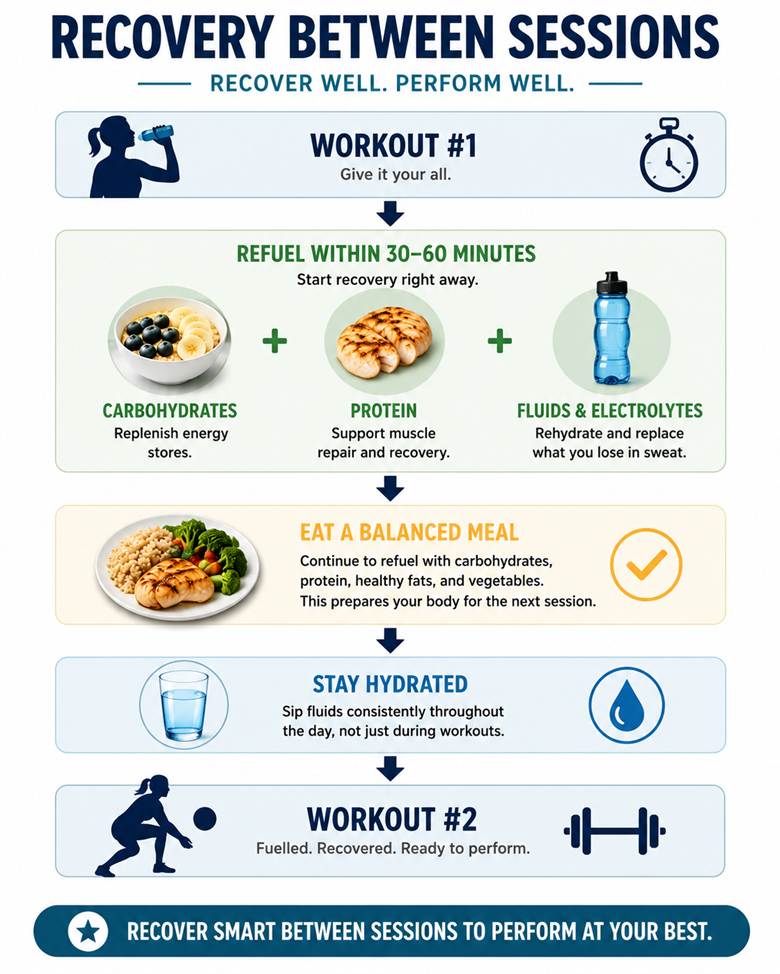
After your first training session, your body has several priorities.
It needs to:
- Replace the carbohydrates used during exercise
- Begin repairing muscle tissue
- Restore fluids lost through sweat
- Prepare for another training session just a few hours away
Unlike athletes who train once a day, you don’t have all evening to recover.
That’s why every meal, snack, and bottle of water between workouts matters.
Think of this time as preparation—not just recovery.
You’re not simply recovering from the morning workout.
You’re actively getting ready for the next one.
Start Refueling Soon After Your First Workout
One of the biggest mistakes I see is athletes waiting until lunch to eat.
Sometimes that’s two or three hours after practice ends.
Instead, aim to eat within about 30 to 60 minutes after your first workout.
That doesn’t mean you need a huge meal.
Sometimes a simple snack is enough to begin replacing energy, provide protein for muscle repair, and prevent excessive hunger later in the day.
Good recovery snack ideas include:
- Chocolate milk
- Greek yogurt with fruit
- Cottage cheese and pineapple
- Fruit smoothie made with milk or yogurt
- Turkey sandwich
- Peanut butter sandwich and banana
- Protein shake with fruit
If you’re planning to eat a full meal within the next hour, you may not need a separate recovery snack.
The important thing is to avoid going several hours without eating.
If you’d like more ideas, read my guide on Recovery Nutrition for Athletes.
Build a Balanced Meal Between Sessions
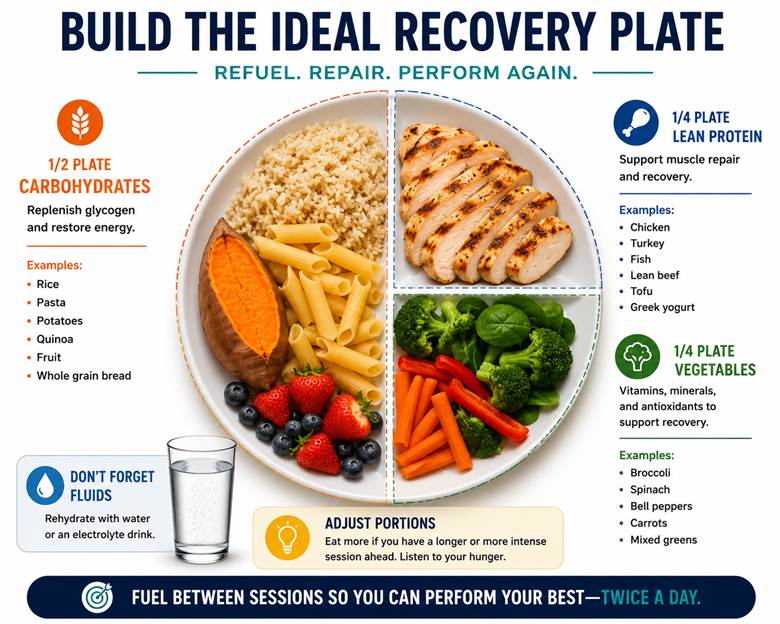
Once you’ve had your initial recovery snack—or if enough time has passed to eat a meal—focus on building a plate that supports both recovery and your upcoming workout.
A balanced meal should generally include:
- A carbohydrate-rich food
- A lean protein source
- Fruits and vegetables
- Fluids
Examples include:
- Grilled chicken with rice, broccoli, and fruit
- Turkey sandwich with baked chips, yogurt, and an apple
- Burrito bowl with rice, beans, chicken, salsa, and avocado
- Whole-wheat pasta with grilled chicken and vegetables
- Salmon with roasted potatoes and green beans
Rather than worrying about eating the “perfect” meal, focus on eating consistently.
Your body benefits much more from regular fueling than from trying to make one meal flawless.
Adjust Your Meal Based on Time
Not every athlete has the same schedule.
The amount of time you have before your second workout should influence the size of your meal.
If You Have 4–6 Hours
You have enough time to eat a complete meal and digest comfortably before training.
This is the ideal situation.
Build a balanced plate that includes carbohydrates, protein, colorful fruits or vegetables, and fluids.
If You Have 2–3 Hours
A regular meal is still appropriate, but some athletes prefer slightly smaller portions if they tend to experience stomach discomfort during exercise.
Choose familiar foods that digest well and avoid eating significantly more than usual.
If You Have 60–90 Minutes
When time is limited, keep your meal lighter.
Choose foods that provide carbohydrates while being easy to digest.
Good options include:
- Banana with Greek yogurt
- Peanut butter sandwich
- Applesauce and pretzels
- Fruit smoothie
- Granola bar and fruit
- Low-fat chocolate milk
Everyone’s digestive system is different.
Use training days to determine what works best for your body.
Don’t Be Afraid of Carbohydrates
Many athletes tell me they’re hesitant to eat carbohydrates between workouts because they don’t want to “undo” their workout or feel heavy before practice.
In reality, the opposite is often true.
During your first workout, your muscles use stored carbohydrate as one of their primary energy sources.
Eating carbohydrate-rich foods between sessions helps replenish those stores so you have energy available when your second workout begins.
Rice, pasta, potatoes, bread, oatmeal, fruit, cereal, tortillas, and dairy foods can all contribute to your daily carbohydrate intake.
If you’re training intensely twice in one day, carbohydrates aren’t working against your goals.
They’re helping you get more out of your next workout.
For a more detailed discussion, read Carbohydrates and Athletic Performance.
Protein Still Matters
Although carbohydrates often take center stage between workouts, don’t overlook protein.
Including protein with meals and snacks supports muscle repair throughout the day and helps your body adapt to training over time.
Good protein choices include:
- Greek yogurt
- Cottage cheese
- Eggs
- Chicken
- Turkey
- Lean beef
- Fish
- Milk
- Tofu
- Edamame
Rather than eating most of your protein at dinner, aim to include a quality protein source with each meal and snack whenever possible.
To learn more, visit Protein Needs for Athletes.
Stay Hydrated All Day
Replacing fluids isn’t something you do five minutes before practice.
It’s something you do continuously.
After your first workout:
- Continue sipping water throughout the day.
- Drink fluids with meals and snacks.
- Replace sweat losses before your second session begins.
- Include electrolyte-containing beverages when appropriate, especially during prolonged exercise or hot, humid conditions.
One simple way to monitor hydration is by checking your urine color.
Pale yellow generally suggests you’re well hydrated, while darker urine may indicate you need additional fluids. Keep in mind that certain vitamins, supplements, and medications can also affect urine color.
We’ll discuss hydration in more detail in the next section.
Recovery Is More Than Nutrition
Food plays a major role in recovery, but it’s only one piece of the puzzle.
Whenever possible, also prioritize:
- Getting off your feet between sessions
- Changing out of sweaty clothing
- Gentle stretching or mobility work if recommended
- Foam rolling if it helps reduce stiffness
- Taking a short nap when your schedule allows
- Protecting your sleep later that night
These habits won’t replace good nutrition, but together they create an environment that allows your body to recover more efficiently.
Consistency Wins the Season
Elite performance isn’t built on one perfectly timed recovery shake.
It’s built on hundreds of small decisions repeated day after day.
The athletes who consistently perform well during demanding training schedules usually aren’t doing anything extraordinary.
They’re simply eating enough, drinking enough, planning ahead, and treating recovery as part of their training—not something they think about afterward.
When you consistently fuel between workouts, you’re giving yourself the opportunity to train with higher quality, recover more effectively, and return ready to perform again tomorrow.
Hydration Throughout the Day
Hydration is one of the simplest ways to support performance during two-a-day training, yet it’s often one of the first things athletes overlook.
Many athletes don’t begin thinking about hydration until they’re already walking onto the field, court, or gym floor.
By then, it’s too late to fully replace the fluids lost during the first workout.
Instead of trying to “catch up” right before practice, think about hydration as an all-day habit.
Small amounts of fluid consumed consistently throughout the day are generally more effective than drinking a large amount all at once.
Simple Hydration Habits
To stay ahead of your fluid needs:
- Drink water when you wake up.
- Bring a reusable water bottle wherever you go.
- Drink fluids with every meal and snack.
- Replace fluids lost during your first workout before the second session begins.
- Consider an electrolyte-containing beverage during prolonged exercise, heavy sweat losses, or training in hot and humid conditions.
Do You Need Electrolytes?
Not always.
For many athletes, water and balanced meals provide everything they need.
However, electrolyte replacement may be beneficial if you:
- Exercise longer than 60–90 minutes
- Sweat heavily
- Notice salt stains on your clothing
- Train outdoors in the heat
- Complete multiple intense workouts in one day
💡 Sports Dietitian Tip
I often remind athletes that hydration isn’t something you fix.
It’s something you maintain.
If you’re waiting until you feel thirsty—or drinking an entire bottle of water just before practice—you’re probably already behind.
The athletes who stay hydrated most consistently are usually the ones who make drinking fluids part of their normal daily routine rather than something they only think about during exercise.
Common Fueling Mistakes During Two-a-Day Training
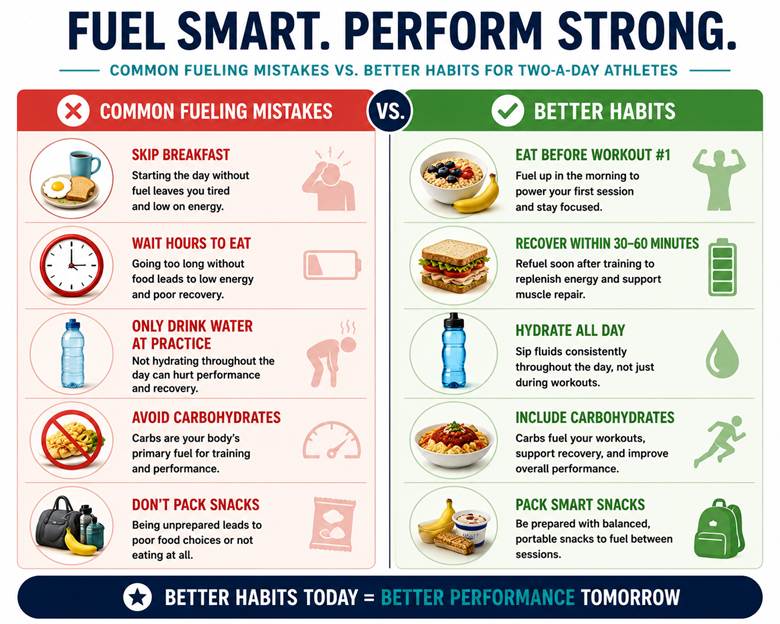
Training twice a day can make it difficult to consistently meet your nutrition needs. Between school, work, commuting, and busy practice schedules, even well-intentioned athletes can fall behind on fueling.
The good news is that many of the most common mistakes are easy to correct once you recognize them.
1. Skipping Breakfast
Starting your day without eating leaves you playing catch-up before your first workout even begins. A balanced breakfast provides the energy needed to start training strong and makes it easier to recover between sessions.
Instead: Aim to include carbohydrates, protein, and fluids before your first workout whenever possible.
2. Waiting Too Long to Eat After Your First Workout
Recovery begins as soon as your workout ends.
Waiting several hours before eating can make it more difficult to restore energy and prepare for your second training session.
Instead: Eat a recovery snack or meal within about 30 to 60 minutes after your first workout.
3. Avoiding Carbohydrates
Some athletes worry that eating carbohydrates will hurt their body composition goals.
However, when you’re training twice in one day, carbohydrates help replace the energy your muscles used during exercise and prepare you for your next workout.
Instead: Include carbohydrate-rich foods throughout the day, especially between training sessions.
4. Falling Behind on Hydration
Many athletes don’t realize they’re dehydrated until they already feel tired, sluggish, or develop a headache.
Trying to drink several bottles of water right before practice usually isn’t enough.
Instead: Sip fluids consistently throughout the day and include electrolytes when appropriate.
5. Depending on Supplements Instead of Meals
Protein powders, sports drinks, and recovery supplements can all have a place in an athlete’s nutrition plan.
But they should supplement a balanced diet—not replace it.
Instead: Build your nutrition around whole foods first, then use supplements only when they provide added convenience or meet a specific need.
6. Trying New Foods Before Important Practices or Competitions
Every athlete responds differently to food before exercise.
Experimenting with unfamiliar meals right before an intense workout can increase the risk of stomach discomfort or poor performance.
Instead: Practice your nutrition strategy during regular training so you know what works well for your body.
7. Not Planning Ahead
The athletes who struggle most with nutrition are often the ones making decisions when they’re already hungry.
Busy schedules make it easy to skip meals or settle for whatever food is available.
Instead: Pack meals, snacks, and a water bottle before leaving home so you’re prepared no matter how busy your day becomes.
Frequently Asked Questions
What should I eat if I have less than an hour between workouts?
Choose foods that digest easily and provide mostly carbohydrates with a small amount of protein. Examples include a banana with Greek yogurt, a fruit smoothie, applesauce with pretzels, or chocolate milk.
Do I need more protein when training twice a day?
Training more frequently may increase your daily protein needs, but protein alone isn’t enough. Your body also needs adequate carbohydrates and total energy to recover well and maintain performance throughout the day.
Can I lose weight while training twice a day?
Possibly, but aggressive calorie restriction during periods of high training volume can reduce energy levels, slow recovery, and negatively affect performance.
If fat loss is one of your goals, working with a sports dietitian can help you create a plan that supports both body composition and athletic performance.
Are sports drinks necessary?
Not always.
For shorter or lower-intensity workouts, water is usually sufficient.
Sports drinks may be beneficial during prolonged exercise, multiple daily training sessions, or workouts performed in hot and humid conditions where sweat losses are higher.
What if I’m not hungry after my first workout?
A reduced appetite after intense exercise is common.
If a full meal doesn’t sound appealing, start with something light like chocolate milk, yogurt, fruit, or a smoothie. As your appetite returns, follow it with a balanced meal to continue supporting recovery.
Is it okay to train fasted if I have another workout later?
For most athletes, no.
Training without eating before your first workout can make it harder to maintain intensity and may leave you underfueled for the rest of the day.
Whenever possible, eat at least a small snack before your morning session.
Sports Dietitian Insight: What I See in Real Athletes
One of the biggest lessons I’ve learned from working with athletes is that poor afternoon performance is often blamed on conditioning when nutrition is actually the limiting factor.
I’ve seen beach volleyball players lose their explosiveness late in practice, CrossFit athletes struggle to maintain intensity during evening workouts, and athletes from many different sports feel mentally drained long before practice ends.
In many cases, the solution wasn’t a new supplement or a more advanced training program.
It was simply eating enough, recovering sooner, and staying hydrated throughout the day.
Nutrition won’t replace hard work.
But it allows your hard work to produce better results.
The athletes who consistently perform at a high level usually aren’t doing anything extraordinary.
They’re simply prepared.
They arrive at practice fueled.
They recover intentionally.
And they repeat those habits every day.
Over the course of a season, those small decisions become a significant competitive advantage.
M3 Two-a-Day Fueling Checklist
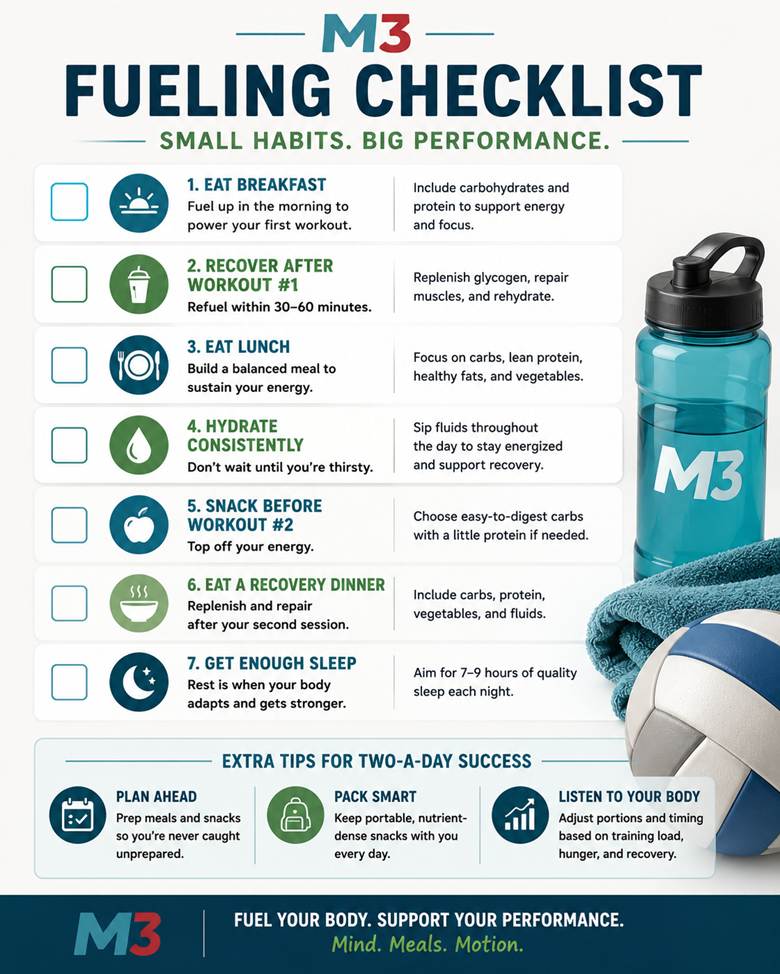
Before you finish reading, ask yourself these six questions:
✅ Did I eat before my first workout?
✅ Did I begin recovery within 30–60 minutes afterward?
✅ Did I eat a balanced meal between training sessions?
✅ Have I been drinking fluids consistently throughout the day?
✅ Will I have a snack before my second workout if I need one?
✅ Have I planned my dinner to support recovery for tomorrow?
You don’t need a perfect nutrition plan to become a better athlete.
You simply need a plan that you can follow consistently.
Small habits repeated every day often produce the biggest improvements in energy, recovery, and performance.
Conclusion
Training twice a day is demanding.
It challenges your muscles, your energy stores, your hydration status, and your ability to recover before doing it all again.
Fortunately, you don’t need a complicated nutrition plan to support your performance.
The fundamentals still matter most.
Fuel before your first workout.
Recover soon after you finish.
Eat consistently throughout the day.
Stay hydrated.
Plan ahead.
When these habits become part of your routine, they work together to help you train with more energy, recover more effectively, and perform more consistently—not just during one practice, but throughout an entire season.
One message I hope you take away from this guide is that nutrition isn’t separate from training.
Nutrition is part of training.
Every breakfast, recovery snack, lunch, water bottle, and dinner is another opportunity to support the work you’re putting in.
You don’t have to be perfect.
You simply have to be consistent.
Over time, those small, intentional choices become one of the biggest competitive advantages an athlete can have.
Ready to Take Your Performance to the Next Level?
Every athlete has different goals, training schedules, and nutritional needs. While general sports nutrition recommendations are a great place to start, the best results come from a plan that’s personalized to you.
Whether you’re preparing for preseason, training for a tournament, trying to improve your recovery, or simply looking for more consistent energy during workouts, I’d love to help.
At M3 Total Wellness, I provide evidence-based sports nutrition coaching for athletes of all ages and competition levels. Together, we’ll build a fueling strategy that fits your sport, your schedule, and your goals—so you can spend less time wondering what to eat and more time performing at your best.
During nutrition coaching, we’ll work together to:
- Develop a personalized fueling plan based on your training schedule
- Optimize pre-, during-, and post-workout nutrition
- Improve hydration strategies for practices and competitions
- Support healthy body composition goals without sacrificing performance
- Reduce fatigue and improve recovery between training sessions
- Create practical meal and snack ideas that fit your lifestyle
Whether you’re a competitive athlete, weekend warrior, or active adult, having the right nutrition plan can make training more productive—and more enjoyable.
Ready to fuel smarter and perform your best?
References
These references support the recommendations throughout this article and are among the most widely accepted consensus statements and position stands in sports nutrition.
Burke, L. M., Hawley, J. A., Wong, S. H. S., & Jeukendrup, A. E. (2011). Carbohydrates for training and competition. Journal of Sports Sciences, 29(Suppl. 1), S17–S27. https://doi.org/10.1080/02640414.2011.585473
Jäger, R., Kerksick, C. M., Campbell, B. I., Cribb, P. J., Wells, S. D., Skwiat, T. M., Purpura, M., Ziegenfuss, T. N., Ferrando, A. A., Arent, S. M., Smith-Ryan, A. E., Stout, J. R., Arciero, P. J., Ormsbee, M. J., Taylor, L. W., Wilborn, C. D., Kalman, D. S., Kreider, R. B., Willoughby, D. S., … Antonio, J. (2017). International Society of Sports Nutrition Position Stand: Protein and exercise. Journal of the International Society of Sports Nutrition, 14(20). https://doi.org/10.1186/s12970-017-0177-8
Kerksick, C. M., Arent, S., Schoenfeld, B. J., Stout, J. R., Campbell, B., Wilborn, C. D., Taylor, L., Kalman, D., Smith-Ryan, A. E., Kreider, R. B., Willoughby, D., Arciero, P., VanDusseldorp, T., Ormsbee, M. J., Wildman, R., Greenwood, M., Ziegenfuss, T., Aragon, A. A., & Antonio, J. (2017). International Society of Sports Nutrition Position Stand: Nutrient timing. Journal of the International Society of Sports Nutrition, 14(33). https://doi.org/10.1186/s12970-017-0189-4
McDermott, B. P., Anderson, S. A., Armstrong, L. E., Casa, D. J., Cheuvront, S. N., Cooper, L., Kenney, W. L., O’Connor, F. G., & Roberts, W. O. (2017). National Athletic Trainers’ Association Position Statement: Fluid replacement for the physically active. Journal of Athletic Training, 52(9), 877–895. https://doi.org/10.4085/1062-6050-52.9.02
Mountjoy, M., Ackerman, K. E., Bailey, D. M., et al. (2023). International Olympic Committee (IOC) Consensus Statement on Relative Energy Deficiency in Sport (REDs): 2023 Update. British Journal of Sports Medicine, 57(17), 1073–1098. https://doi.org/10.1136/bjsports-2023-106994
Thomas, D. T., Erdman, K. A., & Burke, L. M. (2016). Position of the Academy of Nutrition and Dietetics, Dietitians of Canada, and the American College of Sports Medicine: Nutrition and athletic performance. Journal of the Academy of Nutrition and Dietetics, 116(3), 501–528. https://doi.org/10.1016/j.jand.2015.12.006