
Quick Answer
There are several reasons why athletes should not skip meals regularly. Athletes don’t necessarily need to follow a rigid meal schedule, and occasionally missing a meal is unlikely to derail performance. However, regularly skipping meals can make it more difficult to consume enough energy, carbohydrate, protein, and other nutrients to support training, recovery, and overall health.
This becomes especially important as training demands increase. When eating opportunities are repeatedly missed, athletes have fewer opportunities to replace the energy used during exercise, prepare for upcoming sessions, and distribute important nutrients throughout the day.
For most athletes, the goal isn’t to eat constantly.
It’s to create enough consistent fueling opportunities to meet the demands of training, competition, recovery, and everyday life.
Key Takeaways
- Missing an occasional meal does not automatically cause poor performance, underfueling, low energy availability, or RED-S.
- Regularly skipping meals can make it harder for athletes to meet total energy and nutrient needs.
- Athletes with higher training volumes may have less flexibility to miss eating opportunities because they have more energy to replace.
- Missing meals around training can reduce opportunities to consume carbohydrate before exercise or replenish glycogen afterward.
- Regular meals and snacks can also help distribute protein throughout the day.
- Hunger isn’t always a perfect reflection of an athlete’s immediate fueling needs, particularly around intense exercise.
- Athletes do not universally need to eat every three or four hours.
- Eating more later can compensate for some missed intake, but fitting large energy needs into only one or two eating opportunities may be difficult or uncomfortable.
- Regular meal skipping can contribute to underfueling, but it does not automatically mean an athlete has low energy availability or RED-S.
- The best meal pattern is one that helps an athlete consistently meet nutrition needs while fitting their training schedule, preferences, appetite, and lifestyle.
Introduction: Athletes Don’t Always Skip Meals on Purpose
When people hear that an athlete isn’t eating enough, they may imagine someone deliberately restricting calories.
In practice, inadequate fueling can be much less obvious.
An athlete wakes up late and leaves without breakfast.
Classes run straight into practice.
A meeting goes through lunch.
There isn’t enough time between work and the gym to eat.
A morning workout suppresses appetite, so the athlete waits several hours before having a real meal.
A tournament schedule changes and the food that was supposed to be eaten between matches stays in the cooler.
None of these situations necessarily reflects an unhealthy relationship with food.
Sometimes life simply gets in the way.
But athletes have an additional challenge:
Training creates energy and nutrient demands that still need to be met.
The more demanding the training schedule becomes, the harder it may be to fit those needs into only one or two large meals at the end of the day.
This is why meal consistency can matter.
It isn’t because the body suddenly stops functioning if an athlete goes several hours without food. And it isn’t because every athlete needs to follow the same rigid eating schedule.
Instead, meals and snacks create fueling opportunities.
Those opportunities can help athletes:
- Meet overall energy needs
- Consume adequate carbohydrate
- Distribute protein throughout the day
- Fuel upcoming training
- Replace energy and nutrients after exercise
- Prepare for subsequent training sessions
- Avoid reaching the end of a demanding day with a large amount of nutrition still left to consume
Within the M3 Performance Framework — Mind • Meals • Motion, this is where Meals and Motion have to work together.
Motion creates demand.
As training increases, nutrition often needs to increase with it.
Meals provide opportunities to meet that demand.
Missing those opportunities occasionally isn’t a crisis. But when meal skipping becomes the normal pattern, adequately supporting training can become increasingly difficult.
And Mind matters too.
Sometimes the obstacle is logistical.
Other times athletes repeatedly tell themselves:
I’ll eat later.
I’m not hungry yet.
I don’t have time.
I’ll make up for it at dinner.
Understanding why meals are being missed is often more useful than simply telling an athlete to “eat more.”
The goal isn’t to make athletes afraid of occasionally missing a meal.
It’s to understand how a consistent fueling pattern can make it easier to support performance, recovery, and health.
Table of Contents
Why Do Athletes Skip Meals?
Athletes skip meals for many of the same reasons everyone else does.
The difference is that athletes may have significantly greater energy and nutrient demands because of training.
Common reasons include:
- Busy work or school schedules
- Early-morning practices
- Back-to-back classes or meetings
- Limited breaks
- Travel
- Tournament schedules
- Limited access to food
- Poor meal planning
- Low appetite
- GI discomfort around exercise
- Lack of convenient food options
- Trying to lose weight or body fat
- Fear of eating too much
- Believing that eating less will improve performance
Some of these barriers are logistical.
Others involve appetite.
Others may involve beliefs about food, body composition, or performance.
The solution therefore depends on why the athlete is skipping meals in the first place.
An athlete who doesn’t have time for lunch needs a different strategy from an athlete who intentionally avoids lunch because they’re afraid of gaining weight.
Why Meal Consistency Matters for Athletes
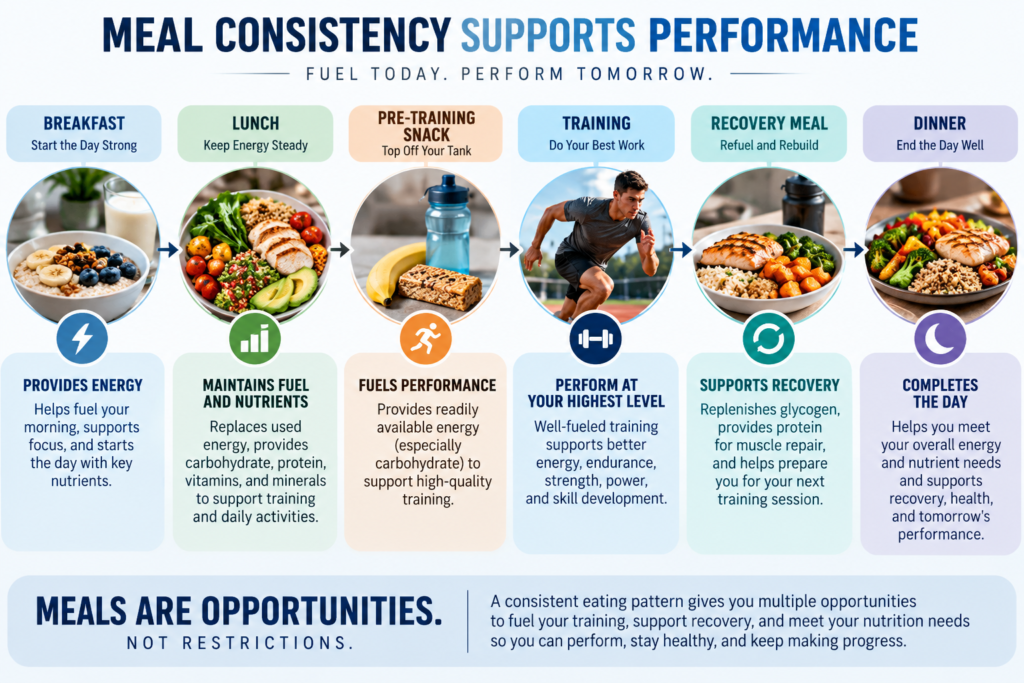
Meal consistency isn’t valuable because athletes need food at precisely scheduled intervals.
It’s valuable because athletes need enough opportunities to consume the nutrition their bodies require.
Imagine two athletes who have similar energy requirements.
One eats:
Breakfast → Lunch → Pre-training snack → Dinner → Evening snack
The other eats:
Coffee → Training → Nothing → Late lunch → Large dinner
It’s possible for both athletes to consume the same amount of energy by the end of the day.
But depending on their training schedules and food choices, the second athlete may find it much more difficult.
The issue becomes even more important when energy requirements are high.
An athlete who needs a substantial amount of food to support daily training may simply become too full trying to fit everything into one or two meals.
Regular eating opportunities can make those requirements more manageable.
What Happens When an Athlete Regularly Skips Meals?
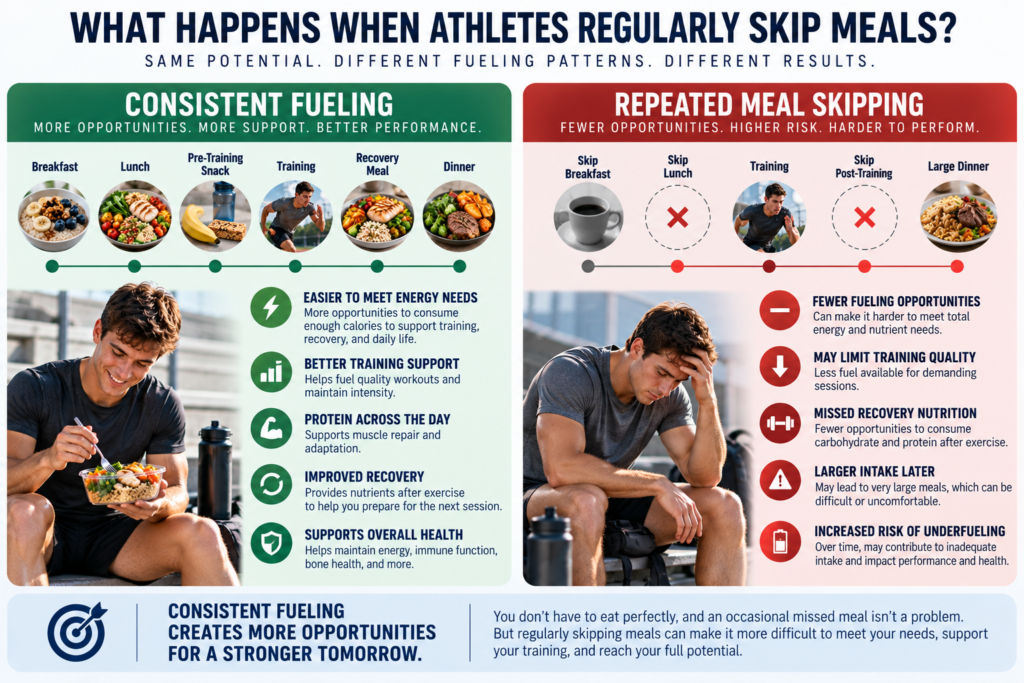
There isn’t one universal physiological response to skipping a meal.
What happens depends on factors such as:
- What the athlete ate previously
- When they are training
- Training duration and intensity
- Overall daily intake
- Carbohydrate availability
- Hydration
- Individual tolerance
- The frequency of meal skipping
That’s why statements such as “skipping breakfast ruins your metabolism” or “your blood sugar will crash if you don’t eat every three hours” are too simplistic.
The bigger concern for athletes is often cumulative.
Repeatedly removing eating opportunities can reduce total energy and nutrient intake.
If those missed opportunities aren’t adequately replaced, the athlete may gradually create a mismatch between what their training requires and what their nutrition provides.
How Skipping Meals Can Affect Training Performance
Whether missing a particular meal affects performance depends heavily on when the meal is missed.
Skipping dinner on a rest evening is not necessarily equivalent to missing lunch before a demanding afternoon practice.
Less Fuel Available Before Training
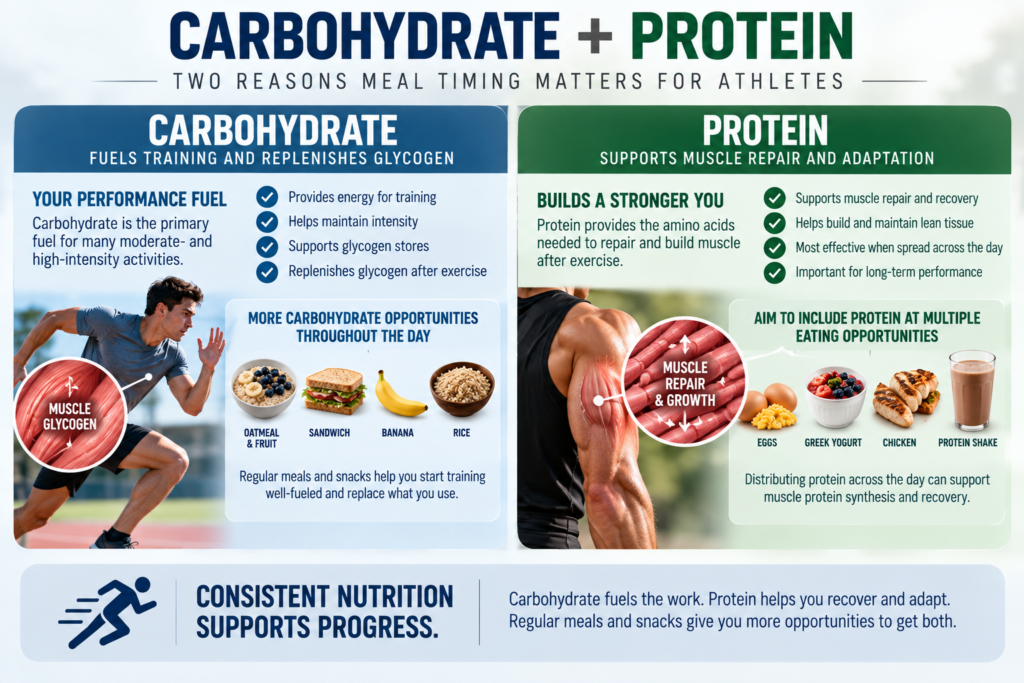
Carbohydrate is an important fuel for many moderate- and high-intensity sports.
Athletes participating in:
- Running
- Swimming
- Soccer
- Volleyball
- Basketball
- Tennis
- CrossFit
- High-intensity interval training
- Long resistance-training sessions
may benefit from having adequate carbohydrate available for training.
If an athlete repeatedly misses meals before demanding sessions, they may also miss important opportunities to consume carbohydrate.
Depending on the session and athlete, that may contribute to:
- Earlier fatigue
- Reduced ability to sustain intensity
- Lower training quality
- Difficulty completing repeated high-intensity efforts
For more on this topic, see Carbohydrates and Athletic Performance.
Training Quality Matters
One mediocre workout isn’t going to destroy an athlete’s progress.
But training adaptations develop from what happens repeatedly.
If inadequate fueling consistently reduces training quality, the athlete may struggle to complete the volume or intensity necessary to produce the desired adaptation.
That’s why nutrition isn’t separate from the training program.
It helps support the athlete’s ability to execute it.
How Skipping Meals Can Affect Recovery
Exercise creates a need for recovery.
Depending on the type of training, recovery may involve:
- Replenishing glycogen
- Supporting muscle protein synthesis
- Replacing fluids and electrolytes
- Repairing damaged tissue
- Preparing for another training session
Skipping an eating opportunity after exercise doesn’t mean recovery suddenly stops.
The body doesn’t operate on an immediate on/off switch.
But repeatedly delaying or missing post-exercise nutrition may be less than ideal—particularly when another demanding session is approaching.
An athlete who finishes training at 10:00 a.m. and doesn’t eat until 3:00 p.m. has missed several hours in which nutrition could have contributed to the recovery process.
The urgency becomes greater when recovery time is short.
An athlete training once today and resting tomorrow has more flexibility than an athlete who needs to perform again later the same day.
For practical strategies, see Post-Workout Recovery Nutrition for Athletes.
Skipping Meals, Carbohydrate Availability, and Training Quality
One reason meal consistency matters is that athletes don’t simply need calories.
They need appropriate amounts of specific nutrients.
Carbohydrate availability is particularly relevant for athletes performing prolonged or high-intensity exercise.
Muscle and liver glycogen help provide stored carbohydrate that can support exercise.
After demanding training, carbohydrate intake contributes to glycogen restoration.
Now consider an athlete who:
trains in the morning → skips breakfast → eats a small lunch → trains again in the afternoon.
Even if they eventually eat a large dinner, the nutritional support available between those two training sessions may have been inadequate.
This becomes especially relevant during:
- Two-a-day training
- Tournament weekends
- Training camps
- Multiple matches
- Heavy endurance blocks
- High-volume practice schedules
When recovery time is limited, nutrition between sessions becomes more important.
See Fueling for Two-a-Day Training Sessions for a deeper look at this situation.
Skipping Meals and Protein Distribution
Total daily protein intake is one of the most important nutritional considerations for athletes trying to maintain, repair, or build muscle.
But distribution matters too.
Rather than consuming almost all of the day’s protein at dinner, athletes can benefit from consuming high-quality protein across multiple eating opportunities.
Sports-nutrition literature commonly supports spreading appropriate protein doses across the day rather than concentrating most protein into a single meal.
That might look like:
Breakfast: eggs + Greek yogurt
Lunch: chicken bowl
Snack: yogurt or protein smoothie
Dinner: salmon + rice + vegetables
Compare that with:
Breakfast: skipped
Lunch: small salad
Dinner: enormous serving of protein
The second athlete might still reach their daily protein goal.
But consistently missing earlier meals removes opportunities to distribute protein throughout the day.
This is one reason meal consistency can support recovery even when total daily intake remains the primary priority.
For more information, see Protein Needs for Athletes.
Does Skipping Meals Cause Underfueling?
It can contribute to underfueling, but the terms shouldn’t be treated as interchangeable.
An athlete who misses breakfast once hasn’t automatically become underfueled.
The concern increases when meal skipping becomes a repeated pattern and the missed energy isn’t adequately replaced.
For example:
Skipped breakfast + small lunch + afternoon practice + late dinner
may leave an athlete substantially short of their needs.
Repeated across multiple days, that pattern becomes more meaningful.
But another athlete might occasionally miss breakfast and comfortably consume adequate nutrition through the rest of the day.
Context matters.
That’s why the better question isn’t:
“Did I skip a meal?”
It’s:
“Is my overall eating pattern consistently supporting what I’m asking my body to do?”
For a broader discussion, see Signs of Underfueling in Athletes: How to Know If You’re Not Eating Enough.
Does Skipping Meals Cause Low Energy Availability or RED-S?
Not automatically.
This distinction is important.
Low energy availability (LEA) occurs when dietary energy intake is insufficient relative to exercise energy expenditure to support the energy requirements for optimal health and performance.
The current IOC model recognizes that LEA exists on a continuum and distinguishes adaptable LEA from problematic LEA. RED-S involves physiological and/or psychological impairment associated with exposure to problematic prolonged and/or severe LEA.
So the relationship might look like:
Repeated meal skipping → may contribute to inadequate total intake → may contribute to LEA
But:
Skipping one meal ≠ LEA ≠ RED-S
RED-S should never be diagnosed simply because an athlete has an inconsistent eating schedule.
For more detail, see:
Low Energy Availability in Athletes: Signs, Risks, and Why It Matters
and
Relative Energy Deficiency in Sport (RED-S): What Athletes Need to Know
Is Skipping Breakfast Bad for Athletes?
Not necessarily.
Breakfast isn’t magically different from every other meal.
What matters is how the athlete’s eating pattern interacts with their training schedule and overall nutritional needs.
Consider an athlete who doesn’t train until 6:00 p.m.
If that athlete prefers their first meal later in the morning and still comfortably meets their nutrition needs, that may work perfectly well.
Now consider an athlete who:
wakes at 6:00 a.m. → practices at 7:00 → attends class until noon → doesn’t eat until 1:00 p.m.
That’s a very different situation.
The athlete has completed a demanding training session and then gone several additional hours without creating a meaningful recovery opportunity.
The question isn’t simply:
“Did you eat breakfast?”
It’s:
“Does your morning eating pattern support what you’re asking your body to do?”
What If You’re Not Hungry?
Hunger is useful information.
But it isn’t always a perfect real-time measurement of an athlete’s energy requirements.
Exercise can temporarily suppress subjective appetite in some people, particularly after moderate-to-vigorous exercise, and responses vary considerably among individuals.
This creates an interesting problem.
An athlete can expend substantial energy during training without immediately feeling extremely hungry afterward.
Waiting until intense hunger appears may therefore make it harder for some athletes to replace what they’ve used.
If appetite is low, the solution doesn’t necessarily need to be a huge meal.
Smaller or easier-to-consume options might include:
- Smoothies
- Chocolate milk
- Greek yogurt with fruit
- Cereal with milk
- Toast with eggs
- A sandwich
- Fruit with yogurt
- A protein shake plus a carbohydrate source
Liquid nutrition can be particularly useful when appetite is limited.
The goal isn’t to ignore hunger signals.
It’s to recognize that appetite and athletic energy expenditure don’t always rise together perfectly. Research on athlete energy intake has identified exercise response, time, and food availability among factors that can influence whether athletes adequately replace their energy expenditure.
Can You Just Eat More Later?
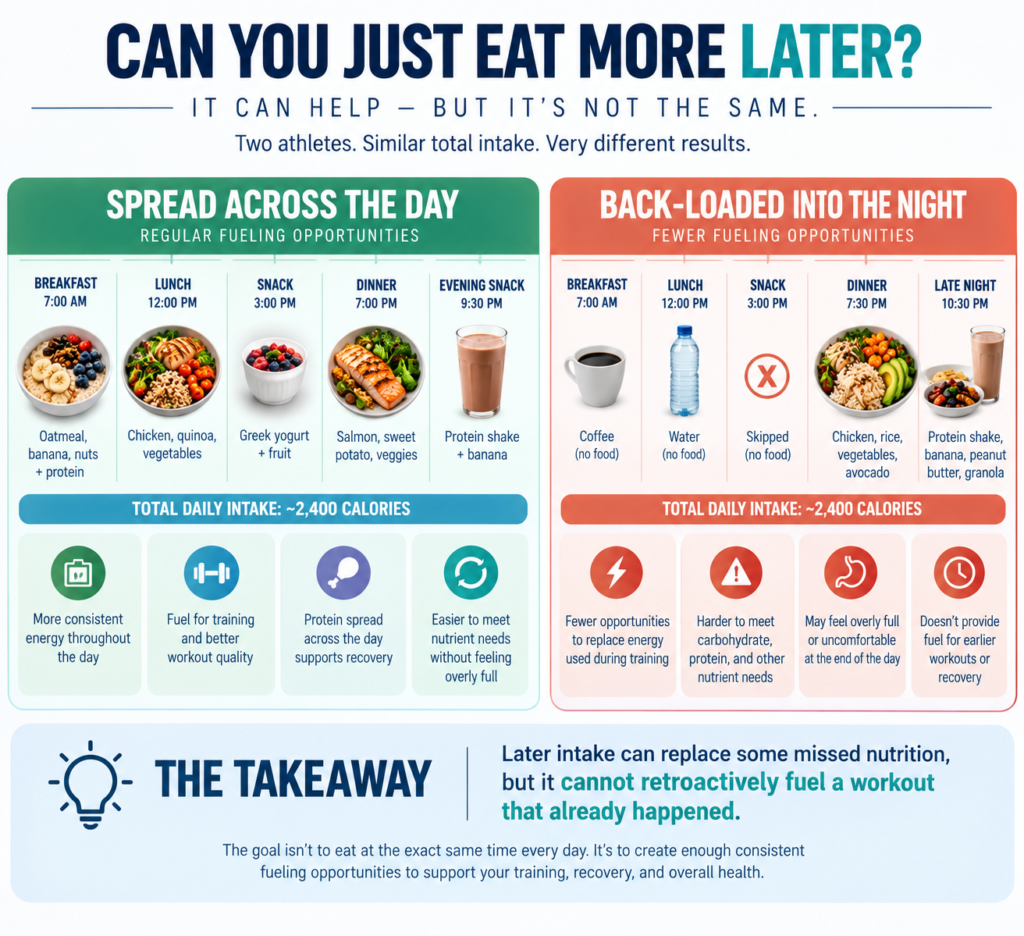
Sometimes.
This is another area where the answer shouldn’t be overly rigid.
If an athlete misses lunch but eats a substantial afternoon snack and dinner, they may be able to compensate for much of the missed intake.
The body doesn’t erase calories simply because they were eaten at a different time.
However, there are practical limitations.
An athlete with high energy needs may struggle to comfortably consume a very large amount of food late in the day.
Large late meals may also cause:
- Excessive fullness
- GI discomfort
- Difficulty eating enough
- Poor timing relative to another training session
And if the missed meal was supposed to fuel a workout that already happened, eating more afterward cannot go back in time and change the fuel availability for that session.
So yes—later intake can compensate for some missed nutrition.
But consistently relying on dinner to rescue an inadequately fueled day may not be the best strategy for many athletes.
Do Athletes Need to Eat Every 3–4 Hours?
No universal rule says every athlete must eat every three or four hours.
That recommendation can be useful in certain situations, particularly for athletes who:
- Have high energy requirements
- Struggle to eat large meals
- Want to distribute protein across the day
- Train multiple times per day
- Need regular carbohydrate opportunities
- Frequently forget to eat
Protein research also provides a rationale for distributing protein-containing meals across the day rather than saving nearly all protein for one meal.
But meal frequency should still be individualized.
One athlete may perform well with:
3 meals + 2 snacks
Another may prefer:
3 larger meals + 1 training snack
Another high-volume athlete might require:
3 meals + several snacks + nutrition during training
The goal isn’t to win an award for eating most frequently.
The goal is to build an eating pattern that supports the athlete’s actual needs.
What About Athletes Who Train Fasted?
Training before eating is not automatically harmful.
Some athletes comfortably complete certain sessions before breakfast.
The appropriateness of fasted training depends on factors such as:
- Training intensity
- Training duration
- The goal of the session
- What was eaten the previous day
- Overall energy and carbohydrate availability
- The athlete’s tolerance
- What training is scheduled afterward
A short, easy session after an adequate dinner is very different from completing a long, high-intensity workout after an overnight fast.
Athletes also shouldn’t assume that training without food automatically produces superior fat loss or better performance.
Sports nutrition should match the goal of the training session.
For sessions where high intensity, quality, or prolonged performance matters, appropriate pre-exercise carbohydrate may be beneficial.
See Pre-Workout Nutrition for Athletes for practical strategies.
How to Stop Skipping Meals When You’re Busy
The solution to meal skipping isn’t always better motivation.
Sometimes athletes need a better system.
1. Identify the Meal You Most Often Miss
Don’t overhaul the entire diet immediately.
Ask:
Which eating opportunity repeatedly disappears from my day?
Breakfast?
Lunch?
Post-workout nutrition?
Afternoon snack?
Start there.
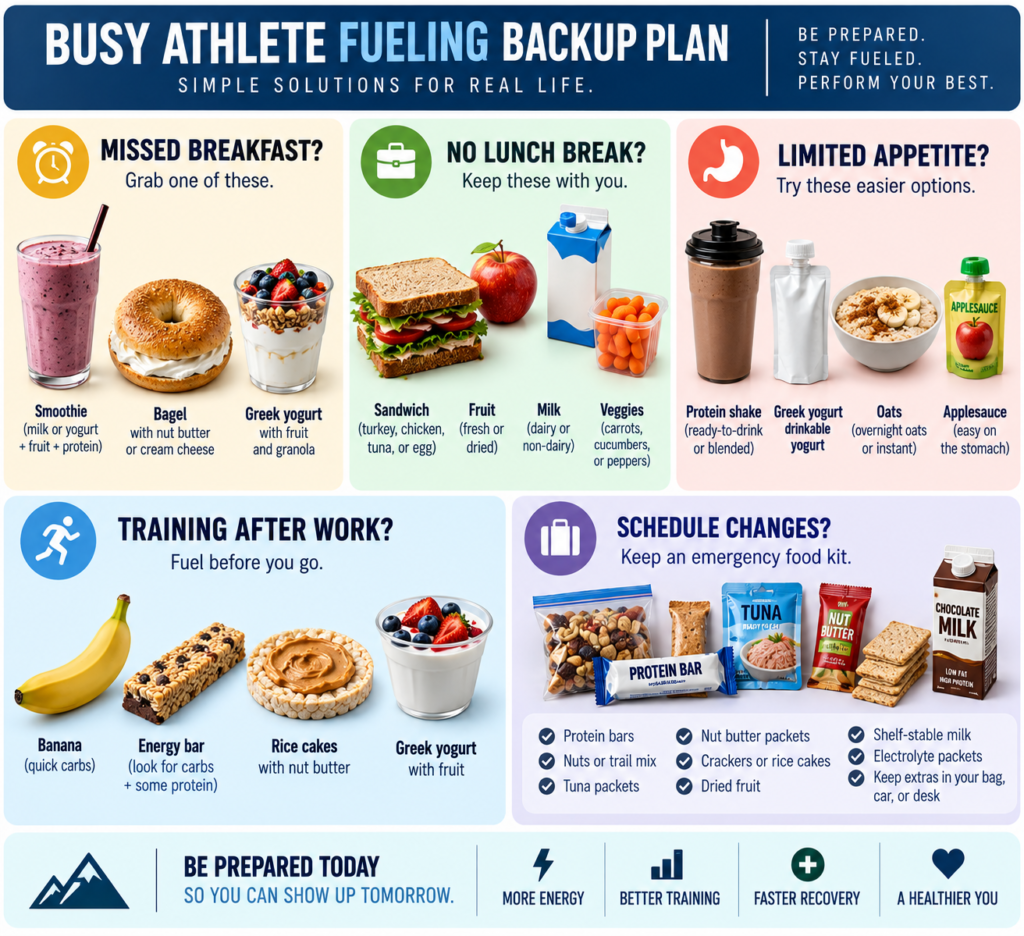
2. Build a Backup Option
Every athlete should have a few foods that require almost no preparation.
Examples include:
- Greek yogurt
- Fruit
- Cereal
- Milk
- Trail mix
- Sandwiches
- Granola bars
- Bagels
- String cheese
- Ready-to-drink shakes
- Tuna packets
- Crackers
- Overnight oats
The perfect meal you never have time to prepare isn’t useful.
A simple meal you consistently eat often is.
3. Keep Food Where You Need It
Consider keeping appropriate shelf-stable foods in:
- Your work bag
- Backpack
- Desk
- Gym bag
- Training facility
When possible and food-safety appropriate, a cooler can dramatically increase your options.
4. Use Snacks Strategically
A snack doesn’t have to replace a complete meal.
It can bridge the gap until a full meal is possible.
For example:
11:30 a.m. meeting prevents lunch
Instead of waiting until 4:00 p.m.:
11:00 a.m. — Greek yogurt + banana + granola
Then eat a full meal when your schedule allows.
For more ideas, see Best Snacks for Athletes.
5. Plan Around Training First
Instead of trying to fit nutrition into whatever time remains, identify your most important training sessions and work backward.
Ask:
When can I fuel before this?
When can I eat afterward?
Then build the rest of the day around those anchors.
Practical Meal Strategies for Different Training Schedules
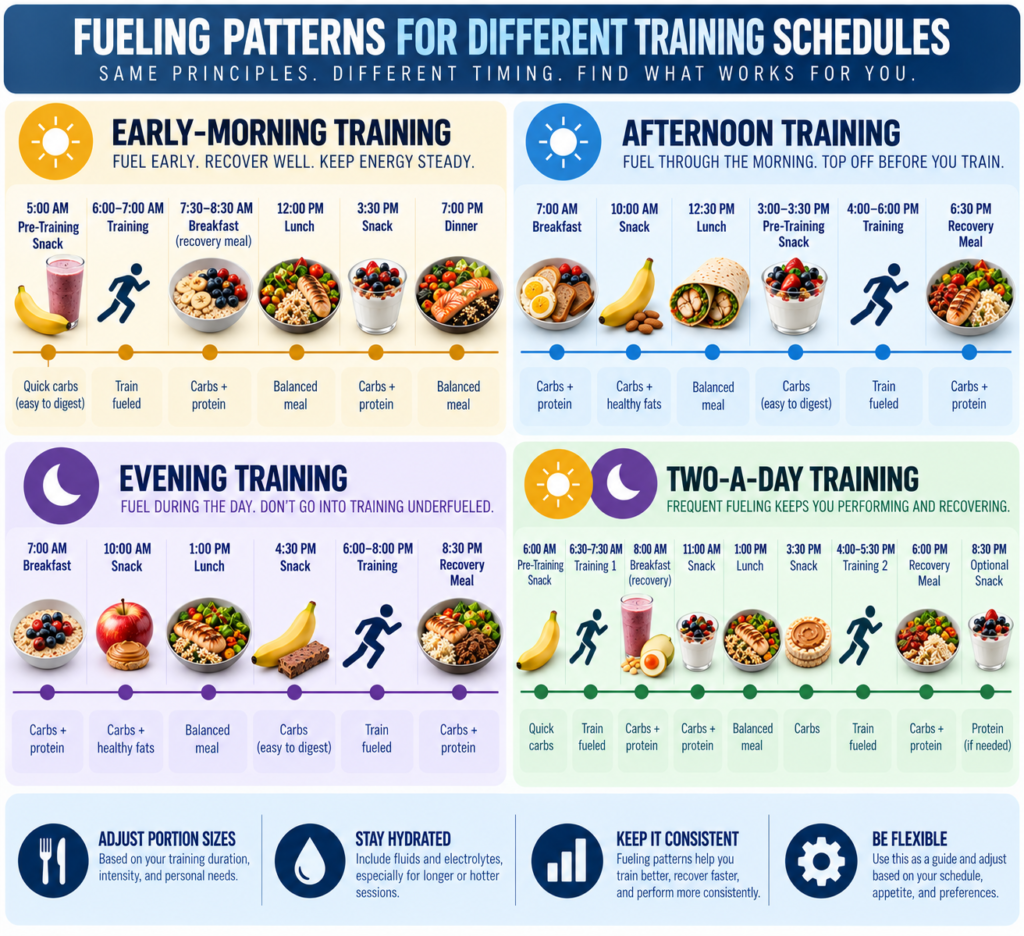
There isn’t one ideal meal schedule for every athlete.
Here are examples of how fueling opportunities might change with training.
Early-Morning Training
Before training:
Small carbohydrate option if appropriate
After training:
Breakfast with carbohydrate + protein
Midday:
Lunch
Afternoon:
Snack
Evening:
Dinner
If eating before an early workout is difficult, post-workout breakfast becomes especially important.
Afternoon Training
Morning:
Breakfast
Midday:
Lunch
Before training:
Snack if needed
After training:
Recovery meal or snack
Evening:
Dinner
In this scenario, repeatedly skipping lunch could leave a substantial gap before training.
Evening Training
Morning:
Breakfast
Midday:
Lunch
Afternoon:
Pre-training meal or snack
After training:
Dinner or recovery nutrition
Athletes who train after work often benefit from deliberately planning the afternoon eating opportunity instead of arriving at practice having eaten nothing since lunch.
Two-a-Day Training
With multiple daily sessions, the opportunities between workouts become especially valuable.
Nutrition may need to include:
Pre-session fuel → Session 1 → Recovery meal → Lunch → Pre-session fuel → Session 2 → Recovery → Dinner
The exact structure varies, but missing several eating opportunities becomes increasingly difficult to compensate for as training demand rises.
Sport-Specific Example: A Beach Volleyball Tournament Day
Consider a beach volleyball athlete competing in several matches throughout the day.
They eat breakfast at 7:00 a.m.
The first match begins at 9:00.
Matches continue through the afternoon.
Because competition times change, the athlete keeps telling themselves:
“I’ll eat after the next match.”
No real meal happens.
By 2:30 p.m., breakfast was more than seven hours ago.
The athlete may still be consuming fluids or an occasional snack, but total carbohydrate and energy intake may be falling behind the demands of several hours of competition.
Late in the day, they notice:
- Legs feeling heavier
- Difficulty sustaining repeated jumps
- Reduced intensity
- Increasing fatigue
- Difficulty concentrating between points
Not every late-tournament performance decline is caused by inadequate nutrition.
Heat, hydration, fitness, sleep, competition level, and many other factors matter.
But tournament nutrition is something the athlete can plan.
A better strategy might include:
Breakfast → between-match carbohydrate → portable midday meal → additional carbohydrate and fluids between later matches → recovery meal afterward
The athlete doesn’t need to sit down for three traditional meals during competition.
They need consistent access to appropriate fuel.
For a complete competition strategy, see Tournament Day Nutrition: What Athletes Should Eat Before, Between, and After Competition.
Common Meal-Skipping Myths
Myth 1: “Skipping One Meal Will Ruin My Performance”
Reality: Probably not.
Performance depends on the athlete’s overall nutrition, training, glycogen availability, hydration, sleep, and many other factors.
The concern is more about repeated patterns and strategically important meals.
Myth 2: “I Have to Eat Every Three Hours”
Reality: Not necessarily.
Some athletes benefit from frequent meals and snacks, while others comfortably meet their needs with fewer eating opportunities.
Meal frequency should support—not control—the athlete.
Myth 3: “If I’m Not Hungry, I Don’t Need Food”
Reality: Not always.
Appetite can be temporarily altered by exercise, and some athletes don’t experience hunger that perfectly matches their energy expenditure.
Training demands still need to be considered.
Myth 4: “I’ll Just Eat Everything at Dinner”
Reality: You may replace some missed energy later, but that doesn’t necessarily make it the best performance strategy.
It can be difficult to meet high energy needs in one meal, and dinner can’t retroactively fuel an afternoon workout.
Myth 5: “Skipping Meals Is an Easy Way for Athletes to Lose Fat”
Reality: Simply removing meals isn’t automatically a good body-composition strategy.
Athletic weight-management strategies should consider training quality, recovery, nutrient adequacy, and overall health—not simply how little food an athlete can tolerate.
Myth 6: “Skipping Meals Means I Have RED-S”
Reality: No.
Meal skipping can contribute to inadequate intake, but RED-S is a clinical syndrome associated with problematic low energy availability and cannot be diagnosed from one eating behavior.
Sports Dietitian Insight: Consistency Often Matters More Than Perfection
Athletes sometimes assume sports nutrition needs to be complicated.
They focus on supplements.
Exact nutrient timing.
Special recovery products.
Perfect macronutrient ratios.
But before worrying about advanced strategies, I would ask a much simpler question:
Are you consistently giving yourself enough opportunities to eat?
An athlete can have an excellent nutrition plan on paper and still struggle if their real day looks like:
skip breakfast → work through lunch → train → eat everything at night
The problem isn’t necessarily that they don’t know what foods are healthy.
The structure of the day doesn’t support their goals.
That’s why I view meal consistency as part of performance planning.
It doesn’t require eating perfectly.
It means creating a routine that makes adequate fueling easier to accomplish repeatedly.
Because the best nutrition strategy isn’t the one that looks perfect on paper.
It’s the one the athlete can consistently execute while meeting the demands of training.
The M3 Meal Consistency Check-In
Rather than following a rigid meal schedule, look at how your current eating pattern fits your training.
Mind
Ask yourself:
- Do I intentionally skip meals because I’m afraid of eating too much?
- Do I believe being hungry means my diet is “working”?
- Do I feel guilty about eating more on harder training days?
- Do I repeatedly tell myself I’ll eat later even when food is available?
- Am I using exercise to compensate for eating?
Meals
Consider:
- How many meaningful opportunities do I have to eat during the day?
- Which meal or snack do I most commonly miss?
- Am I consuming carbohydrate around demanding training?
- Am I getting protein across multiple meals?
- Do I regularly reach the evening realizing I’ve eaten very little?
- Do I have backup foods available when my schedule changes?
Motion
Look at your training:
- What time do I train?
- How long are my sessions?
- How demanding are they?
- Am I training more than I was a few months ago?
- Do I train more than once per day?
- Are competition days creating long gaps without food?
Then ask the most important question:
Does my eating pattern actually match my training pattern?
That’s more useful than trying to force every athlete into the same meal schedule.
When Meal Skipping May Signal a Bigger Problem
Not every skipped meal is concerning.
But repeated meal skipping deserves more attention when it occurs alongside patterns such as:
- Significant food restriction
- Fear of weight gain
- Anxiety around eating
- Compulsive exercise
- Persistent fatigue
- Declining training tolerance
- Recurrent injuries
- Menstrual or reproductive changes
- Frequent illness
- Significant body-image distress
- Unexplained weight changes
- Persistent gastrointestinal symptoms that limit intake
These signs do not automatically mean an athlete has an eating disorder, LEA, or RED-S.
But they may indicate that the issue is more complicated than poor meal planning.
In those situations, evaluation by an appropriately qualified healthcare professional may be warranted.
Frequently Asked Questions About Athletes Skipping Meals
Is It Bad for an Athlete to Skip a Meal?
Occasionally missing a meal is unlikely to cause a major problem for most healthy athletes.
The bigger concern is when meal skipping becomes frequent enough that the athlete struggles to meet energy and nutrient needs or repeatedly misses important fueling opportunities around training.
How Many Meals Should an Athlete Eat Per Day?
There is no universal number.
Many athletes do well with three meals plus snacks, but the appropriate pattern depends on energy needs, training schedule, appetite, preferences, and lifestyle.
Higher-volume athletes may require more frequent eating opportunities.
Should Athletes Eat Even When They Aren’t Hungry?
It depends.
Hunger should not be ignored, but appetite doesn’t always perfectly match exercise-related energy expenditure. After demanding exercise, some athletes may temporarily experience reduced appetite.
Smaller meals, snacks, or liquid nutrition can be useful when nutritional needs are high but appetite is low.
Is Skipping Breakfast Bad Before a Workout?
It depends on the workout.
Some athletes tolerate short or easy sessions without eating beforehand.
Longer, harder, or high-intensity sessions may benefit more from pre-exercise carbohydrate.
The athlete’s previous meals and overall nutrition also matter.
Does Skipping Meals Slow Your Metabolism?
Skipping a single meal doesn’t suddenly “shut down” metabolism.
For athletes, the more relevant concern is whether a repeated pattern of inadequate intake leaves them unable to adequately support training, recovery, and physiological needs.
Can Skipping Meals Cause Muscle Loss?
One missed meal doesn’t cause meaningful muscle loss.
However, chronically inadequate energy or protein intake can make maintaining or building lean tissue more difficult.
Athletes interested in muscle development should prioritize adequate total energy and protein while distributing protein across the day.
Can Athletes Make Up for a Missed Meal?
Often, at least partially.
Additional food later can help replace missed energy and nutrients.
However, repeatedly trying to consume most of the day’s nutrition late in the day may be impractical for athletes with high requirements and cannot retroactively improve fuel availability for a workout that has already occurred.
Conclusion
Athletes don’t need to fear missing an occasional meal.
And they don’t need to live according to a stopwatch that tells them to eat every three hours.
But they do need enough nutrition to support what they’re asking their bodies to do.
That’s where meal consistency becomes valuable.
Regular meals and strategically placed snacks create opportunities to:
- Meet energy needs
- Consume adequate carbohydrate
- Distribute protein
- Fuel training
- Support recovery
- Prepare for the next session
The harder an athlete trains, the more important those opportunities may become.
Within the M3 Performance Framework — Mind • Meals • Motion, the goal is alignment.
Mind helps athletes develop a practical and flexible approach to fueling.
Meals provide the energy and nutrients needed to support health and performance.
Motion creates the training demand those meals need to support.
Athletes don’t need a perfect eating schedule.
They need a fueling pattern that consistently supports the work they’re doing.
Need Help Building a Fueling Routine Around Your Training?
If you’re struggling to fit meals and snacks around work, school, training, or competition, an individualized sports nutrition plan can help turn general recommendations into a strategy that actually fits your day.
Learn more about M3 Performance Nutrition Coaching.
If you’re unsure whether your current eating and training habits are supporting your goals, you can also start with the M3 Performance Assessment.
This article is for educational purposes and is not intended to diagnose or treat a medical condition. Athletes experiencing persistent fatigue, recurrent injuries, significant food restriction, menstrual or reproductive changes, or other concerning symptoms should seek evaluation from an appropriately qualified healthcare professional.
References
- Thomas, D. T., Erdman, K. A., & Burke, L. M. (2016). Position of the Academy of Nutrition and Dietetics, Dietitians of Canada, and the American College of Sports Medicine: Nutrition and athletic performance. Journal of the Academy of Nutrition and Dietetics, 116(3), 501–528. DOI: 10.1016/j.jand.2015.12.006.
- Kerksick, C. M., Arent, S., Schoenfeld, B. J., et al. (2017). International Society of Sports Nutrition position stand: Nutrient timing. Journal of the International Society of Sports Nutrition, 14, 33. DOI: 10.1186/s12970-017-0189-4.
- Jäger, R., Kerksick, C. M., Campbell, B. I., et al. (2017). International Society of Sports Nutrition position stand: Protein and exercise. Journal of the International Society of Sports Nutrition, 14, 20. DOI: 10.1186/s12970-017-0177-8.
- Mountjoy, M., Ackerman, K. E., Bailey, D. M., et al. (2023). 2023 International Olympic Committee’s (IOC) consensus statement on Relative Energy Deficiency in Sport (REDs). British Journal of Sports Medicine, 57(17), 1073–1097. DOI: 10.1136/bjsports-2023-106994.
- Thackray, A. E., & Stensel, D. J. (2023). The impact of acute exercise on appetite control: Current insights and future perspectives. Appetite, 186, 106557. DOI: 10.1016/j.appet.2023.106557.
- Burke, L. M., Lundy, B., Fahrenholtz, I. L., & Melin, A. K. (2018). Pitfalls of conducting and interpreting estimates of energy availability in free-living athletes. International Journal of Sport Nutrition and Exercise Metabolism, 28(4), 350–363. DOI: 10.1123/ijsnem.2018-0142.