
Quick Answer
Athletes need enough energy—or calories—to fuel training and support everything the body does outside of exercise. Your individual energy needs depend on factors such as your body size, training volume and intensity, sport, age, goals, and where you are in your training season.
There is no single calorie target that’s appropriate for every athlete.
Rather than chasing a perfect number, athletes should focus on consistently eating enough to maintain training quality, recover between sessions, support normal body functions, and stay healthy over time.
If you’re frequently exhausted, struggling to recover, losing performance, or constantly playing catch-up with your nutrition, you may need more fuel than you’re currently getting.
Key Takeaways
- Athletes generally need more energy than less-active individuals because training adds substantial energy demands.
- Your energy needs can change from one day, week, or training phase to another.
- Calories don’t just fuel exercise. Energy is also needed for recovery, brain function, immune function, bone health, reproduction, growth, and other physiological processes.
- Eating too little can compromise both health and athletic performance.
- Hunger can be useful information, but it isn’t always a reliable measure of an athlete’s energy needs.
- Most athletes don’t need to obsessively count calories to fuel well.
- Regular meals and snacks can make meeting higher energy needs easier.
- Higher-volume training days usually require more fuel, while rest days still require adequate nutrition to support recovery.
- Performance, recovery, energy levels, health, and longer-term trends often tell us more than any single calorie estimate.
- There is no universal “perfect” calorie intake for athletes.
Introduction
“How many calories should I be eating?”
It’s one of the most common questions athletes ask me—and understandably so.
Energy needs for athletes can vary considerably based on body size, sport, training volume, daily activity, goals, and where an athlete is in their training season.
Search online and you’ll find calorie calculators that promise to give you an answer in seconds. Enter your age, height, weight, sex, and activity level, and out comes a number:
2,400 calories.
2,800 calories.
3,200 calories.
It looks precise.
But an athlete’s actual energy needs aren’t that simple.
Two athletes of the same age, height, and body weight can have very different needs depending on their sport, training schedule, body composition, daily activity, recovery demands, and goals.
Even the same athlete’s needs can change considerably throughout the week.
A rest day is different from a two-hour practice.
A normal practice day is different from a tournament with several matches.
Preseason training may look completely different from an off-season recovery week.
And that’s where athletes sometimes get into trouble.
They choose one calorie target and try to hit it every day regardless of what their body is being asked to do.
Others don’t think about energy intake at all. They eat when they’re hungry, stop when they’re full, and assume their appetite will automatically tell them exactly how much they need.
For some athletes, that works reasonably well.
For others, it doesn’t.
Intense exercise, busy schedules, stress, heat, travel, early-morning training, and limited opportunities to eat can make it surprisingly easy to consume less energy than training requires.
And underfueling doesn’t always look dramatic.
An athlete may still practice.
They may still compete.
They may even perform well—for a while.
But eventually, inadequate energy intake can begin showing up as persistent fatigue, poor recovery, declining training quality, increased injuries or illness, difficulty concentrating, or other changes in health and performance. Prolonged or severe low energy availability can contribute to Relative Energy Deficiency in Sport (REDs) in both female and male athletes.
That’s why understanding energy needs is about much more than counting calories.
It’s about learning to match your nutrition to what you’re asking your body to do.
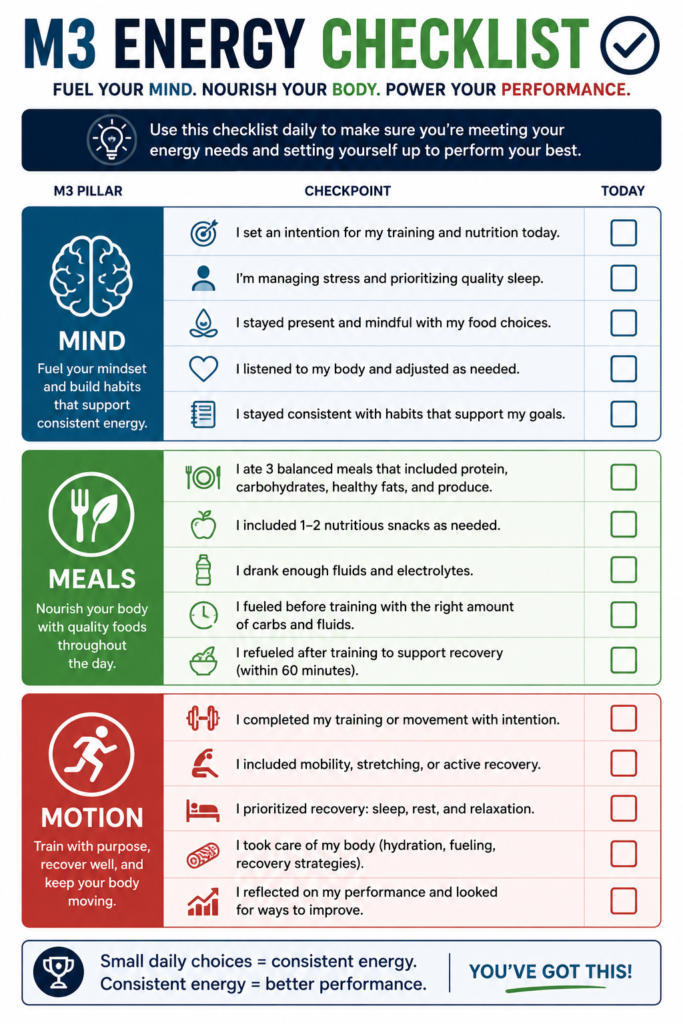
Within the M3 Performance Framework, I think of it this way:
Motion creates the demand.
Meals provide the energy.
Mind influences how consistently and confidently you fuel.
When those three pieces work together, nutrition becomes part of your training—not something separate from it.
Table of Contents
What Are Energy Needs?
When we talk about an athlete’s energy needs, we’re talking about the amount of dietary energy required to support everything the body needs to accomplish during the day.
Exercise is only part of that equation.
Your body requires energy to keep your heart beating, lungs working, brain functioning, body temperature regulated, tissues repaired, and countless other processes running—even if you stayed in bed all day.
Then there’s normal daily activity.
Walking around campus.
Going to work.
Climbing stairs.
Doing household chores.
Playing with your kids.
Standing for hours at a job.
And then, for athletes, we add training and competition.
That might mean:
- A 60-minute strength session
- Two hours of volleyball practice
- A long endurance workout
- Conditioning followed by lifting
- Multiple matches during a tournament
- Two training sessions in the same day
Finally, your body needs energy to recover from all of that activity.
So when an athlete says:
“I burned 600 calories during practice, so I just need to replace 600 calories.”
that’s an incomplete way of looking at energy needs.
Your body was using energy before practice started, continues using energy afterward, and needs resources to repair and adapt to the training you just completed.
Calories Aren’t the Enemy
The word calorie has developed a strange reputation.
In weight-loss culture, calories are often treated as something we should burn, avoid, reduce, or “earn.”
For an athlete, I want you to think about them differently.
Calories are simply a measure of energy.
And energy is what allows you to:
- Sprint
- Jump
- Lift
- Run
- Concentrate
- Recover
- Adapt to training
- Come back and do it again tomorrow
That doesn’t mean athletes should eat unlimited calories or ignore food quality.
It means that adequate energy intake is a fundamental part of athletic nutrition.
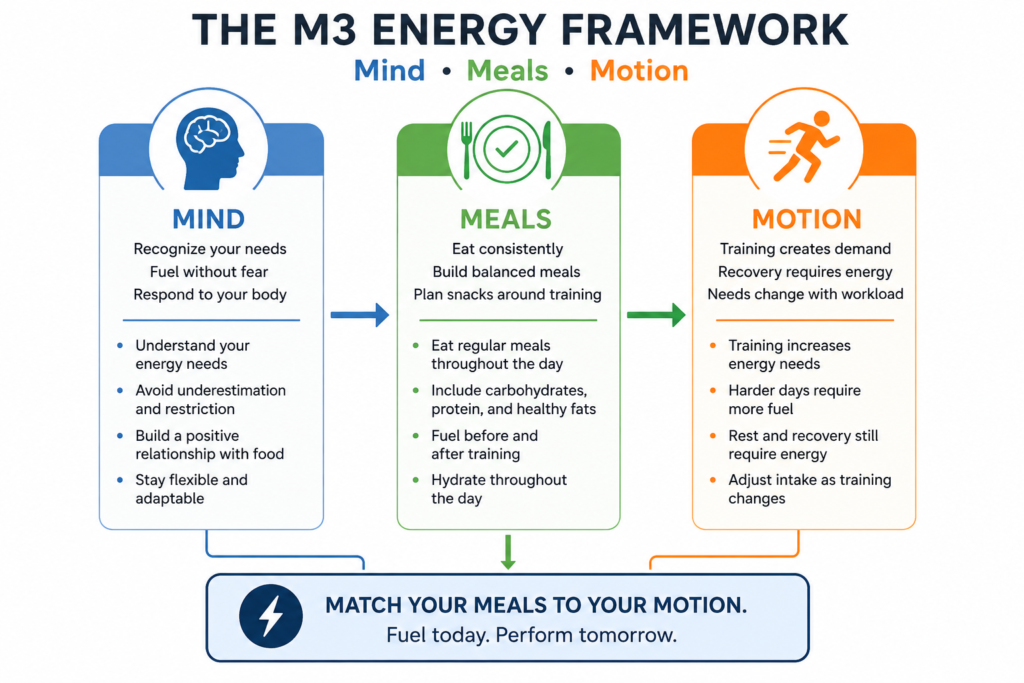
The M3 Energy Framework
Energy needs fit naturally into the M3 Performance Framework: Mind, Meals, and Motion.
Instead of viewing calories as an isolated nutrition number, the framework helps us look at the athlete as a whole.
Mind: Understand What Your Body Is Asking For
Your mindset influences how you respond to your nutritional needs.
Athletes sometimes unintentionally underfuel because they’re afraid that eating more will automatically cause unwanted weight gain.
Others believe that feeling hungry is a sign of discipline or that eating less will always improve body composition.
And some simply underestimate how much energy their sport requires.
A performance-focused mindset asks a different question:
“Am I giving my body enough fuel to do what I’m asking it to do?”
That’s a much more useful question than:
“How little can I eat?”
Awareness matters.
So does flexibility.
Your nutritional needs aren’t exactly the same every day, and your eating habits shouldn’t have to be either.
Meals: Provide Energy Consistently
Knowing that you need more fuel doesn’t help much if you’re going six or seven hours without eating.
For many athletes, the easiest way to meet energy needs isn’t dramatically increasing the size of every meal.
It’s improving consistency throughout the day.
That might look like:
Breakfast → Snack → Lunch → Pre-training snack → Recovery nutrition → Dinner
rather than:
Coffee → Nothing → Small lunch → Practice → Huge dinner
Both patterns may technically contain food, but they create very different fueling environments.
Regular meals and snacks help distribute energy across the day so that you’re fueling before you desperately need it.
Motion: Training Determines Demand
This is where athlete nutrition becomes highly individualized.
Your training schedule influences how much energy your body needs.
A light recovery session doesn’t create the same demand as a three-hour practice.
One volleyball match doesn’t create the same demand as six matches during a tournament.
And an off-season week doesn’t necessarily require the same intake as preseason conditioning.
World Athletics’ sports nutrition consensus similarly emphasizes that dietary energy needs to meet the cost of training and competition while still supporting the body’s non-sport functions.
That’s why athlete nutrition should be responsive rather than rigid.
Motion creates demand.
Meals help meet that demand.
Mind helps you recognize and respond to it.
That’s the M3 approach to energy.
Energy Needs vs. Energy Availability
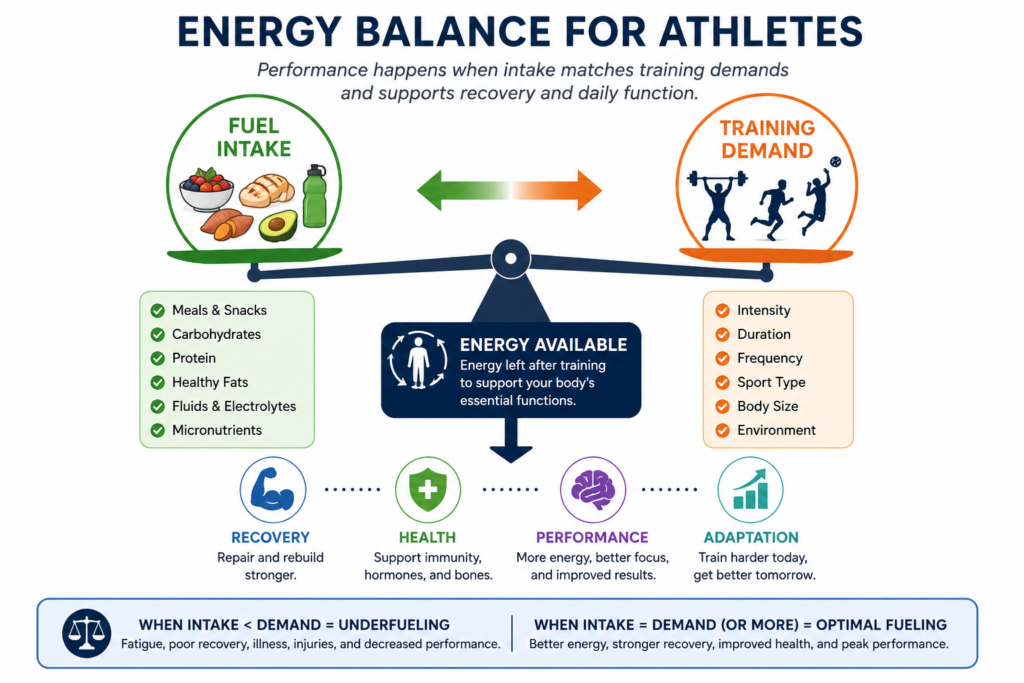
These terms sound similar, but they’re not exactly the same.
Understanding the difference is important.
Energy Needs
Your energy needs describe the total energy required to support your body and activity.
That includes energy for:
- Basic physiological functions
- Normal daily activity
- Training
- Competition
- Recovery
Energy Availability
Energy availability looks at the energy remaining for the body’s physiological functions after accounting for exercise energy expenditure, relative to fat-free mass.
This concept is especially important in sports nutrition because an athlete can consume what seems like a substantial amount of food and still have inadequate energy available for normal physiological function if training expenditure is very high.
The 2023 International Olympic Committee consensus describes low energy availability as a mismatch between dietary energy intake and exercise energy expenditure that leaves the body’s total energy needs unmet. The effects exist on a continuum; prolonged or severe problematic low energy availability can impair health and performance and contribute to REDs.
This is also why I don’t want athletes trying to diagnose low energy availability by plugging numbers into an online calculator.
Energy availability is useful as a scientific and clinical concept, but measuring it accurately outside controlled settings is difficult. Individual responses also vary. The modern REDs framework specifically recognizes that the magnitude, duration, frequency, and individual context of low energy availability matter.
Instead, athletes should understand the concept and pay attention to the bigger picture.
Are you consistently giving your body enough energy to support both training and health?
That’s what matters.
What Determines Energy Needs for Athletes?
There isn’t one calorie number that applies to all athletes.
Several factors work together to determine how much energy you need.
Training Volume
Generally, more training requires more energy.
An athlete training five or six days per week will usually have different needs from someone training recreationally twice per week.
Two-a-day sessions, tournament weekends, preseason conditioning, and high-mileage endurance training can increase requirements substantially.
Athletes training multiple times per day can read Fueling for Two-a-Day Training Sessions for more specific strategies.
Training Intensity
Duration isn’t everything.
A shorter but extremely demanding session can create substantial energy and recovery demands.
High-intensity intervals, repeated sprinting, heavy resistance training, and explosive court sports all require adequate fuel.
Body Size and Composition
Larger bodies generally require more energy to maintain than smaller bodies, although body composition also matters.
Two athletes who weigh the same can still have different requirements based on lean mass, training, daily movement, and individual physiology.
Sport
Different sports create very different demands.
Consider the difference between:
- A marathon runner
- A powerlifter
- A swimmer
- A gymnast
- A football lineman
- A beach volleyball player
They’re all athletes.
But their training schedules, body composition demands, competition environments, and energy expenditures can look completely different.
That’s why generic statements such as “athletes need 2,500 calories” aren’t particularly useful.
Age and Growth
Young athletes have an additional consideration:
They’re still growing.
Energy must support not only sport and recovery but normal growth and development.
That makes aggressive calorie restriction particularly concerning in young athletes.
Daily Activity Outside of Training
Training isn’t the only movement that counts.
An athlete who works an active job and walks 15,000 steps per day may need more energy than an athlete completing similar training but spending most of the remaining day seated.
Body Composition and Performance Goals
Some athletes want to gain muscle.
Others may need to gradually reduce body fat.
Others simply want to maintain weight and maximize performance.
Goals matter—but performance and health still have to remain part of the equation.
Body composition changes should generally be approached strategically rather than by drastically reducing food intake.
Training Phase
Energy needs can change throughout the year.
Preseason.
Competition season.
Off-season.
Injury rehabilitation.
Taper weeks.
Heavy training blocks.
Each can alter what your body needs.
This is one reason I don’t like giving an athlete one calorie target and treating it as permanent.
Your nutrition should evolve with your training.
Why Do Athletes Need More Energy?
Athletes need more energy because training adds demands that simply aren’t present in a less active lifestyle.
That extra energy is used not only to complete the workout itself, but also to support the recovery and adaptation that follow.
When intake consistently falls short, the body has to start making tradeoffs.
You may still be able to train, but something else can begin to suffer: recovery, concentration, immune function, bone health, hormonal function, or performance consistency.
For athletes, eating enough helps support:
- Training intensity
- Repeated sprinting and explosive movement
- Muscle repair
- Glycogen restoration
- Immune function
- Bone remodeling
- Concentration and decision-making
- Adaptation between workouts
This is especially important during high-volume phases like preseason, tournament weekends, two-a-day training, or periods when practices become longer and more intense.
A common mistake is to increase training without increasing food intake.
If your workload goes up but your meals stay exactly the same, you may gradually fall behind without realizing it.
Energy Is About More Than Exercise
One of the most important mindset shifts I want athletes to make is this:
You don’t eat only to fuel your workout.
Your body needs energy all day long.
Even when you’re sitting in class, sleeping, working, or resting after practice, your body is still using energy to keep essential systems functioning.
Adequate energy intake supports:
Brain Function
Your brain needs a steady supply of energy to concentrate, make decisions, learn plays, react quickly, and stay mentally engaged during training.
Athletes who are chronically underfueled may notice brain fog, irritability, or difficulty concentrating.
Muscle Repair
Training creates a stimulus.
Recovery is what allows your body to adapt to it.
Energy and nutrients are required to repair damaged muscle tissue and prepare you for the next session.
Bone Health
Bone is constantly remodeling.
Adequate energy availability is important for maintaining normal bone turnover and supporting skeletal health over time.
Immune Function
Heavy training already places stress on the body.
When energy intake is also inadequate, recovery and immune defense may become less resilient.
Hormonal and Reproductive Function
When the body senses that energy is consistently scarce, it may begin reducing investment in physiological functions that aren’t immediately essential for survival.
That’s one reason chronic low energy availability can affect reproductive and endocrine function.
This is why reducing calories too aggressively can create problems even when an athlete is still able to complete workouts.
Energy intake is not just about body weight.
It’s about giving your body enough resources to stay healthy while performing at a high level.
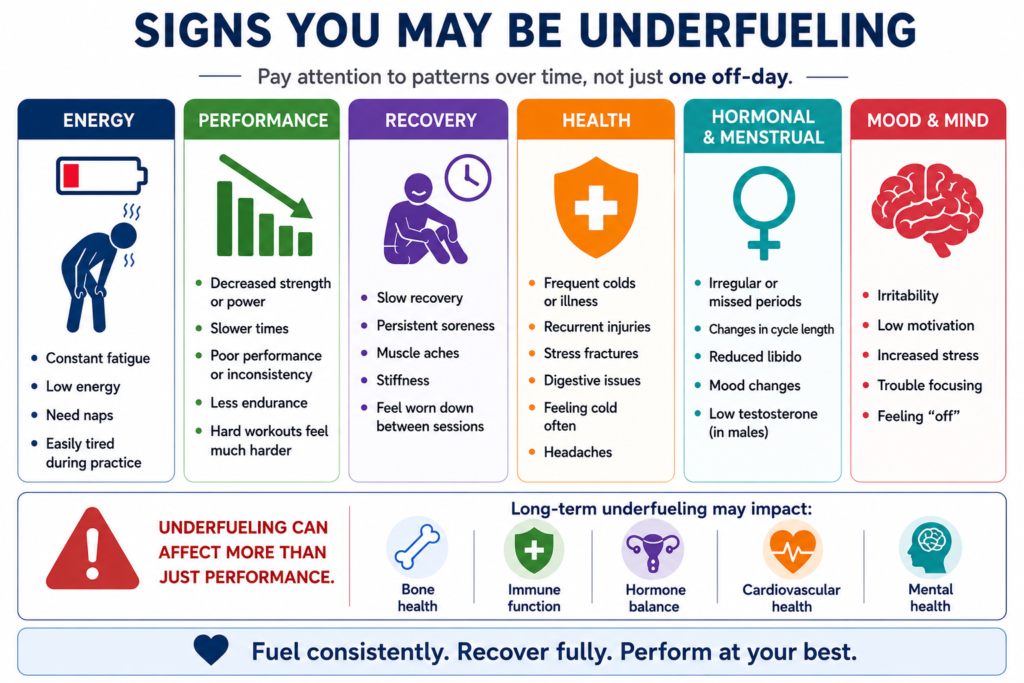
Signs You May Not Be Eating Enough
Underfueling doesn’t always begin with dramatic symptoms.
Often, the earliest signs are easy to dismiss.
You might blame them on a hard week of training, poor sleep, school stress, or simply “being tired.”
Pay attention if you begin noticing a pattern of:
- Persistent fatigue
- Needing unusually long to recover from workouts
- Declining strength, power, endurance, or training quality
- Difficulty concentrating
- Irritability or mood changes
- Feeling unusually cold
- Frequent illness
- Recurrent injuries
- Persistent soreness
- Sleep disturbances
- Unintended weight loss
- Menstrual changes in female athletes
- Reduced libido or other hormonal changes
- Feeling like every workout suddenly requires much more effort
One symptom by itself doesn’t automatically mean you’re underfueled.
But several occurring together—especially alongside a demanding training schedule—deserve attention.
If symptoms persist or include frequent injuries, menstrual changes, significant weight loss, or other health concerns, an athlete should speak with an appropriate healthcare professional rather than trying to self-diagnose based on a checklist.
Signs You May Be Fueling Well
I don’t want this article to become a giant list of everything that can go wrong.
Athletes also need to know what adequate fueling can look like.
You may be in a good place when you generally:
- Have steady energy throughout the day
- Can complete hard workouts without repeatedly crashing
- Recover reasonably well between sessions
- Maintain or improve training quality
- Concentrate well during practice
- Sleep reasonably well
- Maintain a stable mood
- Aren’t constantly dealing with illness or injury
- Feel hungry at predictable times and are able to respond to that hunger
- Maintain body weight or body-composition trends that align with your goals
- Feel prepared to train again rather than chronically depleted
None of these is a perfect measurement by itself.
Athletes naturally have tired days.
Performance fluctuates.
Hard training creates soreness.
The goal is to look at the pattern over time.
If your energy, recovery, health, and performance are generally moving in the right direction, that’s much more useful information than obsessing over whether you ate exactly 2,847 calories yesterday.
How Can Athletes Estimate Their Energy Needs?
This is where I want to avoid giving you a misleading answer.
There are equations and laboratory methods that can estimate energy expenditure.
But there is no calculator that can tell every athlete exactly how much to eat with perfect accuracy.
Energy requirements vary too much from person to person and from day to day.
That doesn’t mean estimates are useless.
It means they should be treated as starting points, not absolute prescriptions.
A Practical Approach
Instead of asking only:
“How many calories do I need?”
also ask:
- How is my energy throughout the day?
- Am I recovering well?
- Is my performance improving, stable, or declining?
- Am I frequently hungry?
- Is my body weight changing unexpectedly?
- Am I getting injured or sick more often?
- Has my training volume recently increased?
- Am I eating regularly enough to realistically meet my needs?
Those answers give context that a calorie calculator can’t.
When Calorie Estimates Can Be Helpful
A calorie estimate may be useful when:
- An athlete has very high energy needs and struggles to eat enough
- Weight is changing unexpectedly
- A structured body-composition goal is being pursued
- An athlete is recovering from chronic underfueling
- A dietitian is assessing whether intake reasonably matches training demand
In those situations, numbers can be helpful as part of a larger assessment.
But I wouldn’t recommend that every athlete download a calorie-tracking app simply because they’re training.
Should Athletes Count Calories?
Usually, not necessarily.
Some athletes like numbers and find tracking helpful.
Others become anxious, rigid, or overly focused on hitting a specific target.
There’s nothing inherently wrong with knowing approximately how much energy you’re consuming.
The problem comes when the number becomes more important than the athlete.
For example, imagine your calorie target is 2,600.
Then preseason begins.
Your practices get longer.
You’re lifting more.
You’re constantly hungry.
You’re exhausted by Thursday.
But you refuse to eat above 2,600 because “that’s my number.”
At that point, the target is working against you.
A better approach for many athletes is to focus on:
- Eating regular meals
- Adding snacks around training
- Adjusting portions based on workload
- Monitoring energy and performance
- Watching longer-term body-weight trends if relevant
- Responding to hunger and recovery needs
Calorie tracking is a tool.
It isn’t a requirement for good sports nutrition.
Why Hunger Isn’t Always Enough
Hunger is useful.
But it’s not perfect.
Some athletes assume that if they aren’t extremely hungry, they must be eating enough.
That can be misleading.
Appetite can be affected by:
- High-intensity exercise
- Heat
- Stress
- Early-morning practices
- Travel
- Long competition days
- Busy schedules
- Large amounts of caffeine
- Gastrointestinal discomfort
I’ve seen athletes finish a brutal practice and say:
“I’m not hungry.”
Then three hours later they’re starving and eating everything they can find.
That’s why structured eating can be useful.
You don’t always need to wait until you’re extremely hungry to fuel.
What If You’re Not Hungry After Training?
Start small.
Liquid or softer foods can be easier to tolerate.
Examples include:
- Chocolate milk
- Smoothies
- Greek yogurt
- Milk and cereal
- Applesauce
- Fruit
- Drinkable yogurt
Then follow with a more substantial meal when your appetite returns.
This is especially useful during tournaments or two-a-day training, when waiting several hours to eat can leave you behind for the next session.
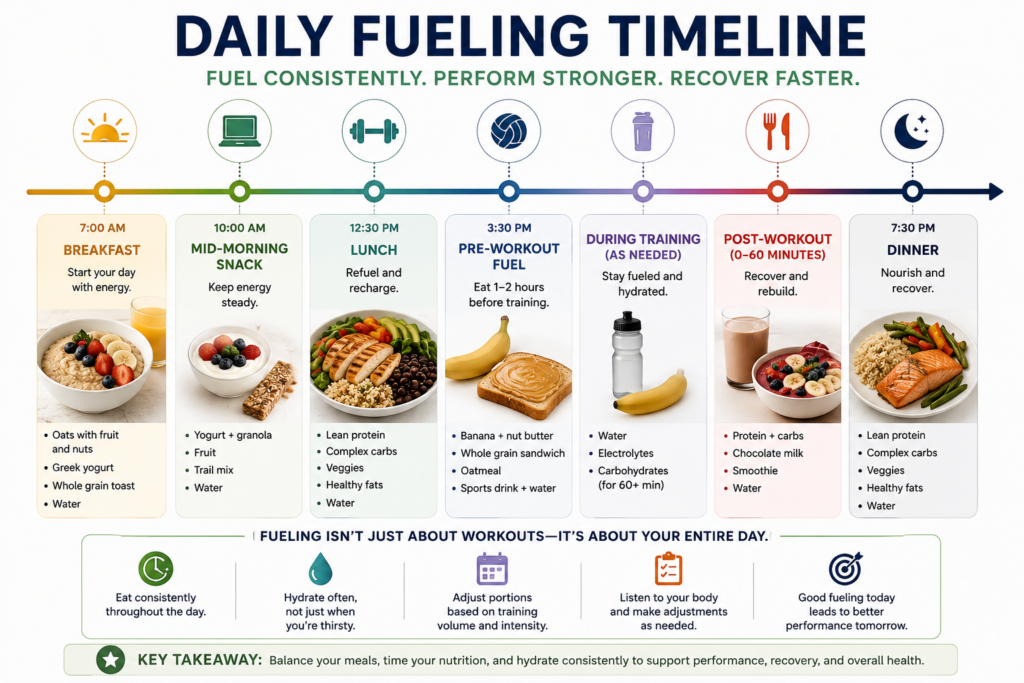
How Should Athletes Distribute Food Throughout the Day?
For most athletes, trying to meet all of their energy needs in two huge meals is difficult.
A more practical strategy is to spread intake across the day.
This doesn’t mean you need to eat on a stopwatch.
Think of it as a structure.
For example:
Breakfast
Fuel the start of your day.
↓
Morning Snack
Bridge the gap to lunch if needed.
↓
Lunch
Provide another substantial fueling opportunity.
↓
Pre-Workout Snack
Prepare for training.
↓
Recovery Food
Begin replacing what you used.
↓
Dinner
Support recovery and daily energy needs.
↓
Evening Snack
Helpful for athletes with higher energy needs or long training days.
Sample Daily Fueling Schedule
Here’s what that might look like for an athlete with an afternoon practice.
7:00 AM — Breakfast
- Oatmeal with milk, banana, and peanut butter
- Eggs
- Water
10:30 AM — Snack
- Greek yogurt
- Granola
- Berries
1:00 PM — Lunch
- Chicken or tofu
- Rice
- Vegetables
- Fruit
4:00 PM — Pre-Workout Snack
- Bagel with peanut butter
- Banana
- Water
6:30 PM — Post-Workout Recovery
- Chocolate milk or smoothie
- Pretzels or fruit
8:00 PM — Dinner
- Salmon, chicken, beans, or lean beef
- Potatoes, rice, or pasta
- Vegetables
- Water
9:30 PM — Optional Evening Snack
- Cereal with milk
- Cottage cheese with fruit
- Yogurt and granola
- Toast with nut butter
This isn’t a prescription.
It’s an example of what consistent fueling can look like.
The specific foods and portions should change based on the athlete, sport, schedule, preferences, and goals.
Matching Food Intake to Training
Your intake doesn’t have to look exactly the same every day.
And in many cases, it shouldn’t.
Higher-Training Days
On demanding days, you may need:
- Larger carbohydrate portions
- Additional snacks
- More pre- and post-workout fuel
- More fluids
- Extra recovery nutrition
For example, if you normally have one afternoon practice but suddenly add a morning lift, continuing to eat exactly the same amount may leave you underfueled.
Lower-Training or Rest Days
Yes, your total energy expenditure may be somewhat lower.
But your body is still recovering.
Rest days are when your muscles continue repairing, glycogen is replenished, and adaptations from previous training occur.
That means a rest day isn’t a reason to slash your intake.
You may naturally eat a little less because appetite is lower or you don’t need an extra pre-workout snack.
That’s different from intentionally skipping meals because you’re “not earning the calories.”
Recovery still requires energy.
How Energy Needs Change Throughout the Season
Your nutrition should change when your training changes.
Off-Season
Training volume may be lower.
Some athletes focus more on strength, mobility, or body-composition goals.
Energy needs may decrease slightly—but adequate intake still supports training and recovery.
Preseason
This is often where energy needs jump dramatically.
Practices may become longer.
Conditioning increases.
Two-a-days may appear.
If food intake doesn’t increase with training, fatigue can accumulate quickly.
In-Season
Competition schedules, travel, school, and practices can make consistency harder.
The challenge may be less about knowing what to eat and more about finding enough opportunities to eat.
Tournament or Competition Weeks
Multiple matches, races, heats, or events can dramatically increase daily needs.
Portable snacks, carbohydrate-rich foods, hydration, and recovery nutrition become especially important.
Injury or Rehabilitation
Energy expenditure may decrease, but recovery still requires adequate nutrition.
Extremely restricting calories during injury can work against tissue repair and maintenance of lean mass.
The important principle is simple:
Fuel the athlete you are today—not the training schedule you had three months ago.
Common Fueling Mistakes Athletes Make
Even athletes who care about nutrition can unintentionally fall short of their energy needs.
Most of the time, it isn’t because they’re deliberately trying to underfuel.
It happens because training gets busier, meals become inconsistent, appetite changes, or athletes underestimate how much energy their sport actually requires.
Here are some of the most common patterns I see.
1. Underestimating Training Demands
An athlete may add another practice, start lifting, increase mileage, or enter preseason without making any meaningful changes to food intake.
Training goes up.
Fuel stays the same.
Eventually, recovery starts falling behind.
Better approach: When your workload increases, expect your nutrition needs to change too.
2. Relying Only on Hunger
Hunger is helpful, but it isn’t always enough.
Intense exercise, heat, stress, and busy schedules can temporarily suppress appetite even when your body still needs energy.
Better approach: Use a combination of hunger cues and structured meals and snacks, especially around training.
3. Skipping Meals Because You’re Busy
This may be one of the most common causes of accidental underfueling.
Classes.
Work.
Commuting.
Practice.
Suddenly it’s 5 p.m., and you’ve eaten once.
Better approach: Pack portable foods and treat fueling opportunities like part of your training schedule.
4. Trying to “Make Up” for Eating More the Day Before
Some athletes eat more after a hard tournament or social event and then drastically restrict food the following day.
That creates an unnecessary cycle of overeating and restriction.
Better approach: Return to your normal fueling routine. Your intake doesn’t need to be perfectly balanced every 24 hours.
5. Cutting Too Much Food on Rest Days
A rest day isn’t an inactive day for your body.
Recovery, muscle repair, and glycogen replenishment are still taking place.
Better approach: Let intake adjust naturally with your activity, but don’t turn rest days into fasting or restriction days.
6. Prioritizing Protein but Forgetting Total Energy
Protein is important.
But a high-protein diet can still be an underfueled diet.
Athletes need sufficient total energy, including adequate carbohydrates and fats, to support performance and recovery.
7. Using Body Weight as the Only Measure of Success
A stable body weight doesn’t necessarily mean an athlete is adequately fueled.
Likewise, short-term changes in weight don’t automatically tell you whether your nutrition plan is working.
Performance, recovery, health, mood, training quality, and longer-term trends all provide useful information.
A Real-World Example: The Volleyball Athlete Who Was Always Tired
Imagine a volleyball player with the following schedule:
7:00 AM: School or work
12:00 PM: Small lunch
4:00 PM: Strength training
6:00 PM: Volleyball practice
8:30 PM: Dinner
On paper, they’re eating several times during the day.
But look closer.
Breakfast is frequently skipped.
Lunch is small.
There’s no snack before lifting.
Nothing is eaten between lifting and volleyball practice.
By the time dinner arrives, the athlete is exhausted and extremely hungry.
Over several weeks, they begin noticing:
- Less explosiveness late in practice
- Poor concentration
- Increased soreness
- Difficulty recovering between training days
- Strong cravings at night
Their instinct might be:
“I need better conditioning.”
But conditioning may not be the problem.
They’re trying to complete several hours of activity with very little fuel available beforehand.
A few practical changes could make a significant difference:
Morning
Add breakfast.
Midday
Eat a more substantial lunch.
Before Training
Add a carbohydrate-rich snack.
Between Sessions
Use easy recovery nutrition if time allows.
After Practice
Eat dinner instead of relying on dinner to replace everything missed earlier.
The goal isn’t simply to increase calories.
It’s to put more energy where the athlete actually needs it.
This is something I especially notice in sports like volleyball, where athletes may train hard for several hours but don’t always think of themselves as having the same fueling needs as endurance athletes.
Explosive sports require fuel too.
Frequently Asked Questions
How many calories does an athlete need each day?
There is no single calorie target that applies to all athletes.
Needs depend on body size, training volume, sport, age, body composition, daily activity, and goals.
A calorie estimate may provide a starting point, but it should be adjusted based on performance, recovery, health, and changes in training.
Should athletes count calories?
Not necessarily.
Some athletes find short-term tracking helpful for understanding how much they’re eating.
Others perform better using regular meals, snacks, portion adjustments, and feedback from energy, recovery, and performance.
Calorie tracking should be a tool—not something that creates anxiety or rigid eating.
Should I eat less on rest days?
Possibly a little less, especially if your activity is significantly lower.
But rest days still require energy for recovery.
You may naturally need fewer training snacks or slightly smaller portions, but there’s usually no reason to drastically restrict food.
Why am I so hungry after practice?
Hard or prolonged exercise can increase energy needs significantly.
Sometimes athletes also arrive at practice underfueled, so hunger afterward reflects not only what they used during the workout but what they failed to eat earlier in the day.
If you’re consistently ravenous at night, take a closer look at breakfast, lunch, and pre-workout nutrition.
What if I don’t feel hungry enough to eat more?
You may still need more fuel.
Try adding smaller, energy-dense foods throughout the day rather than forcing yourself to eat very large meals.
Examples include:
- Smoothies
- Yogurt and granola
- Nut butter
- Trail mix
- Milk
- Sandwiches
- Dried fruit
- Avocado
- Olive oil added to meals
Liquid nutrition can also be useful when appetite is low after intense training.
Can eating too little hurt athletic performance?
Yes.
Problematic low energy availability can negatively affect physiological function and athletic performance, particularly when it is prolonged or severe. The IOC’s current REDs framework recognizes effects across areas such as bone health, reproductive function, immune function, cardiovascular health, metabolism, and performance.
What if I’m trying to lose body fat?
Body-composition goals can be appropriate for some athletes, but aggressive energy restriction can work against training quality and recovery.
The goal should be to create a plan that supports gradual progress while preserving performance, lean mass, and health.
This is one situation where individualized guidance from a sports dietitian can be especially valuable.
Sports Dietitian Insight
One of the biggest patterns I see with athletes is accidental underfueling.
They aren’t necessarily dieting.
They’re simply busy.
They train hard, go to work or school, skip snacks, eat a light lunch, and assume they’ll make up for it at dinner.
By the end of the day, they’re exhausted.
When I review their intake, the issue often isn’t one specific food.
It’s the large gaps without enough energy.
That’s why I don’t start by asking every athlete to count calories.
I start by looking at the structure of the day.
Are they eating breakfast?
Is lunch substantial enough?
Are they fueling before training?
Are they recovering afterward?
Are they eating differently when training volume changes?
Sometimes adding one or two well-timed snacks can improve an athlete’s energy more than completely rebuilding their diet.
I’ve also found that athletes often underestimate how important consistency is.
A great dinner can’t always compensate for being underfueled for the previous ten hours.
Your body performs best when it has access to energy throughout the day—not only after training is over.
Conclusion
Athletes need enough energy to support much more than the workout happening in front of them.
Your body also needs fuel for recovery, adaptation, concentration, immune function, bone health, normal physiology, and everything else you do throughout the day.
That’s why asking:
“What’s the lowest number of calories I can eat?”
is usually the wrong question.
A better question is:
“Am I eating enough to support the athlete I want to become?”
There isn’t one perfect calorie number that applies to every athlete.
Your needs change with your body, your sport, your training, your goals, and your season.
What matters most is whether your nutrition is keeping pace with those demands.
Within the M3 Performance Framework, it comes back to the relationship between Mind, Meals, and Motion.
Motion creates demand.
Meals provide fuel.
Mind helps you recognize your needs and respond consistently.
When those pieces work together, energy intake becomes more than a number.
It becomes part of your performance strategy.
Ready to Find Out Whether You’re Fueling Enough?
If you’re constantly tired, struggling to recover, unsure how much you should be eating, or trying to balance performance with body-composition goals, you don’t have to guess.
At M3 Total Wellness, I help athletes develop practical, evidence-based nutrition strategies that match their sport, training schedule, lifestyle, and goals.
During a sports nutrition consultation, we can work together to:
- Evaluate whether your current intake supports your training
- Identify possible gaps in your daily fueling routine
- Build meals and snacks around practices and competitions
- Adjust intake for heavy and light training days
- Support recovery and body-composition goals
- Create a plan that’s realistic enough to follow consistently
Ready to fuel your training with more confidence?
References
Burke, L. M., Castell, L. M., Casa, D. J., et al. (2019). International Association of Athletics Federations Consensus Statement 2019: Nutrition for Athletics. International Journal of Sport Nutrition and Exercise Metabolism, 29(2), 73–84.
https://doi.org/10.1123/ijsnem.2019-0065
Loucks, A. B., Kiens, B., & Wright, H. H. (2011). Energy availability in athletes. Journal of Sports Sciences, 29(Suppl. 1), S7–S15.
https://doi.org/10.1080/02640414.2011.588958
Melin, A., Tornberg, Å. B., Skouby, S., et al. (2019). Energy availability in athletics: Health, performance, and physique. International Journal of Sport Nutrition and Exercise Metabolism, 29(2), 152–164.
https://doi.org/10.1123/ijsnem.2018-0201
Mountjoy, M., Ackerman, K. E., Bailey, D. M., et al. (2023). 2023 International Olympic Committee’s (IOC) consensus statement on Relative Energy Deficiency in Sport (REDs). British Journal of Sports Medicine, 57(17), 1073–1097.
https://doi.org/10.1136/bjsports-2023-106994
Thomas, D. T., Erdman, K. A., & Burke, L. M. (2016). Position of the Academy of Nutrition and Dietetics, Dietitians of Canada, and the American College of Sports Medicine: Nutrition and athletic performance. Journal of the Academy of Nutrition and Dietetics, 116(3), 501–528.
https://doi.org/10.1016/j.jand.2015.12.006