Quick Answer
Nutrition for volleyball players starts with consuming enough total energy, carbohydrate, protein, fluids, and other nutrients to support repeated jumping, explosive movement, training, competition, and recovery.
Both indoor and beach volleyball rely on repeated high-intensity efforts, but the fueling challenges are not always identical.
Indoor players may face long practices, multiple sets, position-specific workloads, strength training, travel, and tournament days with several matches.
Beach volleyball adds other considerations, including movement on sand, two-player coverage of the court, outdoor heat and humidity, direct sun exposure, and potentially substantial sweat losses.
For both types of volleyball, the goal is not simply to eat a particular “volleyball diet.”
It is to build a fueling strategy that matches the athlete’s actual training and competition demands.
Key Takeaways
- Volleyball combines repeated explosive movements with periods of lower-intensity activity and recovery.
- Indoor and beach volleyball share many nutritional needs, but their playing environments and competition structures create different challenges.
- Carbohydrate is an important fuel for demanding practices, matches, tournaments, strength training, and repeated high-intensity efforts.
- Protein supports muscle repair, remodeling, and adaptation to training.
- Dietary fat remains an important part of an athlete’s overall nutrition.
- Volleyball players need enough total energy—not just the “right” macronutrient percentages.
- Pre-exercise meals should provide useful fuel without creating unnecessary gastrointestinal discomfort.
- During ordinary shorter sessions, food may not always be necessary, but longer practices and tournament days can create greater fueling needs.
- Tournament nutrition should be planned around the time available between matches rather than relying on one large meal.
- Hydration needs vary considerably between athletes.
- Beach volleyball players need to pay particular attention to environmental heat, humidity, sun exposure, and sweat losses.
- Sports drinks can be useful in some situations, but they are not automatically necessary for every volleyball session.
- Consistently underfueling can interfere with training, recovery, health, and performance.
- Volleyball nutrition should be individualized according to the athlete, position, training load, environment, competition schedule, and goals.
Table of Contents
Why Volleyball Nutrition Deserves Its Own Strategy
Volleyball can look deceptively simple from a nutrition perspective.
A rally happens.
The athletes rest.
Another rally begins.
But across a practice, match, tournament, or training week, volleyball players repeatedly jump, accelerate, decelerate, shuffle, dive, hit, block, serve, and react.
The demands also vary considerably.
A middle blocker does not experience a match exactly like a libero.
A two-hour practice does not create the same nutritional demands as a short technical session.
A single indoor match is different from spending an entire day at a club tournament.
And playing beach volleyball for hours in South Florida heat is not the same environment as competing inside an air-conditioned gym.
That is why volleyball nutrition shouldn’t begin with:
“What foods should volleyball players eat?”
A better starting point is:
“What is this athlete asking their body to do, and what nutrition strategy supports those demands?”
Within the M3 Performance Framework — Mind • Meals • Motion, all three pieces matter.
Mind helps the athlete plan, prepare, and develop a sustainable relationship with fueling.
Meals provide the energy, carbohydrate, protein, fat, fluids, electrolytes, and micronutrients needed to support training and recovery.
Motion determines what needs to be fueled in the first place.
When those three areas work together, nutrition becomes part of the performance plan rather than something the athlete thinks about only when they become hungry.
What Are the Physical Demands of Volleyball?
Volleyball is an intermittent sport.
Players alternate between brief, explosive actions and periods of lower activity or recovery.
Depending on the position and format, these actions can include:
- Repeated jumping
- Blocking
- Hitting
- Serving
- Short accelerations
- Rapid decelerations
- Lateral movement
- Diving
- Transitioning between offensive and defensive positions
- Repeated technical actions requiring concentration and coordination
Recent research examining indoor volleyball match play shows that workload can vary substantially by position. Setters may accumulate large numbers of jumps, while middle blockers and outside or opposite hitters can perform many higher-intensity jumps.
That matters nutritionally because there is no single energy requirement that applies to every volleyball player.
Training volume matters.
Position matters.
Body size matters.
Strength and conditioning work matters.
The number of matches matters.
And the rest of the athlete’s day matters too.
A volleyball athlete who practices five days per week and lifts three days per week has different requirements from a recreational athlete who plays once or twice per week.
The nutrition plan should reflect that.
Indoor vs. Beach Volleyball: How Are the Demands Different?
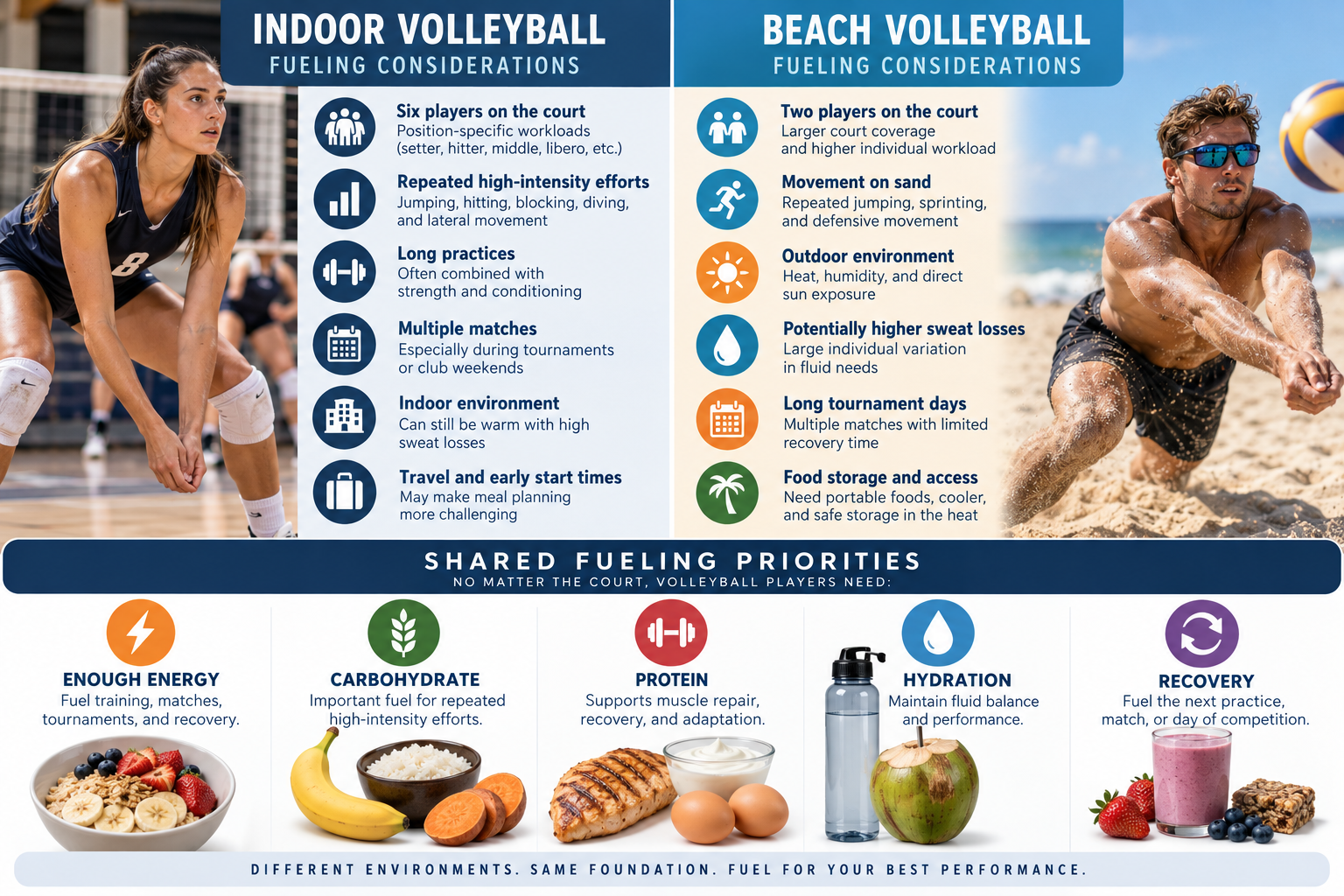
Indoor and beach volleyball share the same fundamental objective, but athletes shouldn’t assume that the two formats create identical demands.
Indoor Volleyball
Indoor volleyball is played six versus six, and the athlete’s workload can depend heavily on position.
For example:
- Middle blockers may accumulate frequent jumping and blocking demands.
- Outside and opposite hitters repeatedly approach, jump, hit, block, and transition.
- Setters may accumulate a substantial number of lower and moderate jumps while continuously organizing the offense.
- Liberos and defensive specialists experience less jumping but substantial movement, reaction, and defensive demands.
Indoor players may also deal with:
- Long team practices
- Strength and conditioning sessions
- Matches lasting multiple sets
- Weekend tournaments
- Several matches in one day
- Travel
- Early-morning competition
- Limited food options at tournament venues
The indoor environment may reduce some of the direct heat and sun exposure associated with beach volleyball, but indoor athletes can still sweat heavily.
A warm gym, long practice, poor ventilation, individual sweat rate, and repeated matches can all increase fluid needs.
Beach Volleyball
Beach volleyball is played two versus two.
That means each athlete is responsible for a much larger proportion of the court.
Players repeatedly move, jump, defend, serve, attack, and transition on sand.
Playing and repeatedly jumping on sand creates sport-specific movement demands that should be considered alongside the outdoor environment and two-player format.
Research examining beach volleyball has demonstrated meaningful physiological and neuromuscular demands, reinforcing the need to consider the playing surface, match demands, recovery opportunities, and environment when planning nutrition and recovery.
Then there is the environment itself.
Beach athletes may compete in:
- Heat
- Humidity
- Direct sunlight
- Wind
- Hot sand
- Long tournament days
These factors can increase thermal strain and influence fluid and electrolyte requirements.
Research conducted during beach volleyball tournaments has also demonstrated substantial individual variation in sweat losses and voluntary fluid intake.
So although beach players need to think carefully about hydration, the answer isn’t:
“Every beach volleyball player needs exactly X ounces per hour.”
The better approach is to develop an individualized hydration strategy.
The M3 Volleyball Fueling Framework
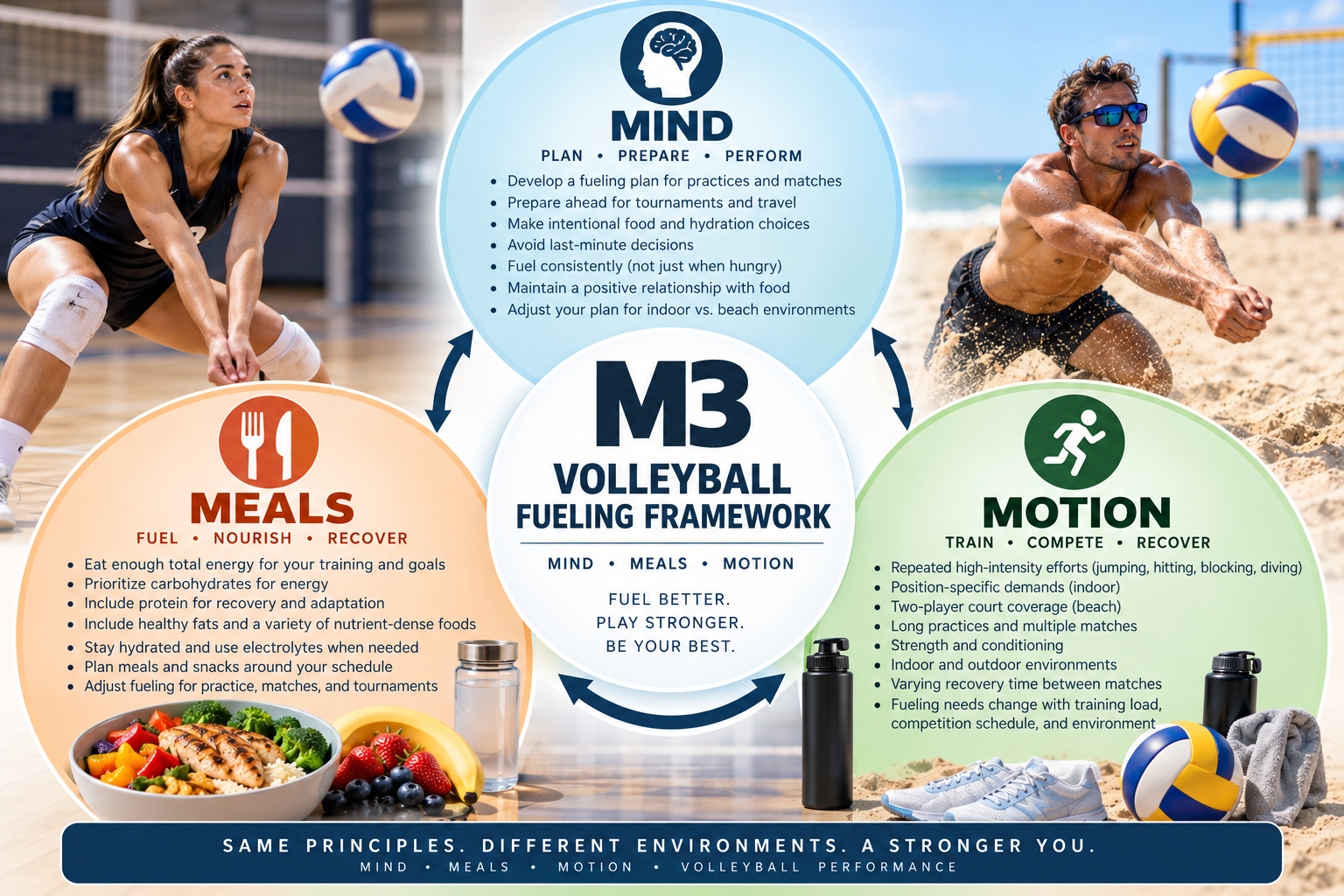
Before getting into specific foods, think about volleyball nutrition through Mind • Meals • Motion.
Mind
Ask:
- Do I plan ahead for practices and matches?
- Do I know when I will have opportunities to eat?
- Am I afraid that eating before volleyball will make me feel heavy?
- Do I intentionally restrict food because I want to become leaner?
- Do I wait until I’m extremely hungry before eating?
- Do I have backup foods when the tournament schedule changes?
- Am I relying on whatever happens to be available at the venue?
Tournament fueling often fails before the athlete ever steps onto the court.
If you arrive with no food, no fluids, and no plan, your options become whatever happens to be available.
Preparation matters.
Meals
Consider whether your eating pattern provides enough:
- Total energy
- Carbohydrate
- Protein
- Dietary fat
- Vitamins and minerals
- Fluids
- Electrolytes when appropriate
The goal isn’t to eat perfectly.
The goal is to consistently provide enough nutrition to support what you’re asking your body to do.
Motion
Look at the actual training schedule.
Ask:
- How long is practice?
- How hard is it?
- Am I lifting on the same day?
- Am I playing multiple matches?
- Am I playing indoors or outdoors?
- Is it hot and humid?
- Am I in-season or off-season?
- Is this a light technical day or a demanding training day?
- Do I have another session later?
Fueling should change when the demands change.
How Much Energy Do Volleyball Players Need?
There is no single calorie target for volleyball players.
Energy requirements depend on factors including:
- Age
- Sex
- Body size
- Body composition
- Training volume
- Training intensity
- Position
- Strength training
- Additional conditioning
- Competition schedule
- Goals
- Growth and development in younger athletes
This is important because athletes sometimes focus heavily on protein, supplements, or meal timing while overlooking the most basic question:
Am I eating enough overall?
Research examining indoor team-sport athletes has identified inadequate energy and carbohydrate intake as potential concerns, and studies specifically involving volleyball players have also reported inadequate intake in some groups.
That doesn’t mean every volleyball player is underfueling.
It means adequate energy intake deserves attention.
An athlete can choose nutritious foods and still fail to eat enough of them.
Carbohydrates for Volleyball Performance
Carbohydrate deserves particular attention for volleyball players.
Carbohydrate can be stored as glycogen in muscle and the liver and contributes fuel for moderate- and high-intensity exercise.
Volleyball repeatedly asks athletes to produce explosive efforts throughout training and competition.
Carbohydrate needs will not necessarily be identical every day.
A demanding practice plus strength session may justify greater carbohydrate availability than a rest day or short technical session.
That is why sports nutrition often uses the idea of matching carbohydrate intake to training demands rather than prescribing exactly the same intake every day regardless of activity.
Useful carbohydrate foods can include:
- Rice
- Potatoes
- Pasta
- Bread
- Oats
- Cereal
- Tortillas
- Fruit
- Beans
- Dairy foods
- Sports foods and beverages when useful
The athlete doesn’t need to fear carbohydrate simply because they also have body-composition goals.
The more useful question is:
When do I need carbohydrate most?
For many volleyball players, important opportunities include:
- Before demanding practices
- Before matches
- Between matches
- During prolonged training or tournament days when appropriate
- After demanding sessions
- Between two sessions performed on the same day
Protein for Recovery, Strength, and Adaptation
Volleyball performance depends heavily on the neuromuscular system.
Players train for qualities such as:
- Strength
- Power
- Jump performance
- Speed
- Stability
- Resilience
Protein provides amino acids used in muscle protein remodeling and adaptation.
Rather than consuming very little protein during the day and an enormous amount at dinner, athletes can generally benefit from distributing protein across several eating opportunities.
Examples include:
- Eggs
- Greek yogurt
- Milk
- Cottage cheese
- Chicken
- Turkey
- Fish
- Lean beef
- Tofu
- Tempeh
- Beans and lentils
- Soy foods
- Protein-fortified foods
- Protein powders when convenient
Protein supplements are not mandatory.
They are simply convenient tools.
A shake may be useful when an athlete finishes practice late, has little appetite, needs something portable, or cannot get a regular meal soon.
Food still works.
Dietary Fat Still Matters
Volleyball players sometimes become so focused on carbohydrate and protein that dietary fat becomes an afterthought.
Fat contributes:
- Energy
- Essential fatty acids
- Absorption of fat-soluble vitamins
- Cell structure
- Overall dietary adequacy
Useful sources can include:
- Nuts
- Seeds
- Nut butters
- Avocado
- Olive oil
- Fatty fish
- Eggs
- Dairy foods
Very high-fat meals immediately before intense play may feel uncomfortable for some athletes because they can take longer to digest.
That doesn’t make dietary fat bad.
It simply means timing and portion size matter.
What Should Volleyball Players Eat Before Practice or a Match?
The purpose of pre-volleyball nutrition is not to find one magical “performance meal.”
The goal is to begin the session:
- Adequately fueled
- Hydrated
- Comfortable
- Without excessive hunger
About 2–4 Hours Before
A larger meal can generally contain:
Carbohydrate + protein + fluids, with amounts of fat and fiber that the athlete knows they tolerate well.
Examples:
- Rice + chicken + vegetables
- Pasta + lean protein
- Turkey sandwich + fruit + yogurt
- Burrito bowl with rice and protein
- Oatmeal + fruit + Greek yogurt
- Bagel + eggs + fruit
As competition approaches, individual tolerance becomes increasingly important.
Someone with a sensitive stomach may prefer smaller portions and lower amounts of fat and fiber.
About 30–60 Minutes Before
If the athlete needs additional fuel closer to play, something smaller and easier to digest may work better.
Examples:
- Banana
- Applesauce pouch
- Pretzels
- Toast with honey or jam
- Granola bar
- Crackers
- Sports drink
- Dried fruit
- Small amount of cereal
Not every athlete needs a snack 30 minutes before every practice.
Context matters.
Someone who ate a substantial meal two hours earlier may not need anything.
Someone who ate lunch at noon and practices at 6:00 PM probably needs a different strategy.
What Should Volleyball Players Eat During Training or Matches?
Not every volleyball session requires food during play.
For shorter sessions where the athlete arrived adequately fueled, water may be sufficient.
But as exercise becomes longer or the athlete plays repeatedly throughout the day, additional carbohydrate and fluids can become more useful.
This is particularly relevant for:
- Long practices
- Multiple matches
- Tournament days
- Two-a-day training
- Hot conditions
- Athletes who haven’t been able to eat adequately beforehand
Practical options include:
- Banana
- Orange slices
- Applesauce
- Pretzels
- Crackers
- Granola or cereal bars
- Dried fruit
- Sports drink
- Sports chews or gels when appropriate
The closer the athlete is to returning to the court, the more useful it can be to prioritize foods that are familiar and easy to digest.
What Should Volleyball Players Eat After Playing?
Recovery nutrition becomes especially important when another demanding session or match is coming soon.
After volleyball, think about:
Carbohydrate + Protein + Fluids
Carbohydrate supports glycogen replenishment.
Protein supports muscle repair and remodeling.
Fluids help replace losses from sweating.
Examples include:
- Rice bowl with chicken or tofu
- Turkey sandwich + fruit
- Greek yogurt + granola + fruit
- Chocolate milk + banana
- Smoothie containing fruit and protein
- Burrito bowl
- Pasta + lean protein
- Cereal + milk + fruit
Recovery doesn’t need to come from a special supplement.
A regular meal can be excellent recovery nutrition.
The urgency also depends on what happens next.
If you finish volleyball and have the rest of the day to recover, your normal meal pattern may be enough.
If you have another match in two hours, recovery becomes much more time-sensitive.
Hydration for Volleyball Players
Hydration affects more than thirst.
Fluid balance can influence:
- Cardiovascular strain
- Temperature regulation
- Perceived effort
- Exercise tolerance
But hydration needs vary significantly between athletes.
Sweat rate is affected by:
- Body size
- Genetics
- Exercise intensity
- Temperature
- Humidity
- Clothing
- Acclimatization
- Individual physiology
That is why hydration recommendations should not be reduced to one universal amount for every player.
Before Volleyball
Begin practices and matches reasonably well hydrated.
If you’re arriving at practice extremely thirsty after barely drinking all day, the hydration problem began long before warm-ups.
Build fluid intake throughout the day.
During Volleyball
Have fluids accessible and drink during appropriate breaks.
Longer sessions and hotter conditions generally increase the importance of replacing fluids.
After Volleyball
Continue replacing fluid losses after exercise, particularly when another session is coming soon.
Food and beverages consumed after play can also contribute sodium and other electrolytes.
Indoor Volleyball Hydration
Indoor volleyball removes direct sun exposure, but it doesn’t eliminate sweat loss.
Hydration needs may increase with:
- Warm gyms
- Poor ventilation
- Long practices
- Multiple matches
- High individual sweat rates
- Strength or conditioning sessions performed around volleyball
Players shouldn’t assume:
“I’m indoors, so dehydration isn’t an issue.”
Pay attention to the actual environment and your own response to it.
Beach Volleyball Hydration
Beach volleyball requires additional planning because athletes may be exposed to heat, humidity, and direct sun for extended periods.
Tournament research has demonstrated substantial individual variation in sweat losses among beach volleyball players.
This is exactly why copying another athlete’s fluid plan may not work.
Practical considerations include:
- Arriving hydrated
- Bringing more fluid than you expect to need
- Keeping beverages cool when possible
- Drinking between matches
- Replacing sodium when sweat losses and conditions warrant it
- Monitoring how your body responds to heat
- Using shade and cooling opportunities when available
A cooler filled with fluids, food, ice, and recovery options can be just as important to tournament preparation as what’s inside your volleyball bag.
Do Volleyball Players Need Electrolytes?
Sometimes.
Electrolyte-containing beverages may be particularly useful during:
- Long sessions
- Heavy sweating
- Hot and humid conditions
- Tournament days
- Multiple matches
- Situations where substantial fluid is being replaced
Sodium is the primary electrolyte lost in sweat.
But electrolyte requirements vary.
Someone playing casually for an hour in a cool gym may not need the same strategy as a heavy sweater playing beach volleyball for several hours in hot, humid conditions.
More isn’t automatically better.
The goal is to match the strategy to the situation.
Do Volleyball Players Need Sports Drinks?
Sports drinks are tools, not requirements.
They can provide:
- Fluid
- Carbohydrate
- Sodium
That combination can be useful when athletes need hydration and fuel at the same time.
Examples include:
- Long practices
- Tournament days
- Multiple matches
- Hot conditions
- Situations where solid food is difficult to tolerate
For a short practice after adequate meals, water may be perfectly appropriate.
The question isn’t:
“Are sports drinks healthy or unhealthy?”
It’s:
“Would a sports drink serve a useful purpose in this situation?”
How to Fuel an Indoor Volleyball Tournament
Indoor tournaments create a unique problem.
The athlete may be at the gym from early morning until late afternoon or evening, but actual match times can change depending on:
- Pool play
- Previous matches
- Court availability
- Tournament progression
That makes rigid meal schedules difficult.
Instead, think in terms of fueling opportunities.
Example Indoor Tournament Day
6:30–7:00 AM — Breakfast
A substantial meal containing carbohydrate, protein, and fluids.
For example:
- Oatmeal + banana + Greek yogurt
- Bagel + eggs + fruit
- Cereal + milk + fruit + toast
8:30 AM — Warm-Up
Top off with fluids and, if needed, a small carbohydrate snack.
9:00 AM — First Match
Begin adequately fueled rather than trying to “catch up” during the match.
Between Matches
The amount eaten depends on how long you have.
Short break:
Choose easier-to-digest carbohydrate.
Longer break:
Use a more substantial snack or small meal containing carbohydrate and some protein.
Midday
If the schedule allows, eat something more substantial rather than surviving on snack foods all day.
Examples:
- Turkey sandwich + fruit
- Rice bowl
- Wrap + fruit
- Yogurt + granola + banana
After the Final Match
Eat a complete recovery meal and continue rehydrating.
The goal isn’t to follow exact clock times.
It is to prevent the athlete from accidentally going six or seven hours with only a few bites of food.
How to Fuel a Beach Volleyball Tournament
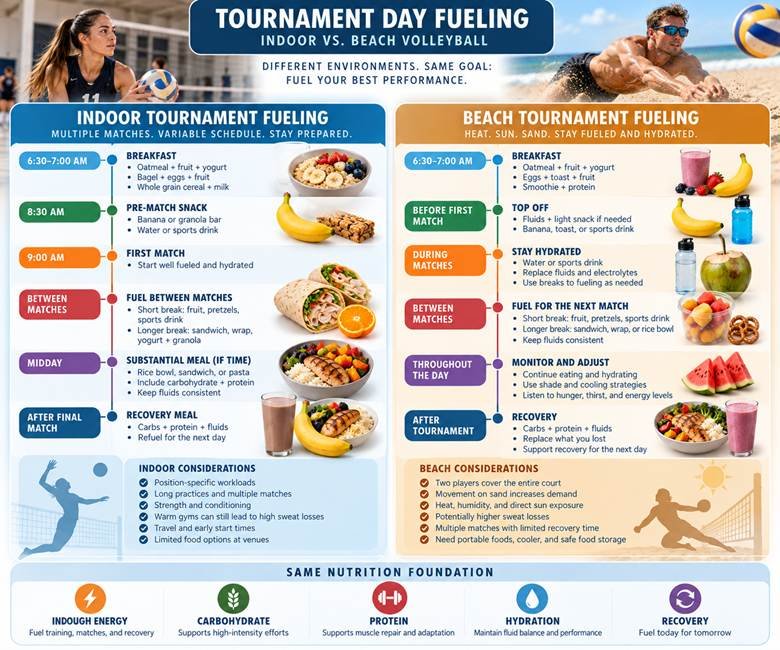
Beach tournaments can be even less predictable.
You may be outside for many hours while playing multiple matches with variable recovery time.
Heat and humidity can further complicate appetite, hydration, and food storage.
Example Beach Tournament Day
Before Leaving Home
Eat a substantial breakfast containing:
- Carbohydrate
- Protein
- Fluids
For example:
- Oatmeal + fruit + yogurt
- Eggs + toast + fruit
- Bagel + eggs + banana
Before the First Match
Top off with fluids and carbohydrate if needed.
Immediately After a Match
Ask:
How long until I play again?
If the next match is soon, prioritize easier-to-digest carbohydrate and fluids.
Examples:
- Banana
- Applesauce
- Pretzels
- Sports drink
- Crackers
- Dried fruit
Longer Break
When you have enough time to digest, eat something more substantial.
Examples:
- Turkey sandwich
- Rice bowl
- Wrap
- Yogurt + granola + fruit
Throughout the Day
Continue monitoring:
- Fluids
- Carbohydrate availability
- Hunger
- Heat
- Energy
- Recovery between matches
After the Tournament
Have a complete recovery meal containing carbohydrate, protein, fluids, and the rest of the nutrients your body needs.
The Volleyball Tournament Fueling Timeline

A useful way to think about tournament nutrition is:
Before → Fuel
Begin the day with enough energy and carbohydrate.
During → Maintain
Continue providing carbohydrate and fluids as the day progresses.
Between Matches → Match the Food to the Break
Short break = lighter, faster-digesting foods.
Longer break = more substantial food.
After → Recover
Replace carbohydrate, provide protein, rehydrate, and return to a normal meal pattern.
This is much more useful than trying to survive a tournament on one breakfast and a handful of snacks.
Volleyball Nutrition for Strength and Jump Performance
Volleyball athletes understandably care about jumping.
Nutrition can support the training needed to improve athletic qualities, but no specific food will automatically increase vertical jump height.
Jump performance is influenced by factors including:
- Strength
- Rate of force development
- Power
- Technique
- Coordination
- Training status
- Fatigue
- Recovery
- Body composition
Nutrition supports that process by helping the athlete train and recover.
That includes:
- Enough total energy
- Adequate carbohydrate to support demanding training
- Protein to support adaptation
- Adequate hydration
- Micronutrient adequacy
- Appropriate recovery nutrition
Think of nutrition as supporting the training that develops the athlete—not replacing the training.
What If a Volleyball Player Wants to Lose Body Fat?
Body-composition goals and performance goals can coexist, but they need to be managed carefully.
A volleyball player who dramatically reduces food intake while continuing to practice, lift, and compete may create a conflict between the body-composition goal and the performance goal.
Fat loss, when appropriate, does not require eliminating carbohydrate or trying to train while hungry.
A more performance-informed strategy considers:
- The size of the energy deficit
- Protein intake
- Carbohydrate availability around important sessions
- Resistance training
- Recovery
- Competition schedule
- Current health and fueling status
The goal should not be:
Become as light as possible.
It should be to determine whether an appropriate body-composition change can be made while continuing to support the athlete’s health and performance needs.
For a deeper discussion, see Balancing Performance and Body Composition: How Athletes Can Fuel for Both.
Underfueling in Volleyball Players
Volleyball players can underestimate how much energy they need.
This may happen when athletes:
- Skip breakfast
- Eat very little before practice
- Avoid carbohydrates
- Replace meals with small snacks
- Restrict food to change body composition
- Have long gaps between meals
- Fail to increase food intake when training increases
- Spend an entire tournament day grazing without eating enough overall
Research involving volleyball athletes has identified inadequate energy and carbohydrate intake as potential concerns in some populations.
This doesn’t mean every volleyball player who feels tired has low energy availability.
Fatigue has many possible causes.
But persistent underfueling deserves attention.
Signs that the overall fueling pattern may need to be evaluated can include:
- Persistent fatigue
- Declining training quality
- Poor recovery
- Recurrent injuries
- Frequent illness
- Difficulty concentrating
- Significant food restriction
- Increasing anxiety around food
- Menstrual or reproductive changes
- Unexplained changes in performance or health
Repeated underfueling can contribute to low energy availability.
Exposure to problematic low energy availability—which can involve prolonged and/or severe LEA—may contribute to Relative Energy Deficiency in Sport (RED-S).
One symptom does not diagnose LEA or RED-S.
Athletes with persistent or concerning symptoms should be evaluated appropriately.
For more information, see:
Signs of Underfueling in Athletes
Low Energy Availability in Athletes: Signs, Risks, and Why It Matters
Relative Energy Deficiency in Sport (RED-S): What Athletes Need to Know
Common Volleyball Nutrition Mistakes
Mistake 1: Playing on an Empty Stomach Because You Don’t Want to Feel Heavy
The solution isn’t necessarily to avoid eating.
The athlete may need to adjust:
- Meal timing
- Portion size
- Food choices
- Fat and fiber close to play
A familiar, well-tolerated meal several hours before play is very different from eating a huge meal immediately before warm-ups.
Mistake 2: Cutting Carbohydrates Because You Want to Get Leaner
Body-composition goals do not eliminate the need to fuel training.
Carbohydrate can be strategically placed around demanding sessions while the overall nutrition plan supports the athlete’s goals.
Mistake 3: Eating Only Snacks During an Entire Tournament
Snacks can be excellent tools.
The problem occurs when a long tournament day requires substantial energy but the athlete never gets enough food overall.
Use snacks strategically, but take advantage of longer breaks to eat something more substantial when possible.
Mistake 4: Waiting Until You’re Thirsty to Think About Hydration
Tournament hydration begins before the tournament.
Build normal fluid intake throughout the day and arrive prepared.
Mistake 5: Trying a New Food or Supplement on Competition Day
Competition is not the ideal time to discover that a new pre-workout, gel, energy drink, or meal doesn’t agree with your stomach.
Practice your fueling strategy during training.
Mistake 6: Treating Every Volleyball Day the Same
A recovery day, lifting day, two-hour practice, and all-day tournament don’t create identical demands.
Your nutrition shouldn’t pretend they do.
Mistake 7: Focusing on Supplements Before Basic Nutrition
Protein powders, creatine, caffeine, electrolyte products, and other evidence-based sports products can have appropriate uses.
But they don’t replace:
- Adequate energy
- Carbohydrate
- Protein
- Dietary quality
- Hydration
- Sleep
- Recovery
Build the foundation first.
What Should Volleyball Players Pack for a Tournament?

Your exact list will depend on your preferences and access to refrigeration, but useful options can include:
Carbohydrate Foods
- Bananas
- Applesauce pouches
- Pretzels
- Crackers
- Bread or bagels
- Granola bars
- Cereal
- Dried fruit
- Rice-based foods
- Sports drinks
- Sports chews when appropriate
More Substantial Foods
- Sandwiches
- Wraps
- Rice bowls
- Yogurt
- Overnight oats
Protein Options
- Greek yogurt
- Milk
- Sandwich meat
- Tuna packets
- Protein drinks
- Protein bars
- Other portable foods the athlete tolerates
Hydration
- Water
- Electrolyte beverage when appropriate
- Sports drink when carbohydrate and electrolytes are useful
- Extra fluids for long outdoor tournament days
Beach Tournament Extras
- Cooler
- Ice
- Shade when possible
- Foods that can be safely stored in the heat
The best tournament food is not the food that looks most impressive on Instagram.
It’s food that:
you tolerate, you will actually eat, can be stored safely, and helps you meet the demands of the day.
Sports Dietitian Insight: Fuel the Entire Day, Not Just the First Match
One of the easiest mistakes to make in volleyball is preparing for the first match while forgetting about everything that comes afterward.
The athlete eats breakfast.
They feel great during the first match.
Then the day becomes unpredictable.
One match becomes three.
The schedule falls behind.
It’s hot.
Appetite decreases.
The athlete eats a few pretzels and half a banana.
Several hours later, they may notice that maintaining their usual energy and training quality feels more difficult.
From my experience with volleyball, tournament fueling is often less about finding a “perfect” sports food and more about maintaining access to fuel throughout the day.
That is especially noticeable in beach volleyball, where you may spend hours outside and have no guarantee that your next match will start exactly when expected.
I don’t want an athlete asking only:
“What should I eat before my first match?”
I also want them asking:
“How am I going to continue fueling if I’m still playing six hours from now?”
That’s the bigger performance question.
The M3 Volleyball Fueling Check-In
Before your next practice, match, or tournament, run through Mind • Meals • Motion.
Mind
Ask:
- Do I have a fueling plan?
- Am I avoiding food because I’m worried about feeling heavy?
- Am I restricting because of body-composition concerns?
- Do I know what foods work well for me before playing?
- Do I have backup options if the schedule changes?
Meals
Ask:
- Did I eat enough today?
- Have I included carbohydrate?
- Am I getting protein throughout the day?
- Am I hydrated?
- Do I have food available between matches?
- Am I relying on snacks when I actually need a meal?
- Do I have a recovery option afterward?
Motion
Ask:
- How hard is today’s session?
- How long will I be playing?
- Am I lifting too?
- Am I playing multiple matches?
- Is this indoors or outdoors?
- What will the temperature and humidity be?
- How much recovery time do I have?
- Do I train again tomorrow?
Then ask one final question:
Does my fueling plan actually match the volleyball I’m about to play?
Frequently Asked Questions
What Should Volleyball Players Eat Before a Game?
A pre-game meal should generally provide carbohydrate, some protein, fluids, and foods the athlete tolerates well.
Examples might include rice with chicken, pasta with lean protein, a sandwich with fruit, or oatmeal with fruit and Greek yogurt.
As the match gets closer, smaller and easier-to-digest carbohydrate foods may be more appropriate if additional fuel is needed.
Individual tolerance matters.
Should I Eat Before an Early-Morning Volleyball Match?
Usually, some nutrition beforehand is preferable to automatically playing fasted, particularly when the athlete has a demanding or prolonged day ahead.
If a large breakfast feels uncomfortable, experiment during training with smaller options such as:
- Banana
- Toast
- Applesauce
- Cereal
- Granola bar
- Sports drink
Then eat more substantially when the schedule allows.
What Should Volleyball Players Eat Between Matches?
It depends primarily on the amount of time available.
With a short break, prioritize familiar, easily digested carbohydrate and fluids.
With a longer break, include a more substantial meal or snack containing carbohydrate and protein.
Do Volleyball Players Need Sports Drinks?
Not for every session.
Sports drinks can be useful during prolonged exercise, tournament days, hot conditions, or when the athlete needs carbohydrate, fluid, and sodium together.
Water may be sufficient for shorter sessions when the athlete is otherwise adequately fueled.
Do Beach Volleyball Players Need More Electrolytes Than Indoor Players?
Not automatically.
Beach volleyball often increases exposure to heat, humidity, and direct sunlight, which can increase sweat losses.
However, sweat rate and sweat sodium concentration vary between individuals.
An indoor athlete who sweats heavily during a long practice may have greater fluid and sodium needs than another athlete playing a shorter beach session.
Individualize the strategy.
Is Protein or Carbohydrate More Important for Volleyball Players?
They serve different purposes.
Carbohydrate is particularly important for fueling demanding exercise.
Protein supports muscle repair, remodeling, and adaptation.
A complete volleyball nutrition strategy includes both rather than treating them as competitors.
Should Volleyball Players Eat During Practice?
Not always.
For shorter sessions, food during practice may be unnecessary if the athlete arrived adequately fueled.
As sessions become longer or more demanding—or when the athlete has multiple sessions—carbohydrate during exercise may become more useful.
What Should Volleyball Players Eat After Practice?
A meal or snack containing carbohydrate and protein is a useful starting point.
Examples include:
- Rice + chicken
- Yogurt + granola + fruit
- Smoothie + fruit
- Sandwich + fruit
- Cereal + milk
- Pasta + lean protein
The athlete should also replace fluid losses.
How Should Volleyball Players Eat on Rest Days?
Rest days still support recovery and adaptation.
Athletes do not need to stop eating simply because they aren’t practicing.
Energy and carbohydrate needs may differ from a demanding training day, but protein, micronutrients, hydration, and overall nutrition remain important.
Can Volleyball Players Lose Fat Without Hurting Performance?
Sometimes.
Whether it is appropriate depends on the athlete’s starting point, health, training, competition schedule, energy availability, and the magnitude of the desired change.
Aggressive restriction can create unnecessary conflict between fat loss and performance.
A sports dietitian can help determine whether a body-composition goal is appropriate and how to pursue it while supporting training.
Conclusion
Volleyball nutrition is not simply about eating a banana before a match or drinking a protein shake afterward.
The bigger goal is to create a fueling pattern that supports the entire athlete.
Indoor and beach volleyball share many nutritional priorities:
- Adequate energy
- Carbohydrate for demanding training
- Protein for recovery and adaptation
- Dietary fat
- Micronutrients
- Hydration
- Recovery nutrition
But the details matter.
Indoor players may need to account for position-specific workloads, long practices, strength training, travel, and multi-match tournaments.
Beach players need to account for movement on sand, two-player court coverage, outdoor heat, humidity, sun exposure, sweat losses, and long tournament days.
Neither format has one perfect meal plan.
Within the M3 Performance Framework — Mind • Meals • Motion, the goal is to match nutrition to the athlete’s actual demands.
Mind prepares the plan.
Meals provide the fuel.
Motion determines what needs to be supported.
Before your next practice or tournament, don’t just ask:
“What should a volleyball player eat?”
Ask:
“What does my body need to support the volleyball I’m actually playing today?”
That’s where individualized sports nutrition begins.
Need Help Building Your Volleyball Nutrition Strategy?
If you’re training hard but struggling with energy, recovery, hydration, tournament fueling, or figuring out how much you should actually eat, an individualized sports nutrition plan can help connect your nutrition to your training.
Learn more about M3 Performance Nutrition Coaching.
You can also start with the M3 Performance Assessment to evaluate how your current nutrition, training, recovery, and lifestyle habits are supporting your performance.
This article is for educational purposes and is not intended to diagnose or treat a medical condition. Athletes experiencing persistent fatigue, recurrent injuries, menstrual or reproductive changes, significant food restriction, disordered eating behaviors, heat-related symptoms, or other concerning health changes should seek evaluation from an appropriately qualified healthcare professional.
References
- Thomas, D. T., Erdman, K. A., & Burke, L. M. (2016). Position of the Academy of Nutrition and Dietetics, Dietitians of Canada, and the American College of Sports Medicine: Nutrition and athletic performance. Journal of the Academy of Nutrition and Dietetics, 116(3), 501–528. DOI: 10.1016/j.jand.2015.12.006.
- Rebelo, A., Stojanović, E., Martinho, D. V., Pérez-López, A., López-Samanes, Á., & Scanlan, A. T. (2026). What are the demands of volleyball match-play? A systematic review of the external and internal loads encountered according to playing position, number of sets, and player sex. Journal of Sports Sciences, 44(6), 769–796. DOI: 10.1080/02640414.2025.2609028.
- Castillo, M., Lozano-Casanova, M., Sospedra, I., Norte, A., Gutiérrez-Hervás, A., & Martínez-Sanz, J. M. (2022). Energy and macronutrients intake in indoor sport team athletes: Systematic review. Nutrients, 14(22), 4755. DOI: 10.3390/nu14224755.
- Zapolska, J., Witczak, K., Mańczuk, A., & Ostrowska, L. (2014). Assessment of nutrition, supplementation and body composition parameters on the example of professional volleyball players. Roczniki Państwowego Zakładu Higieny, 65(3), 235–242.
- Zetou, E., Giatsis, G., Mountaki, F., & Komninakidou, A. (2008). Body weight changes and voluntary fluid intakes of beach volleyball players during an official tournament. Journal of Science and Medicine in Sport, 11(2), 139–145. DOI: 10.1016/j.jsams.2007.01.005.
- Magalhães, J., Inácio, M., Oliveira, E., Ribeiro, J. C., & Ascensão, A. (2011). Physiological and neuromuscular impact of beach-volleyball with reference to fatigue and recovery. Journal of Sports Medicine and Physical Fitness, 51(1), 66–73.
- Natali, S., Ferioli, D., La Torre, A., & Bonato, M. (2019). Physical and technical demands of elite beach volleyball according to playing position and gender. Journal of Sports Medicine and Physical Fitness, 59(1). DOI: 10.23736/S0022-4707.17.07972-5.
- Mountjoy, M., Ackerman, K. E., Bailey, D. M., et al. (2023). 2023 International Olympic Committee’s (IOC) consensus statement on Relative Energy Deficiency in Sport (REDs). British Journal of Sports Medicine, 57(17), 1073–1097. DOI: 10.1136/bjsports-2023-106994.
- Jäger, R., Kerksick, C. M., Campbell, B. I., et al. (2017). International Society of Sports Nutrition position stand: Protein and exercise. Journal of the International Society of Sports Nutrition, 14, 20. DOI: 10.1186/s12970-017-0177-8.